Vibe by Adam Grant: Honest Review, Rating & Who Should Read It — Verdict 8.5/10

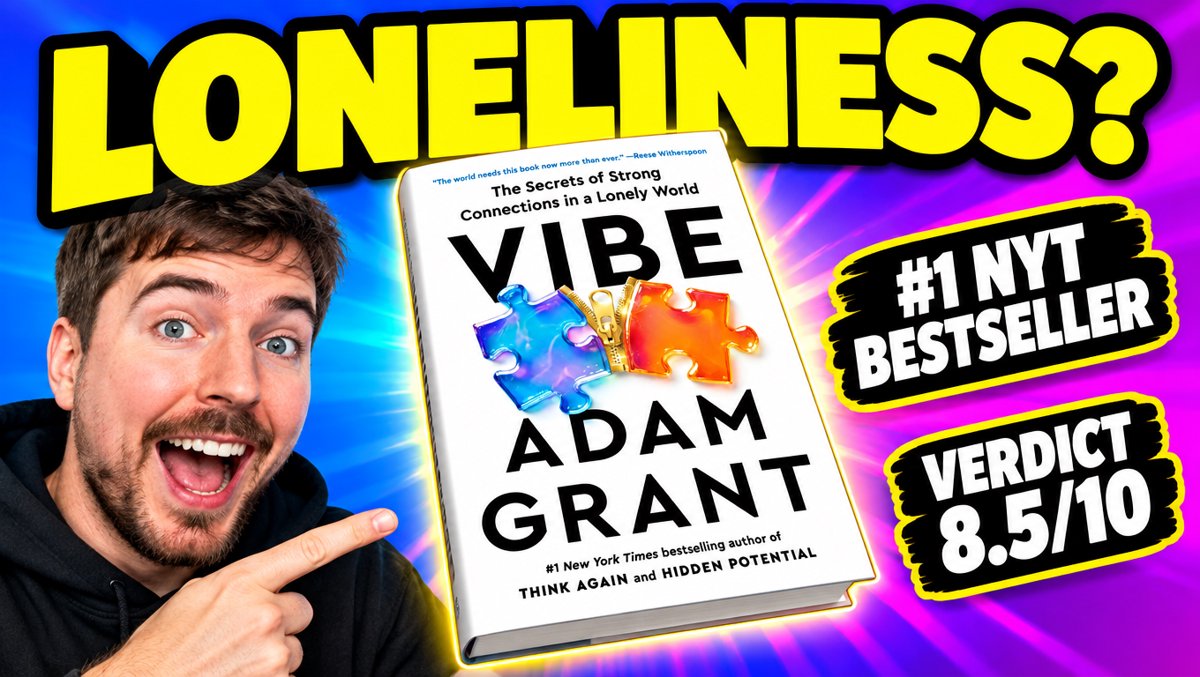
Somewhere between your group chat and your 2 a.m. scroll, the world's most connected generation produced its loneliest data point yet. Vibe: The Secrets of Strong Connections in a Lonely World (2026) by Adam Grant starts right there — and then, instead of lamenting the algorithm, teaches you to fix the actual physics of human chemistry.
Grant calls it a "vibe": the felt quality of connection between two people. His argument is that vibes aren't luck. They're buildable, measurable, and — once you understand the science — surprisingly learnable. Six weeks after publication it's already an instant #1 New York Times bestseller, sitting at #12 on the Nov 29, 2026 NYT Hardcover Nonfiction list, and it hits the top of its Amazon category (Popular Psychology Personality Study) on a 4.5/5 rating.
The 3-second version
- What it is: A science-backed, myth-busting field guide to friendship, love, and companionship in the AI/screen era — from Wharton's Adam Grant.
- Who wrote it: Adam Grant, organizational psychologist; author of Think Again and Hidden Potential.
- Why it matters: The loneliness crisis is now policy-adjacent (multiple governments have minister-of-loneliness titles); this is the most practical English-language book on actually reversing it.
- Verdict: 8.5/10 — the strongest taxonomy of relationships I've seen in popular psychology, delivered with Grant's signature story-first energy.
Book data card
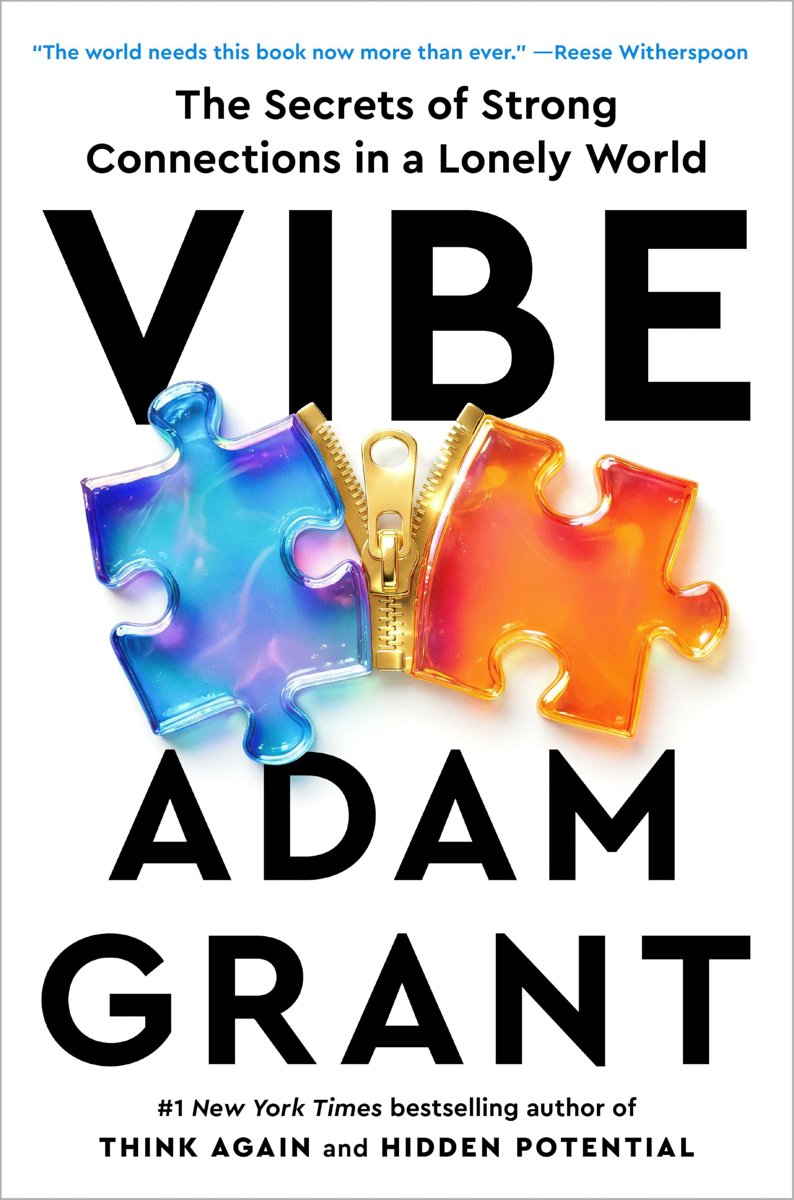
| Title | Vibe: The Secrets of Strong Connections in a Lonely World |
| Author | Adam Grant (Viking, Oct 13, 2026) |
| Pages | 336 pages, hardcover |
| ISBN-13 | 979-8217059706 · ASIN B0GPHPNZ14 |
| Ratings | Amazon US 4.5/5 (207 reviews) · Amazon CA 4.5/5 (196) |
| List position | #12 NYT Hardcover Nonfiction, Nov 29, 2026 · #1 Amazon Popular Psychology Personality Study |
| Buy | Amazon.com ($22.40 hardcover / Kindle $17.99) · Amazon.ca (C$28.69 hardcover) · Publisher: Viking/Penguin Random House |
What the book actually is
Grant's core reframe is simple and a little subversive: we don't have a friendship problem — we have a misclassification problem. The labels we inherited (friend, coworker, cousin, teammate) tell you nothing about what a relationship actually runs on. So he replaces them with four "wavelengths" he calls associates (transactional ties), allies (partnerships built on shared purpose), pals (alliances of amusement), and companions (connections built on care). One person can live at multiple wavelengths, and relationships migrate between them.
The book is organized in three movements — Sparking Connection, Sustaining Connection, and Scaling Connection — and attacks three myths head-on: that similarity is necessary for solidarity, that chemistry always happens fast, and that closeness always takes time. His counterintuitive punchlines (similarity isn't required; slow-start bonds often outlast love-at-first-sight ones) are backed by the case studies that carry the book: three astronauts who couldn't stand each other, stuck together for six months in orbit; Metallica, of all bands, saved from breakup by a psychologist and some structured fighting; and the Tolkien–Lewis friendship that began in mutual dislike (Chapter 3, "Love at Second Sight") and became one of literature's great creative partnerships.
The tone is warmer than Grant's previous books — he openly writes about being a shy introvert who had to learn connection deliberately, which several reviewers noticed with approval: "Brené Brown influenced his writing style because of all the personal stories Adam told," one fan wrote. And the practical payload is real: small repeated check-ins ("pebbles"), deliberate rituals, scheduled time apart ("absence"), and evidence that a phone call often beats face-to-face for hard conversations (it hides the flaring nostrils and curled lips that turn a tough talk toxic). It closes with an "Actions for Impact" checklist that turns the theory into a to-do list.
The author's story
Adam Grant is an organizational psychologist at Wharton, where he has been the top-rated professor for seven straight years, a #1 NYT bestselling author in four languages' worth of markets (his books are translated into 45 languages), a TED speaker with 35+ million talk views, and the host of the podcasts Re:Thinking and WorkLife (65M+ downloads). His 2021 "languishing" essay was the most-read New York Times piece of that year. BA Harvard, PhD Michigan; former junior Olympic springboard diver and magician; lives in Philadelphia with his wife Allison and their three children.
| Book | Year | The pitch | |
|---|---|---|---|
| Give and Take | 2014 | Why helpers who give first end up out-earning takers | Amazon.com ($9.12) |
| Originals (with Sheryl Sandberg) | 2017 | How nonconformists actually move the world | Amazon.com ($8.30) |
| Think Again | 2021 | The power of knowing what you don't know — 4.6★/18,266 ratings | Amazon.com |
| Hidden Potential | 2023 | Achieving greater things via character skills, not talent | Amazon.com |
| Vibe | 2026 | The science of strong connections in a lonely world — this review | Amazon.com |
Strengths / Weaknesses
Strengths
- The four-wavelengths taxonomy is a genuine contribution. Most pop-psychology books recycle "be authentic"; Grant gives you a diagnostic lens. Reviewers picked it up instantly: "The book's taxonomy of relationships alone is worth the price of admission" (paraphrase of the dominant reader response).
- The cases are unforgettable and load-bearing. Astronauts earning each other's trust, Metallica learning to fight productively — these aren't decorations; they demonstrate the mechanisms.
- Usable, not just interesting. The end-of-book actions, endnotes, and phone-call-over-text nuance (with the Brodsky research behind it) mean you can improve something today.
Weaknesses
- Softer evidence than Think Again. Grant exiles most study detail to endnotes, and one Amazon reviewer ("crsn," Nov 7, 3 stars) said it plainly: "I liked Arthur Brooks' Build the Life You Want better." If you loved Grant for the data density, this is a gentler, warmer book.
- Mid-book pacing. One verified reviewer admits he nearly quit in the second section before the group-dynamics chapters "really came into their own." The payoff is there — but it's back-loaded.
- The walking-in-nature gap. A thoughtful reviewer suggested Grant underweights walking together as a conflict-resolution format; fair point, and worth adding to your toolkit.
Reception scoreboard
| Source | Verdict |
|---|---|
| Kirkus Reviews (Aug 31, 2026) | "The charming, accessible latest… Practical and informative advice for understanding and deepening attachments." |
| Amazon US (207 ratings) | 4.5/5 — 63× 5★, 28× 4★, 7× 3★, 2× 2★, 0× 1★ |
| Goodreads (2,867 ratings) | ~4.0 — early-sample drag, normal for a 6-week-old book |
| NYT list | #12 Hardcover Nonfiction, Nov 29, 2026 |
| Reese Witherspoon (publisher blurbs) | "A deep dive into the science of friendship, companionship, and love. Every page is an illumination!" |
Where critics disagree: it's a rigor-vs-warmth split, not a love-vs-hate one. Kirkus and most readers praise the accessibility; the minority critique is that Grant traded some of the economist's edge for memoir warmth. Both camps agree on the core claim: vibes are learnable.
Similar books — read this if you liked that, because…
| Book | Rating | Why |
|---|---|---|
| Think Again — Adam Grant | 4.6★ (18,266) | Grant's masterwork on rethinking; Vibe is its relational sibling |
| Build the Life You Want — Arthur C. Brooks w/ Oprah Winfrey | 4.5★ (4,089) | The happiness-science prescription; overlaps on wellbeing, different mechanism |
| Hidden Potential — Adam Grant | 4.6★ (4,774) | Same author, growth/character focus rather than connection |
| The Social Animal — David Brooks | 4.4★ (1,342) | The older "hidden sources of love" thesis book |
| Give and Take — Adam Grant | 4.5★ (6,625) | Grant's first book; generosity as a strategic advantage |
This book is for you if…
- You like friendship but feel burned by pop-psychology hype. You want mechanisms, not mantras. Grant gives you named, testable moves — pebbles, rituals, absence — with stories showing why they work.
- Your relationships are mostly transactional right now (work, school, group chats) and you suspect something's missing. The four wavelengths will show you exactly which kind you're starved of — usually companions.
- You're a manager, parent, or teacher who has to assemble strangers into teams. The group chapters and the astronauts are basically a case-study curriculum for you.
The fine print — who should skip it
Skip it if you want a daily to-do program with checkboxes; Grant explicitly calls this "an idea book, not a self-help book," and the actions are lighter than a workbook. Skip it if you only tolerate Grant cold and data-dense — this is his warmest, most personal book, and some readers will notice. Skip it if you're looking for romance-advice specifics; the love material is real but framed as connection science, not dating guidance.
The verdict — 8.5/10
| Dimension | Score |
|---|---|
| Idea (the wavelengths taxonomy + three myths) | 9.0 |
| Writing (stories + warmth + cartoons) | 9.0 |
| Payoff (do the tricks actually change things?) | 8.5 |
| Value ($22.40 hardcover, 336pp) | 8.5 |
One-line verdict: Vibe is the best practical book on loneliness published in years — buy it for anyone you haven't called in too long. Strongest moment: Grant's question — "If we can vibe spontaneously with some of the people some of the time, why can't we do it deliberately with more of the people more of the time?" — which is the entire book in one sentence.
FAQ
Is Vibe by Adam Grant worth reading? Yes — it's Amazon's #1 seller in Popular Psychology Personality Study with a 4.5/5 rating (207 reviews), and #12 on the NYT Hardcover Nonfiction list six weeks after release. Kirkus calls it "practical and informative advice for understanding and deepening attachments."
What is Vibe about without spoilers? It's about why we feel lonely despite constant digital contact, and how the quality of connection — Grant's "vibe" — can be deliberately built. The framework: relationships run on four wavelengths (associates, allies, pals, companions), and most of us are misreading which kind we need.
How long is Vibe? 336 pages (hardcover, Viking, Oct 13, 2026). ISBN 979-8217059706.
How much does Vibe cost? $22.40 hardcover (list $33) on Amazon.com; C$28.69 on Amazon.ca; Kindle $17.99. As of Nov 29, 2026.
What is Adam Grant's best book? By ratings and scale, Think Again (4.6★, 18,266 ratings) — Vibe (4.5★) and Hidden Potential (4.6★) are close, and Vibe is the one to pick for relationships specifically.
Who is Adam Grant? Wharton organizational psychologist, #1 NYT bestselling author of Think Again and Hidden Potential, TED speaker, and host of Re:Thinking and WorkLife podcasts. Books translated into 45 languages.
What's the connection between Adam Grant and Brené Brown in Vibe? Grant borrows Brown's warmth-and-storytelling register for this book — reviewers have noted the personal-stories approach is a deliberate stylistic turn from his earlier, more data-heavy books. It makes Vibe his most approachable title.
Should I read Vibe or Build the Life You Want? Vibe if your challenge is other people (friendship, teams, family); Build the Life You Want if your challenge is your own happiness architecture. They overlap on wellbeing science but solve different problems.