
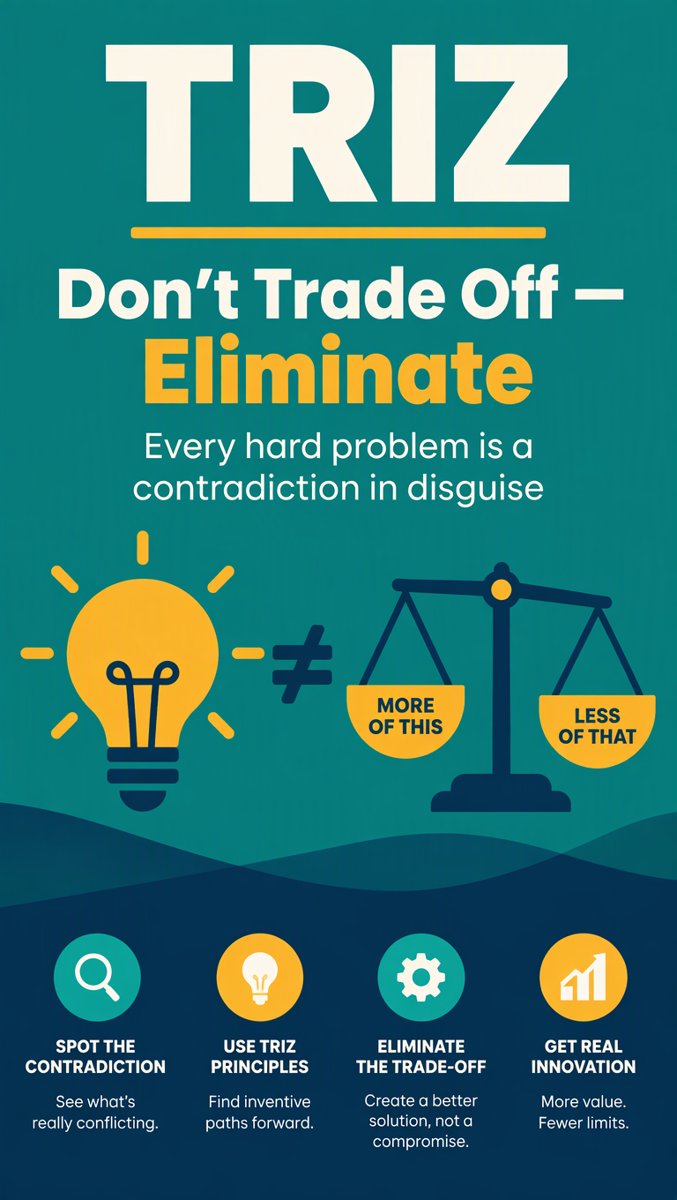
TRIZ: Don't Trade Off — Eliminate
Theme: Innovation · Published: 2026-11-22 · Episode #41
The full article
Every Hard Problem Is a Contradiction
Most problems we call difficult are actually contradictions in disguise. You want a project that's faster — but faster costs more. You want a product that's bigger — but bigger gets heavier. Trade-offs feel like the laws of physics. They're not. They're the limits of your imagination, and a Soviet patent examiner named Genrich Altshuller proved it.
Starting in 1946, Altshuller — a naval officer who noticed that good inventions looked suspiciously similar — spent nearly forty years analyzing patents. Over 400,000 of them. The pattern he found was shocking: breakthrough inventions aren't creative leaps into the unknown. They're repeats. The same solutions keep appearing, again and again, in different industries, solving the same underlying contradiction. He distilled it all into TRIZ, the Theory of Inventive Problem Solving: 40 inventive principles, each one a proven way to break a specific trade-off.
The Idea
A contradiction means improving one thing makes another thing worse. The standard response is a compromise — accept a little of the pain and move on. TRIZ refuses the compromise. Its core belief: if you know which contradiction you're facing, you can look up how professionals in other fields have already eliminated it, and steal that exact pattern. The patent archive is a cheat code.
How It Works
Three steps. First, name the contradiction precisely: "If we increase X, Y gets worse." Not "this is hard" — the exact mechanical clash. Second, find the matching principle among TRIZ's 40 — principles like Segmentation (split the system), Dynamism (make it move), or Prior Action (do the hard part early). Third, apply that principle to your problem, translating the borrowed solution into your domain. The contradiction matrix Altshuller built maps hundreds of problem types to the principles that solved them before.
A Real-World Example
The rocket industry ran on a brutal contradiction: booster rockets are the most expensive part of a launch — the first stage is roughly 60% of a Falcon 9's total cost — so throwing them away was ruinously expensive, but landing them back consumed fuel and hurt performance. Everyone accepted the trade-off. SpaceX didn't. Instead of optimizing either side, they removed the contradiction entirely: the booster lands, gets caught, and flies again. Reusability is TRIZ thinking in action — a professional pattern (reuse what others discard) applied to an engineering contradiction. The result wasn't a better throwaway rocket. It was a different game.
How to Apply It
- Write your contradiction down. "If I [do X], then [Y] gets worse." Vague problems have no answers; precise contradictions do.
- Ask who solved this differently. Google your contradiction, not your industry. If packaging engineers solved your logistics problem, steal their move.
- Steal the principle, not the product. Take the underlying pattern — segment, dynamize, do it early — and translate it into your field.
Takeaway
Compromises feel wise. They're usually just imagination on the cheap. TRIZ teaches a harder habit: refuse the trade-off, find the principle, eliminate the contradiction. The breakthrough isn't hiding in your head — it's sitting in somebody else's solved problem, waiting to be borrowed.
Narration script (~195 words, ~74s)
Hook + idea "Every hard problem is a contradiction in disguise — one thing gets better, another gets worse. A Soviet patent examiner named Genrich Altshuller found the answer hiding in 400,000 patents. The same inventive patterns kept appearing."
Mechanism "His system — TRIZ — lists forty principles that break specific trade-offs. Name your contradiction. Find the matching principle. Apply it in your field. Steal the solution professionals already proved somewhere else."
Example "SpaceX faced the ultimate rocket contradiction: boosters cost about sixty percent of a launch, yet landing them back wastes fuel. They refused the trade-off — the booster lands, gets caught, and flies again. Reusability eliminated the contradiction."
Apply + takeaway + CTA "So today: write your contradiction down. Ask who solved it differently. Steal the principle, not the product. Innovation isn't a lightning bolt. It's a solved contradiction, borrowed. Follow Think and Growth — one mental model, ninety seconds, every day."
Per-segment text (clips.json source)
- cover: "Every hard problem is a contradiction in disguise — one thing gets better, another gets worse."
- slide-1a: "A Soviet patent examiner named Genrich Altshuller searched 400,000 patents for the pattern."
- slide-1b: "The same inventive patterns kept appearing, solving the same trade-offs, across every industry."
- slide-2a: "TRIZ lists forty principles that break specific trade-offs."
- slide-2b: "Name your contradiction. Find the matching principle. Apply it in your field."
- slide-2c: "Steal the solution professionals already proved somewhere else."
- slide-3a: "SpaceX faced the rocket contradiction: boosters cost sixty percent of a launch."
- slide-3b: "But landing them back wastes fuel — so the industry accepted the trade-off."
- slide-3c: "SpaceX refused it. The booster lands, gets caught, and flies again."
- slide-4a: "So today: write your contradiction down. Ask who solved it differently."
- slide-4b: "Steal the principle, not the product — translate it into your work."
- slide-5: "Innovation isn't a lightning bolt. It's a solved contradiction, borrowed."
- cta: "Follow Think and Growth — one mental model, ninety seconds, every day."