
Timeboxing: Your To-Do List Never Says When
Think and Growth — Monday, October 19, 2026 · Theme: Work
Your to-do list has a dirty secret. It tells you what to do, but it never tells you when. That omission is why the list keeps growing while the important work keeps slipping to tomorrow.
The fix has a name — timeboxing — and when Harvard Business Review published a ranking of 100 productivity techniques, timeboxing came out on top (Zao-Sanders, HBR; HBR podcast, June 2026).
The Idea
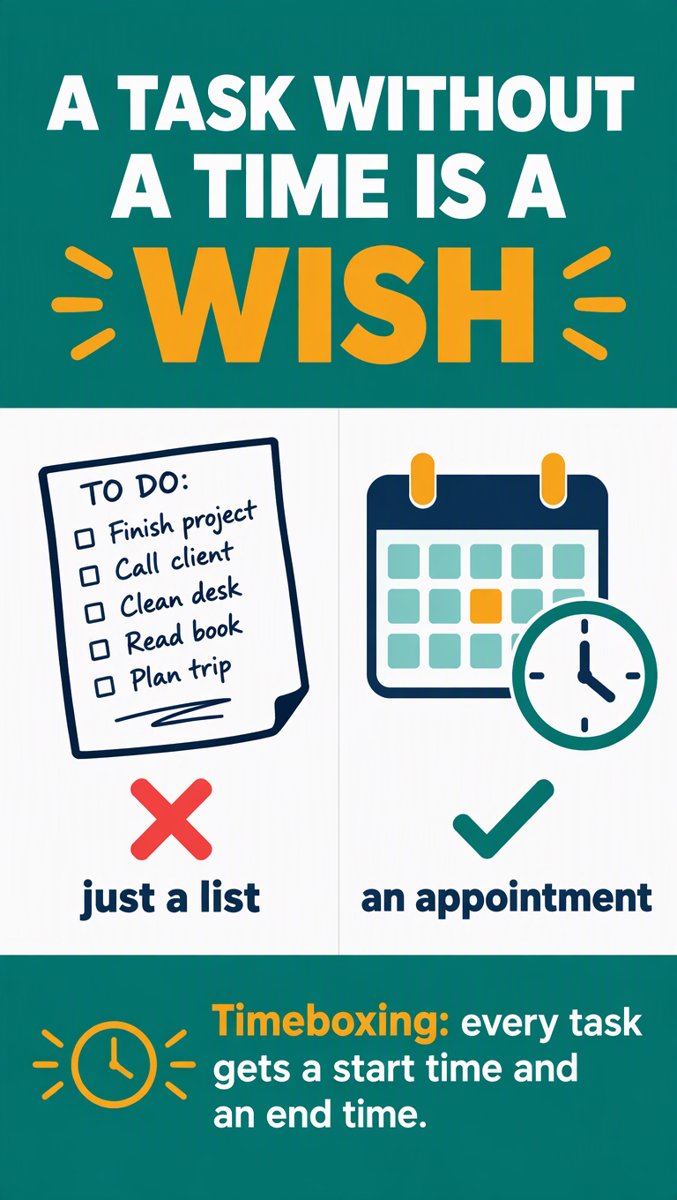
Timeboxing is simple to state: every task becomes an appointment on your calendar, with a start time and an end time. Your to-do list stops being a list of intentions and becomes a schedule of commitments. "Write the proposal" is a wish. "Write the proposal, Tuesday 9:00–10:30" is a plan.
Why It Works
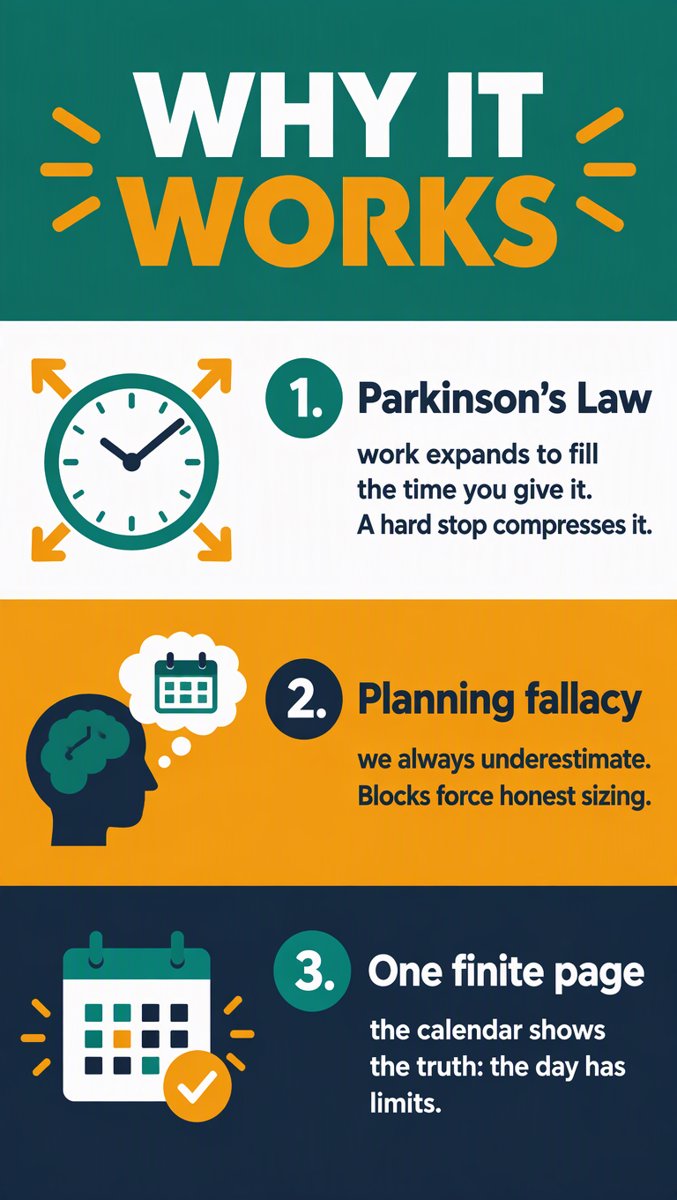
Three forces make timeboxing work:
1. Parkinson's Law. C. Northcote Parkinson wrote in The Economist in 1955: "Work expands so as to fill the time available for its completion" (Economist, Nov 19, 1955). Give a task all day and it takes all day. A hard stop compresses the work.
2. The planning fallacy. We are systematically terrible at estimating. In the classic study by Buehler, Griffin and Ross, students predicted their honors thesis would take 33.9 days — it actually took 55.5 days (Buehler et al., 1994, JPSP). Sizing tasks into calendar blocks forces that honesty before you commit, not at 9 p.m. when the day is gone.
3. One finite page. A list is infinite; a calendar page is not. When the day is full, adding a task means displacing a block. Timeboxing makes the trade-off visible — which is exactly what a to-do list hides from you.
The Proof
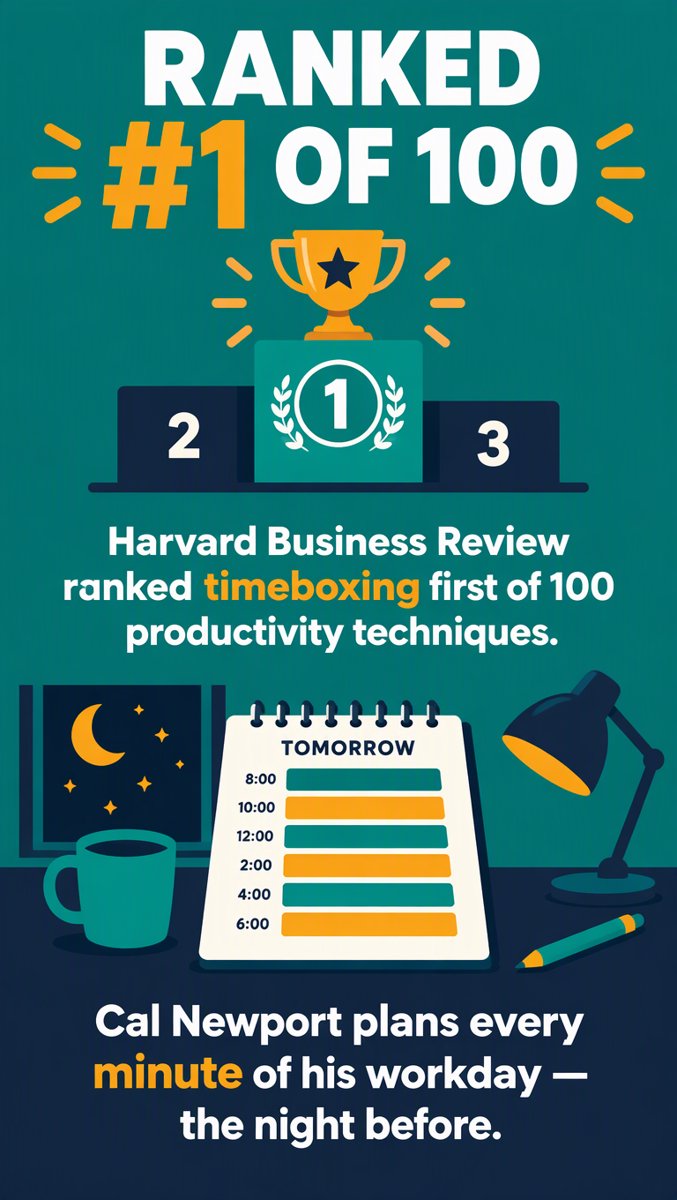
This isn't productivity folklore. Marc Zao-Sanders' study of 100 productivity techniques — published in Harvard Business Review as "How Timeboxing Works and Why It Will Make You More Productive" — put timeboxing first, above more famous methods. And the method has a high-profile practitioner: Cal Newport, the Georgetown computer scientist who wrote Deep Work, plans every minute of his workday in 30-minute lines — and builds tomorrow's schedule the evening before, in a 10–20 minute planning ritual (Newport, "The Importance of Planning Every Minute of Your Work Day").
How to Apply It Tonight
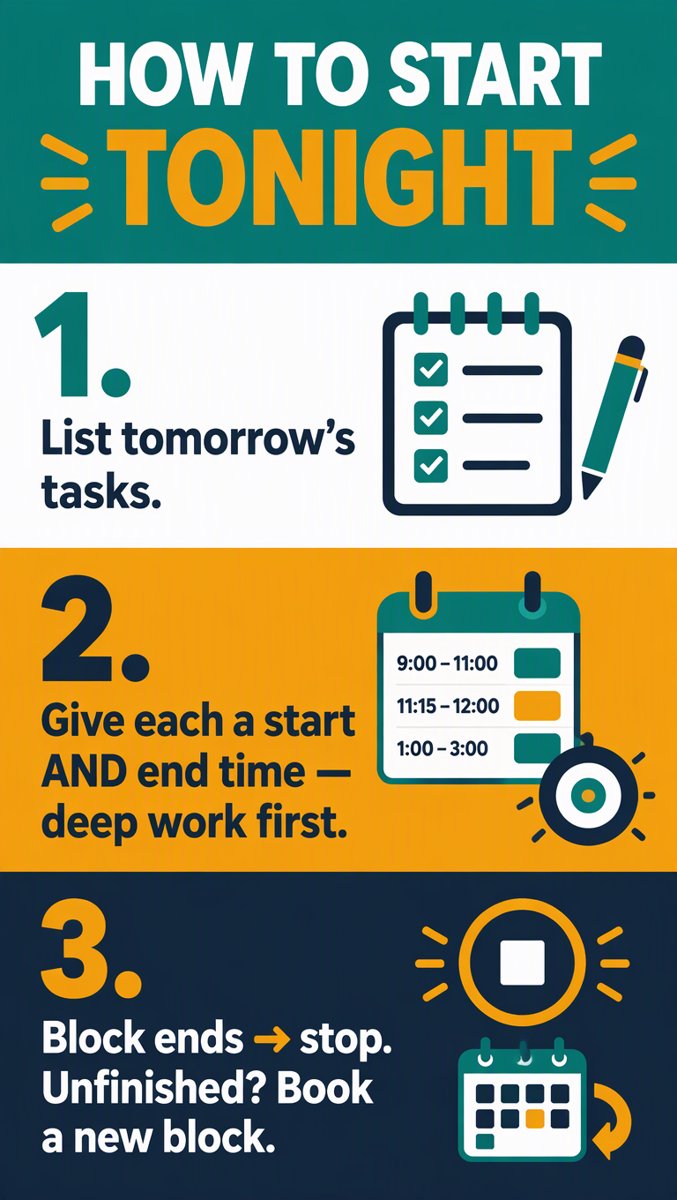
- Tonight, list tomorrow's tasks. All of them, on paper or in your calendar app.
- Give each one a start time AND an end time. Put your deep work first, in your best hours. Protect 90–120 minute blocks for it.
- When a block ends, stop. Not finished? Don't bleed into the next block — book the unfinished work a new block. That's the discipline that keeps the system honest.
Expect your estimates to be wrong at first. They're supposed to be. The blocks turn estimation errors into visible data, and within a week or two you'll size tasks like someone who has actually done them before.
The Takeaway
A to-do list is a wish list. A timeboxed calendar is a decision record. Give every hour a job — or the hours will find their own.

🎬 Narration Script (for the video — ~175 written words, est. ~70s)
[Cover / Hook] Your to-do list is lying to you. It says what to do — never when.
[Slide 1 — The Idea] Timeboxing fixes that. Every task becomes an appointment on your calendar. With a start time, and an end time. Not a list — a schedule of commitments.
[Slide 2 — Why It Works] Here's why it works. Parkinson's Law: work expands to fill the time you give it. So give it less. And the planning fallacy? We underestimate everything. One study: students predicted thirty-four days for a thesis. It took fifty-five. A calendar block exposes that gap — before you start, not at nine p.m.
[Slide 3 — The Proof] This isn't theory. Harvard Business Review ranked one hundred productivity techniques. Timeboxing came first. Cal Newport, the Deep Work author, plans every minute the night before.
[Slide 4 — Apply] Try it tonight. List tomorrow's tasks. Give each one a start time and an end time — deep work first. When a block ends, stop. Not finished? Book it a new block.
[Slide 5 — Takeaway] Don't write a to-do list tomorrow morning. Build the schedule tonight.
[CTA] Give every hour a job. Follow Think and Growth — one mental model, every single day.
📑 Per-Segment Clip Text (14 clips — subtitle-fit ≤15 words each)
| # | Slide | Motion | Segment text |
|---|---|---|---|
| 1 | cover | none | Your to-do list is lying to you. It says what to do — never when. |
| 2 | slide-1 | none | Timeboxing fixes that. Every task becomes an appointment on your calendar. |
| 3 | slide-1 | none | With a start time, and an end time. Not a list — a schedule of commitments. |
| 4 | slide-2 | none | Here's why it works. Parkinson's Law: work expands to fill the time you give it. |
| 5 | slide-2 | none | So give it less. And the planning fallacy? We underestimate everything. |
| 6 | slide-2 | none | One study: students predicted thirty-four days for a thesis. It took fifty-five. |
| 7 | slide-2 | none | A calendar block exposes that gap — before you start, not at nine p.m. |
| 8 | slide-3 | none | This isn't theory. Harvard Business Review ranked one hundred productivity techniques. |
| 9 | slide-3 | none | Timeboxing came first. Cal Newport, the Deep Work author, plans every minute the night before. |
| 10 | slide-4 | none | Try it tonight. List tomorrow's tasks. |
| 11 | slide-4 | none | Give each one a start time and an end time — deep work first. |
| 12 | slide-4 | none | When a block ends, stop. Not finished? Book it a new block. |
| 13 | slide-5 | none | Don't write a to-do list tomorrow morning. Build the schedule tonight. |
| 14 | cta | fade_out | Give every hour a job. Follow Think and Growth — one mental model, every single day. |
Sources
- HBR Podcast — How to Actually Finish What You Need to Get Done (Zao-Sanders, Jun 2026)
- Marc Zao-Sanders — Top 10 time management techniques (timeboxing #1 of 100)
- Cal Newport — The Importance of Planning Every Minute of Your Work Day
- Buehler, Griffin & Ross (1994) — Exploring the "Planning Fallacy" (33.9 vs 55.5 days)
- The Economist (Nov 19, 1955) — Parkinson's Law