

The Worry Window: Don't Fight Your Worries — Give Them an Appointment
A worry shows up at 2 PM. By 4 PM, it has eaten your afternoon. There's a 40-year-old technique that ends exactly this pattern — and in 2024 it was put through a randomized controlled trial. Here's the model, the evidence, and how to run it this week.
Friday on Think and Growth is mental health day: resilience, focus, clarity. Today's model is the Worry Window — the popular name for what clinical psychology calls worry postponement or scheduled worry time.
The Idea
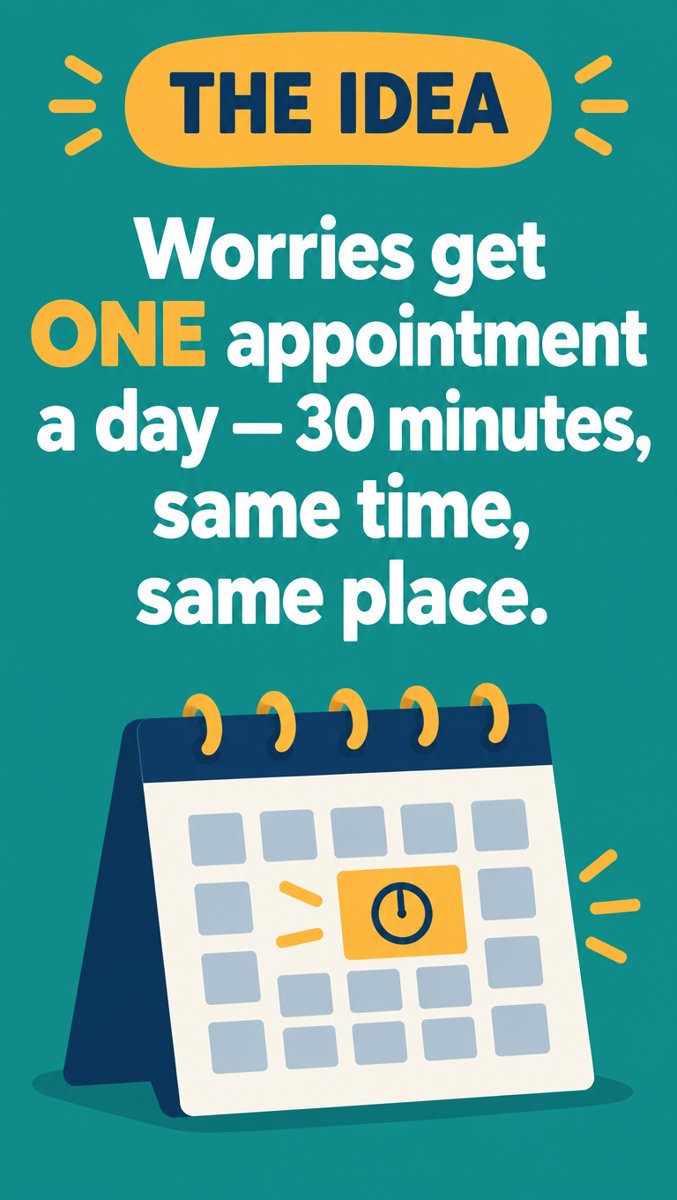
The rule is almost insultingly simple: your worries get one appointment a day. A fixed window of 15–30 minutes, at the same time, in the same place. When a worry appears at any other moment, you don't wrestle it, and you don't obey it. You write it down in one line and tell it, "Noted. See you at 5:30."
The technique was introduced by Borkovec and colleagues in 1983 as a "stimulus control" task in Behaviour Research and Therapy. The insight: worry becomes conditioned to random cues — a notification, an email, a quiet moment — until it fires all day. Confining worry to one time and place breaks that conditioning. The method became a standard component of cognitive-behavioral treatment for generalized anxiety disorder (GAD).
How It Works
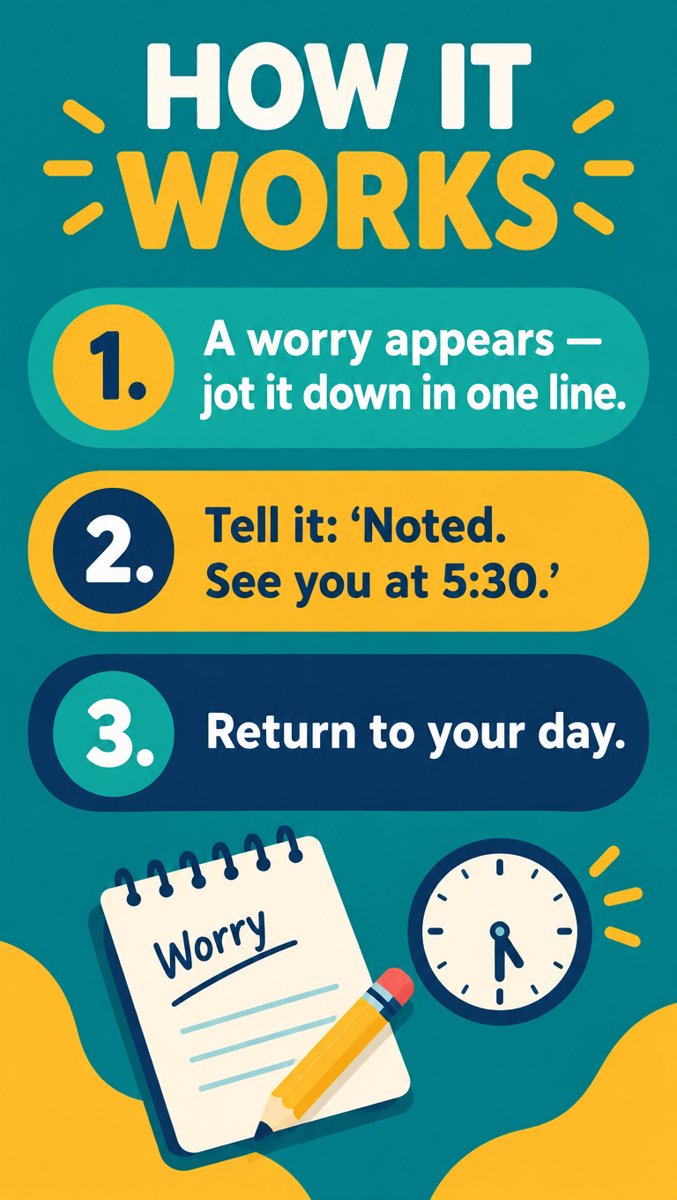
Three moves, every time a worry shows up outside the window:
- Jot it down in one line. Externalizing stops the loop of re-looping the same thought to avoid losing it.
- Postpone it out loud: "Noted. See you at five thirty." In the 2024 trial, participants even composed a personal deferral line — e.g., "Another worry arises, I acknowledge it, and now I let it go."
- Return to your day. At the window, worry deliberately. And here's the quiet miracle: most items already feel smaller. As Psychology Tools puts it, clients "often report that worries lose their urgency or relevance when revisited."
The deeper mechanism is belief repair. Worry feels uncontrollable — that belief is what keeps it alive. But you cannot postpone something for six days and still believe it's uncontrollable. Deferral is a behavioral experiment that proves control, one appointment at a time.
The Proof
This is not wellness-blog folklore. The evidence stack:
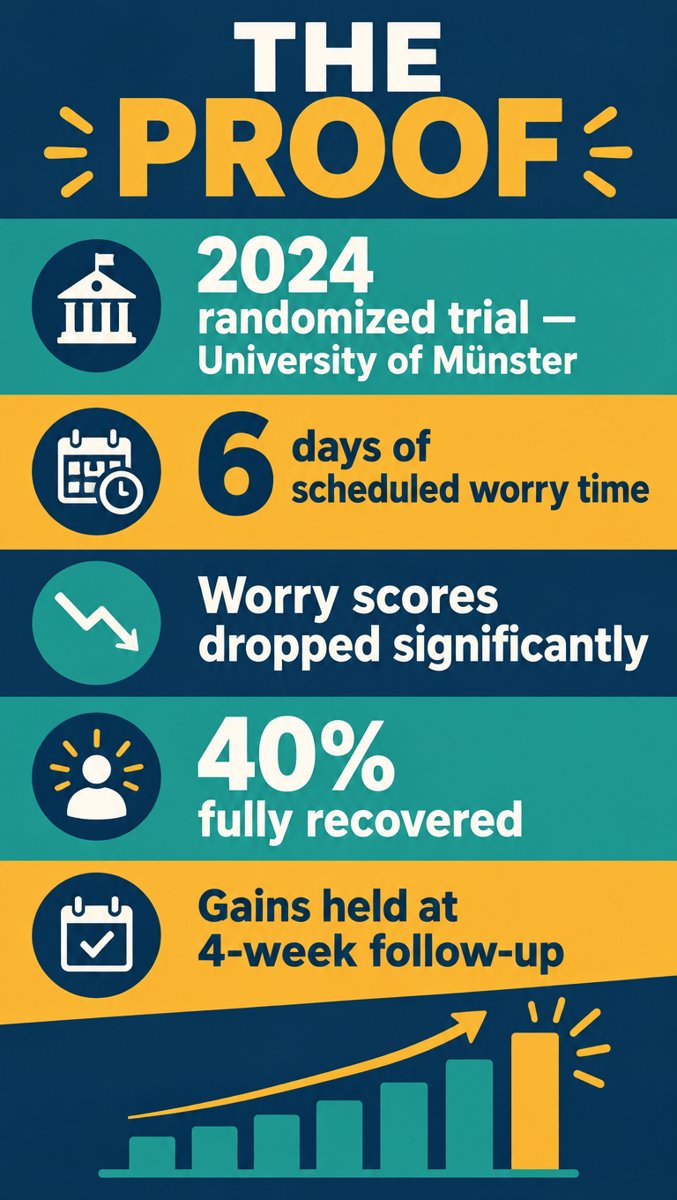
- 2024 randomized waitlist-controlled trial (Krzikalla et al., Clinical Psychology in Europe, University of Münster): participants with GAD postponed worry to a window of no more than 30 minutes at a predefined time for six days. Worry scores (Penn State Worry Questionnaire) dropped from 63.21 to 53.90 in the treated group versus 64.52 to 61.91 on the waitlist. 40% fully recovered on the worry measure — "particularly remarkable given the short duration of the intervention," the authors write. Effects persisted at four-week follow-up.
- 2023 meta-analysis (Dippel et al., International Journal of Cognitive Behavioral Therapy): across studies, worry postponement reduces daily worry, with small-to-medium effects.
- Since 1983 (Borkovec et al.): stimulus-control worry postponement has repeatedly significantly reduced daily worry and remains a standard CBT component for GAD.
One honest caveat for the curious: the trial also tested the technique on health-anxiety (hypochondriasis) patients, where results were limited. The strongest evidence is for worry itself — which is exactly what most of us are drowning in.
How to Apply It
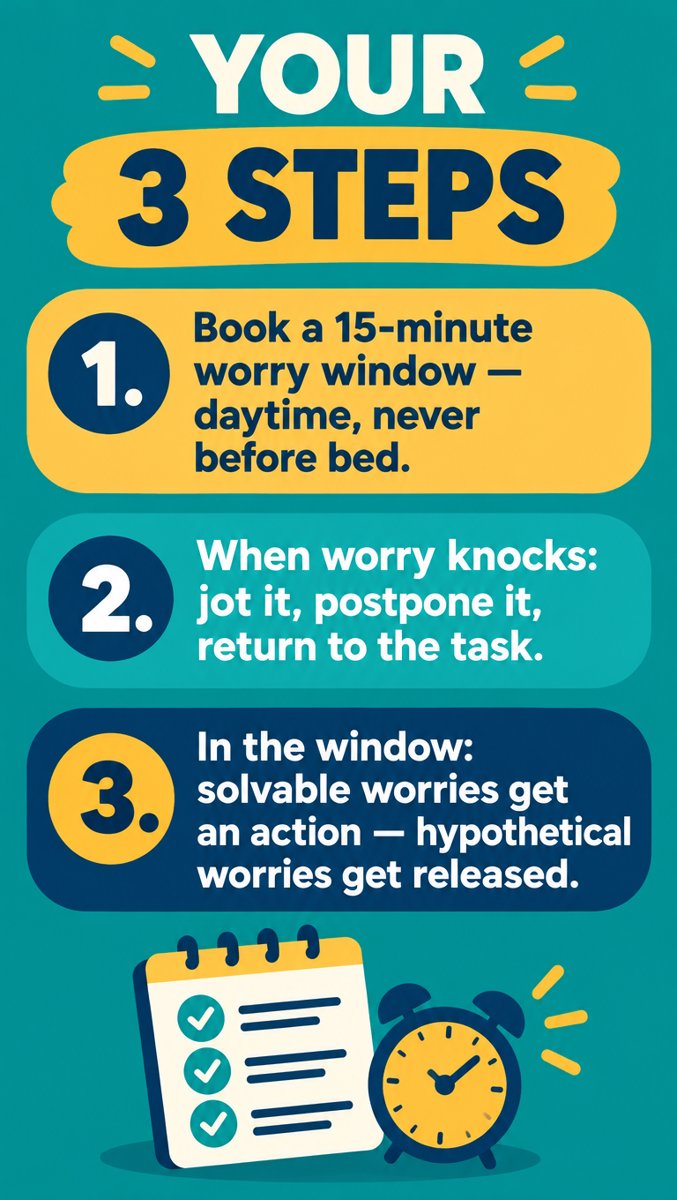
- Book the window: 15–30 minutes, daytime, same time daily — never right before bed. Both the classic protocol and practitioners are explicit on this point: 5:30 PM, not 11 PM.
- Run the deferral loop all day. Worry knocks → jot one line → "Noted. See you at [your time]" → back to the task. Don't suppress; postpone. There's a difference, and it's the whole technique.
- In the window, sort and close. Solvable worries get one concrete action — a call, a decision, a calendar block. Hypothetical worries get acknowledged and released. Then the window ends, and worry clocks out with you.
Give it six days — that's the trial's duration, and a fair test for yours.
The Takeaway
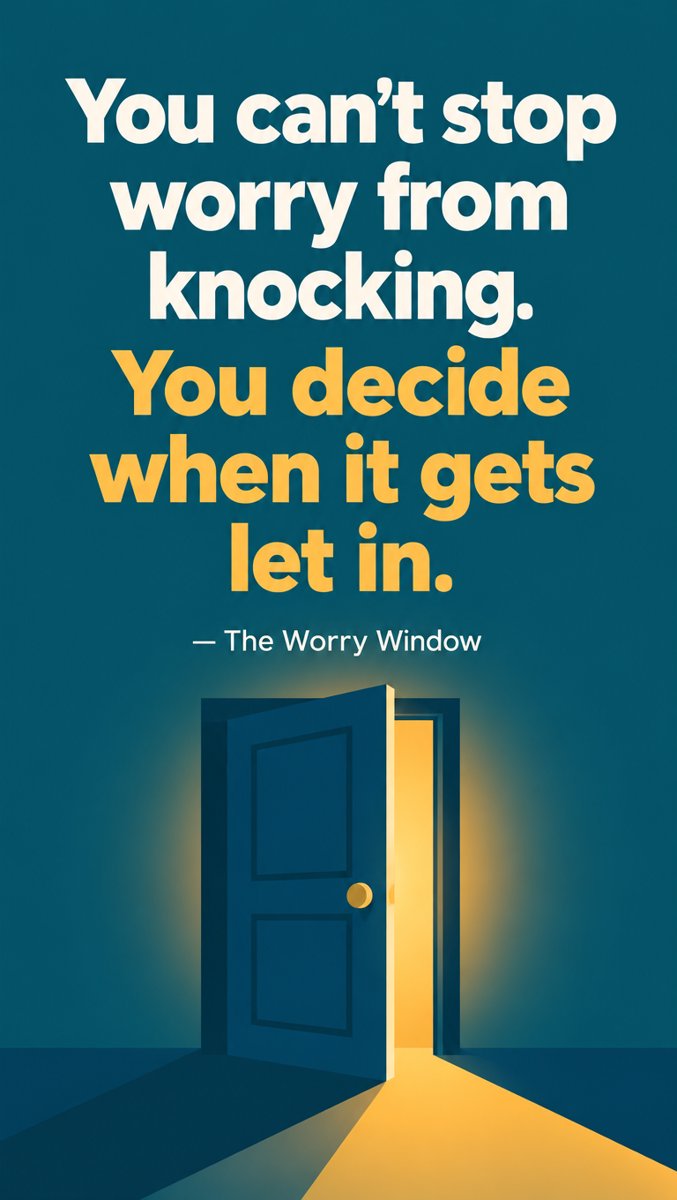
You can't stop worry from knocking. You decide when it gets let in.
Sources
- Krzikalla C., Buhlmann U., Schug J., Kopei I., Gerlach A.L., Doebler P., Morina N., Andor T. (2024). Worry Postponement From the Metacognitive Perspective: A Randomized Waitlist-Controlled Trial. Clinical Psychology in Europe, 6(2):e12741. doi:10.32872/cpe.12741 — https://pmc.ncbi.nlm.nih.gov/articles/PMC11303915/
- Dippel N. et al. (2023). Effects of Worry Postponement on Daily Worry: a Meta-Analysis. International Journal of Cognitive Behavioral Therapy — https://link.springer.com/article/10.1007/s41811-023-00193-x
- Psychology Tools. Worry Postponement (cites Borkovec, T.D., et al., 1983, "Stimulus control applications to the treatment of worry," Behaviour Research and Therapy, 21(3), 247–251) — https://www.psychologytools.com/resource/worry-postponement
- Psychology Today. A Surprising Way to Manage Worrying — https://www.psychologytoday.com/us/blog/psy-curious/201909/a-surprising-way-to-manage-worrying
Peter writes daily on Think and Growth — one mental model, one sharper decision. Tomorrow: Saturday's connection edition.
🎬 Narration Script (video version, ~75s)
[Cover] A worry just hijacked your afternoon. Don't fight it. Schedule it.
[Slide 1 — The Idea] It's called the Worry Window. Psychology calls it worry postponement — around since 1983. One rule: worries get a single appointment a day. Thirty minutes. Same time, same place. Everything else waits.
[Slide 2 — How It Works] Here's the move. When a worry appears, write it down in one line. Then tell it: "Noted. See you at five thirty." Return to your day. At the window, worry deliberately — most items already feel smaller.
[Slide 3 — The Proof] And it's tested. A 2024 German trial had anxiety patients try this for six days. Worry scores dropped significantly — and forty percent fully recovered. A month later, the gains held. Meta-analyses agree: postponement shrinks daily worry.
[Slide 4 — Your 3 Steps] Your move: book a fifteen-minute worry window. Daytime — never right before bed. When worry knocks, jot one line, postpone it, and return to the task. In the window: solvable worries get an action. Hypothetical ones get released.
[Slide 5 — Takeaway] You can't stop worry from knocking. You decide when it gets let in.
[CTA] I'm Peter. Every day on Think and Growth: one mental model, one sharper decision. Follow the channel — see you tomorrow.