The Soft Startup: The First 3 Minutes Decide the Fight


The Soft Startup: The First 3 Minutes Decide the Fight
Think & Growth — Daily Mental Model · Wednesday, October 14, 2026 Theme: Family — relationships & communication
Here's a number that should change how you open every difficult conversation: 96%.
That's how often relationship researcher Dr. John Gottman could predict how a conflict conversation would end — by watching only how it began. His six-year longitudinal study found that the outcome of a fifteen-minute argument could be forecast from its first three minutes with striking accuracy. The couples who divorced weren't just more negative overall; they opened their discussions with criticism, and the conversation simply carried that opening note to its conclusion.
Gottman's team put it plainly: discussions end on the same note they begin.
The Idea: Your Opening Line Is a Prediction
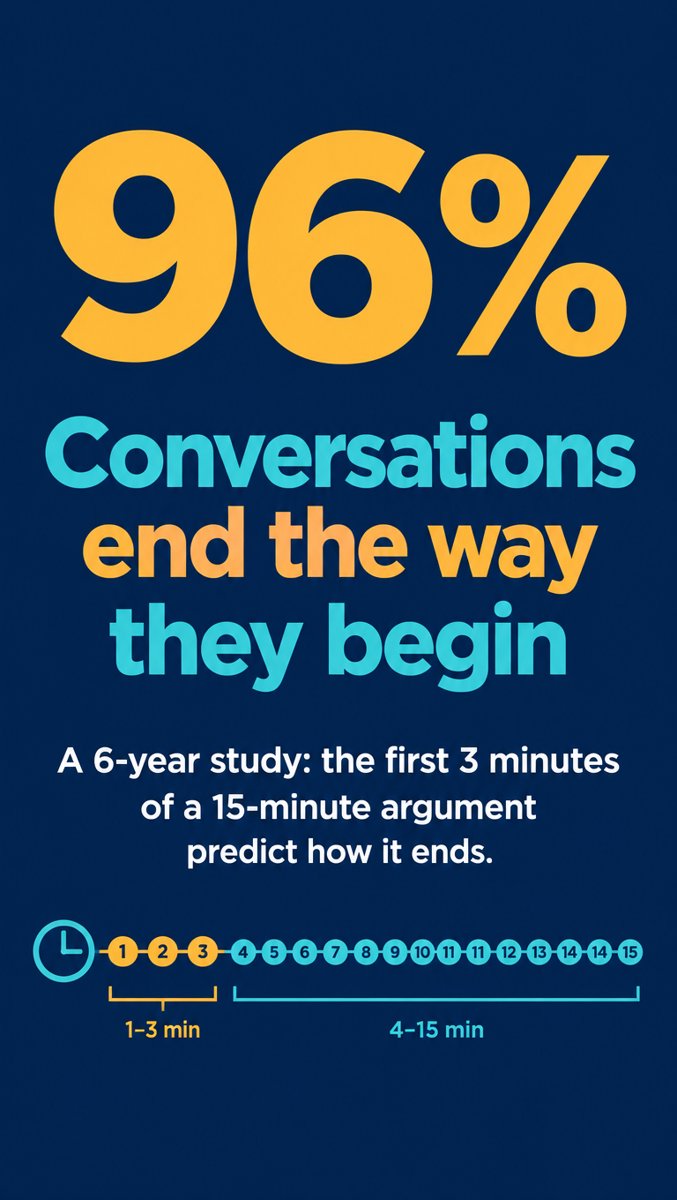
Most of us treat a hard conversation like a poker hand — we think the outcome gets decided in the middle, by whoever argues best. Gottman's data says otherwise. The die is cast in the opening minutes. Start harsh, and the conversation almost never climbs back to warmth. Start soft, and even a serious complaint can land on common ground.
That's why the Gottman Method treats the soft startup as the first skill of conflict — not communication polish, but structural engineering. The opening frames everything the other person hears afterward.
How It Works: Harsh vs. Soft
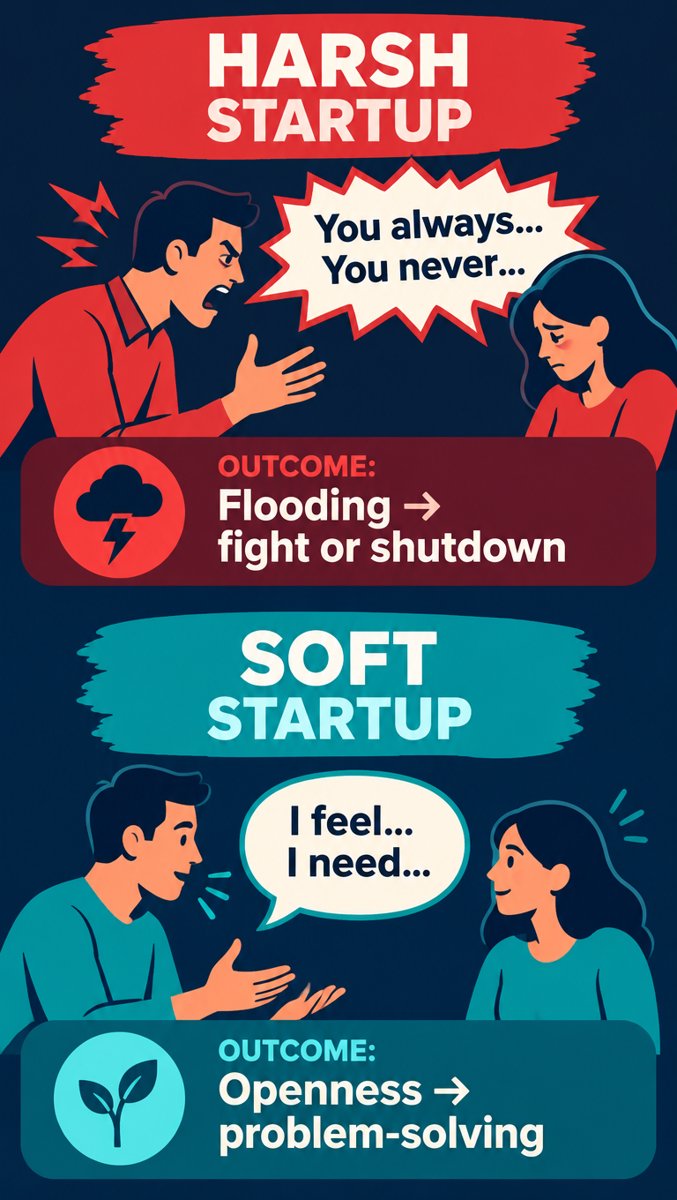
A harsh startup opens with blame — "You always…" "You never…" "Why are you so…". It invites what Gottman calls the Four Horsemen (criticism, contempt, defensiveness, stonewalling) into the room. The attacked partner experiences flooding: heart rate spikes, stress hormones surge, and the brain shifts from problem-solving mode into fight, flight, or shutdown. From there, the conversation is mathematically unlikely to recover.
A soft startup makes the same complaint without the attack. The Gottman Institute's rule: complain, but don't blame. You describe the situation and your feeling about it, rather than prosecuting your partner's character. No attack means no defense to mount — the listener stays receptive instead of reflexive.
The Formula: Three Lines
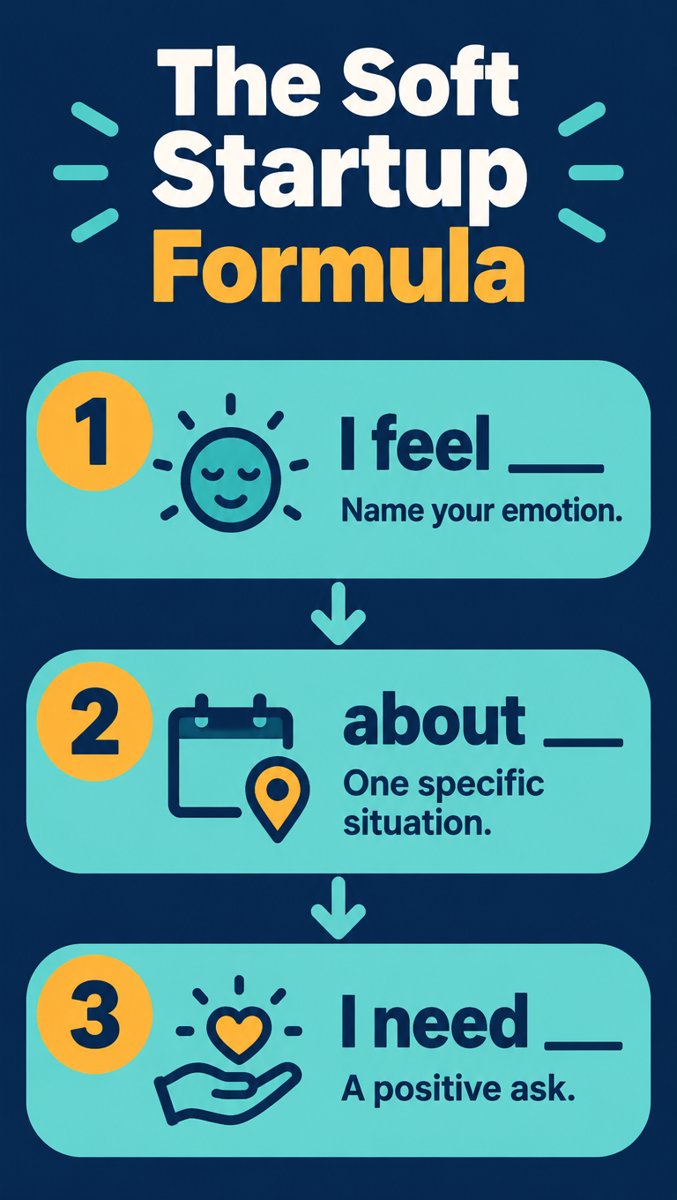
- "I feel ___." Name your emotion, not their flaw. "I feel overwhelmed" — not "you're inconsiderate."
- "…about ___." Pinpoint one specific situation. "About tonight's kitchen piling up" — not "about how lazy you are."
- "I need ___." Make a positive, concrete ask. "I need fifteen minutes of help before we sit down" — not "stop ignoring your chores."
One warning the Gottman Institute is explicit about: an "I" statement is not a disguise for blame. "I feel like you never listen to me" is still a harsh startup — the "you never" is the tell.
Same Grievance, Opposite Endings
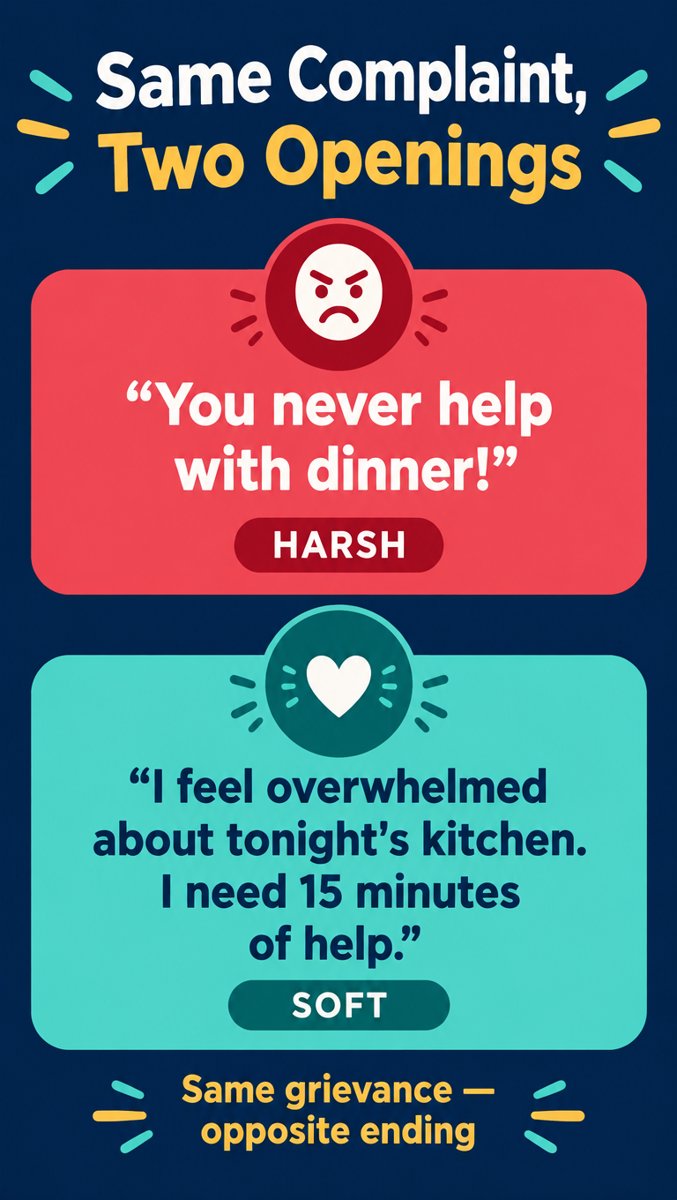
Take one ordinary grievance:
- Harsh: "You never help with dinner!"
- Soft: "I feel overwhelmed about tonight's kitchen mess. I need fifteen minutes of your help before we sit down."
Identical underlying complaint. Completely different first three minutes — and by the 96% rule, completely different endings. The first sentence starts a war about character. The second starts a fifteen-minute solution about dishes.
How to Apply It This Week
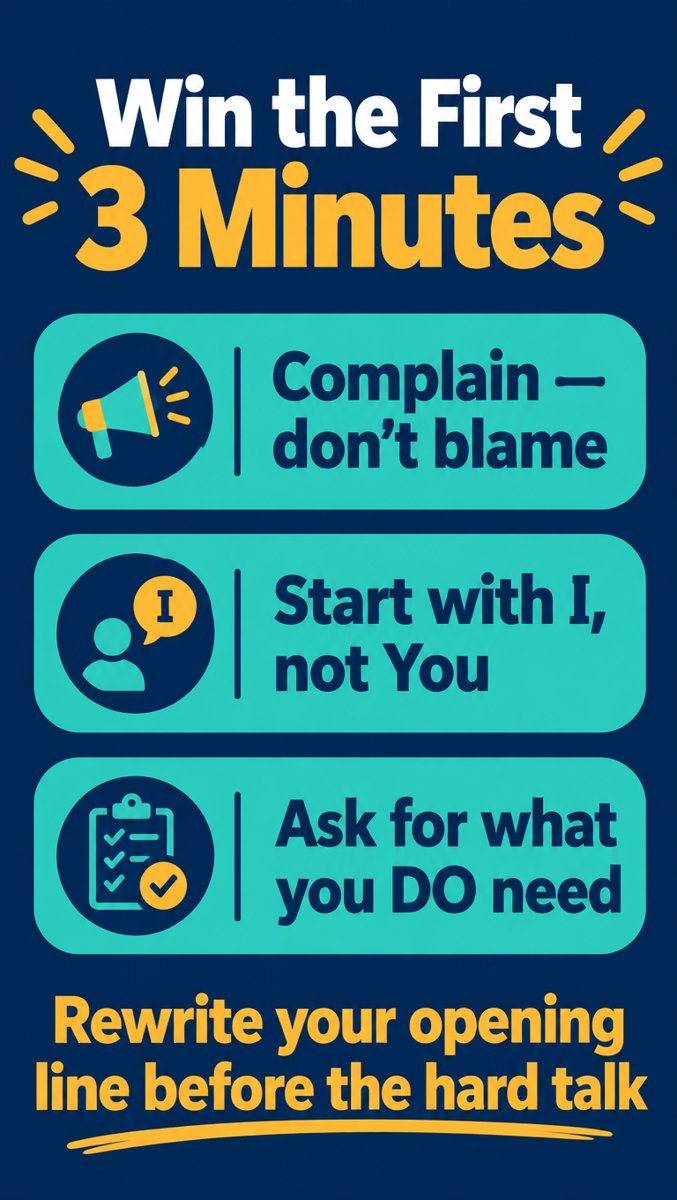
- Complain — don't blame. The issue is the situation, never the person.
- Start with "I," not "You." Feelings and needs in, accusations out.
- Ask for what you DO need. Vague resentment gets vague results; a concrete request gets help.
- Don't store things up. Bottled grievances explode as a laundry list; raise issues while they're small.
The move is simple: before your next hard conversation, rewrite your opening line. Draft it like a headline, because functionally it is one — it sets the story everyone else lives in for the next fifteen minutes. Win the first three minutes, and you've already won the talk.
Sources
- The Gottman Institute — "How to Fight Smarter: Soften Your Start-Up" — six-year longitudinal study; "discussions will end on the same note they begin"; complain-don't-blame skills.
- The Gottman Institute — "5 Steps to Fight Better" — harsh startup begins with the Four Horsemen and causes flooding.
- Resilience Focused Therapy — "Gottman Soft Start-Up" — 96% of 15-minute conversation outcomes predictable from the first 3 minutes.
- OU Community — Softened Startup Guide (PDF) — "96% of the time you can predict the outcome of a conversation based on the first three minutes."
🎬 Narration Script (TTS — ~80s, 13 segments)
[Cover] Ninety-six percent of the time, a fight's ending is decided in its first three minutes.
[Slide 1 — a] Relationship researcher John Gottman found it: conversations end on the same note they begin.
[Slide 1 — b] His six-year study watched couples argue — the opening minutes predicted the outcome.
[Slide 2 — a] A harsh startup — "You always," "You never" — floods your partner with stress.
[Slide 2 — b] A flooded brain can't problem-solve. It can only fight, flee, or shut down.
[Slide 2 — c] A soft startup skips the attack: complain about the situation, never the character.
[Slide 3 — a] The formula is three lines. One: I feel — name your emotion.
[Slide 3 — b] Two: about — one specific situation. Three: I need — a positive, concrete ask.
[Slide 4 — a] Same grievance, two openings. "You never help with dinner!" starts a war.
[Slide 4 — b] "I feel overwhelmed about tonight's kitchen — I need fifteen minutes of help" starts a solution.
[Slide 5 — a] So before your next hard conversation, rewrite your opening line.
[Slide 5 — b] Win the first three minutes — you've already won the talk.
[CTA] I'm Peter, and this is Think and Growth: one mental model a day. Follow the channel — I'll see you tomorrow.
(Word budget: ~195 written words → ~75-85s at TTS pacing. All clips subtitle "none" — infographic cards carry their own text. Motion "none" everywhere; CTA uses fade_out.)