The Sleep Regularity Principle: The One Health Habit That Isn't About Hours

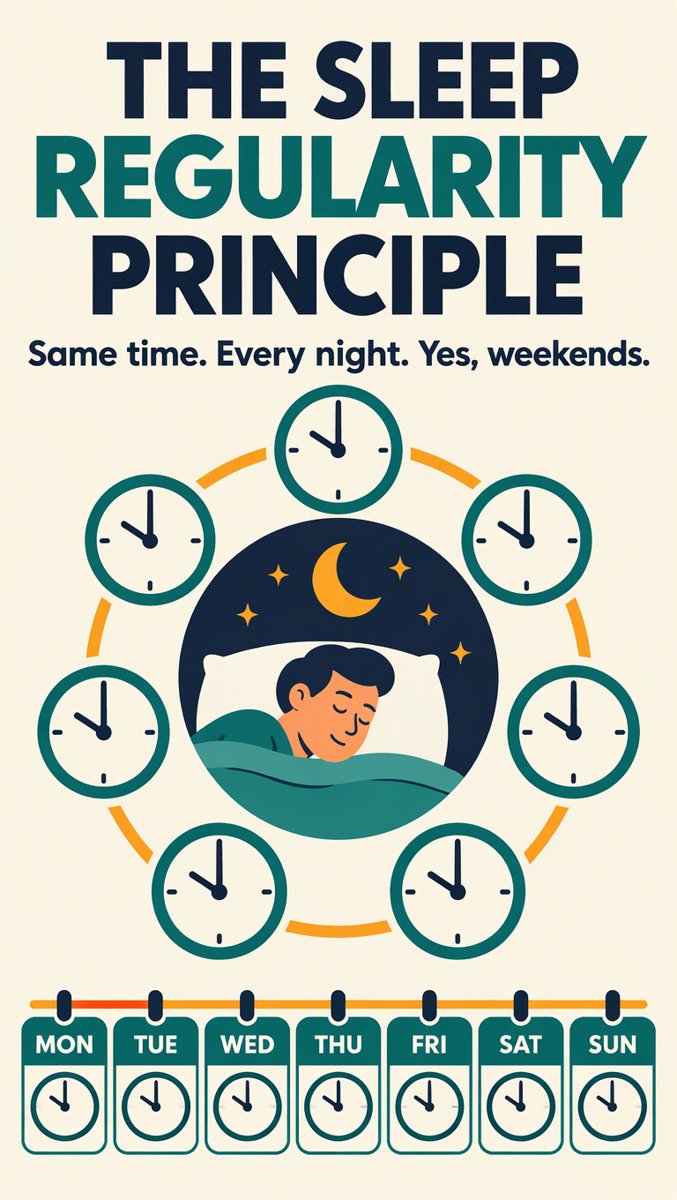
The Sleep Regularity Principle: The One Health Habit That Isn't About Hours
Think and Growth — Thursday, October 22, 2026 · Theme: Health (habits, energy, wellness)
Ask ten people about their sleep and you'll hear one number repeated like scripture: seven to eight hours. We've been trained to count sleep like calories. But a 2024 study published in SLEEP, the flagship journal of sleep research, analyzed more than 60,000 people and found something uncomfortable for the hour-counters: how consistently you sleep may matter more than how long you sleep.
Researchers call it the sleep regularity principle: your body doesn't just tally hours in bed — it grades your timing. And the grade for consistency turned out to be the stronger predictor of who was still alive at the end of the study window.
What it is
The sleep regularity principle holds that day-to-day consistency of your sleep–wake schedule — including weekends — predicts health outcomes more strongly than total sleep duration.
The study behind it is worth naming: Windred and colleagues, publishing in SLEEP (2024), analyzed 60,977 UK Biobank participants wearing activity trackers. Using a metric called the Sleep Regularity Index (SRI) — the probability that you're asleep at two time points exactly 24 hours apart, averaged across days — they tracked outcomes over a mean follow-up of 6.30 years, during which 1,859 deaths occurred.
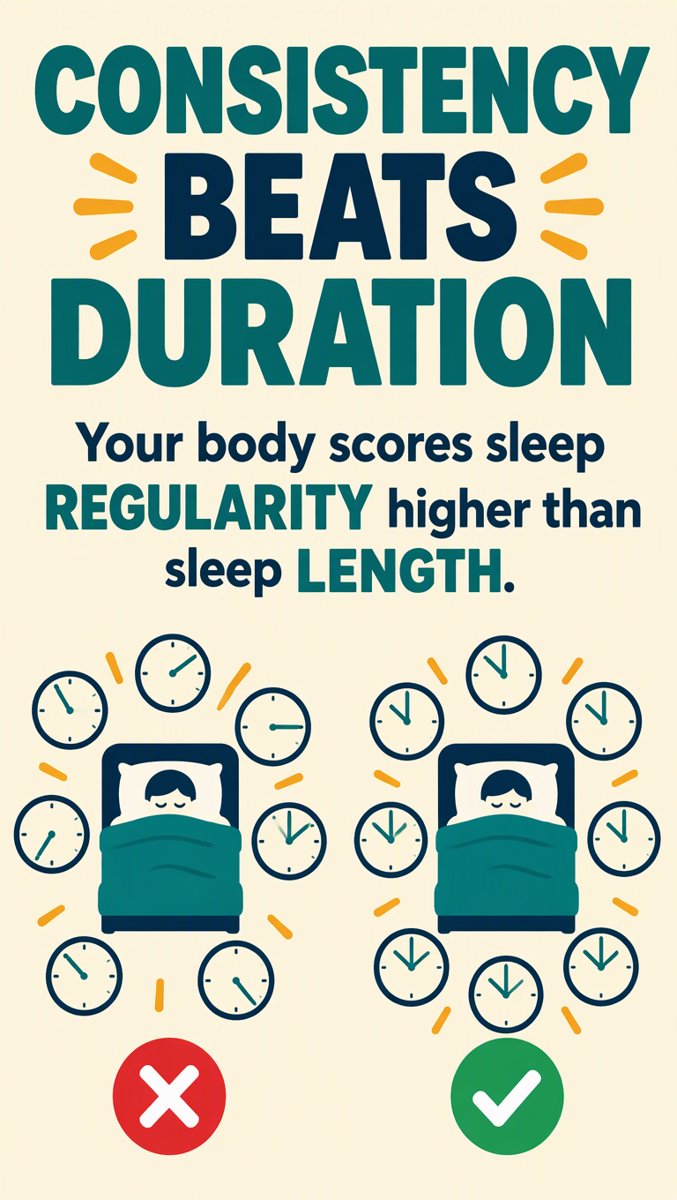
The headline finding: sleep regularity predicted all-cause mortality more strongly than sleep duration did. In the UK Biobank summary, higher regularity was associated with 20%–48% lower all-cause mortality risk, along with lower cancer and cardiometabolic mortality. The people in the most consistent quintile weren't necessarily sleeping more — they were sleeping on schedule.
How it works: one cue syncs everything
Your circadian clock is the body's master scheduler. Nearly every system you own — hormone release, digestion, body temperature, cellular repair — takes its timing cues from it. And the single strongest daily cue you give that clock is when you wake up.
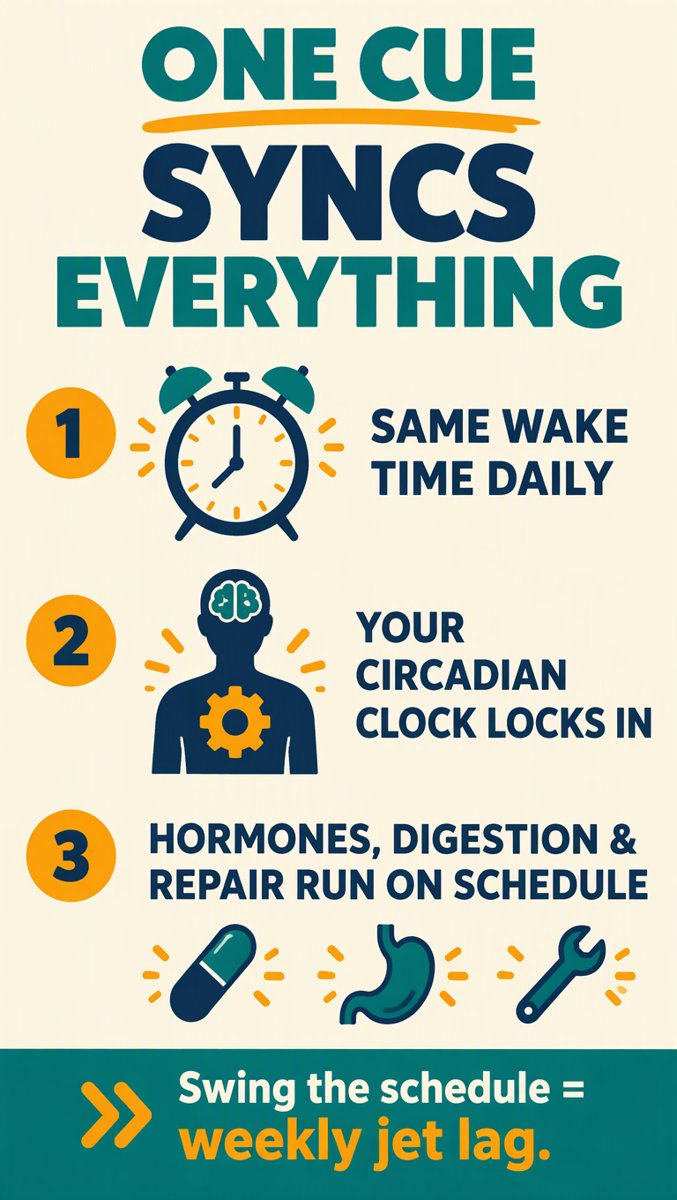
- Same wake time, every day. The alarm goes off at one time — and your clock locks in.
- The clock syncs the org chart. Hormones, digestion, and repair cycles align to the schedule instead of scrambling to catch up.
- Swing the schedule and you desynchronize. Researchers have a name for the weekend pattern — staying up two hours later Friday and Saturday, then crashing Sunday night: social jet lag. Your body experiences the Monday-morning version as genuinely as a flight across time zones.
This is why the old advice — keep weekend sleep within about an hour of weekday sleep, as the NIH's National Heart, Lung, and Blood Institute puts it — isn't fussy perfectionism. It's clock hygiene.
The evidence, in one number
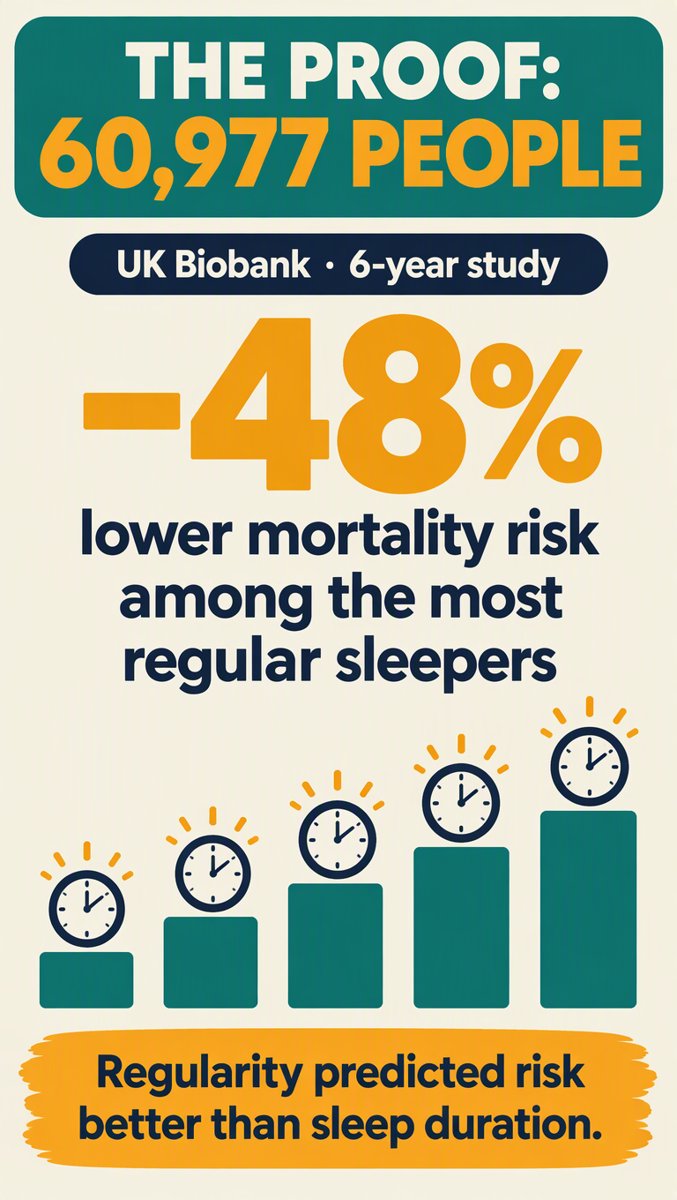
Sixty thousand people. Six years of follow-up. Nearly two thousand deaths. The analysis held duration in the model and still found regularity carrying more predictive weight. That's the part worth sitting with: the number your fitness tracker emphasizes — hours — was the weaker signal. The boring number nobody brags about at brunch — what time — was the stronger one.
How to apply it this week
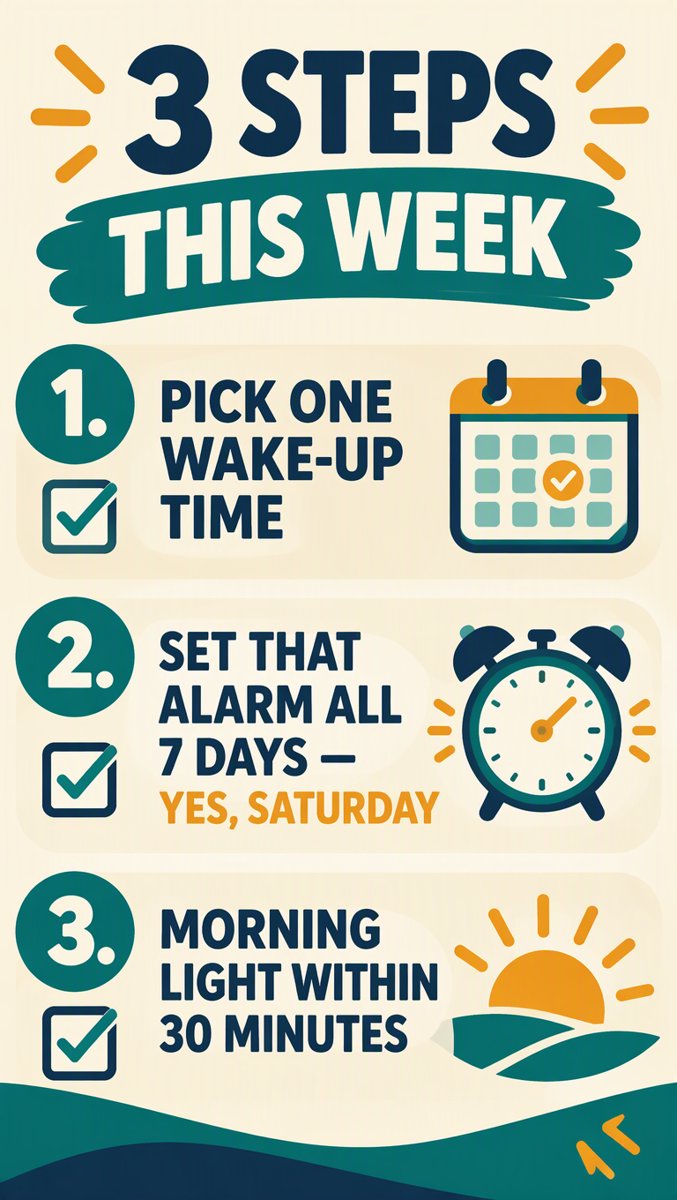
- Pick one wake-up time. One. The time you can honestly hold seven days a week — not your workday fantasy time.
- Set that alarm for all seven days. Yes, Saturday. Yes, Sunday. The NIH and Mayo Clinic prescribe exactly this: same schedule on weeknights and weekends, difference capped at about an hour.
- Get morning light within 30 minutes of waking. Daylight is the second half of the cue pair; it stamps the wake time into the clock even deeper.
Expect the first weekend to feel like a mild betrayal of your social life. That's the adjustment cost. The payoff is a body clock that stops re-shocking itself twice a week.
The takeaway
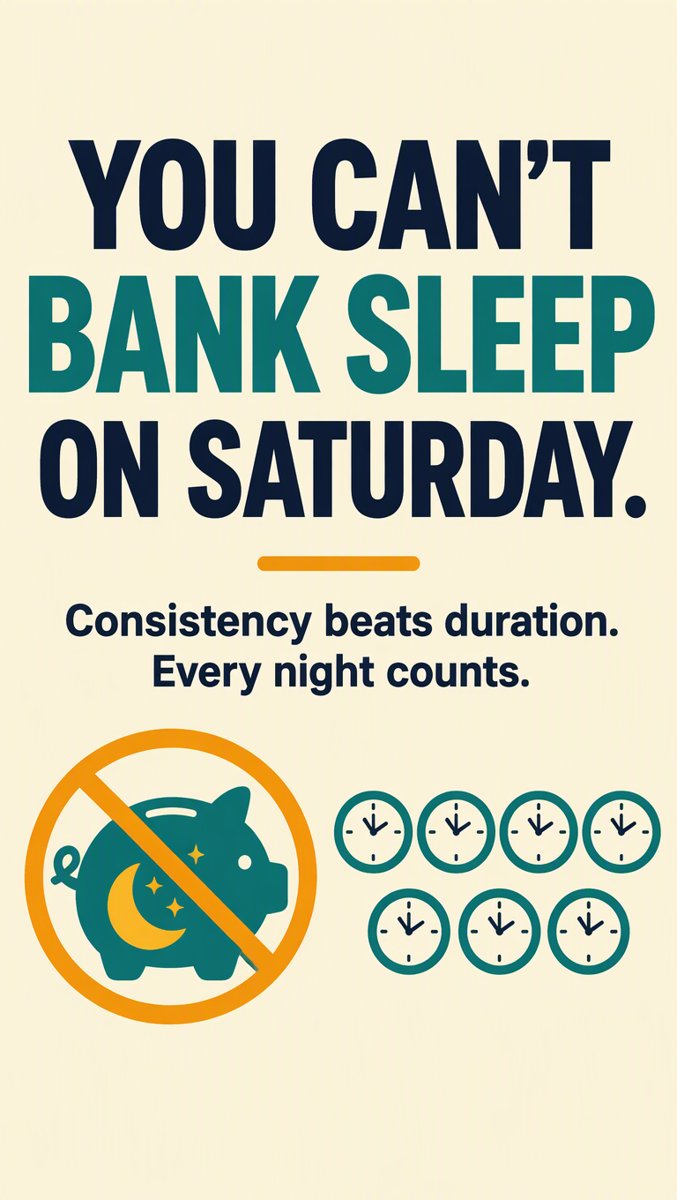
You can't bank sleep on Saturday. There is no compensatory deposit for a week of 2 a.m. nights — the clock doesn't accept them. Consistency beats duration, and every night is a fresh vote for or against the schedule.
One time. Every day. That's the habit.
🎬 Narration script (video version, ~179 words ≈ 72s at TTS pacing)
[Hook] The most powerful health habit isn't a workout. It's a time. Here's the sleep science.
[Idea 1] Researchers call it the sleep regularity principle. And it quietly outranks sleep duration.
[Idea 2] Same bedtime, same wake time, every single day. Your body scores that consistency first.
[Mechanism 1] Here's the mechanism. A stable wake time is the strongest cue your body clock gets.
[Mechanism 2] Lock it in, and hormones, digestion, and cellular repair all run on schedule.
[Mechanism 3] Swing it every weekend, and you fly through social jet lag without leaving home.
[Example 1] The proof is big. Over sixty thousand people, tracked for about six years.
[Example 2] The most regular sleepers showed up to forty-eight percent lower mortality risk.
[Example 3] And regularity predicted that risk better than sleep duration did.
[Apply 1] This week, try three steps. Pick one wake-up time and keep it.
[Apply 2] Set that alarm all seven days — yes, Saturday. Then get morning light within thirty minutes.
[Takeaway] Remember: you can't bank sleep on Saturday. Consistency beats duration — every night counts.
[CTA] Follow Think and Growth for one practical mental model every morning — and give your body clock the one gift it actually wants: a schedule it can trust.
📋 Per-segment ↔ clip mapping
| # | Slide | Segment | Words |
|---|---|---|---|
| 1 | cover | Hook | 15 |
| 2 | slide-1 | Idea seg 1 | 13 |
| 3 | slide-1 | Idea seg 2 | 15 |
| 4 | slide-2 | Mechanism seg 1 | 15 |
| 5 | slide-2 | Mechanism seg 2 | 13 |
| 6 | slide-2 | Mechanism seg 3 | 14 |
| 7 | slide-3 | Example seg 1 | 13 |
| 8 | slide-3 | Example seg 2 | 12 |
| 9 | slide-3 | Example seg 3 | 10 |
| 10 | slide-4 | Apply seg 1 | 13 |
| 11 | slide-4 | Apply seg 2 | 15 |
| 12 | slide-5 | Takeaway | 14 |
| 13 | cta (fade_out) | CTA | 27 |
All clips: motion: "none" (content) / fade_out (CTA only) · all subtitle: "none".
Sources
- Windred, Burns, Lane, Saxena, Rutter, Cain & Phillips (2024), "Sleep regularity is a stronger predictor of mortality risk than sleep duration: A prospective cohort study," SLEEP 47(1):zsad253 — https://academic.oup.com/sleep/article/47/1/zsad253/7280269
- UK Biobank publication summary (20%–48% lower all-cause mortality association) — https://www.ukbiobank.ac.uk/publications/sleep-regularity-is-a-stronger-predictor-of-mortality-risk-than-sleep-duration-a-prospective-cohort-study/
- NHLBI, NIH — Healthy Sleep Habits ("same schedule weeknights and weekends… within about an hour") — https://www.nhlbi.nih.gov/health/sleep-deprivation/healthy-sleep-habits
- Mayo Clinic — Sleep tips: 6 steps to better sleep ("go to bed and get up at the same time every day, including weekends") — https://www.mayoclinic.org/healthy-lifestyle/adult-health/in-depth/sleep/art-20048379
- JCEM — Social Jetlag, Chronotype, and Cardiometabolic Risk — https://academic.oup.com/jcem/article-abstract/100/12/4612/2536396