
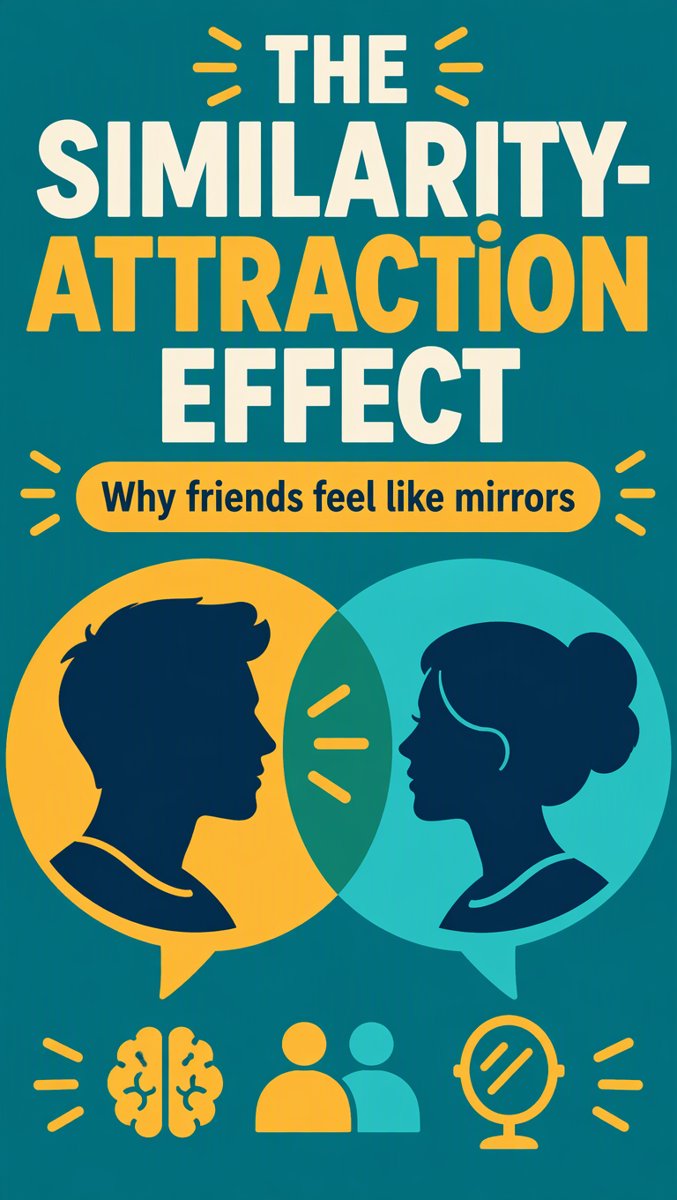
The Similarity-Attraction Effect: Why Friends Feel Like Mirrors
Think and Growth — Episode #38 · Theme: Friendship (Saturday) · October 31, 2026
Ever meet someone and click instantly — like looking into a mirror? Psychologists have a name for that: the similarity-attraction effect. It's one of the most replicated findings in social psychology, and once you see how it works, you can stop treating friendship like luck — and start engineering it.
The Idea
The principle is disarmingly simple: we like people who are like us. Shared attitudes, values, hobbies, and beliefs are among the strongest predictors of interpersonal attraction — stronger, across decades of research, than proximity alone, complementarity, or the old myth that "opposites attract."
The effect was mapped most famously by psychologist Donn Byrne, whose 1971 book The Attraction Paradigm summarized hundreds of experiments. In the classic setup — the "bogus stranger" paradigm — participants read a questionnaire supposedly filled out by another person. The experimenters secretly controlled how many of that stranger's attitudes matched the participant's own. The result was almost mechanical: the more the stranger agreed with you, the more you liked them, with liking climbing nearly linearly as the proportion of similar attitudes rose (Byrne, 1971; Byrne et al., 1971).
Why does agreement feel so good? Byrne's reinforcement account: each "me too" is a tiny reward. Someone who validates your worldview is telling you, in effect, that the way you see the world is right. Your brain keeps score.
The Twist: Perception Beats Reality
For decades the finding seemed settled. Then in 2008, R. Matthew Montoya, Robert Horton, and Jeffrey Kirchner did what meta-analysts do: they pooled 460 effect sizes from 313 laboratory and field studies (Montoya, Horton & Kirchner, 2008). Their conclusion added a crucial twist — perceived similarity predicts attraction more strongly than actual similarity. In existing relationships, actual similarity turned out not to be strictly necessary at all. What binds people is the belief that we match.
That reframes the whole game. Friendship isn't determined by whether you objectively match someone; it's determined by whether the match gets noticed — by both of you. Two people can share half a worldview and never become friends, because nobody ever surfaced the overlap.
It Works at Work, Too
The effect isn't just a lab curiosity. A 2024 systematic review in Management Review Quarterly examined decades of studies on the "similarity leads to attraction" hypothesis in workplace interactions and found repeated evidence that both psychological similarity — values, interests, personality — and demographic similarity drive friendship and close-relationship formation on the job (Management Review Quarterly, 2024). Shared interests especially: the colleagues who become genuine friends are overwhelmingly the ones who found common ground beyond the task list.
This also connects to everything this channel has covered about connection: the propinquity effect puts people near you; the similarity-attraction effect decides which of them you actually befriend.
One Honest Caveat
Similarity magnetizes — but don't let it build an echo chamber. Teams and friend groups that are too similar think alike, miss blind spots, and stop growing. The research note is worth repeating: the effect runs on perceived similarity, and perception can be deliberately broadened. Use the effect to open doors; keep a few doors open to people who challenge you. Deliberately diverse ties — the "weak ties" we've covered before — are where new opportunities live. The skill is noticing common ground without making sameness your only filter.
How to Apply It
- Ask about values and hobbies, early. When you meet someone new, skip the résumé small talk. Ask what they're into, what they're working on, what they care about. You're mining for overlap.
- Name the overlap out loud. When you find one, say it: "No way — me too." This is the step most people skip, and it's the step that matters most. Since perceived similarity drives the bond, an overlap only counts once it's spoken. A 2008-scale body of evidence says: don't leave common ground unspoken.
- Build on it. Turn the shared interest into a concrete plan — a run, a book swap, a project. Similarity opens the door; shared activity (and a little propinquity) walks you through it.
The Takeaway
Friendship isn't luck, and it isn't chemistry you can't control. Common ground is everywhere — between you and dozens of people you'll cross paths with this week. The difference between a stranger and a friend is usually one noticed overlap, spoken out loud.
Find the mirror. Then say it out loud.
Sources
- Byrne, D. (1971). The Attraction Paradigm. Academic Press. — https://books.google.com/books/about/The_Attraction_Paradigm.html?id=FojZAAAAMAAJ
- Byrne, D., Gouaux, C., Griffitt, W., et al. (1971). The Ubiquitous Relationship: Attitude Similarity and Attraction. Human Relations, 24(3). — https://journals.sagepub.com/doi/10.1177/001872677102400302
- Montoya, R. M., Horton, R. S., & Kirchner, J. (2008). Is actual similarity necessary for attraction? A meta-analysis of actual and perceived similarity. Journal of Social and Personal Relationships, 25(6), 889–922. — https://journals.sagepub.com/doi/10.1177/0265407508096700
- Empirical studies of the "similarity leads to attraction" hypothesis in workplace interactions: a systematic review. Management Review Quarterly, 74, 661–709 (2024). — https://link.springer.com/article/10.1007/s11301-022-00313-5
Narration Script (168 words · ~68-80s measured)
[Cover] Ever meet someone and click instantly — like looking into a mirror? Psychologists call it the similarity-attraction effect.
[Slide 1 — The Idea] The idea is simple: we like people who are like us. Decades of research show shared values predict liking better than almost anything.
[Slide 2 — How It Works] In the classic experiments, people read a stranger's opinions. When the stranger agreed with them, liking rose — overlap by overlap. Agreement works like a small reward — and your brain keeps score.
[Slide 3 — The Proof] Then in 2008, researchers pooled 460 findings from 313 studies. The surprise: perceived similarity outweighs actual similarity. It's not whether you truly match. It's whether the match gets noticed.
[Slide 4 — Apply It] So use it. First, ask new people about hobbies and values. Second, name the overlap out loud — a simple "me too." Third, build on it — turn that shared interest into a plan.
[Slide 5 — Takeaway] Friendship isn't luck. Common ground is everywhere. Find the mirror — then say it out loud.
[CTA] If this made you think, follow Think and Growth — one practical mental model, every single day. See you tomorrow. Stay curious.
Clip Segments (16 clips · all motion "none" except CTA fade_out · all subtitle "none")
| # | Card | Narration segment | Words |
|---|---|---|---|
| 1 | cover | Ever meet someone and click instantly — like looking into a mirror? | 11 |
| 2 | cover | Psychologists call it the similarity-attraction effect. | 6 |
| 3 | slide-1 | The idea is simple: we like people who are like us. | 11 |
| 4 | slide-1 | Decades of research show shared values predict liking better than almost anything. | 12 |
| 5 | slide-2 | In the classic experiments, people read a stranger's opinions. | 9 |
| 6 | slide-2 | When the stranger agreed with them, liking rose — overlap by overlap. | 11 |
| 7 | slide-2 | Agreement works like a small reward — and your brain keeps score. | 11 |
| 8 | slide-3 | Then in 2008, researchers pooled 460 findings from 313 studies. | 10 |
| 9 | slide-3 | The surprise: perceived similarity outweighs actual similarity. | 7 |
| 10 | slide-3 | It's not whether you truly match. It's whether the match gets noticed. | 12 |
| 11 | slide-4 | So use it. First, ask new people about hobbies and values. | 11 |
| 12 | slide-4 | Second, name the overlap out loud — a simple "me too." | 10 |
| 13 | slide-4 | Third, build on it — turn that shared interest into a plan. | 11 |
| 14 | slide-5 | Friendship isn't luck. Common ground is everywhere. | 7 |
| 15 | slide-5 | Find the mirror — then say it out loud. | 8 |
| 16 | cta | If this made you think, follow Think and Growth — one practical mental model, every single day. See you tomorrow. Stay curious. | 21 |
Total: 168 words · every segment ≤ 15 words · every clip reuses its slide's exact image.