The Seinfeld Strategy: Don't Break the Chain — And Build an Unstoppable Streak

The Seinfeld Strategy: Don't Break the Chain — And Build an Unstoppable Streak
Think and Growth — Daily Teaching Video · Monday, November 16, 2026 · Work theme: efficiency, productivity, execution
Most productivity systems fail for one reason: they ask you to trust your future motivation. Motivation is unreliable — it shows up on Monday and disappears by Wednesday. The Seinfeld Strategy solves this differently. It gives you a scoreboard instead of a pep talk. One behavior. Done every day. One big red X. And a chain of X's you refuse to break.
The Idea
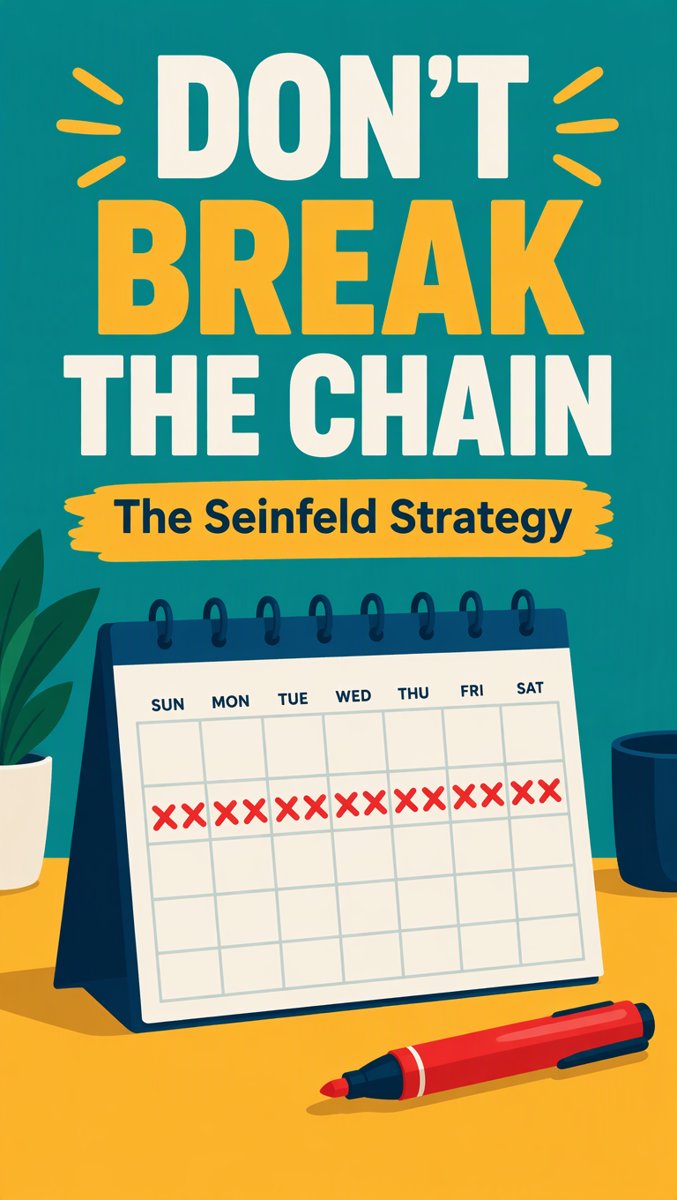
The Seinfeld Strategy is one of the simplest habits systems ever popularized. Pick ONE keystone behavior — writing, workouts, deep work, calls, anything. Do it every single day. Mark a big X on a physical calendar for each day you finish. After a few days, those X's connect into a visible chain. And here's the magic: once you see that chain, you no longer need motivation to continue. The chain itself motivates you. You protect it the way you'd protect a winning streak — because now losing it actually costs something.
As the legend goes, comedian Jerry Seinfeld explained his daily writing method to a young writer named Brad Isaac: get a big wall calendar with a whole year on one page, hang it where you can't miss it, and take a big red marker. Mark an X for every day you write. After a few days you'll have a chain — and soon, you will hate to break it. That simple frame is the whole system. No app, no subscription, no streak counter on your phone. Just paper, marker, and a chain.
How It Works
- Pick ONE keystone task. Not five. One. Seinfeld's was writing material. Yours might be ninety minutes of deep work, twenty sales calls, or a workout. The system collapses if you stack too many chains — choose the behavior that matters most.
- Put the calendar in plain sight. On the wall by your desk, on the bathroom mirror, inside the front door. The chain only works if you see yesterday's X before you excuse today.
- Mark a red X every day you finish. The marker is not decoration — a physical act of marking makes the win real. Digital streaks are easy to ignore; ink on paper is a commitment device.
- The chain becomes your scoreboard. Each new X raises the psychological price of skipping. Day twelve isn't just one missed day — it's the death of a twelve-day chain. That's why the system works: it turns a private decision into a public one, even if the only spectator is you.
The genius of this method is that it targets the input — showing up — not the output. You don't need a great writing day. You need a day where you wrote. The chain doesn't care about quality; it cares about showing up. And quality, as any practitioner will tell you, follows quantity like daylight follows dawn.
Real-World Proof
Seinfeld used the chain to sustain his daily writing practice for years. But the best evidence isn't the celebrity origin story — it's what ordinary people get when they run the system. On Reddit's r/writing, one writer reported using the physical calendar and marker method to go from about 600 words every three or four days to roughly 1,000 words almost every night. Same writer. Same talent. Same tools. The only change was a visible chain and the refusal to break it.
The same pattern shows up across the habit literature. James Clear, author of Atomic Habits, recommends the Seinfeld Strategy for beating procrastination — don't break the chain on your workouts, he advises, and you'll find yourself getting fit surprisingly fast. Todoist, Asian Efficiency, and countless Notion builders have adapted it for digital tracking, but they all keep the same spine: a daily mark, a visible streak, and a rule that protects the chain at all costs. Different tools, same engine.
How to Apply It Today
- Start before you're ready. Put your first X on the calendar today — not Monday, not tomorrow. The chain starts with one link, and the best day to start is the day you stop negotiating with yourself.
- Keep it tiny so you never miss. If your chain keeps breaking, the task is too big. Shrink it until it feels almost stupid — two minutes, one page, one call. A tiny win today keeps the chain alive; a perfect plan that never starts keeps nothing.
- Never miss twice. If you miss a day, that's life — mark it and restart the same day. One miss is an accident. Two misses in a row is a broken chain becoming a broken habit. The comeback is part of the system.
That's the whole playbook. No productivity guru, no $300 course, no twenty-app setup. One behavior, one calendar, one red marker, and a simple rule: don't break the chain.
The Takeaway
You don't need more motivation. Motivation is a mood; a chain is a fact. Build the chain day by day, protect it fiercely, and let the scoreboard do what pep talks never could. Jerry Seinfeld didn't become a writing machine because he was inspired every morning. He became one because there was an X waiting for him on the wall — and he refused to let that chain die.
Narration Script (~70s · Puck voice · 9:16)
Cover hook: "Jerry Seinfeld's productivity secret is one red marker and a chain you refuse to break."
Slide 1 — The Idea (2 clips):
- "The Seinfeld Strategy is dead simple. One keystone behavior, every single day."
- "Mark one big X on a calendar. The X's form a chain — and the chain becomes your motivation."
Slide 2 — How It Works (2 clips):
- "Step one: pick one task that matters. Step two: hang a full-year calendar where you'll see it."
- "Step three: a red X every day you finish. Step four: protect the chain like a winning streak."
Slide 3 — Real-World Proof (2 clips):
- "Seinfeld marked an X for every day he wrote. His chain built a daily writing habit that lasted years."
- "One Reddit writer went from 600 words every three days to a thousand words almost every night. Same talent — new chain."
Slide 4 — How to Apply It (2 clips):
- "Start today, not Monday. Keep the task tiny so you never miss. And if you miss—"
- "-mark it, restart the same day. Never miss twice. That's the whole rule."
Slide 5 — Takeaway (1 clip):
- "You don't need more motivation. You need a scoreboard you refuse to lose."
CTA outro (1 clip):
- "I'm Peter. If this helped you think sharper, hit subscribe and build your chain with us — one X at a time. See you tomorrow."
Total narration: ~165 words · ~70 seconds · 10 clips · 6 slides + CTA
Sources
- Lifehacker — "'Don't Break the Chain' to Build a New Habit" — https://lifehacker.com/jerry-seinfelds-productivity-secret-281626
- James Clear — "How to Stop Procrastinating on Your Goals by Using the 'Seinfeld Strategy'" — https://jamesclear.com/stop-procrastinating-seinfeld-strategy
- Asian Efficiency — "Don't Break the Chain: Complete Guide to Seinfeld's Method" — https://www.asianefficiency.com/productivity/dont-break-chain/
- Todoist — "Don't Break the Chain [Productivity Workflow Guide]" — https://www.todoist.com/inspiration/dont-break-the-chain
- Reddit r/writing — "How the 'Seinfeld Method' helped me go from 600 words every 3-4 days to 1000 almost every night" — https://www.reddit.com/r/writing/comments/wuyaf1/how_the_seinfeld_method_helped_me_go_from_600/
- YouTube, Develop Good Habits — "Jerry Seinfeld's Don't Break the Chain Method" — https://www.youtube.com/watch?v=DpOBvWw1oPg
- YouTube, David Perell — "Jerry Seinfeld says 'Don't Break The Chain!'" — https://www.youtube.com/watch?v=mVQ1bzd816I
— Peter, Business Development Manager @ NXagents.net