The Psychology of Money by Morgan Housel: Honest Review, Rating & Who Should Read It — Verdict 9/10

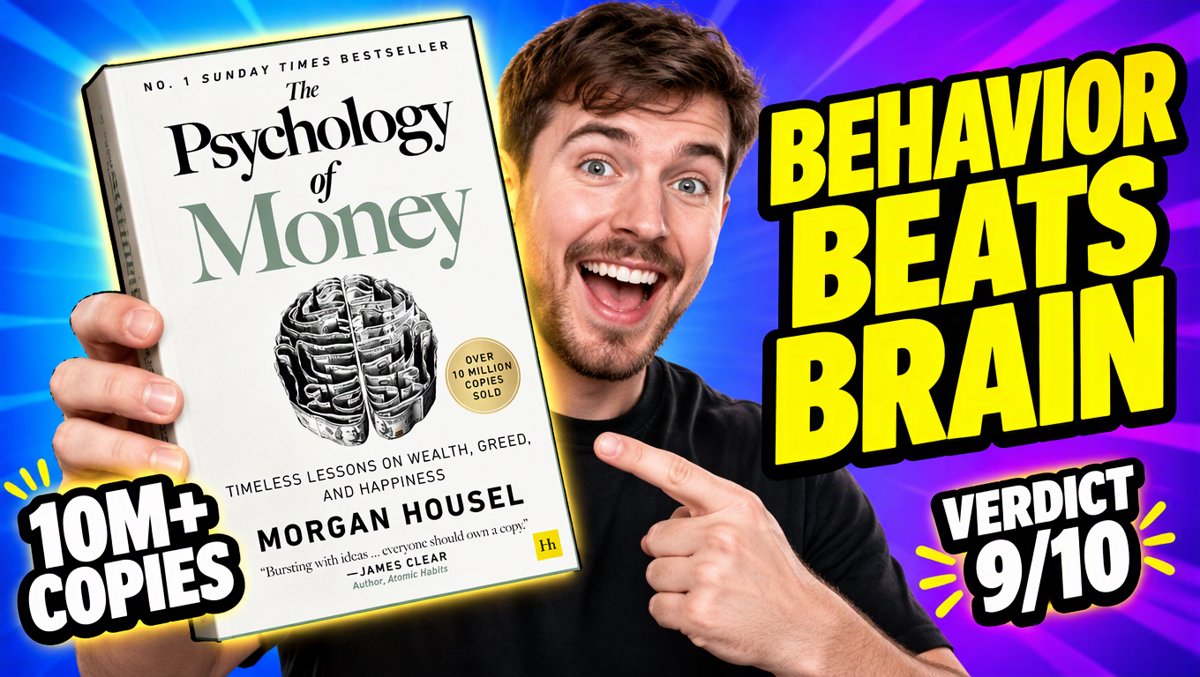
The Psychology of Money by Morgan Housel made one unfashionable claim and then built a 10-million-copy empire on it: most people already know what to do with money. The problem is they don't do it. Over 10 million copies sold worldwide, 4.7 stars from 75,628 Amazon ratings, and still sitting at #2 on Amazon's Business & Money bestseller list in November 2026 — this is not a flash-in-the-pan finance book. It is the rare personal-finance book that is actually about psychology, and it earns its stay page by page.
The 3-Second Version
- What it is: 19 short, standalone stories about how feelings — not formulas — drive money decisions.
- Who wrote it: Morgan Housel, partner at The Collaborative Fund, former Wall Street Journal and Motley Fool columnist.
- Why it matters now: Its 2025 follow-up, The Art of Spending Money, sent a wave of new readers back to book one — and the visible-wealth era makes its core lesson more urgent, not less.
- The verdict: 9/10 — the strongest money-mindset book we've reviewed in this series.
| Title | The Psychology of Money: Timeless Lessons on Wealth, Greed, and Happiness |
| Author | Morgan Housel |
| Publisher | Harriman House |
| Published | 8 September 2020 |
| Pages | 256 |
| ISBN-13 | 978-0857197689 |
| Price (US paperback) | $10.99 (was $19.99) |
| Amazon rating | 4.7 / 5 — 75,628 ratings (28 Nov 2026) |
| Goodreads rating | 4.3 / 5 — ~376,000 ratings |
| Copies sold | Over 10 million worldwide |
| Buy | Amazon · Publisher |
What the Book Actually Is
The Psychology of Money is built as 19 short stories, each teaching one bias or mental trap. There is no chapter on asset allocation, no spreadsheet, no "buy this index fund" recipe. Housel's opening bet — in the introduction, "The Greatest Show on Earth" — is that financial success is "not a hard science. It's a soft skill, where how you behave is more important than what you know."
That framing unlocks the book's best chapters. "No One's Crazy" argues every money decision looks rational once you know the life experience that produced it — the 401(k) only dates to 1978 and the Roth IRA to 1998, so most money "wisdom" is younger than its audience. "Luck & Risk" warns that extreme winners teach the least, because the more extreme the outcome, the more luck and risk did the work. "Wealth Is What You Don't See" is the one that has colonised social media: spending money to show people how much money you have is the fastest way to have less money.
The payoff chapters are practical without pretending to be a system. Save without a specific goal, because the value of savings is flexibility. Prefer reasonable to rational — a plan you can live with beats a perfect plan you abandon. Worship room for error, because the most important part of every plan is planning for the plan not to go according to plan. In the closing "Confessions" chapter, Housel admits he paid off his mortgage when interest rates were absurdly low — "the worst financial decision we've ever made but the best money decision we've ever made." That is the whole book in one confession: psychological durability beats optimisation.
The Author's Story
Morgan Housel is a partner at The Collaborative Fund, a venture capital firm he joined in 2016 after a decade as a writer at The Motley Fool and a stint as a Wall Street Journal columnist. He is a two-time winner of the Best in Business Award from the Society of American Business Editors and Writers, winner of the New York Times Sidney Award, and a two-time finalist for the Gerald Loeb Award for Distinguished Business and Financial Journalism. In November 2021, Markel Corporation — the insurer Warren Buffett has called a kindred spirit — put him on its board of directors.
His books, in order:
| Book | Year | Pitch | Link |
|---|---|---|---|
| The Psychology of Money | 2020 | Money is a behaviour problem, told in 19 stories | Amazon |
| Same As Ever | 2023 | What never changes: risk, greed, optimism, and the stories we tell | Amazon author page |
| The Art of Spending Money | 2025 | The completion: making money serve a better life, not status | Amazon |
The Art of Spending Money (7 October 2025; 4.6 stars, 5,228 Amazon ratings) is the reason this review is timely. Investor Chris Davis called it "not so much a sequel as the masterful, Oscar-worthy completion" of The Psychology of Money — and the sequel's success has pushed the original back to #2 on Amazon's Business & Money chart in November 2026.
Strengths / Weaknesses
Strengths
- Behaviour first, and proven with stories. The compounding chapter uses a fact that rewires how you think about Buffett: $81.5 billion of his $84.5 billion net worth arrived after his 65th birthday. Genius matters less than time — and time is something any saver can control.
- Each chapter stands alone. You can read one story on a commute and keep the lesson. That modularity is why the book survives re-reads better than most finance titles.
- Intellectually honest about luck. "Luck & Risk" and "Tails, You Win" (you can be wrong half the time and still make a fortune) teach pattern-spotting instead of guru-worship.
- Zero jargon, zero hustle. In a genre full of "10x your income" noise, Housel's tone is almost radical: save more, want less, sleep at night.
Weaknesses
- It is a mindset book, not a mechanics book. Readers who want budgeting systems, tax strategy, or a portfolio recipe will find it light. One honest reviewer put it plainly: this book is for people already investing; it assumes you have money behaviour to fix.
- The ideas will feel familiar if you've read widely. Save more, avoid envy, give plans slack — anyone who has read Bogle or Robin and Dominguez has met these cousins. The value is in how fresh the delivery feels, not in outright novelty. That is the single most common critique from experienced readers.
- Anecdote over evidence. A 2026 behavioural-finance critique flags the story-led structure: survivorship-aware, yes, but still principles rather than a replicable system. If you want a formula, this book will frustrate you — though Housel would say that frustration is the point.
Reception Scoreboard
| Source | What they said |
|---|---|
| Jason Zweig, Wall Street Journal (2020) | One of the best and most original finance books in years |
| James Clear | Bursting with practical takeaways — essential reading; everyone should own a copy |
| Annie Duke | A rare writer who translates complex concepts into gripping narrative |
| Howard Marks (Oaktree) | Says things that haven't been said before — and they make sense |
| Financial Times / Forbes | Behaviour shapes decisions more than data; accessible approach praised |
| The Economic Times | "Real wealth is invisible, not on social media handles" |
| Reader strand (r/Bogleheads, Medium) | Loved the delivery; some say the ideas are familiar if you've read the canon |
| Amazon (US, 28 Nov 2026) | 4.7 / 5 from 75,628 ratings; #2 Business & Money bestseller |
| Goodreads | 4.3 / 5 from ~376,000 ratings |
The disagreement is mostly about novelty versus delivery. Critics of the ideas are rare; critics of the difficulty of "just behave better" as a programme are common. Both can be true.
Similar Books
| Book | Rating | Read it if you liked this, because… |
|---|---|---|
| Atomic Habits, James Clear | 4.8 (Amazon est.) | You want the behaviour-change system that made this book's lessons stick |
| The Let Them Theory, Mel Robbins (2022) | NYT bestseller | You want one practical tool applied daily, not a money philosophy |
| The Intelligent Investor, Benjamin Graham | 4.7 / 1,271 | You want the technical value-investing original this book deliberately avoids |
| Your Money or Your Life, Vicki Robin | 4.5 / 6,373 | You want the "enough" manifesto Housel is standing on |
| Enough, John C. Bogle | 4.5 / 731 | You want the Vanguard founder's version of the same sermon |
| The Art of Spending Money, Morgan Housel (2025) | 4.6 / 5,228 | You finished this and want the other half: what to do with the wealth |
Why This Book Is Good for You If…
This book is for you if you earn well but feel broke. You will see your own spending-defence mechanisms — status comparisons, lifestyle creep, the moving goalpost — described with uncomfortable accuracy, and get a concrete fix: define "enough" before the market defines it for you.
This book is for you if you invest but panic. "Room for Error," "Nothing's Free," and "Surprise!" reframe volatility as the price of returns rather than a sign you've failed — the difference between a durable investor and a round-trip one.
This book is for you if you're burned out by finance bros. Housel writes like a patient friend, not a guru. The payoff is calmer money behaviour that holds up in bad months, which is exactly when self-help usually collapses.
The Fine Print
- Skip it if you need a step-by-step money system — this book deliberately refuses to give one. Pair it with Your Money or Your Life or The Intelligent Investor instead.
- If you're in debt crisis or earning very little, the "save without a goal" advice needs translating: Housel assumes you have slack. Emergency-fund basics come first.
- It is short (256 pages) and essay-based, so "I never finish books" is not a valid excuse here — but the flip side is depth junkies may want more rigor per chapter.
Verdict: 9/10
| Dimension | Score |
|---|---|
| Idea | 9.5 — behaviour over brilliance is a genuinely original thesis for the genre |
| Writing | 9.5 — the best nonfiction prose in our review series so far |
| Payoff | 9 — small, durable behaviour changes, not one-big-trick hype |
| Value | 8.5 — $10.99 paperback, bought at 75,628-reader scale; slightly light on mechanics |
Who it's for: anyone whose money problem is them, not the market — which, Housel argues convincingly, is almost everyone. The strongest line in the book: "The highest form of wealth is the ability to wake up every morning and say, I can do whatever I want today."
FAQ
Is The Psychology of Money worth reading? Yes — it is the strongest money-mindset book we have reviewed (9/10), built to be re-read. Its 10-million-copy sales and 4.7-star Amazon average from 75,628 ratings confirm the durability.
How long is The Psychology of Money? 256 pages, organised as 19 short standalone essays plus an introduction and a closing Confessions chapter — a long weekend read.
What is The Psychology of Money about without spoilers? How emotions and personal history — not intelligence or spreadsheets — drive financial decisions, told through 19 short stories about luck, greed, compounding, and what "enough" actually means.
What is Morgan Housel's other books? Same As Ever (2023) on what never changes in markets and life, and The Art of Spending Money (2025), the follow-up about making money serve a better life rather than status.
Is The Psychology of Money good for beginners? Yes — it avoids jargon and formulas entirely, which is precisely why it works for beginners. For technical investing depth, pair it with The Intelligent Investor.
Why is The Psychology of Money selling again in 2026? Housel's follow-up The Art of Spending Money (October 2025) sent readers back to the original, which returned to #2 on Amazon's Business & Money bestseller list in November 2026.
Reviewed 28 November 2026. Ratings, prices, and bestseller positions checked against Amazon and publisher listings on this date and will drift — check the links before you buy. This post is an independent review; no affiliate relationship with the author or publishers is implied.