The Protégé Effect: The One-Sentence Mindset Switch That Makes Studying Stick

The Protégé Effect: The One-Sentence Mindset Switch That Makes Studying Stick
Think and Growth · Daily Mental Model #129 · Tuesday, October 6, 2026 · Theme: School — learning fast, study systems
Most people treat studying as a solo negotiation: me, the textbook, and Friday's exam. You reread. You highlight. You hope. And two weeks later it's gone — because rereading is recognition, not learning.
There is a cheaper, stranger fix. One sentence, said before you study: "I'm teaching this to someone tomorrow."
That's the Protégé Effect — and the remarkable part is that the student never has to actually teach anyone.
The Idea
The Protégé Effect says: expecting to teach changes how you study — even if you never teach.
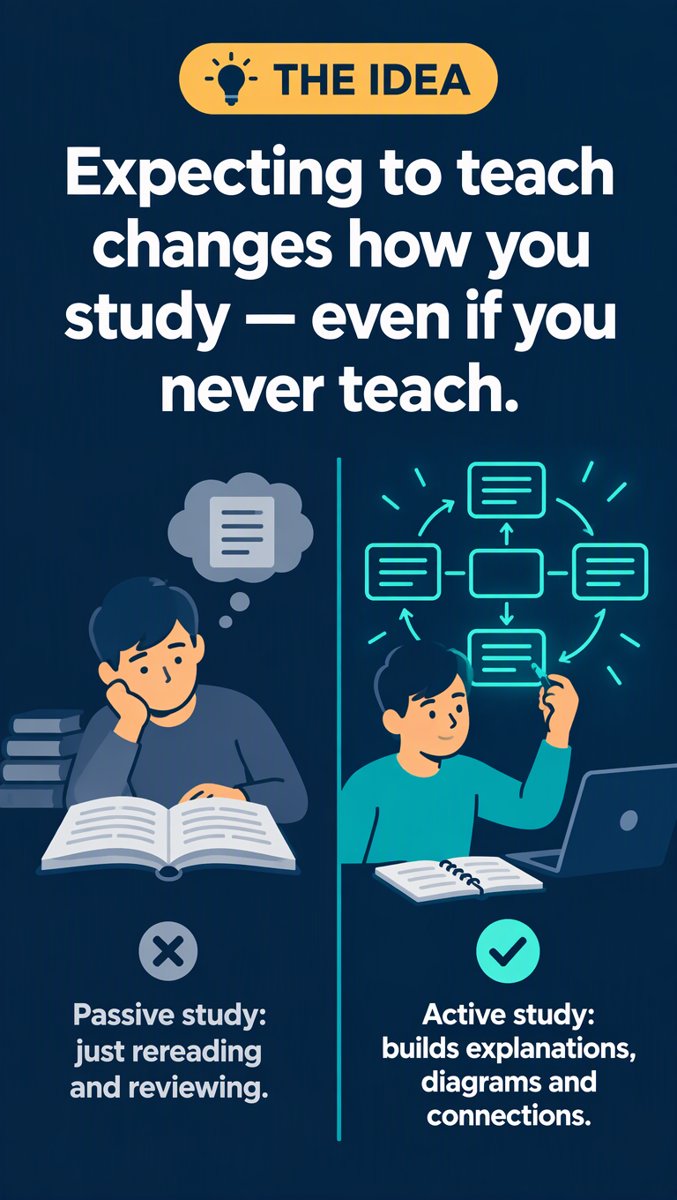
When you study for a test, your brain optimizes for recognition: which answer looks familiar? When you study to explain to another human, your brain has to do something harder and better: find the key points, order them, and make them survive being spoken out loud. The same textbook, the same hour — but the frame you set before you start decides which machinery gets used.
How It Works
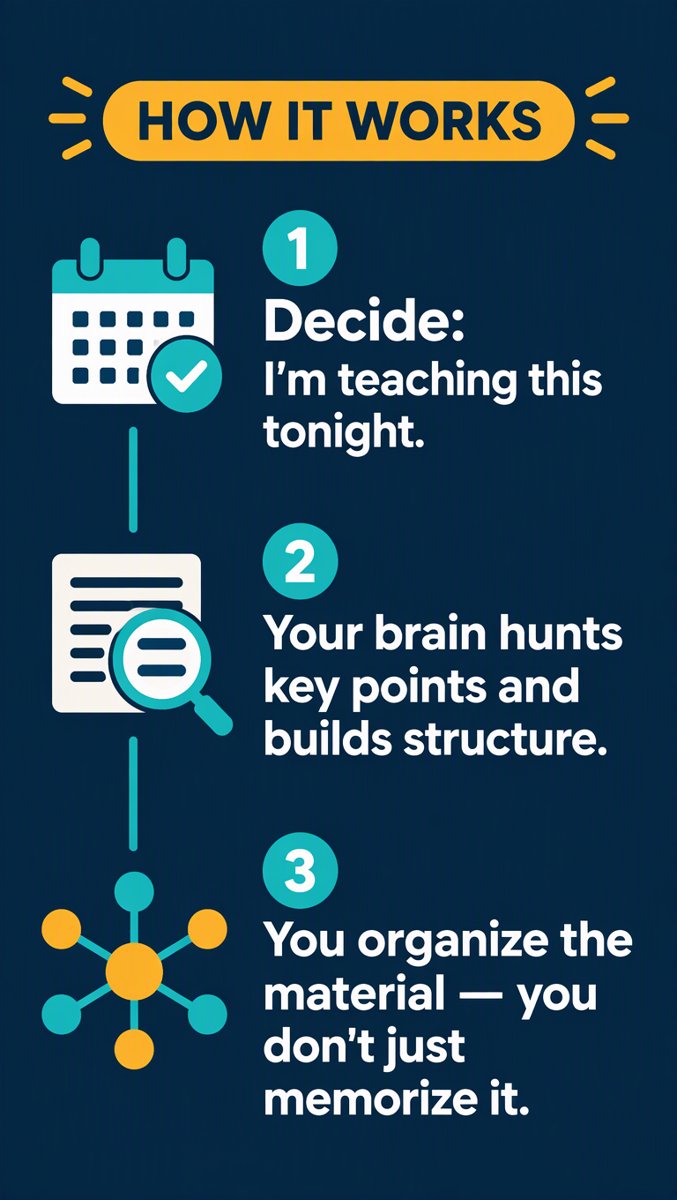
- Decide: "I'm teaching this tonight." One sentence, written down, before you open the book.
- Your brain shifts modes. It starts hunting for key points instead of drifting through paragraphs — the way teachers always have.
- You organize instead of memorize. Material gets built into a structure you can explain, and structures are what survive the forgetting curve.
The magic is that none of this requires a student. The expectation alone triggers the strategy.
The Proof
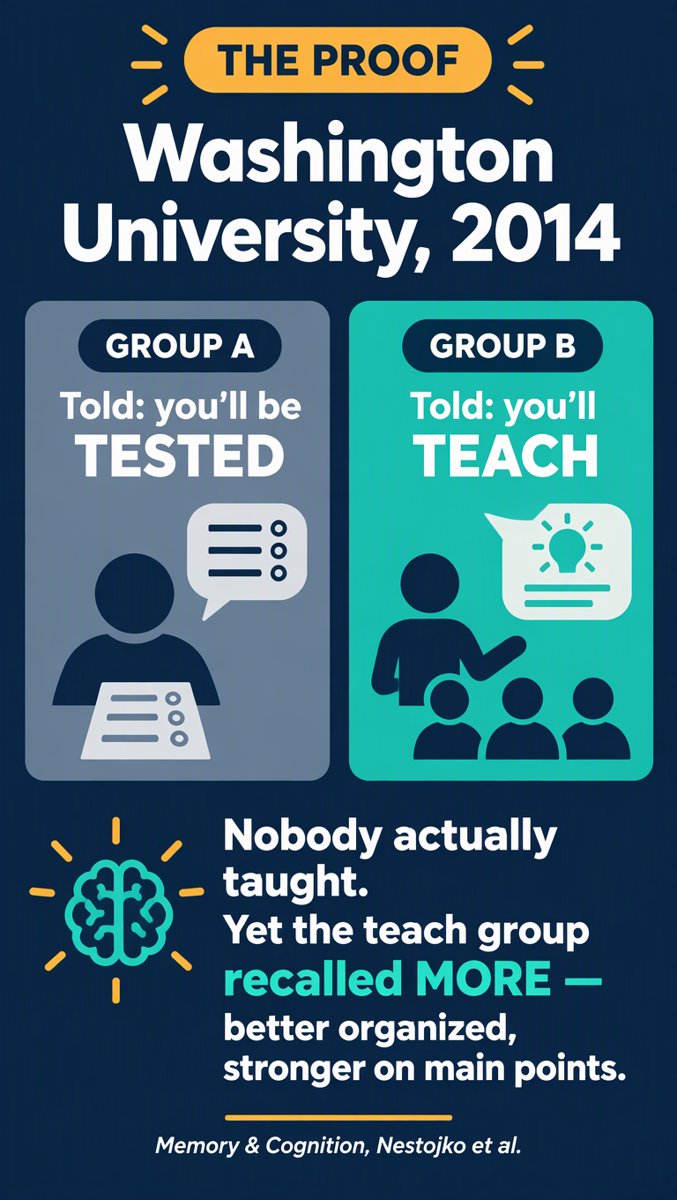
In a 2014 study published in Memory & Cognition, researchers at Washington University in St. Louis — John Nestojko, D.C. Bui, Nicholas Kornell, and UCLA's Elizabeth Bjork — ran a series of reading-and-recall experiments. One group was told they'd be tested on a passage. Another was told they'd teach the passage to another student. (Springer; ScienceDaily)
Then came the twist: everyone was tested, and nobody ever taught.
Even so, the expecting-to-teach group recalled more material correctly, organized their recall more effectively, and had better memory for the important information — especially main points. As Nestojko put it: "When teachers prepare to teach, they tend to seek out key points and organize information into a coherent structure... students also turn to these types of effective learning strategies when they expect to teach." The most striking detail: learning changed even though "we did nothing more than alter participants' expectations prior to learning."
Co-author Elizabeth Bjork added the part that should sting a little: effective strategies are already "in their toolbox" — students just don't pick them when told to prepare for a test. The expectation is what pulls them out.
How to Apply It
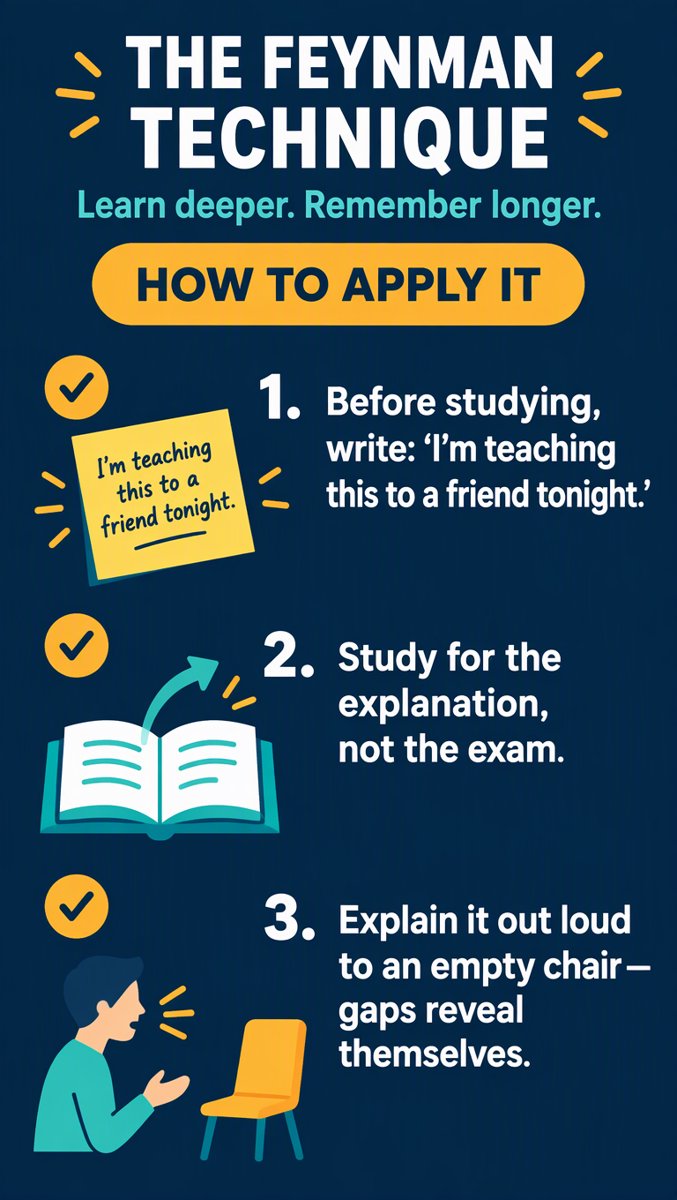
- Set the frame first. Before studying, write: "I'm teaching this to a friend tonight." Thirty seconds, zero cost.
- Study for the explanation, not the exam. Read like someone will ask you "so what's the main point?" — because in this frame, someone will.
- Close the loop out loud. Afterward, explain it to an empty chair (or a voice memo, or a teammate). Every stumble you hear is your review list, auto-generated.
Works for exam prep, new-job onboarding, sales enablement — anywhere you need knowledge to survive contact with Monday.
The Takeaway

The fastest way to keep a thing is to expect to give it away.
🎬 Narration Script (~70–75s, 175 written words)
[Cover] Here's the cheapest learning upgrade you'll ever get: decide tonight — you're teaching this tomorrow. (15w)
[Slide 1 — The Idea] Researchers call it the Protégé Effect. (6w) Just expecting to teach changes how you study — even if you never teach. (13w)
[Slide 2 — Mechanism] Set one intention: tonight, I'm teaching this. Instantly your brain hunts for key points. (14w) Instead of memorizing lines, you start organizing ideas into a structure you can explain. (14w)
[Slide 3 — Proof] Washington University, 2014. One group studied for a test. One group expected to teach. (13w) Nobody taught — yet that group recalled more, organized better, and nailed the main points. (14w)
[Slide 4 — Apply] Tonight, write: "I'm teaching this to a friend." Then study for the explanation. (13w) Finally, explain it aloud to an empty chair. Every stumble shows what to review. (13w)
[Slide 5 — Takeaway] Because the fastest way to keep a thing is to expect to give it away. (13w)
[CTA] If this shifted how you'll study tonight, follow Think and Growth — one mental model every morning, and I'll see you tomorrow. (22w)
Sources
- Nestojko, J.F., Bui, D.C., Kornell, N., & Bjork, E.L. (2014). Expecting to teach enhances learning and organization of knowledge in free recall of text passages. Memory & Cognition, 42, 1038–1048. https://link.springer.com/article/10.3758/s13421-014-0416-z
- Washington University in St. Louis via ScienceDaily, "Expecting to teach enhances learning, recall" (Aug 10, 2014): https://www.sciencedaily.com/releases/2014/08/140808163445.htm
- WashU The Source, "Expecting to teach enhances learning, recall": https://source.washu.edu/2014/07/expecting-to-teach-enhances-learning-recall/
- Supplementary explainer: Accenture "Teach to Learn: The Protégé Effect" — https://www.youtube.com/watch?v=V6FnfEe5TGE