
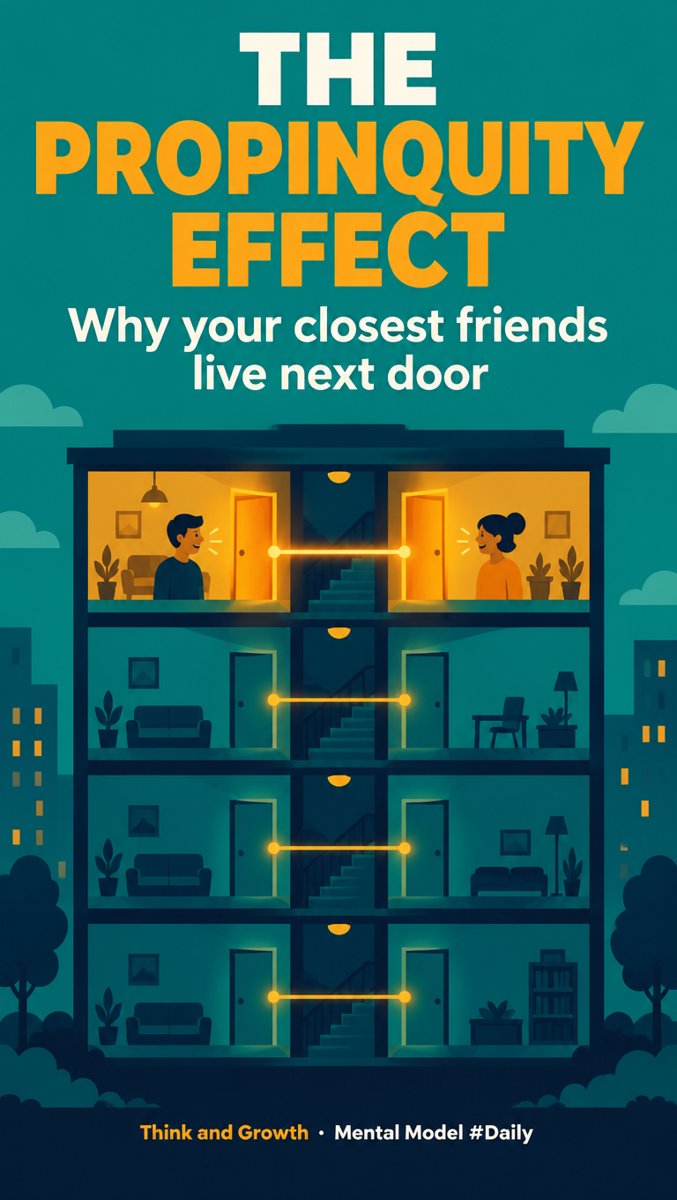
The Propinquity Effect: Why Your Closest Friends Live Next Door
Think and Growth · Saturday theme: Friendship — connection & loyalty · October 17, 2026
Quick exercise: picture your five closest friends. Now picture where they lived when you met them. For most people, the honest answer is "near me." Same dorm. Same neighborhood. Same office floor. Same gym.
That's not a coincidence, and it's not laziness on your part. It's one of the most reliably replicated findings in all of friendship research, and it has a name: the propinquity effect. Propinquity is just a fancy word for nearness — and nearness, it turns out, does more heavy lifting in friendship than personality, values, or "chemistry" ever will.
The study that mapped friendship with a floor plan
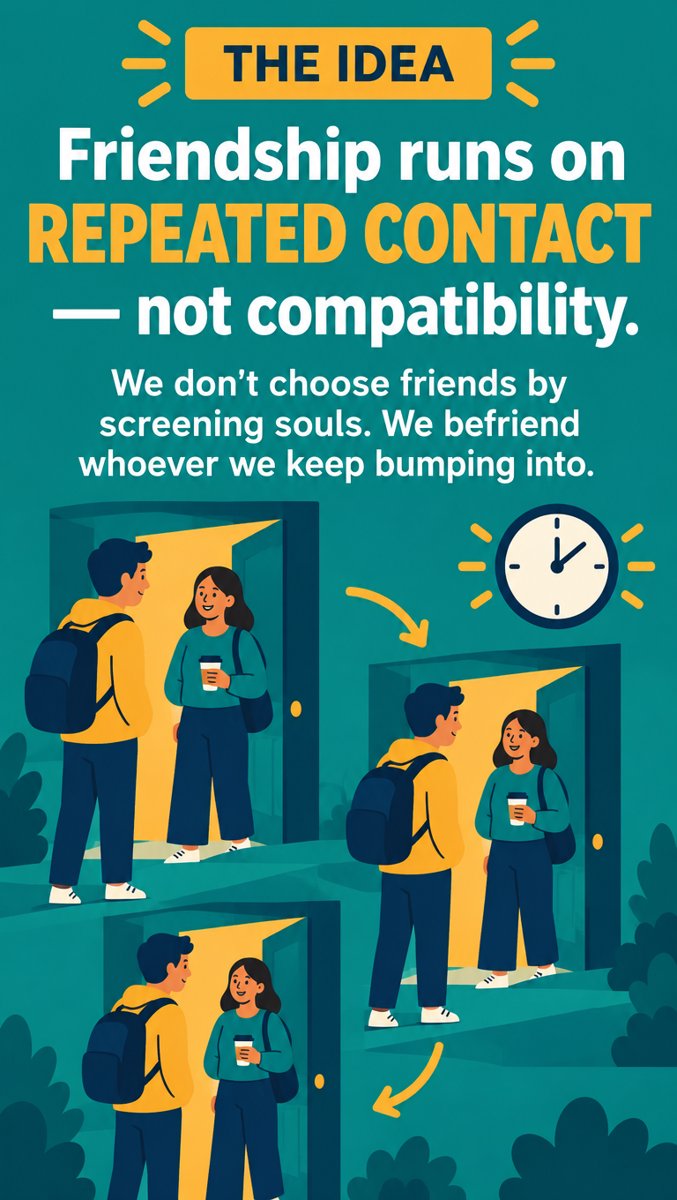
In 1950, social psychologists Leon Festinger, Stanley Schachter, and Kurt Back ran a field study in Westgate West — a complex of seventeen two-story buildings at MIT housing roughly 260 married student veterans and their families. These were men recently returned from World War II, randomly assigned to apartments, all starting fresh in a new place at the same time. If ever there were a natural laboratory for friendship, this was it.
The researchers asked residents to name their three closest friends in the complex. The results were almost embarrassingly predictable — predictable by address:
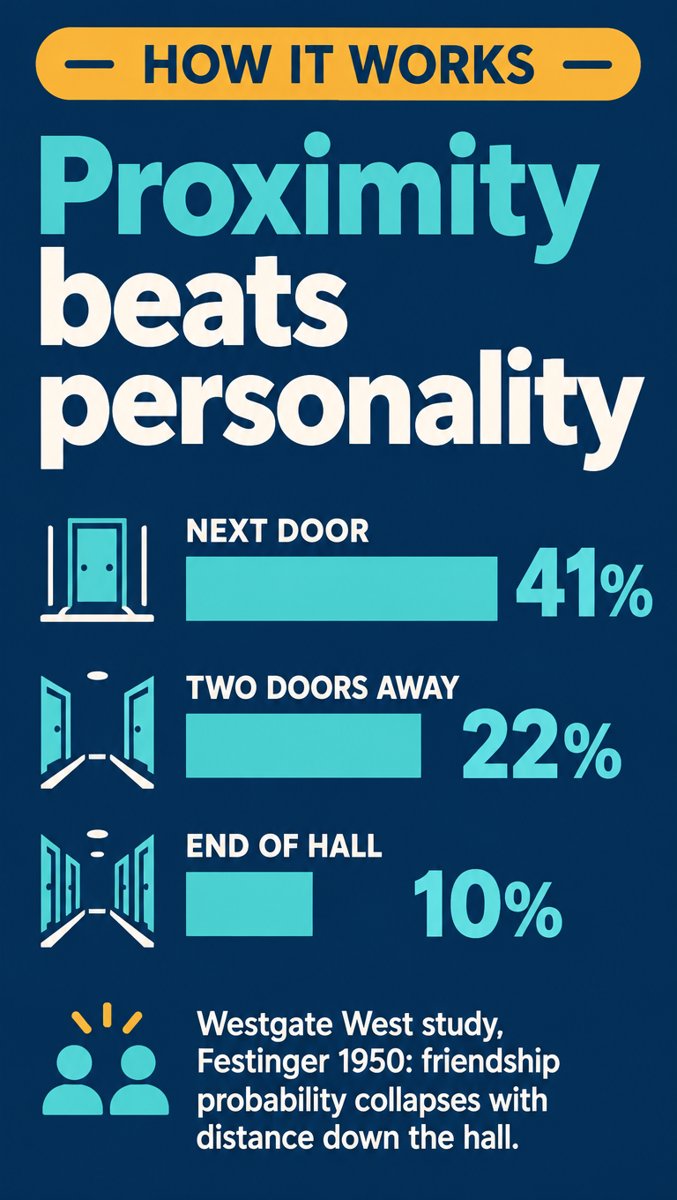
- 41% of residents named their next-door neighbor as a close friend
- 22% named someone living two doors away
- Just 10% named someone at the opposite end of the hall
Twenty feet of hallway nearly quadrupled the odds of friendship. And remember — nobody chose their apartment based on who seemed compatible. The assignments were administrative. The friendship map was drawn by the floor plan.
These were people who shared values (veterans, students, young families), similar life stages, and similar pressures. By every compatibility metric, anyone in the complex should have been fair game as a friend. Instead, two-thirds of all named friends lived in the same building, and the biggest single predictor was literally the number of doors between them.
Functional distance: architecture as a social engineer
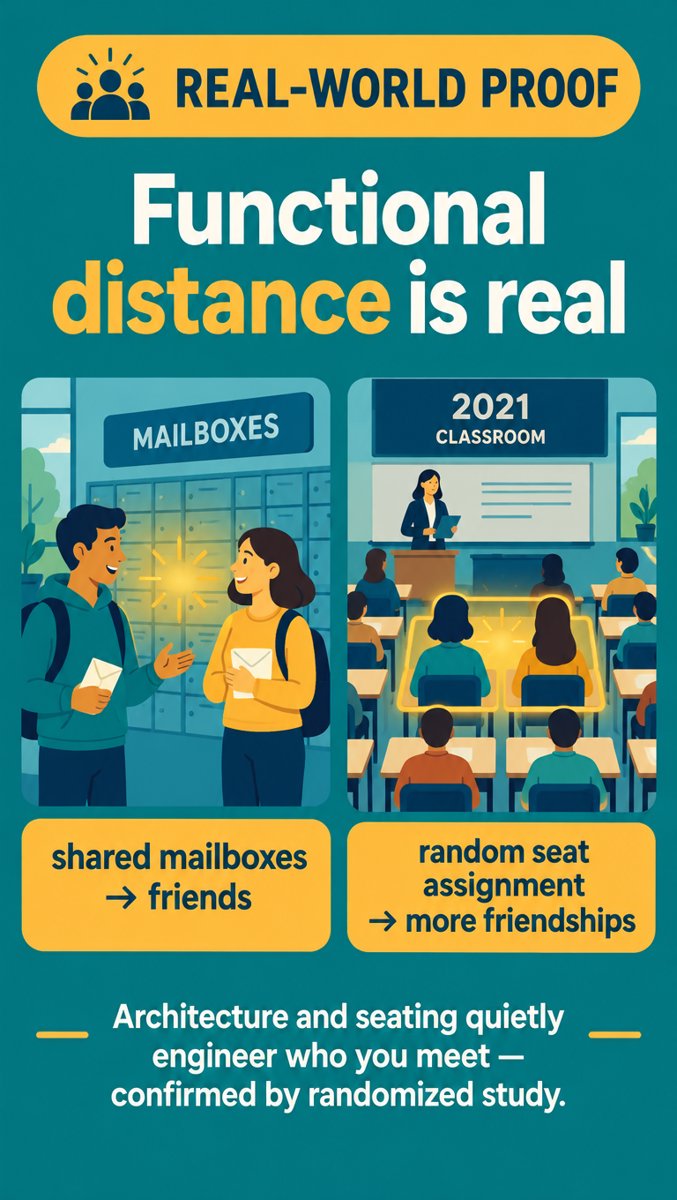
Here's where Festinger's team got subtle. Physical distance wasn't the real variable — functional distance was. The buildings' front staircases each served two apartments, so the families who shared a staircase passed each other constantly. Mailboxes were grouped in ways that made some neighbors cross paths every single day while others practically never did.
The neighbors whose daily routines forced low-effort contact — the shared staircase, the shared mailboxes — became friends at strikingly higher rates. The architecture, designed with zero social intent, quietly engineered the social graph. Nobody decided anything. The staircases decided.
And this wasn't a one-off from 1950. A large randomized study published in 2021 (PNAS) essentially re-ran the experiment in modern classrooms: researchers assigned students to seats, then measured friendship formation. Sitting next to someone significantly increased the probability of becoming mutual friends. When proximity is assigned randomly, friendship follows. That's not just correlation — that's contact causing connection.
Why it works: friction and familiarity
Two mechanisms drive the propinquity effect:
- Mere exposure. Decades of psychology — Zajonc's work onward — show that repeated exposure to almost anything, including a person, increases liking. Familiarity doesn't breed contempt nearly as often as it breeds comfort.
- Low friction. Friendship requires interactions, and interactions require opportunity. The person across the hall costs you ten seconds of hallway chat. The person across town costs you a plan, a commute, and a calendar slot. Most potential friendships don't die from rejection — they die from scheduling friction.
The catch: proximity cuts both ways
Honesty requires the fine print. The same mechanism that builds friendships builds rivalries — the Westgate researchers found close neighbors also reported more disliking of neighbors. Repeated contact amplifies whatever is already there. Propinquity is an amplifier, not a guarantee. It puts you in the game; it doesn't fix your follow-through. And proximity alone won't turn a routine exchange into a relationship — it just makes the thousands of tiny openings possible. You still have to take a few of them.
How to apply it: engineer your proximity
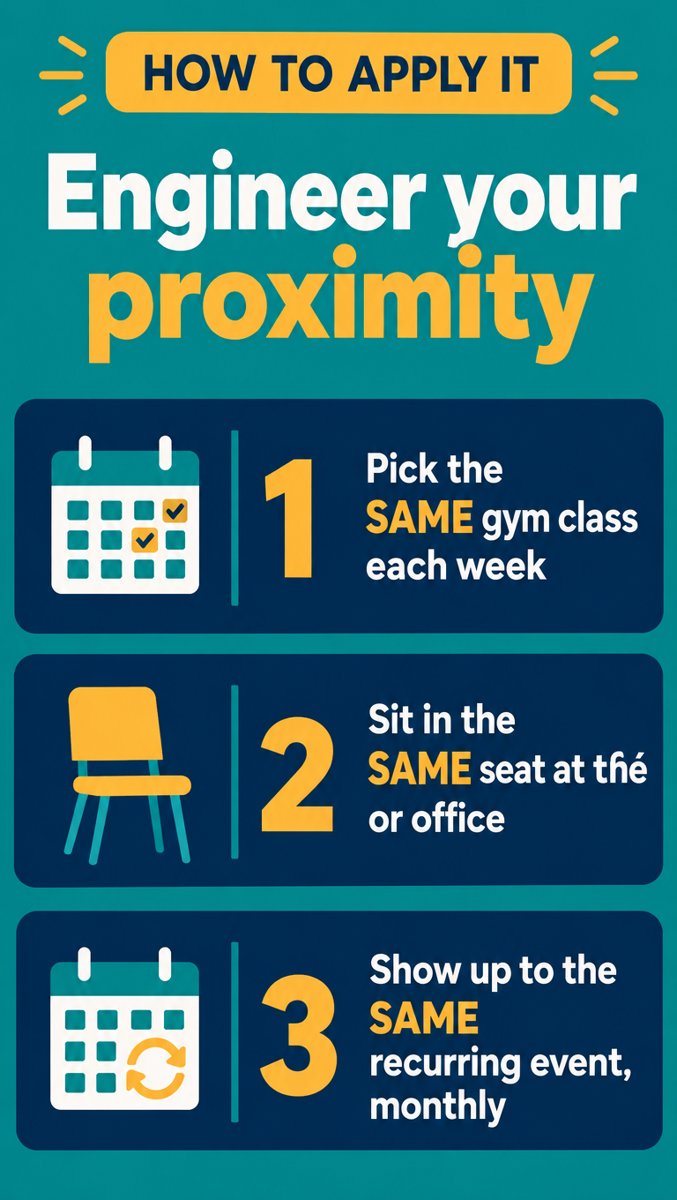
You can't rely on your floor plan anymore — remote work, moving cities, and adult schedules have all flattened natural propinquity. So rebuild it deliberately:
- Pick the same gym class, coffee shop hour, or coworking spot each week. Same time, same place. Repetition is the active ingredient.
- Take the same seat. At the office, the café, the recurring meeting. Fixed positions create fixed encounters with the same faces.
- Commit to one recurring event per month — a run club, a hobby night, a standing dinner. Show up before you feel like it. Familiarity does the rest.
The goal isn't to force intimacy. It's to maximize harmless, repeated, low-stakes contact with the same people until familiarity turns into friendliness.
The takeaway
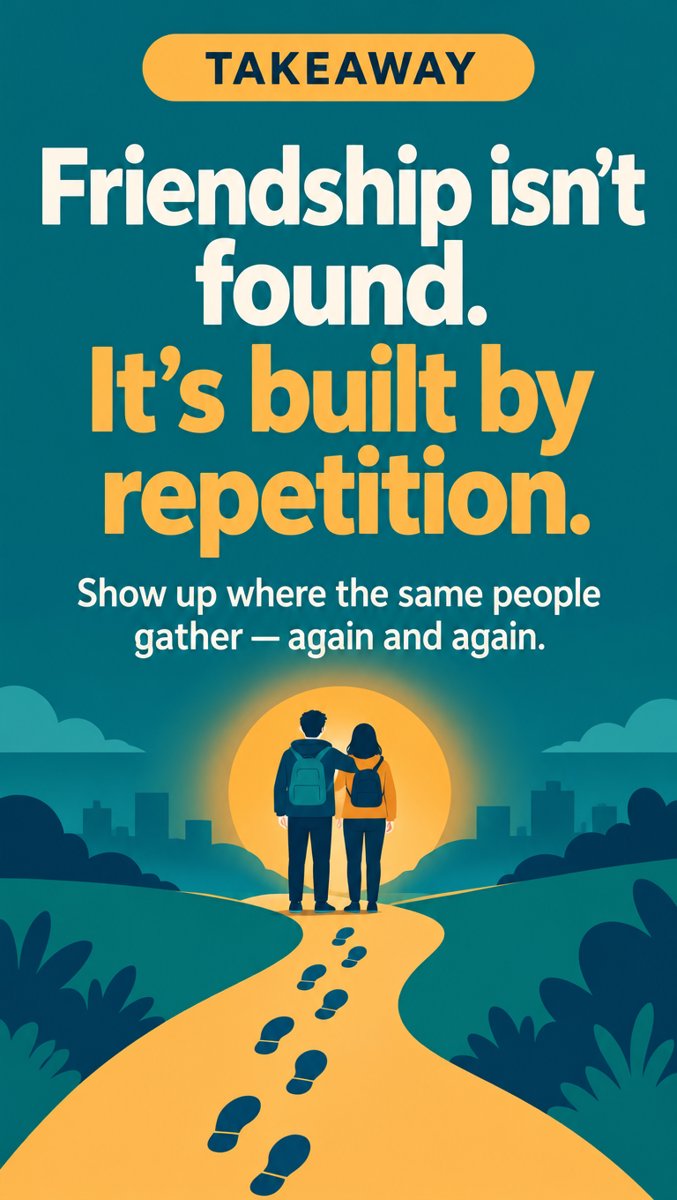
Friendship isn't found. It's built by repetition. Stop searching for the perfect people and start showing up where the same people gather — again and again — and let the oldest law of connection do its quiet work.
Sources
- Festinger, L., Schachter, S., & Back, K. (1950). Social Pressures in Informal Groups: A Study of Human Factors in Housing (Westgate West study) — study summary: http://mralvarezclass.weebly.com/uploads/3/8/0/1/38017881/festinger.pdf ; 41%/22%/10% figures: https://quizlet.com/60376819/social-psych-quiz-1011-13-flash-cards/ and https://www.studocu.com/en-gb/document/university-of-southampton/social-psychology/interpersonal-attraction-chapter-10/15137817
- Proximity principle overview: https://en.wikipedia.org/wiki/Proximity_principle ; https://www.verywellmind.com/what-is-the-proximity-principle-in-psychology-5195099
- Böhm et al. (2021), "Proximity can induce diverse friendships: A large randomized study," PNAS: https://pmc.ncbi.nlm.nih.gov/articles/PMC8357142/
- Adult friendship research (propinquity as most-replicated finding): https://www.simplypsychology.com/articles/adult-friendships-research
- Mere exposure mechanism: https://www.khanacademy.org/test-prep/mcat/individuals-and-society/social-behavior/v/proximity-and-the-mere-exposure-effect
Narration Script (144 words → ~60-70s at measured TTS)
[Cover — hook] Look at your five closest friends. Most of them probably live nearby. That's not luck.
[Slide 1 — the idea] Psychologists call it the propinquity effect. In 1950, Festinger studied married students at MIT's Westgate West housing. Friendship wasn't predicted by personality. It was predicted by geography.
[Slide 2 — mechanism] Next-door neighbors: forty-one percent became close friends. Two doors away: twenty-two percent. Opposite ends of the hall: just ten. The reason is repeated contact. Familiarity builds liking.
[Slide 3 — example] Researchers call it functional distance — the stairs you climb, the mailbox you share. Decades later, a randomized study confirmed it: assigned seating measurably shaped who became friends.
[Slide 4 — apply] So engineer your proximity. Pick the same gym class. Sit in the same seat. Show up to the same recurring event. Familiarity does the rest.
[Slide 5 — takeaway] Because friendship isn't found. It's built by repetition.
[CTA] That's today's mental model. Follow Think and Growth — one idea a day to grow sharper.
Per-Segment Clip Map (12 clips)
| # | Image | Motion | Words | Segment |
|---|---|---|---|---|
| 1 | cover | none | 15 | hook |
| 2 | slide-1 | none | 6 | "Psychologists call it…" |
| 3 | slide-1 | none | 11 | "In 1950, Festinger studied…" |
| 4 | slide-1 | none | 10 | "Friendship wasn't predicted by personality…" |
| 5 | slide-2 | none | 12 | "Next-door neighbors: 41%…" |
| 6 | slide-2 | none | 15 | "Opposite ends of the hall…" |
| 7 | slide-3 | none | 13 | "functional distance…" |
| 8 | slide-3 | none | 14 | "randomized study confirmed…" |
| 9 | slide-4 | none | 14 | "engineer your proximity…" |
| 10 | slide-4 | none | 11 | "Show up to the same recurring event…" |
| 11 | slide-5 | none | 8 | takeaway line |
| 12 | cta | fade_out | 15 | subscribe ask |
All clips ≤15 words / ≤6s. Total 144 words. ≤20 clips ✅. Subtitle checklist: every clip subtitle: "none" ✅. Motion checklist: content clips motion: "none", CTA only fade_out ✅.