The Pratfall Effect: Why Being Too Perfect Makes People Keep Their Distance

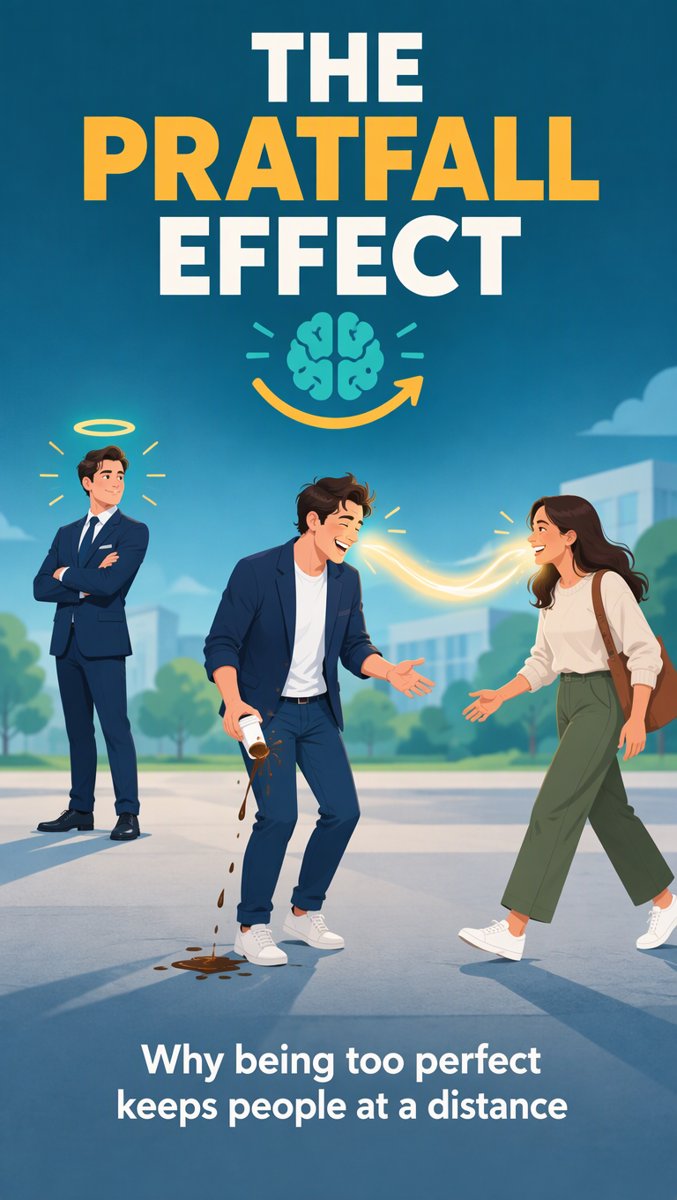
The Pratfall Effect: Why Being Too Perfect Makes People Keep Their Distance
Theme: Saturday — Friendship (connection, loyalty) -Carlo Peter, Think and Growth — Saturday, November 28, 2026 Listen time: ~70 seconds
You already know someone like this. The person who never stumbles, never spills the coffee, never forgets a name, always has the polished answer ready. People admire them from across the room. They rarely know them. That distance isn't an accident — it's psychology. In 1966, social psychologist Elliot Aronson ran one of the cleanest experiments in the science of likability, and it produced a finding that's been repeated ever since: when a highly competent person makes a small, human mistake, people don't like them less. They like them more. That's the pratfall effect — and on a Saturday devoted to friendship, it's the most practical mental model you can carry into your next conversation.
The Core Principle
Here is the definition to memorize. The pratfall effect is the tendency for a person's likability to increase after a small blunder, but only when that person is already perceived as highly competent. A flaw lands completely differently depending on who's making it. For someone the group already reads as superhuman, the slip makes them human and approachable. For someone whose competence is still unproven, the exact same slip confirms the doubt. Competence earns the right to be imperfect; imperfection, spent at the right moment, converts admiration into connection.
Aronson's original intuition was that "superior" people get held at arm's length because they feel unreachable. A small pratfall — spilling coffee, fumbling a demonstration, laughing at your own typo — does something no polished performance can: it lets the other person exhale. They stop performing and start relating. ReachLink's synthesis of the research puts the practical rule in one line: share the small stuff once you have proven the big stuff. Your imperfections make you more likable only when people already believe in your abilities.
How It Works — Three Links in the Chain
-
The competence baseline. Before any flaw can work for you, people need evidence that you're good at what you do. That evidence can be a track record, a calm answer under pressure, or simply doing the core job well in front of them. The baseline is non-negotiable — it's the license everything else spends.
-
The humanizing slip. The mistake has to be small, visible, and real: the spilled coffee, the anecdote about the presentation that went sideways, the honest "I burned the toast again." A pratfall is a garnish, not a meal. It signals, this person is on my level — because nobody is actually superhuman.
-
The connection dividend. The slip triggers a quiet reset in the other person. Threat regulation drops, guardedness drops, and the relationship moves from evaluating you to connecting with you. Forbes' recent review of the effect notes the mirror-image warning: it stains your reputation if you're otherwise exhibiting self-doubting behavior. The flaw must read as a moment, never as a pattern. One human moment after proven competence says "real." A stream of apologies says "unreliable."
The pratfall effect doesn't replace competence. It converts competence into closeness — and closeness is what friendship is actually made of.
The Real-World Example
Aronson's 1966 study, summarized across the literature, compared candidates who were presented as brilliant, average, or suspiciously perfect, then gave each a small humanizing error. The brilliant candidate who fumbled became the most liked of the group. The flawless competitor stayed admired and distant. Later replications — including the version popularized in today's explainer videos, where a Harvard cafeteria demonstration turns a spilled coffee into higher likability ratings — have held up the same asymmetry: the mistake improved the strong candidate and hurt the average one. Same slip, opposite outcomes. The variable was never the mistake. It was the competence people saw before the mistake.
How to Apply It — This Week
Step one: bank one proof point. Before you deploy any vulnerability, put one visible win on the board — deliver the hard thing, answer the tough question, show up prepared. That's your baseline. Everything you do next is spent against it.
Step two: let one small, real flaw show. Own the burnt toast. Tell the story of the meeting where you lost your notes. Laugh at yourself first. Small, real-time, and yours — never manufactured, never a confession about something that actually matters to your credibility.
Step three: watch for the exhale. After the slip, notice what changes. Shoulders drop. The other person volunteers something of their own. That's the effect working — the conversation just moved from performance to connection. Your job is to let it stay there: ask the follow-up question, be curious about them, and let the friendship do the rest.
The Takeaway
Perfection earns respect at a distance. A small, honest flaw — offered after you've proven you can do the work — is what turns respected into liked. For friends, for clients, for every room you want to belong in: stop sanding off every rough edge. Competence gets you admired. One human moment gets you invited in.
🎙️ Narration Script (~70s)
You're perfect at everything — and that's exactly why nobody feels close to you. In 1966, psychologist Elliot Aronson proved something backwards: when a highly competent person makes a small mistake, people like them more, not less. Spill the coffee, fumble the demo, laugh at your own typo — suddenly you're human, and the room relaxes. Here's the catch: the same slip hurts someone whose competence isn't proven yet. Flaws only pay off after you've earned trust. So bank one win, let one small flaw show, and watch the conversation shift from performance to connection. Perfection earns respect at a distance. One honest moment gets you invited in. I'm Peter — follow Think and Growth for the next model.
Per-slide segment text:
| Slide | Card | Segments |
|---|---|---|
| Cover | The Pratfall Effect — Why being too perfect keeps people at a distance (Friendship theme) | "You're perfect at everything — and that's exactly why nobody feels close to you." (13w) |
| Slide 1 | The Idea — A small mistake makes a competent person MORE likable, not less. (Aronson, 1966) | "In 1966, psychologist Elliot Aronson proved something backwards: when a highly competent person makes a small mistake, people like them more, not less." (24w → split 2) |
| Slide 2 | How It Works — 1) Prove competence 2) Let a small flaw show 3) Competence converts into connection | "Spill the coffee, fumble the demo, laugh at your own typo — suddenly you're human, and the room relaxes." (18w → split 2) |
| Slide 3 | The Real-World Example — Brilliant candidate fumbles → most liked. Flawless candidate → admired, distant. Same slip, opposite outcome. | "Here's the catch: the same slip hurts someone whose competence isn't proven yet. Flaws only pay off after you've earned trust." (22w → split 2) |
| Slide 4 | How to Apply It — 1) Bank one proof point 2) Let one small flaw show 3) Watch for the exhale | "So bank one win, let one small flaw show, and watch the conversation shift from performance to connection." (18w → split 2) |
| Slide 5 | Takeaway — Perfection earns respect at a distance. One honest moment gets you invited in. | "Perfection earns respect at a distance. One honest moment gets you invited in." (13w) |
| CTA | Peter outro — Think and Growth branding, no button | "I'm Peter — follow Think and Growth for the next model." (10w) |
Sources
- Wikipedia — Pratfall effect (Aronson 1966; competence-conditional likability shift): https://en.wikipedia.org/wiki/Pratfall_effect
- Forbes (Travers, 2025) — The Pratfall Effect: Why Your Mistakes Make You More Likable: https://www.forbes.com/sites/traversmark/2025/12/23/the-pratfall-effect---why-your-mistakes-make-you-more-likable/
- ReachLink — Why Showing Your Flaws Makes You More Likeable (competence-first practical rule): https://www.reachlink.com/advice/attraction/why-showing-your-flaws-makes-you-more-likeable/
- YouTube — ThoughtTonic, The Pratfall Effect: Why Mistakes Make You Likable (2026-11-13): https://www.youtube.com/watch?v=vuw3vIwDo5Y
Tags: mental_model, growth, friendship, pratfall-effect, likability, social-psychology, think-and-growth, video
Word count: ~850 reading words + narration script