The Physiological Sigh: Two Inhales, One Long Exhale — Your Body's Built-In Calm Button

The Physiological Sigh: Two Inhales, One Long Exhale — Your Body's Built-In Calm Button
Think and Growth — Episode #68 · Theme: Mental Health (resilience, focus, clarity)
Stress hits. You need calm in seconds. Your body has a built-in tool — and it takes about thirty seconds to use.
What Is the Physiological Sigh?
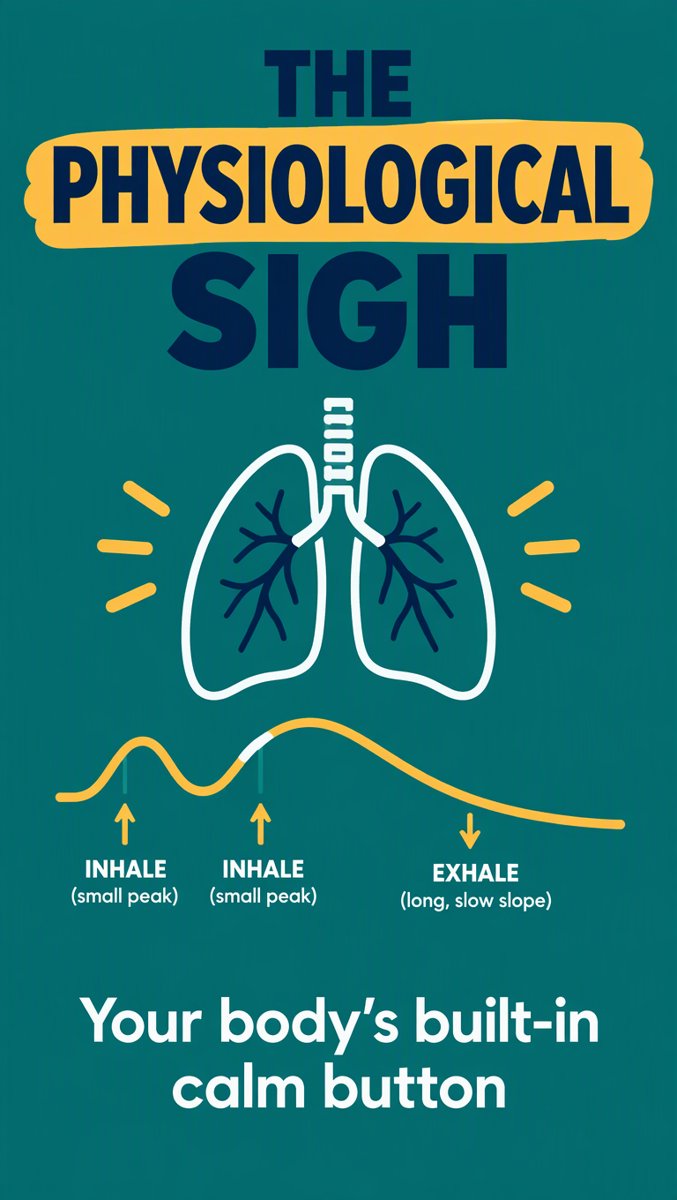
The physiological sigh (also called cyclic sighing, when repeated in a cycle) is the fastest known breathing pattern for moving your body out of stress mode:
- Inhale through your nose until your lungs feel comfortably full.
- Take one more quick "sip" of air on top of that first inhale.
- Exhale slowly through your mouth until all the air is gone.
One or two of these sighs can already take the edge off. Repeated for about five minutes, it becomes a full reset — what Stanford researchers call cyclic sighing.
Why It Works: The Mechanism
The second inhale isn't decoration — it's the engineering trick. As you go through a normal day, some of the tiny air sacs in your lungs (alveoli) slowly deflate and collapse. That top-up sip of air pops them back open, which lets your body offload carbon dioxide far more efficiently.
Then the magic happens on the way out. The long, slow exhale activates your parasympathetic nervous system — the "rest and digest" branch — which slows your heart rate and physically lowers your level of arousal. As Dr. David Spiegel, associate chair of psychiatry at Stanford Medicine and co-leader of the study, puts it: "When we teach people to control the physical effects of a stressor on their body, it puts them in a better position to deal with the stressor itself."
Your breath sits at a unique control point: mostly automatic, like your heartbeat, yet directly steerable — which makes it the one dial in your physiology you can grab with both hands.
The Proof: A Stanford Randomized Controlled Trial
This isn't wellness-influencer folklore. A randomized controlled trial led by Melis Yilmaz Balban, Andrew Huberman, and David Spiegel at Stanford Medicine — published January 17, 2023, in Cell Reports Medicine — put four practices head-to-head for 28 days:
- Cyclic sighing (exhale-emphasis)
- Cyclic hyperventilation (inhale-emphasis)
- Box breathing (equal inhale and exhale)
- Mindfulness meditation (observing the breath, not controlling it)
111 healthy volunteers practiced their assigned exercise for five minutes a day, for one month, tracking mood with standardized questionnaires (State Anxiety Inventory and PANAS) before and after each session.
The results:
- Every practice helped — but cyclic sighing produced the greatest daily improvement in positive affect: on average +1.91 points per day on the PANAS scale, versus +1.22 points for mindfulness meditation — roughly one-third greater.
- The benefit grew with consecutive days of practice — the more days in a row, the better the mood effect.
- Cyclic sighing practitioners significantly lowered their resting breathing rate — they were breathing more calmly not just during the exercise, but throughout the day, a lasting shift in baseline physiology.
Respiratory rate was inversely correlated with mood improvement: the more participants' breathing slowed, the better they felt. As Spiegel notes, rapid breathing and anxiety travel together — controlled breathwork is simply a way to run the loop in reverse.
How to Apply It
In the moment (30 seconds): Before a hard conversation, after a tough email, in the elevator before a meeting — take just two physiological sighs. Heart rate drops, arousal falls, the anxiety snowball loses its momentum.
As a daily practice (5 minutes): For lasting, compounding effect, practice five minutes a day. The Stanford trial showed the benefits build with each consecutive day — calmer baseline breathing, better daily mood, zero equipment, zero cost, zero side effects. It works at your desk, in your car, in bed.
Make it a habit anchor: Stack it onto something you already do — after coffee, before opening your laptop, right when you sit down to commute. (Pair it with Habit Stacking from Episode #29.)
The Takeaway
You can't always control the stressor. You can always control the exhale.
That's the whole discipline of resilience in one breath: not pretending stress doesn't exist, but shortening the distance between trigger and reset — until calm becomes something you can switch on, not something you hope for.
Try one, right now. Two inhales, one long exhale.
Narration Script (200 words · ~80s)
[Cover] Stress hits. You need calm in seconds. Your body has a built-in tool.
[Slide 1 — The Idea] Scientists call it the physiological sigh: two inhales in, one long exhale out. Your body's own reset reflex — used deliberately, it melts stress fast.
[Slide 2 — How It Works] Step one: breathe in through your nose until your lungs feel comfortably full. Step two: take one more quick sip of air on top. That sip reopens tiny air sacs. Then exhale slowly through your mouth until empty. The long exhale flips on your rest-and-digest system, and your heart rate drops.
[Slide 3 — The Proof] Stanford tested it in 2023 with one hundred eleven volunteers. Five minutes a day for a month — against three other methods and meditation. The sigh group's mood improved the most daily — and kept improving every day after.
[Slide 4 — How to Apply It] Before any hard moment — a meeting, a tough email — take two sighs. For lasting calm, practice five minutes a day — it compounds as you repeat. No gear, no cost, no side effects — at your desk or in your car.
[Slide 5 — Takeaway] You can't always control the stressor. But you can always control the exhale.
[CTA] This has been Think and Growth. Try one physiological sigh right now — then follow daily for one mental model that makes life lighter.
Sources
- Stanford Medicine — "Cyclic sighing can help breathe away anxiety"
- Balban et al., Cell Reports Medicine (Jan 17, 2023) — "Brief structured respiration practices enhance mood and reduce physiological arousal"
- Huberman Lab — "Breathwork Protocols for Health, Focus & Stress"
- Stanford Medicine Magazine — "Cyclic sighing tops other breathing methods for calming down"
- Psychology Today — "How Longer Exhalations and Cyclic Sighing Make Us Feel Good"