The OODA Loop: Whoever Decides Faster, Wins

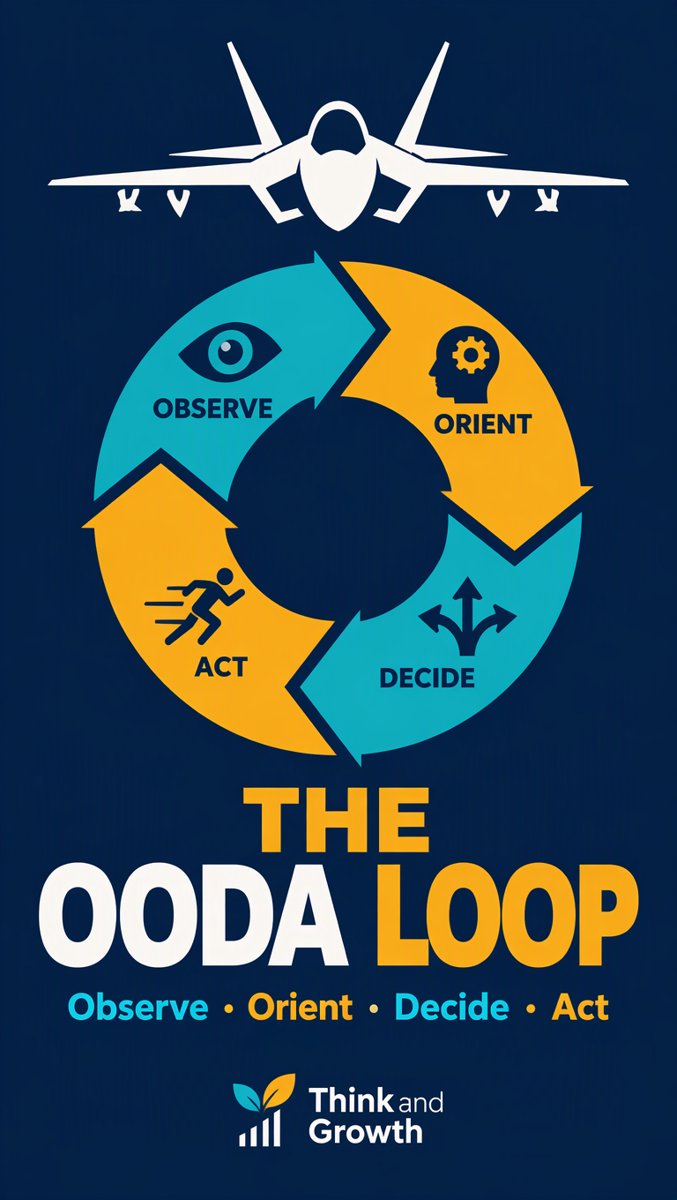
The OODA Loop: Decide Faster Than Your Competitor
Think and Growth — Episode #42 · Theme: Work · By Peter, BDM @ NXagents.net
Reading version. The narrated video tells the same story in ~70 seconds — one mental model, one takeaway.
The hook: speed wins
Here's the most underrated competitive advantage on Earth: whoever loops their decision cycle fastest wins. Not the smartest person in the room — the fastest learner in the room. That idea comes from a U.S. Air Force fighter pilot who rewrote how militaries think about conflict, and it now runs product teams, marketing departments, and trading desks all over the world. It's called the OODA Loop.
The idea
The OODA Loop is a four-step decision cycle: Observe. Orient. Decide. Act. Then you loop again — every pass feeding fresher information into the next decision. It was created in the early 1970s by Colonel John Boyd, who studied how fighter pilots dominated dogfights. His finding was blunt: the pilot who saw first, oriented fastest, and acted first controlled the fight. Everyone else was reacting to a battle that had already moved on.
The secret is in the second step. Observation is just taking in raw signals. Orientation is where those signals get filtered through your experience, your assumptions, your biases — and Boyd argued that's where the battle is actually won or lost. Two pilots can see the same sky and make different reads. The one whose orientation matches reality acts well. The one whose orientation is warped acts confidently — and wrongly.
How it works
- Observe — gather real signals: what customers do, what the market prints, what your numbers say. Not what you hope they're saying.
- Orient — interpret those signals honestly. Ask: what's my bias here? What would I see if I were wrong?
- Decide — commit to the best course given what you know now. Not the perfect course. The best one on the clock.
- Act — move. Ship it, say it, price it. The act generates the next round of observations.
Then you loop. Every cycle sharpens your orientation, because every act teaches you what your last read missed. Speed compounds: the faster you loop, the more learning cycles you run in a year, and the less time your competitor gets to adjust to your move.
A real-world example: Facebook vs MySpace
The cleanest business case is Facebook versus MySpace. Facebook treated product development as a continuous OODA loop: observe user behavior, orient the roadmap to what people actually did, decide the next feature, and ship it — then watch and loop again. MySpace, by contrast, didn't keep pace with new feature development and didn't meet changing consumer demand. The result is written in history: Facebook iterated its way to one of the largest social networks on the planet, while MySpace is largely forgotten. The difference wasn't genius. It was loop speed. One team kept re-observing reality and updating its orientation. The other froze at a decision that used to be right.
The same pattern shows up in marketing. Corporate Finance Institute describes OODA in action: marketers observe trends and customer behavior, orient campaigns toward the right demographics, decide on channels, and act — then adjust on real-time feedback. The team that loops weekly beats the team that plans quarterly, because the market doesn't wait for the planning cycle to finish.
How to apply it this week
- Pick one observable signal before you decide. Write down the metric or the customer's exact words you're watching. If you can't name the signal, you can't observe — you're just vibing.
- Attack your own orientation. Before you commit, ask: "What bias am I bringing? What evidence would prove me wrong?" This one question is worth more than a second opinion, because it targets the exact step where Boyd said fights are lost.
- Ship the smallest test, then re-observe. Don't plan the whole campaign — run the smallest act that produces real data, then loop. One week of real feedback beats a month of confident speculation.
Do this three times and you'll feel the compounding: each loop makes your next read sharper, your next decision faster, and your next act cheaper to correct. That's the whole game.
The takeaway
You don't need to be the smartest person in the market. You need to loop the fastest — observe reality, orient honestly, decide with what you've got, act, and go again. The slowest loop loses, even when it's brilliant.
Think and Growth — one mental model a day, built to compound.
🎙️ Narration script (video, ~195 words ≈ 70s)
Clip 1 (cover): "The pilot who decides fastest wins. Every time. This is the OODA loop." Clip 2 (slide-1a): "John Boyd, a fighter pilot, built a four-step decision loop." Clip 3 (slide-1b): "Observe. Orient. Decide. Act. Then loop again." Clip 4 (slide-2a): "Observe reality. Then orient — challenge your own bias." Clip 5 (slide-2b): "That's where fights are won. Decide fast. Act now." Clip 6 (slide-3a): "Facebook looped on user feedback and shipped, again and again." Clip 7 (slide-3b): "MySpace froze. Now it's largely forgotten." Clip 8 (slide-4a): "To use it: pick one signal. Attack your bias." Clip 9 (slide-4b): "Ship the smallest test. Then re-observe." Clip 10 (slide-5): "You don't need to be the smartest. Loop the fastest." Clip 11 (CTA): "I'm Peter. Follow Think and Growth — one mental model a day, built to compound."
Per-slide segment text
- cover: hook (12 words)
- slide-1: idea definition, split ×2
- slide-2: mechanism, split ×2
- slide-3: Facebook/MySpace example, split ×2
- slide-4: apply steps, split ×2
- slide-5: takeaway
- cta: Peter outro
Sources
- Wikipedia — OODA loop: https://en.wikipedia.org/wiki/OODA_loop
- The Decision Lab — The OODA Loop: https://thedecisionlab.com/reference-guide/computer-science/the-ooda-loop
- OODAloop.com — The OODA Loop Explained: https://oodaloop.com/the-ooda-loop-explained-the-real-story-about-the-ultimate-model-for-decision-making-in-competitive-environments/
- Corporate Finance Institute — Mastering the OODA Loop in Business: https://corporatefinanceinstitute.com/resources/management/ooda-loop/
- LogRocket — OODA loop decision making model: https://blog.logrocket.com/product-management/ooda-loop-model-meaning-process-examples/
- Miro — What's an OODA Loop and How to Use It: https://miro.com/strategic-planning/what-is-ooda-loop/
- DecisionSkills (YouTube) — The OODA Loop: A Competitive Decision-Making Tool: https://www.youtube.com/watch?v=Tj0fgjMdzU0