
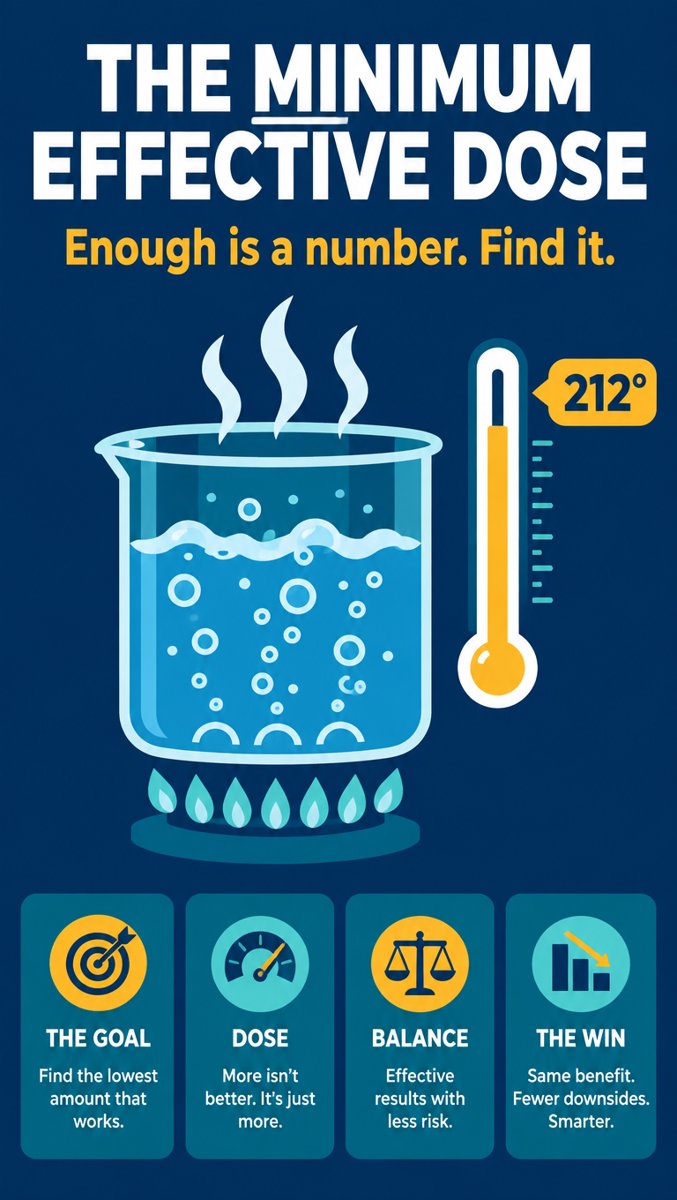
The Minimum Effective Dose: When Is Enough Actually Enough?
Think and Growth — Daily Mental Model · Thursday, October 15, 2026 · Theme: Health
We treat effort like a moral virtue. The longer the workout, the later the night, the bigger the grind — the better we must be doing. But effort is not a virtue. It's an input. And every input has a point where it stops paying you back.
That point has a name: the Minimum Effective Dose (MED) — the smallest dose that will produce the desired outcome. Anything beyond it is waste. Sometimes it's worse than waste.
Where the idea comes from
The term was coined by Arthur Jones, the creator of Nautilus fitness equipment, who called it the "minimum effective load" in weight training. Tim Ferriss later popularized it in The 4-Hour Body, defining it as the smallest dose that will trigger the desired result — "do the least necessary to trigger the hormonal or mechanical cascade" (Gizmodo's 4-Hour Body explainer; book notes).
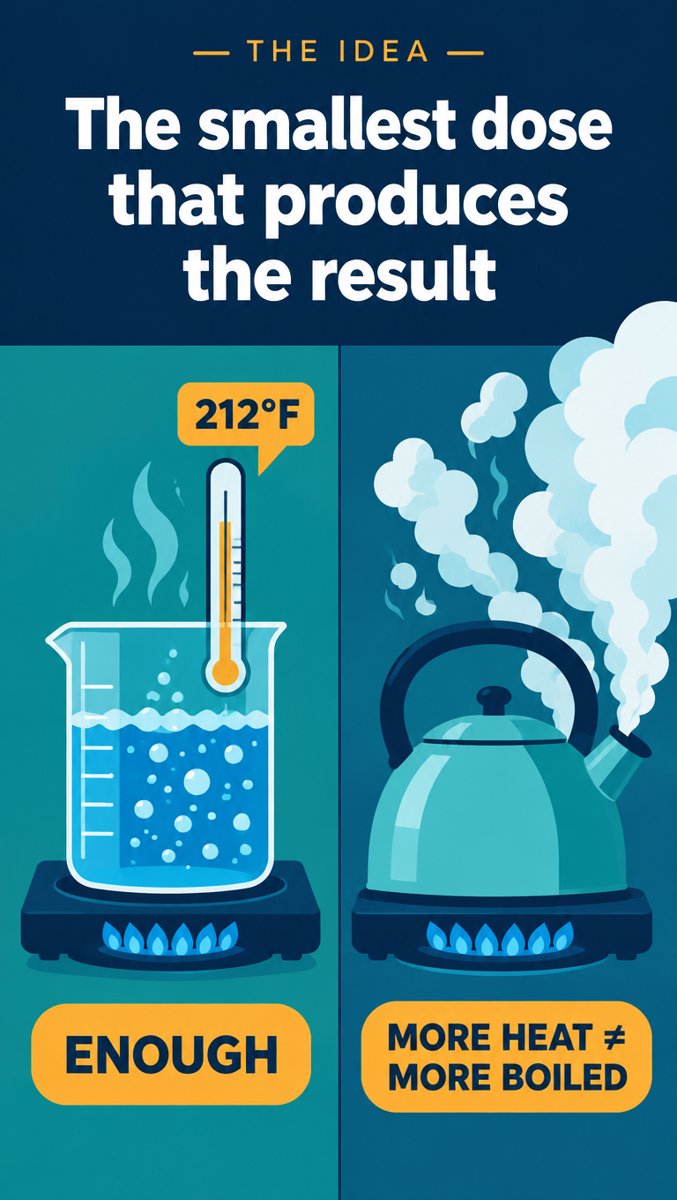
Ferriss' favorite illustration is boiling water. Water boils at 212°F (100°C). That's the MED of heat for boiling. Add more heat and the water doesn't get "more boiled" — it just boils off faster. The extra energy produces nothing you asked for (source). Your body works the same way: sunburn is what happens when "a little more sun" crosses past the dose that produces a tan.
How it works: the threshold
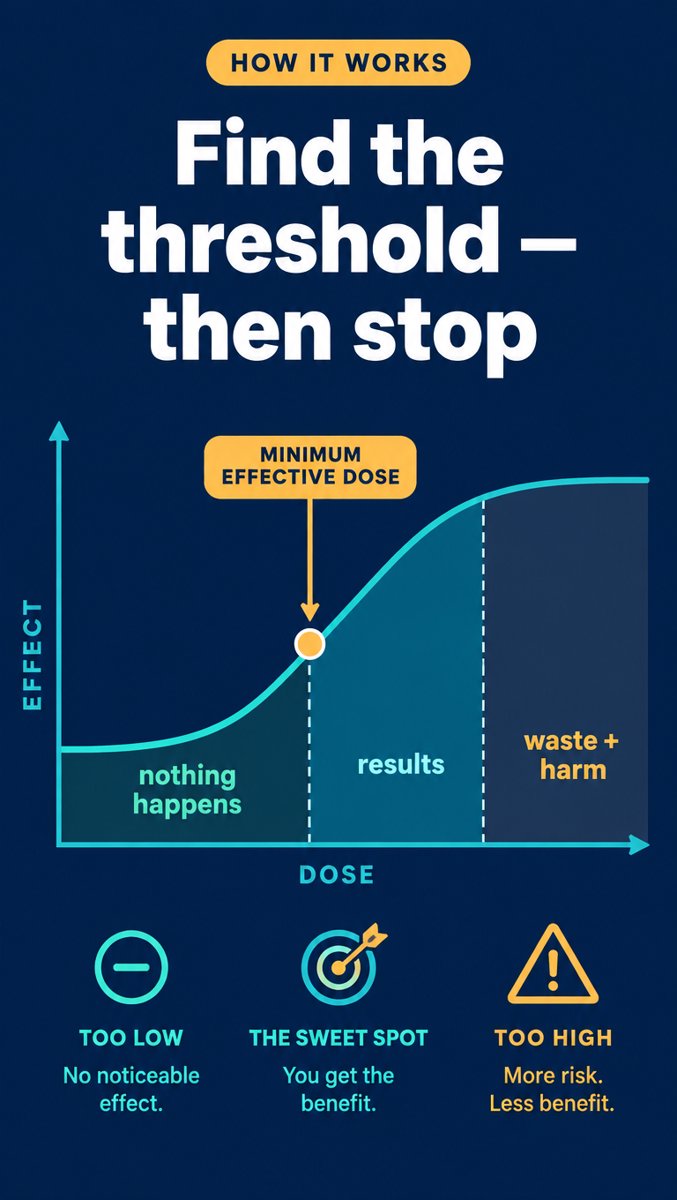
Every result has a curve:
- Below the threshold — nothing happens. The ten-minute jog that's too short to trigger adaptation, the meeting that's too short to decide anything.
- At the threshold — results arrive. This is the minimum effective dose.
- Beyond the threshold — you pay more and get no more. Extra hours, extra fatigue, extra injury risk, extra burnout. The cost line keeps climbing while the benefit line goes flat.
The skill isn't working hard. It's finding the exact point where the curve bends.
The honest version: sometimes more does help — but at a price
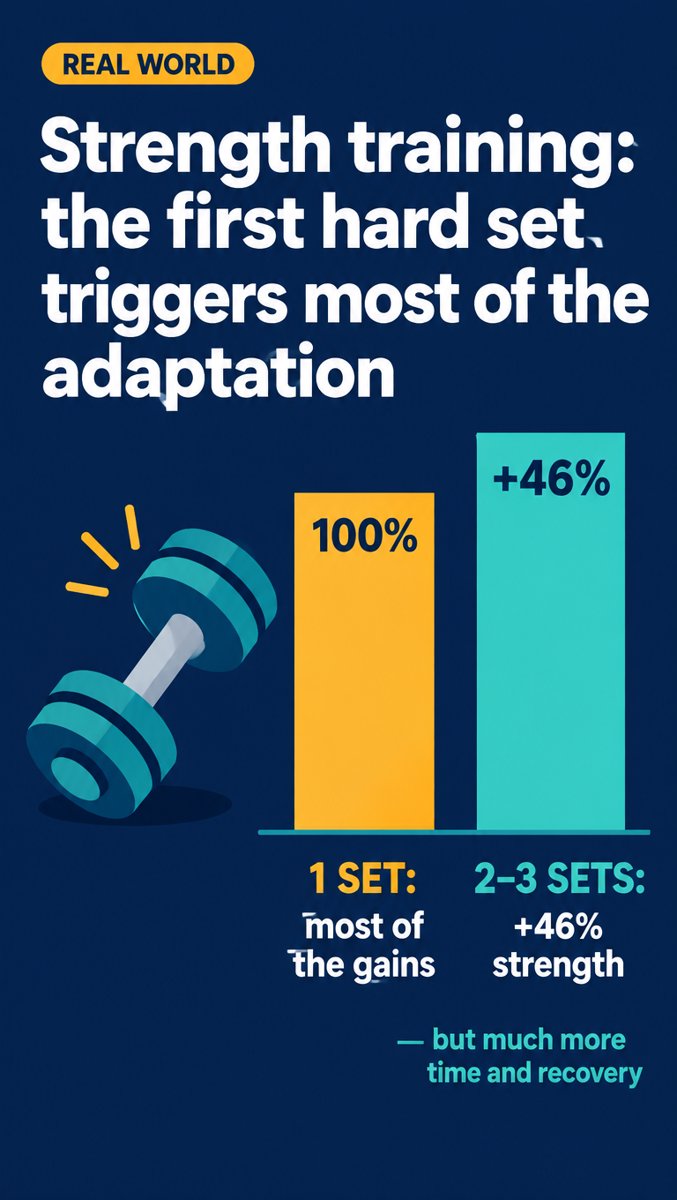
Let's not oversell this. In strength training, the evidence says one hard set triggers most of the adaptation — but it isn't literally everything. A meta-regression indexed in NCBI found that two-to-three sets per exercise produced about 46% greater strength gains than a single set (NCBI DARE review; PubMed).
So is one set the MED? It depends on your goal. If your goal is "get meaningfully stronger in 40 minutes," one hard set per exercise gets you most of the way at a fraction of the recovery cost. If your goal is maximal strength and you have the time and recovery budget, the extra sets are a rational purchase — not a virtue. MED thinking doesn't forbid doing more. It forces you to price doing more.
How to apply it
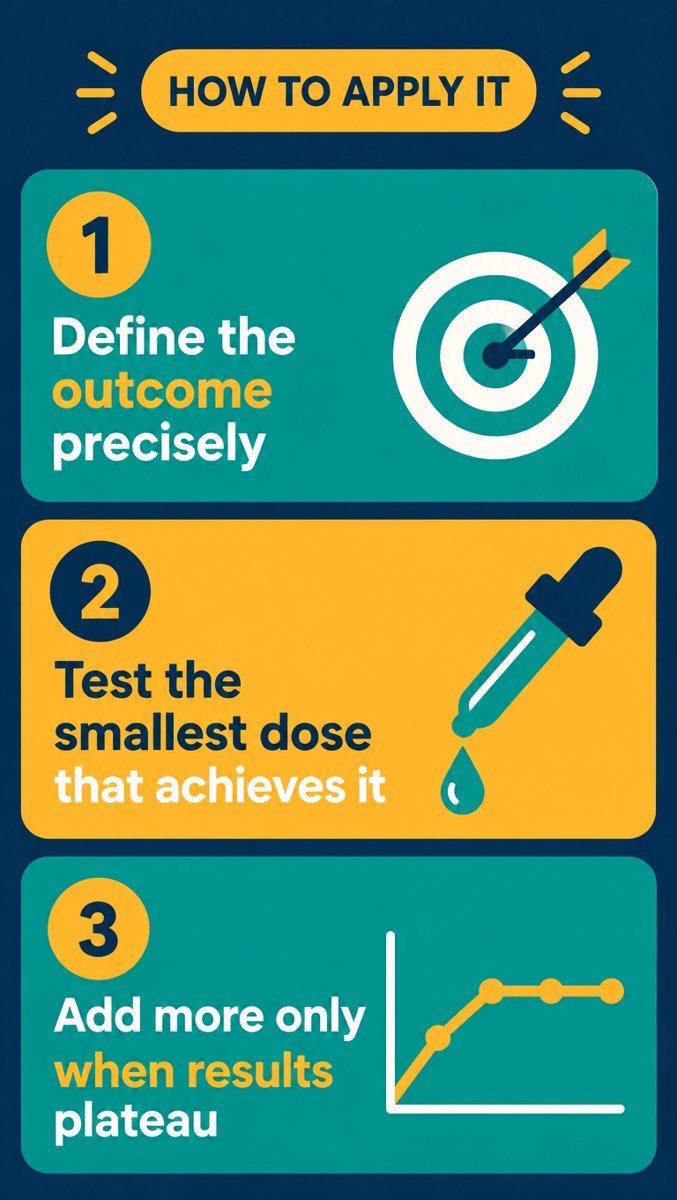
- Define the outcome precisely. "Get fitter" is unmeasurable; "squat bodyweight for 5 reps" is a target. MED only works when the result is defined — you can't titrate a dose against a fog.
- Test the smallest dose that could achieve it. Start below your instinct. If a 20-minute session produces the same weekly progress as the 60 you keep skipping, the 60 was never the requirement.
- Add more only when progress stalls. Growth has stopped? Now — and only now — buy more input. And the moment the cost (time, fatigue, injury risk) outweighs the gain, stop. Boiled is boiled.
The takeaway
More is not the goal. Effective is. The person who finds their minimum effective dose gets the result and keeps the energy — and energy, compounded across weeks, is what actually builds health, habits, and careers.
Find your dose. Then stop.
🎬 Narration Script (162 words · ~65–75s)
[Cover] Your workout, your project, your effort — when is enough actually enough?
[Slide 1 · The Idea] The Minimum Effective Dose is the smallest dose that produces the outcome you want. Water boils at two hundred twelve degrees. More heat gives you steam — not more boiled.
[Slide 2 · Mechanism] First, find the threshold. Below it, nothing happens. Above it, results arrive. Past the threshold, extra input adds cost — time, fatigue, injury risk — not benefit.
[Slide 3 · Example] In strength training, the first hard set triggers most of the adaptation. Meta-analyses found two to three sets beat one set by forty-six percent. But that comes at a steep cost in time and recovery. Know the trade.
[Slide 4 · Apply] Define your outcome precisely. Then test the smallest dose that truly achieves it. Add more only when progress stalls — and stop when cost outweighs benefit.
[Slide 5 · Takeaway] More is not the goal. Effective is. Find your dose — then stop.
[CTA] If this made you think twice about doing more, follow Think and Growth — one practical mental model, every single day.
Sources
- Gizmodo — 4-Hour Body: The Principle of the Minimum Effective Dose: https://gizmodo.com/4-hour-body-the-principle-of-the-minimum-effective-do-5709902
- NCBI Bookshelf (DARE) — Single versus multiple sets of resistance exercise: a meta-regression (+46% strength, 2–3 sets vs 1): https://www.ncbi.nlm.nih.gov/books/NBK77807/
- Graham Mann — The 4-Hour Body notes (MED definition, "least necessary to trigger the cascade"): https://grahammann.net/book-notes/the-4-hour-body-tim-ferriss
- LinkedIn (Jack Mize) — Boiled Is Boiled: Know Your Minimum Effective Dose (212°F illustration): https://www.linkedin.com/pulse/boiled-do-you-know-your-minimum-effective-dose-jack-mize
- PubMed — Single versus multiple sets meta-regression: https://pubmed.ncbi.nlm.nih.gov/19661829/