
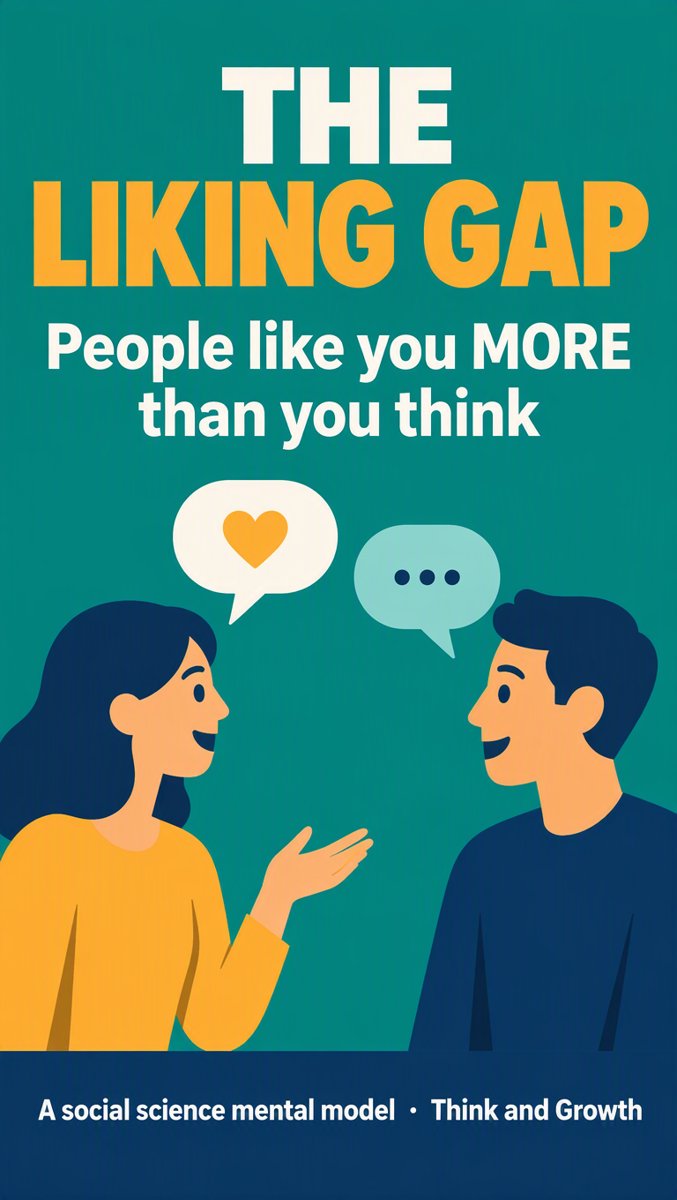
The Liking Gap: People Like You More Than You Think
Think and Growth · Saturday, September 19, 2026 · Theme: Friendship
You leave a conversation replaying every awkward pause, every joke that didn't land, every second you talked too much about yourself. You walk away convinced you flopped. Here's the uncomfortable science: you're almost certainly wrong — and not by a little.
Psychologists call it the liking gap. After a conversation, people systematically underestimate how much their conversation partner liked them and enjoyed their company. It was documented by Erica Boothby (Cornell), Gus Cooney (Harvard), Gillian Sandstrom (Essex), and Margaret Clark (Yale) in a 2018 paper in Psychological Science — and once you see it, you can't unsee it in your own social life.
What the research actually found
Across five studies — in the lab and in the real world — the same pattern emerged. In the first study, 34 students paired up for five-minute guided conversations. Afterwards, each rated their partner and predicted how their partner would rate them. The prediction was reliably, significantly too low. People underestimated how much they were liked.
One detail matters for anyone quiet: the shyer the person, the bigger the gap. Only the least shy participants showed no gap at all. The people most hesitant to reach out are the people most wrong about how they came across.
A second study explained the machinery. While talking, people's inner thoughts about how the other person was judging them were measurably more negative than their thoughts about the other person. We run a harsh inner commentary on our own performance — was that boring? did I talk too much? — and mistake that commentary for the other person's verdict.
The gap survived every stress test:
- Time in conversation didn't matter. Whether pairs talked for 2 minutes or up to 45, the gap held. Researchers also found an "enjoyment gap" — we underestimate how much the other person enjoyed the whole thing.
- It lasted months. In a real-world study of Yale first-year dormitory suites, students surveyed from September through May underestimated how much their suite-mates liked them at every time point except the last one. New roommates spent most of a school year quietly misjudging each other.
- It shows up in the wild. In workshops for "how to talk to strangers," participants predicted their partners would find them less interesting than they found their partners — a mistaken belief that actually grew after the conversation.
- It happens online, too. A 2024 follow-up in Computers in Human Behavior Reports found the same underestimation in digital conversations.
Why our brains do this
The authors' explanation is elegant: we judge ourselves against a private, idealized version of the conversation we meant to have. Every stumble counts against us. Our partner, meanwhile, is comparing us to a normal, ordinary chat — a much easier bar. As the researchers put it, speakers think they failed to live up to their ideal, while listeners think it could have been much worse. Different scoreboards, same game.
Add to that a spotlight effect of anxiety: we're so wrapped up in managing our own performance that we miss the genuine signals of enjoyment coming from across the table — the nods, the laughs, the follow-up questions.
The result is what the authors call "uncharacteristic pessimism." In most domains, humans are overconfident. In conversation, we're the opposite.
The cost: friendships that never start
Here's why this belongs on a Saturday about friendship. Most friendships don't die dramatically — they're never born. Someone enjoyed the chat, felt unsure about whether the other person really did, and simply... didn't follow up. The liking gap quietly taxes every first step: the message to the former colleague, the invitation to the new neighbor, the "we should grab coffee."
The research flips the default assumption. When you can't tell whether someone liked you, the evidence says: assume they liked you more than you think. That's not positive thinking; it's the statistically accurate read.
How to close your liking gap
- Catch the replay. That post-conversation highlight reel of your mistakes is a biased narrator, not evidence. Name it for what it is: the liking gap doing its thing.
- Flip the assumption. Replace "I probably came across badly" with the data-backed default: "they liked me more than I think." Five studies say the second belief is the accurate one.
- Reach out first. Send the message. Propose the coffee. The other person is very likely sitting on a better impression of you than you're carrying of yourself — possibly also hesitating for the same reason.
The takeaway
The researchers' closing line deserves a frame on your wall: "others like us more than we know."
That silence from the friend you haven't texted back isn't rejection. It's the gap talking — on both sides of the conversation. Close it: reach out first.
🎬 Narration Script (~198 words · est. ~88s)
HOOK — Cover You left that conversation sure you flopped. Science says you're wrong.
IDEA — Slide 1 Psychologists call it the liking gap: you underestimate how much people enjoyed talking with you. Five studies — in labs and in the real world — found it every time.
MECHANISM — Slide 2 Here's the mechanism. You grade your own performance against a harsh inner ideal. They grade you against a normal one — a regular chat. And nerves make you miss their smiles and signals of enjoyment.
EVIDENCE — Slide 3 The evidence is striking. Yale tracked new roommates from September to May. Most of the year, they underestimated how much their suite-mates liked them. Two-minute chats or forty-five-minute talks — the gap held. Shy people have the biggest gaps.
APPLY — Slide 4 So use it. First: catch the replay. That harsh post-chat review isn't evidence. Second: flip the assumption. "They liked me more than I think" is the realistic default. Third: reach out first. Send the message. The odds are on your side.
TAKEAWAY — Slide 5 The researchers' own summary: others like us more than we know. That silence from an old friend? It isn't rejection. It's the gap talking.
CTA — Outro card If this sharpened how you think, subscribe to Think and Growth — one mental model every day. Now go text that friend.
📑 Per-Slide Segment Text (clip timeline, 15 clips)
| # | Image | Motion | Segment |
|---|---|---|---|
| 1 | cover | none | You left that conversation sure you flopped. Science says you're wrong. |
| 2 | slide-1 | none | Psychologists call it the liking gap: you underestimate how much people enjoyed talking with you. |
| 3 | slide-1 | none | Five studies — in labs and in the real world — found it every time. |
| 4 | slide-2 | none | Here's the mechanism. You grade your own performance against a harsh inner ideal. |
| 5 | slide-2 | none | They grade you against a normal one — a regular chat. |
| 6 | slide-2 | none | And nerves make you miss their smiles and signals of enjoyment. |
| 7 | slide-3 | none | The evidence is striking. Yale tracked new roommates from September to May. |
| 8 | slide-3 | none | Most of the year, they underestimated how much their suite-mates liked them. |
| 9 | slide-3 | none | Two-minute chats or forty-five-minute talks — the gap held. Shy people have the biggest gaps. |
| 10 | slide-4 | none | So use it. First: catch the replay. That harsh post-chat review isn't evidence. |
| 11 | slide-4 | none | Second: flip the assumption. "They liked me more than I think" is the realistic default. |
| 12 | slide-4 | none | Third: reach out first. Send the message. The odds are on your side. |
| 13 | slide-5 | none | The researchers' own summary: others like us more than we know. |
| 14 | slide-5 | none | That silence from an old friend? It isn't rejection. It's the gap talking. |
| 15 | cta | fade_out | If this sharpened how you think, subscribe to Think and Growth — one mental model every day. Now go text that friend. |
All clips carry subtitle: "none" — the infographic cards carry their own text.
Sources
- Boothby, E. J., Cooney, G., Sandstrom, G. M., & Clark, M. S. (2018). The Liking Gap in Conversations: Do People Like Us More Than We Think? Psychological Science, 29(11), 1742–1756. DOI: 10.1177/0956797618783714 — https://journals.sagepub.com/doi/abs/10.1177/0956797618783714 · PDF: https://clarkrelationshiplab.yale.edu/sites/default/files/files/BoothbyCooneySandstromClark2018.pdf
- Young, E. (2018, Sep 24). The "liking gap". BPS Research Digest — https://www.bps.org.uk/research-digest/liking-gap
- The liking gap online: People like us more than we think (2024). Computers in Human Behavior Reports — https://www.sciencedirect.com/science/article/pii/S245195882400215X