
The Ivy Lee Method: The $25,000 To-Do List
Think and Growth — Episode #89 · Theme: Work · By Peter, NXagents.net — November 9, 2026
In 1918, the story goes, a public-relations pioneer named Ivy Lee sat down with Charles M. Schwab — one of the richest men in America and president of Bethlehem Steel — and offered 15 minutes of advice. No frameworks, no software, no dashboard. One method.
Lee told Schwab: "Use it for three months. Then send me a check for whatever you think it's worth."
Three months later, Schwab reportedly mailed him a check for $25,000 — the equivalent of roughly $400,000+ in today's dollars (some estimates put it above $500,000). For a method you can learn in fifteen minutes.
The only honest caveat: productivity historians have traced the earliest written version of that story to the 1960s, not 1918. It may be folklore. But the method itself has survived a century of being tested by real executives — and that's the part worth stealing.
The Method: Six Lines, One Rule
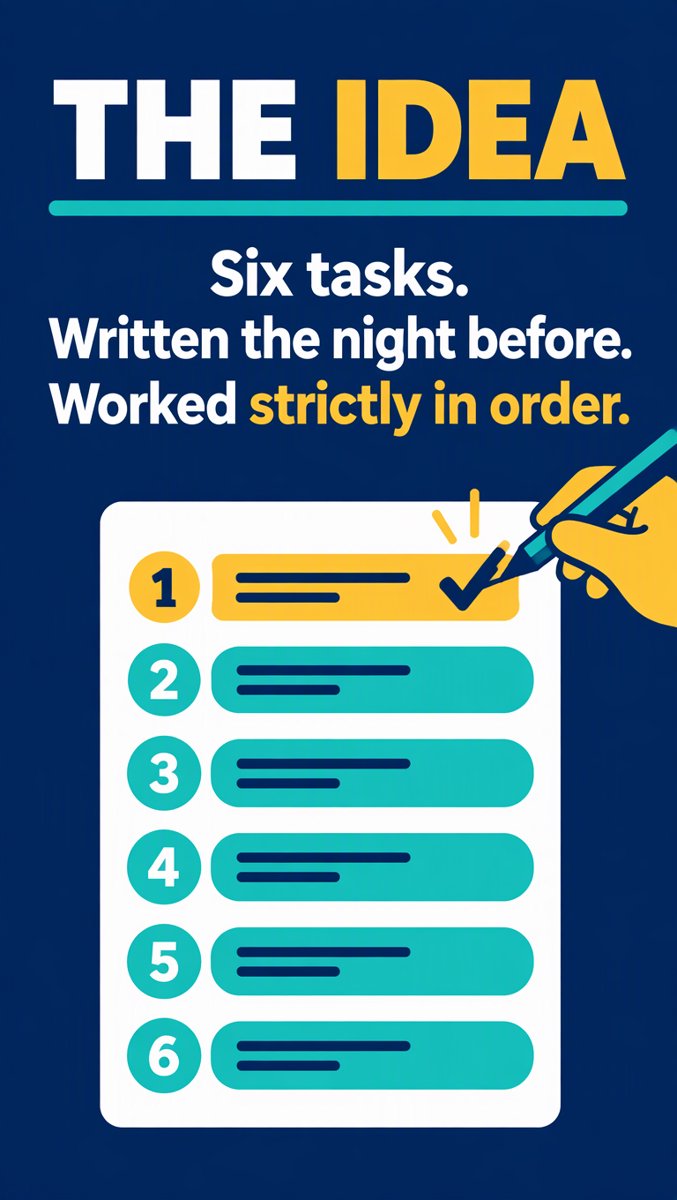
The Ivy Lee Method is five rules:
- At the end of each workday, write down the six most important things you need to accomplish tomorrow. Never more than six.
- Prioritize those six in order of their true importance — not by ease, not by enjoyment.
- Tomorrow, work only on task #1 until it is finished.
- Move through the rest of the list in order, the same way. One at a time.
- Anything unfinished rolls onto tomorrow's new list of six. Repeat every working day.
That's it. No apps required. A notebook works.
Why Something This Simple Survived 100 Years
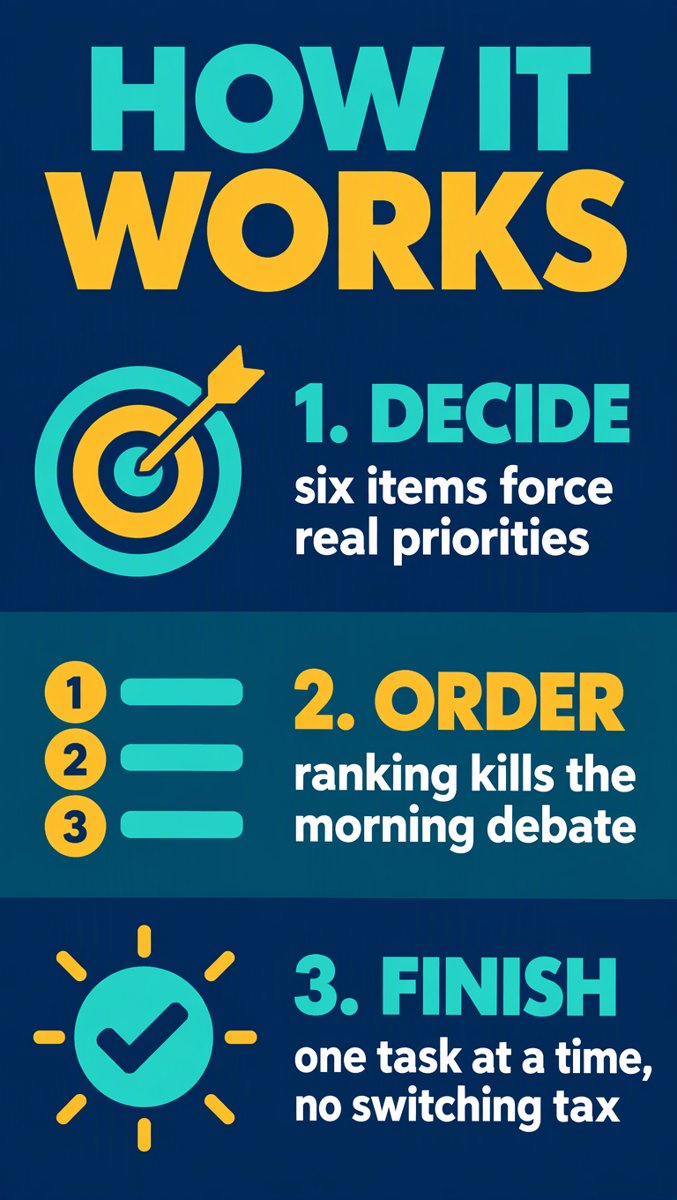
James Clear calls it "the daily routine experts recommend for peak productivity," and the reason is that each rule quietly removes a specific failure mode:
The cap forces real priorities. An uncapped list is a wish list. Six lines is a forcing function: to add a seventh item you must decide what dies. Most people never make that decision — they just carry all seventeen tasks forward, exhausted.
The ranking kills the morning debate. Productivity's real tax isn't work — it's deciding what to work on, re-litigated every single morning at your weakest hour. Lee front-loads that decision into the evening, when you have distance and perspective. You wake up with a pre-made answer.
The strict order removes the switching tax. Research on task-switching is brutal: every jump between tasks leaves residue and costs you reorientation time. Task #1 gets your sharpest hour, in order, until it's done — not started, not "made progress on," done.
The roll-forward keeps nothing buried. Unfinished items don't vanish into guilt; they go on tomorrow's six. The system is self-healing — which is exactly why it survives bad days, interruptions, and fire drills. Analysts of the method add that it aligns with goal-setting research: specific, short-term, written goals outperform vague intentions.
The Story (and the Check)
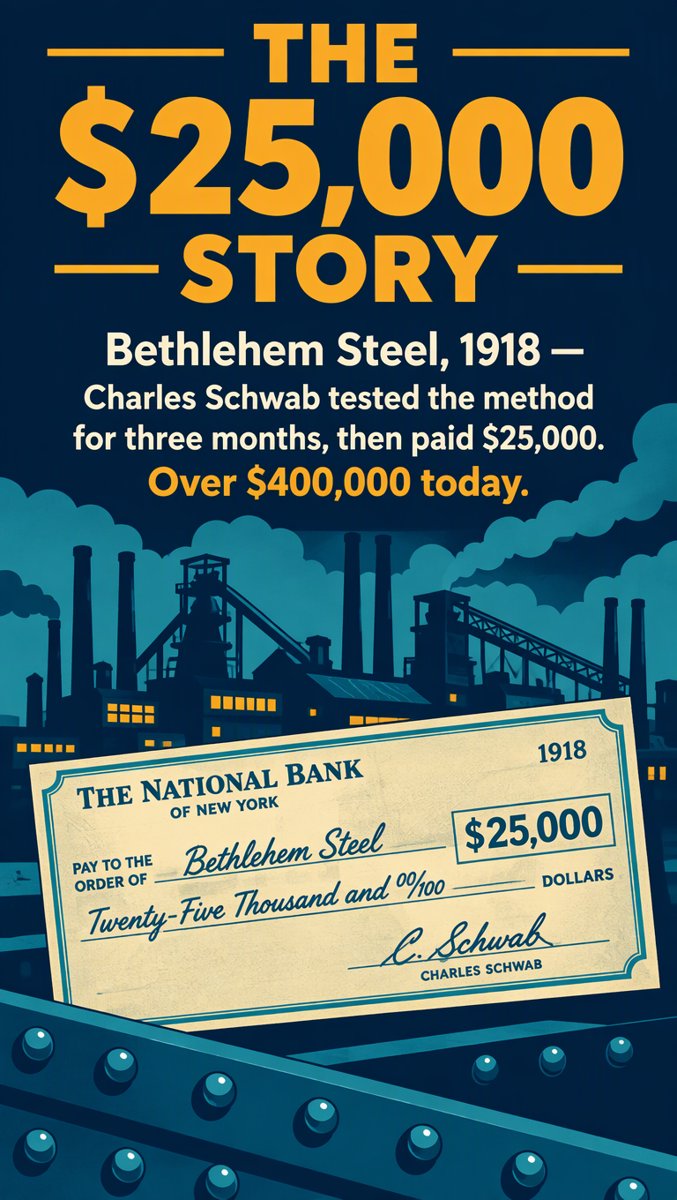
The legend: Lee spent 15 minutes with each of Schwab's executives. Bethlehem Steel's leadership ran the routine for three months. Productivity climbed enough that Schwab — a man who understood the price of wasted executive hours better than almost anyone alive — decided the advice was worth $25,000.
Even if the check is folklore, the adoption isn't. James Clear built his productivity writing around it. Mary Kay Ash drilled the same "six most important things" notepad into her sales force for decades. A century of executives keep independently rediscovering it — because it keeps outperforming their tools.
How to Run It Tonight
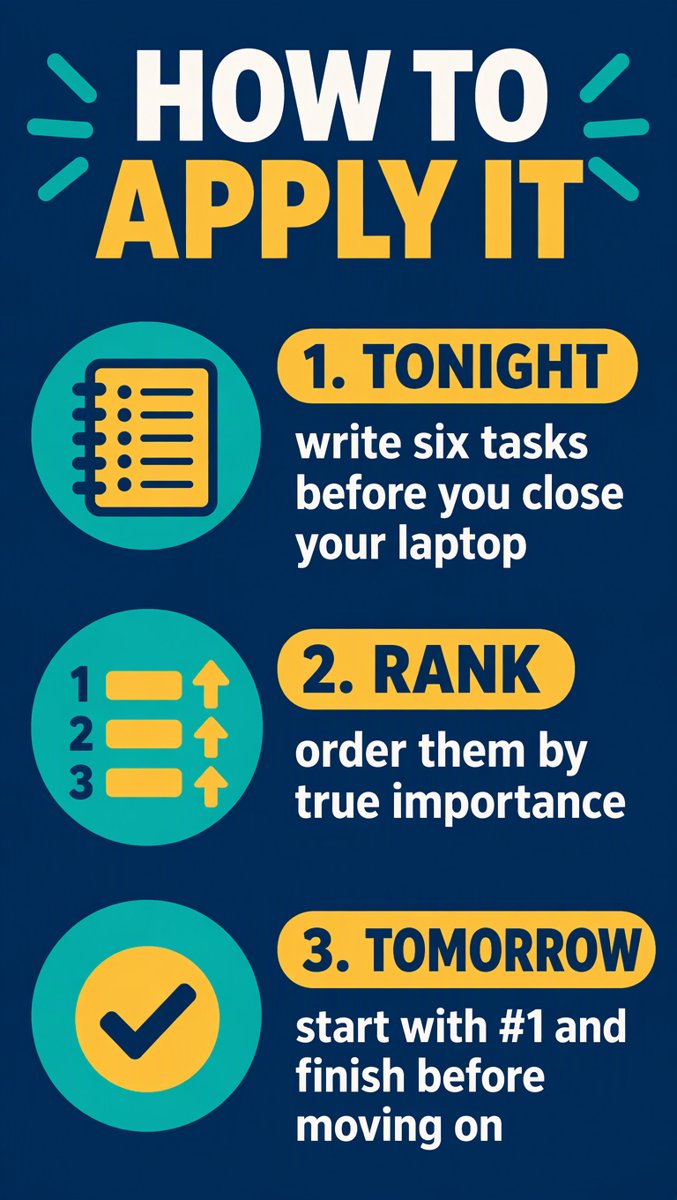
- Tonight, before you close your laptop: write six tasks for tomorrow. If you only have four important things, write four. The number is a ceiling, not a quota.
- Rank by true importance. Not urgency theater — the one task whose completion would make the others smaller.
- Tomorrow: start with #1 and finish it. No email detour. If it's the task you've been dreading, that's usually a confirmation, not an exception.
- Roll the leftovers forward onto tomorrow's six. If the same task rolls three times, stop rolling it: either do it first, delegate it, or delete it.
If six feels heavy on a chaotic week, run three. The discipline that matters isn't the number — it's deciding the night before and finishing in order.
The Takeaway
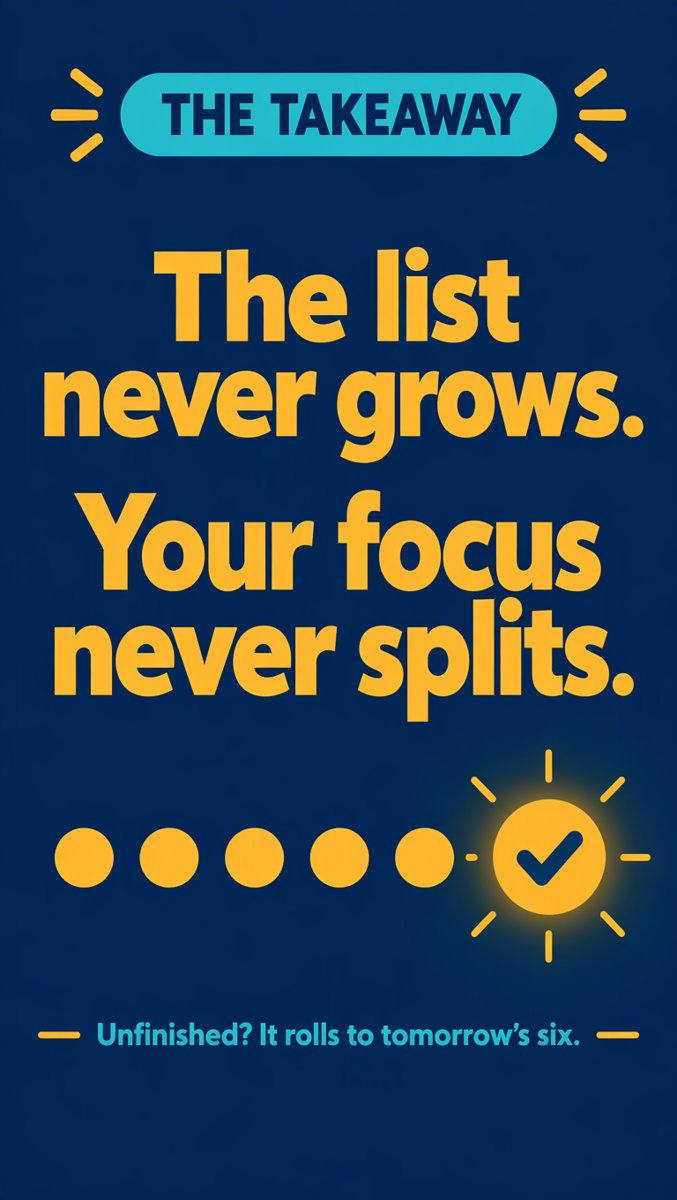
Every productivity system is really a bet about where your day goes wrong. The Ivy Lee Method bets that your day breaks in two places: the morning decision (what should I do first?) and the thousand switches in between. It fixes both with six lines and one rule: finish before you start.
The list never grows. Your focus never splits.
🎬 Narration Script (180 written words ≈ ~72s @ 2.5 wps)
[HOOK — cover] In 1918, a consultant's fifteen minutes of advice earned a twenty-five thousand dollar check.
[IDEA — slide 1, ×3] Ivy Lee gave Charles Schwab's executives one method. // Each evening, write the six most important things for tomorrow. Never more than six. // Then rank them by true importance — not by how easy they feel.
[MECHANISM — slide 2, ×3] Why it works: capping the list at six forces real priorities before you sleep. // Ranking kills the morning debate. You wake up knowing exactly where to start. // And finishing task one before touching task two removes the switching tax of multitasking.
[EXAMPLE — slide 3, ×2] The story goes: Schwab's team ran this method for three months at Bethlehem Steel. // Then Schwab sent a check for twenty-five thousand dollars — over four hundred thousand today.
[APPLY — slide 4, ×3] Try it tonight. Before you close your laptop, write six tasks for tomorrow. // Rank them by true importance. Tomorrow, start with number one — and finish it first. // Whatever doesn't get done rolls onto tomorrow's new list of six.
[TAKEAWAY + CTA — cta card, fade_out] The list never grows. Your focus never splits. That's the Ivy Lee Method. Follow Think and Growth for one model every day.
Clip Timeline (13 clips — subtitle-fit: every segment ≤15 words except CTA card per skill example)
| # | Image | Words | Motion | Subtitle |
|---|---|---|---|---|
| 1 | cover | 15 | none | none |
| 2 | slide-1 | 9 | none | none |
| 3 | slide-1 | 14 | none | none |
| 4 | slide-1 | 12 | none | none |
| 5 | slide-2 | 14 | none | none |
| 6 | slide-2 | 13 | none | none |
| 7 | slide-2 | 14 | none | none |
| 8 | slide-3 | 14 | none | none |
| 9 | slide-3 | 15 | none | none |
| 10 | slide-4 | 13 | none | none |
| 11 | slide-4 | 14 | none | none |
| 12 | slide-4 | 11 | none | none |
| 13 | cta | 22 | fade_out | none |
Sources
- James Clear — The Ivy Lee Method — canonical 5 rules; $25,000 ≈ $400,000; 15-minute advice framing
- Todoist — The Ivy Lee Method — executive meetings; $25,000 worth over $500,000 today
- alfred_ — The $25,000 Productivity System — authenticity note (earliest traceable reference = 1960s)
- Kono/LAMY — Get More Done with the Ivy Lee Method — Lee bio, Bethlehem Steel framing, why-it-works
- RBG CPA — Cracking Productivity Using the Ivy Lee Method — 4-point effectiveness analysis