
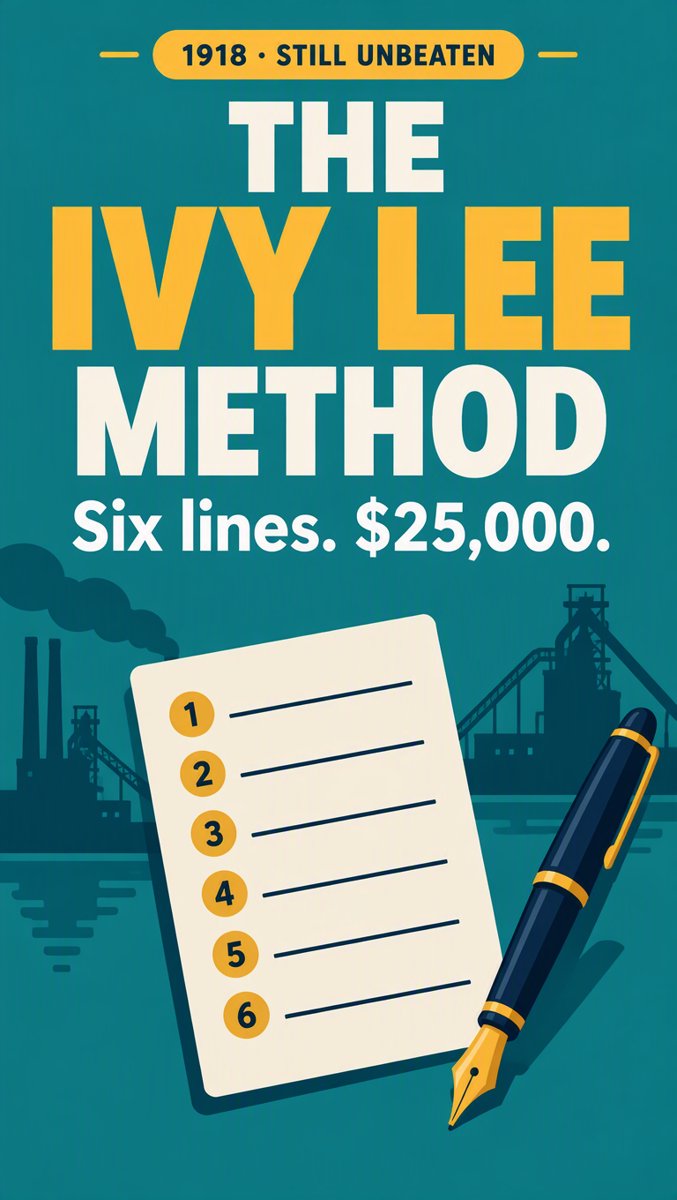
The Ivy Lee Method: Six Lines Worth $25,000 — the 1918 Productivity Ritual That Still Wins
Think and Growth · Daily Mental Model · Monday, September 21, 2026 · Theme: Work
The story that made productivity history
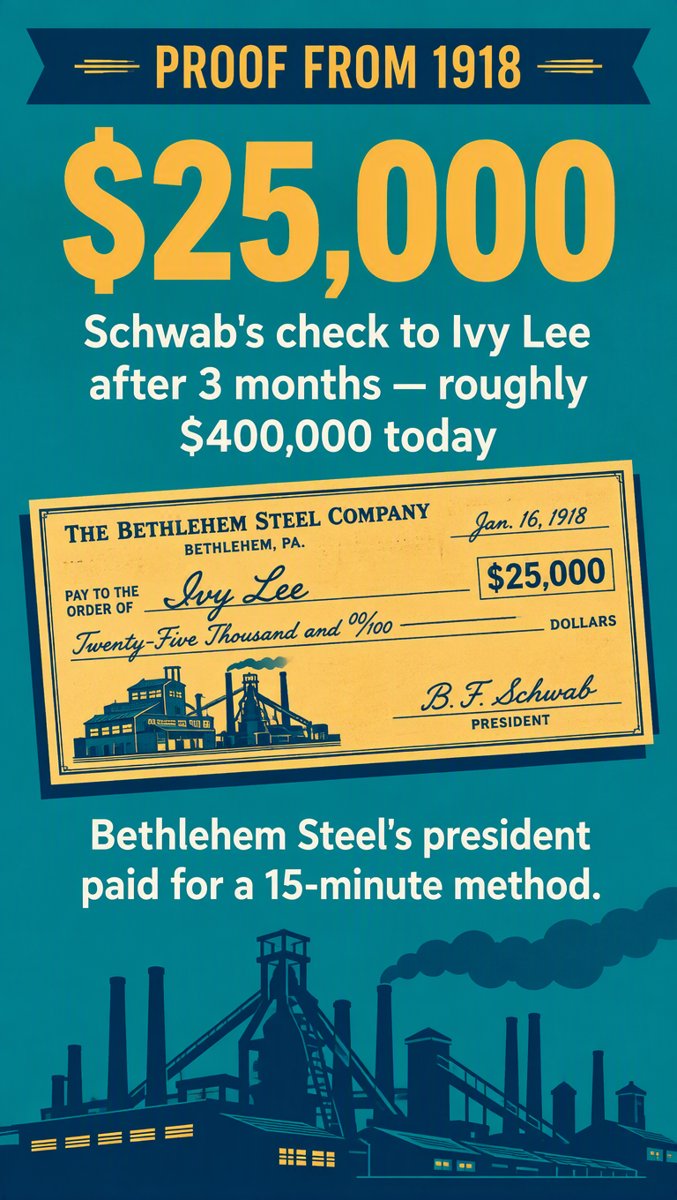
In 1918, Charles M. Schwab was one of the richest men in the world. He was president of Bethlehem Steel — at the time the largest shipbuilder and second-largest steel producer in America. In his quest for an edge, he summoned a consultant named Ivy Ledbetter Lee, a pioneer of public relations, and made a simple request: "Show me a way to get more things done."
Lee's reply has become legend: "Give me 15 minutes with each of your executives." When Schwab asked what it would cost, Lee said: "Nothing, unless it works. After three months, send me a check for whatever you feel it's worth to you."
Three months later, Schwab handed him a check for $25,000 — roughly $400,000 in 2015 dollars by James Clear's inflation calculation, and over $500,000 in today's terms by Todoist's estimate. For a method you can learn in fifteen minutes. (James Clear; Todoist)
(A note on honesty: historians trace the earliest written version of this story to the 1960s, with the 1918 date coming from Scott M. Cutlip's The Unseen Power: Public Relations: A History. It's best treated as the business world's best-documented legend — one that has survived a century precisely because the method works.)
The method: six tasks, one at a time
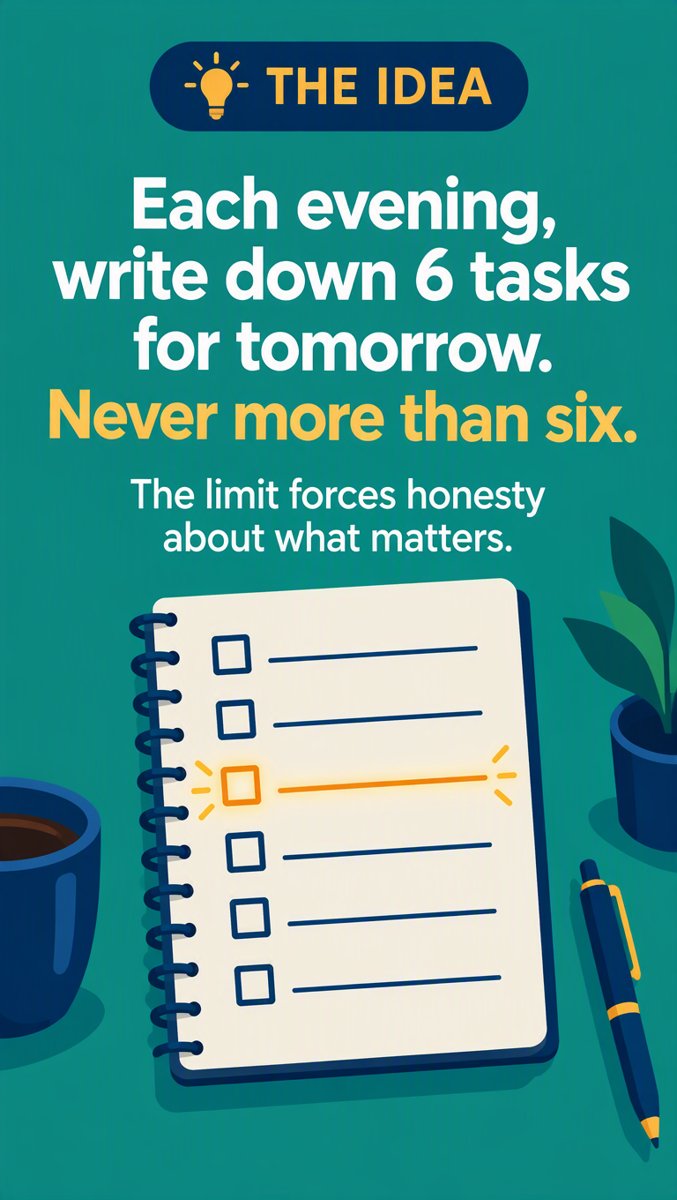
The Ivy Lee Method is almost embarrassingly simple:
- At the end of each workday, write down the six most important things you need to accomplish tomorrow. Never more than six.
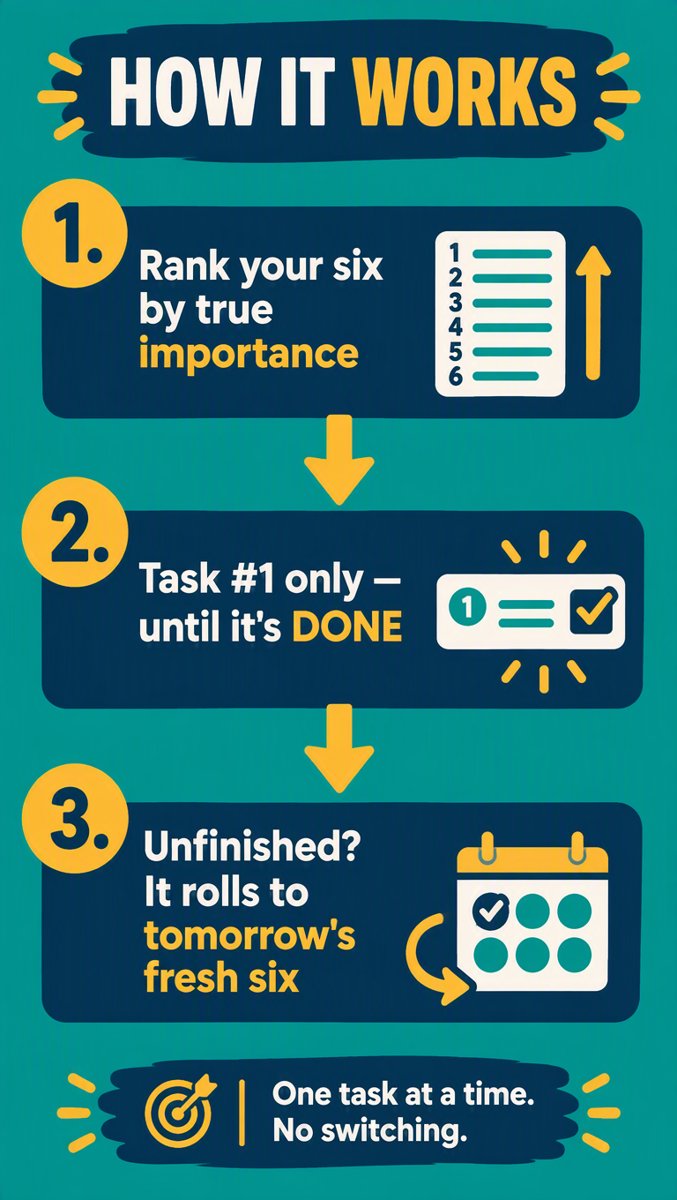
- Prioritize those six in order of their true importance.
- Tomorrow, start with task #1 — and work only on it until it's finished.
- Move to task #2 the same way. Anything unfinished at day's end goes onto a fresh list of six for the following day.
- Repeat every working day.
That's it. No app, no matrix, no colored labels. Six lines on paper.
Why something this simple is worth so much
It kills decision fatigue before it starts. Research summarized by Todoist shows why planning at night beats planning in the morning: Baumeister et al. (1998) found that making choices and self-regulation draw on the same limited mental resource; Vohs et al. (2008) found that a high volume of choices measurably lowers self-control. Writing your six the evening before means your morning self doesn't decide — it executes.
It makes single-tasking structural. A 2015 study by Mark et al. found that every time you switch tasks, it takes an average of 23 minutes to fully resume what you were doing. Lee's rule — task #1 only, until done — is a direct defense against that tax. You don't resist context-switching through willpower; the method removes the option.
It removes the friction of starting. James Clear credits this as the method's hidden engine: deciding your first task the night before means you wake up and begin immediately. As a writer, he notes he could waste three or four hours debating what to write about — unless he decided the night before.
The limit is the magic. There's nothing special about the number six — the constraint is special. Six slots force you to rank, to prune, to admit that twelve "priorities" means zero priorities. As Clear puts it: "If you commit to nothing, you'll be distracted by everything."
How to apply it this week
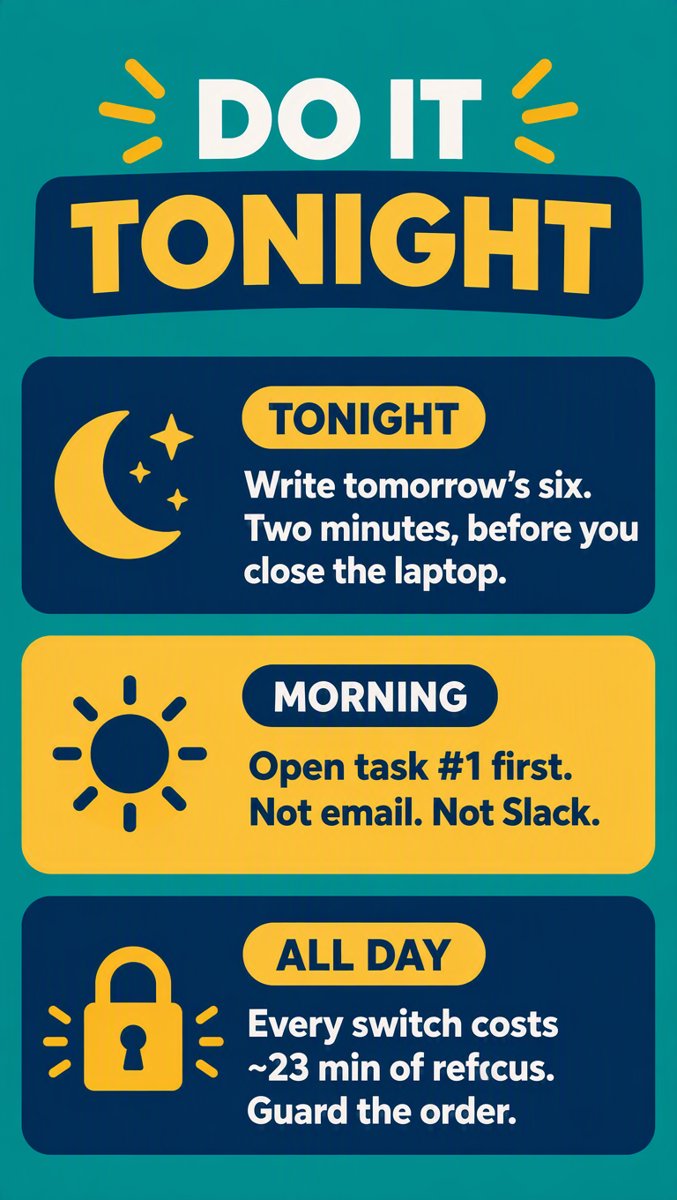
- Tonight: before you close the laptop, take two minutes and write tomorrow's six. Rank them 1 through 6. If a task has sat on your list for a week, that's a signal — either rank it or delete it.
- Tomorrow morning: open task #1 first. Not email, not Slack, not the news. Task #1 stays open until it's done. (If something genuinely urgent detonates, handle it — then return to the list. The method bends for real emergencies; it doesn't break.)
- All day: remember the 23-minute switch cost every time you're tempted to "just quickly check" something. The order you set tonight is the schedule your brain follows tomorrow.
- Tomorrow evening: roll unfinished items onto a fresh six and repeat. A daily reset prevents the zombie backlog that kills most to-do lists — the same open-loop overload behind the Zeigarnik effect we covered last week, but solved by constraint instead of closure.
The takeaway
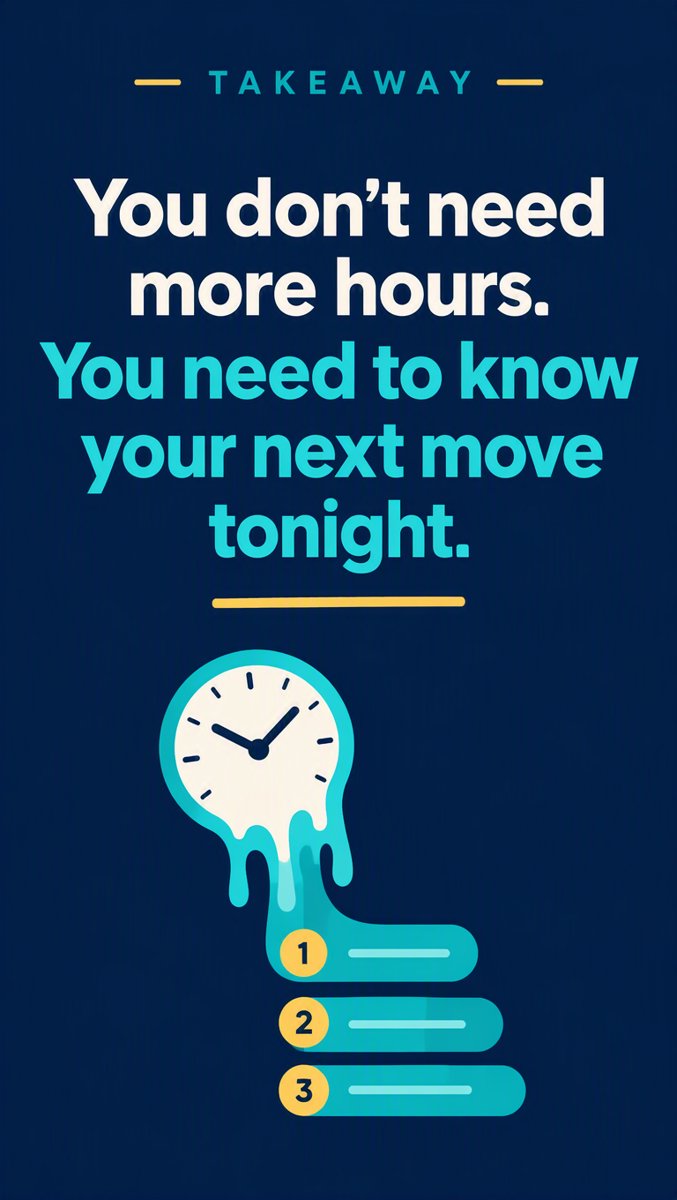
You don't need more hours. You need to know your next move tonight. Six lines, written at day's end, ordered by true importance — that was worth $25,000 to the richest steelman in America in 1918, and it's free for you today.
Sources:
- James Clear — The Ivy Lee Method: The Daily Routine Experts Recommend for Peak Productivity (verified)
- Todoist — The Ivy Lee Method: Focus Better with This 100-Year-Old Strategy (verified)
- Tweek — The Ultimate Guide to the Ivy Lee Method
- Video corroboration: Ivy Lee Method: 6 Steps to Daily Productivity (YouTube)
Narration Script (video, ~180 written words → est. 72-90s)
COVER: In 1918, a consultant taught one method worth four hundred thousand dollars. It's six lines. IDEA-1: Each evening, write down six tasks for tomorrow. Never more than six. IDEA-2: Why six? The limit forces brutal honesty about what actually matters. MECH-1: First, rank those six by true importance. MECH-2: Tomorrow, start with task one. Don't check email. Don't switch. Work until it's finished. MECH-3: Then task two, the same way. Anything unfinished moves to tomorrow's new list of six. EX-1: This worked in 1918. Charles Schwab ran Bethlehem Steel, America's biggest shipbuilder. EX-2: Ivy Lee coached his executives for fifteen minutes. Pay only if it works. EX-3: Three months later, Schwab handed him a check for twenty-five thousand dollars. APPLY-1: Tonight, write tomorrow's six. Two minutes, before you close the laptop. APPLY-2: Morning: open task one first. Not email. Not Slack. Task one. APPLY-3: Research says every switch costs twenty-three minutes of refocus. Guard the order. TAKEAWAY: You don't need more hours. You need to know your next move tonight. CTA: I'm Peter. Every day on Think and Growth, one mental model to sharpen your thinking. Subscribe, and I'll see you tomorrow.