
The Generation Effect: Guess First, Learn Faster
Think & Growth — Tuesday · School · One mental model a day
Here's a question that sounds like a trap: what if the fastest way to learn something is to be wrong about it first?
Not "fail fast" as a slogan. An actual, measured memory advantage — published in a psychology journal, replicated across five experiments in 1978, and extended forty years later by researchers at UCLA who found that students who guessed and were wrong every single time still out-learned the ones who just read the material.
It's called the Generation Effect, and once you see it, you'll never study the same way again.
The Idea
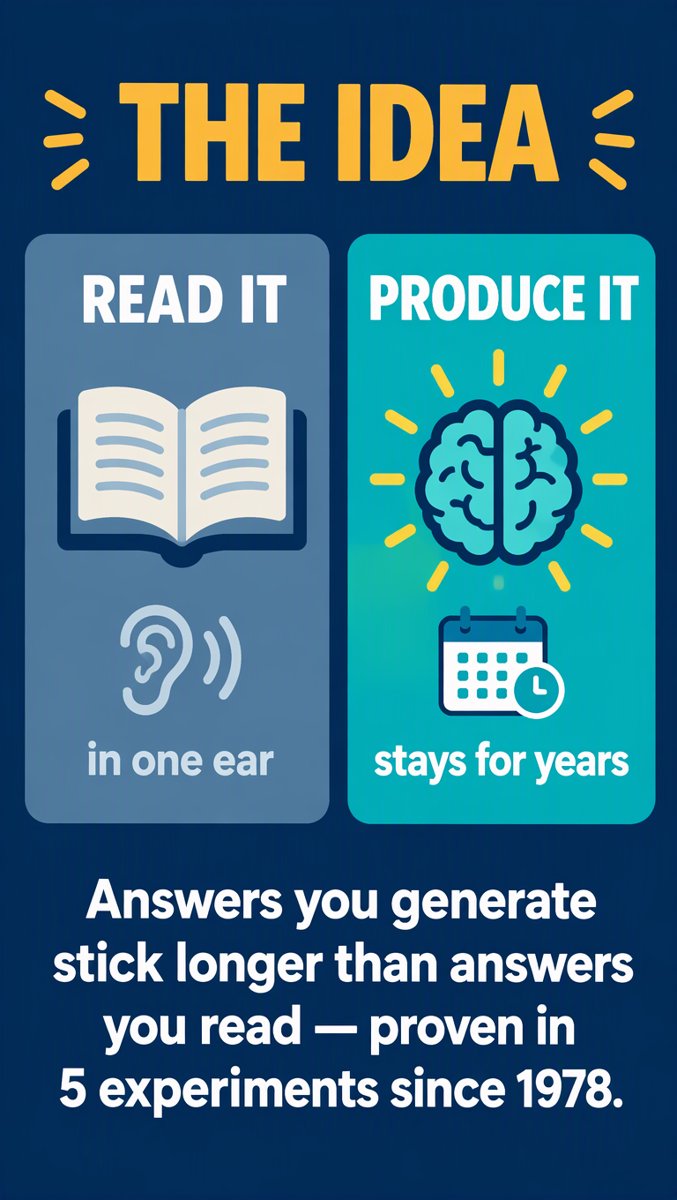
The Generation Effect is one of the most reliable findings in memory science: information you generate yourself is remembered dramatically better than information you simply read — even when the information is identical.
In their landmark study, Slamecka and Graf (1978) ran five experiments comparing two ways of encountering the same words: reading them, or completing a prompt that forced the participant to produce them. The generated words won recall every time, across every condition. The paper, "The Generation Effect: Delineation of a Phenomenon," has since been cited nearly 2,900 times — this is not a fragile effect.
How It Works
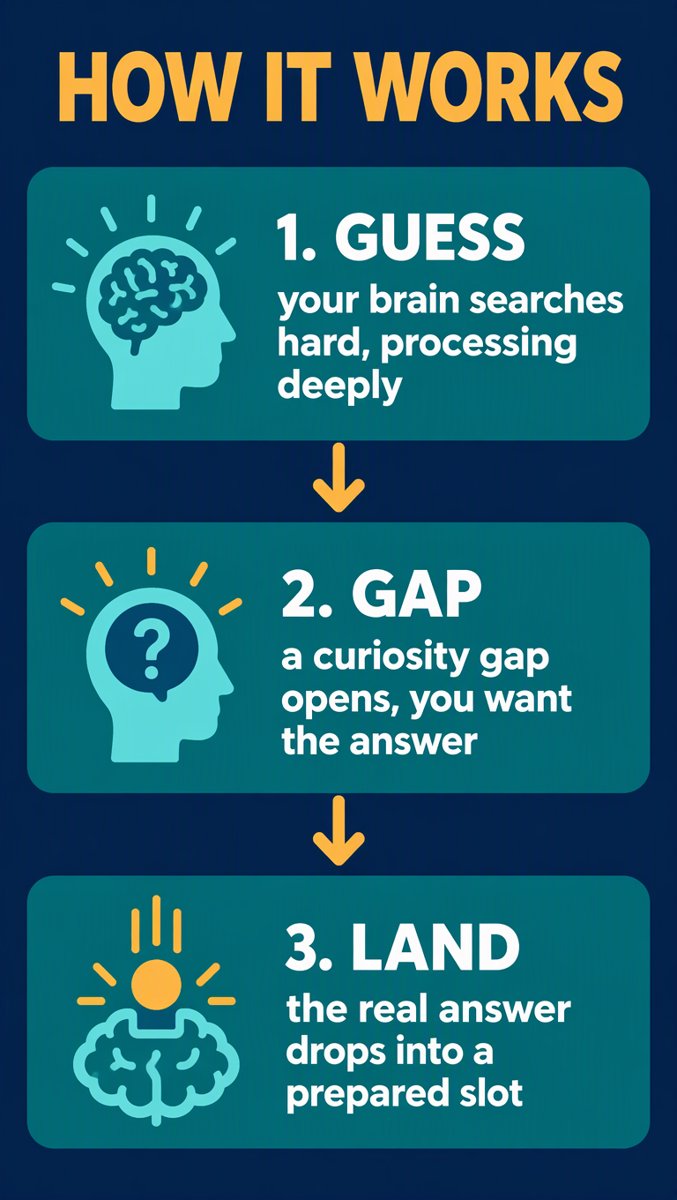
Think of it as a three-step sequence your brain runs automatically:
1. GUESS. When you attempt an answer before you know it, your brain doesn't idle. It searches — activating everything you already know that might relate, processing the question semantically and deeply instead of skimming past it.
2. GAP. The failed guess opens what researchers call a curiosity gap. You are now invested — Metcalfe (2017) describes learners eagerly waiting for feedback on a guess they committed to. Attention that no highlighter can buy.
3. LAND. When the correct answer finally arrives, it doesn't land on a flat surface. It lands in a prepared slot — connected to your guess, your reasoning, and the small sting of being wrong.
The Proof That Stings
Here's the part that separates this from every "effort matters" poster in a school hallway.
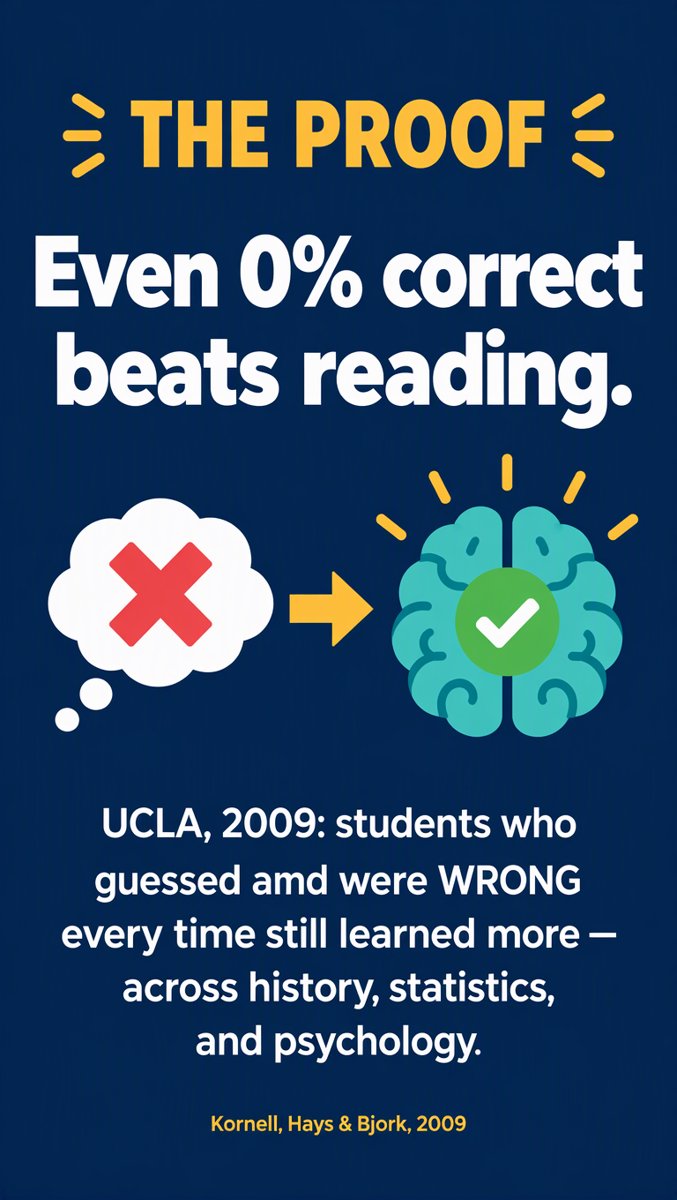
Kornell, Hays and Bjork (2009) — from Robert Bjork's learning lab at UCLA — asked a harder question: what if the guess is a total failure? Does anything survive a 0% score?
Their answer, published as "Unsuccessful Retrieval Attempts Enhance Subsequent Learning": yes. Participants who attempted answers and failed every time still learned the subsequent material better than participants who only studied — across two different types of material. The act of generating, not the accuracy of the generation, was doing the work.
And it scales beyond the lab. The "pretesting effect" — the classroom version of this finding — has been replicated across history, statistics, and psychology courses, with text passages and video material alike. Students who take a test before the lesson outperform students who don't, on questions they initially got wrong. A 2025 study in Memory & Cognition re-confirmed the effect's robustness across adulthood.
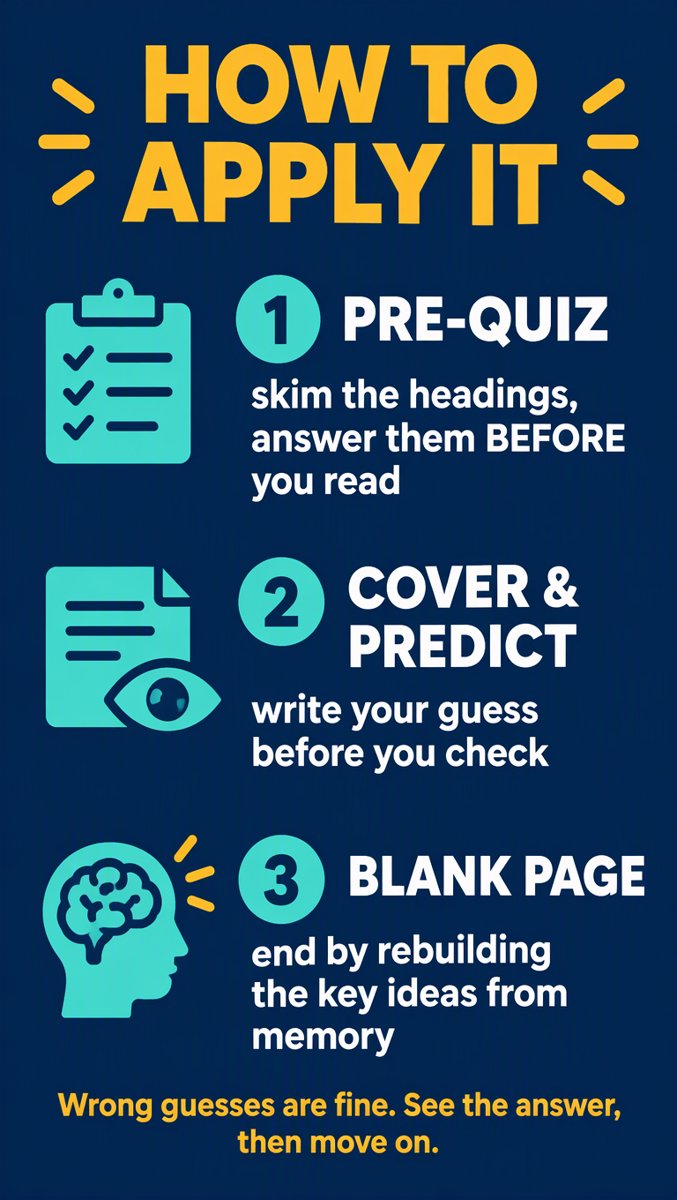
How to Apply It
Three moves, in order of effort-to-payoff:
1. Pre-quiz. Before you read a chapter, skim the headings and subheadings, then answer — out loud or in writing — what you think each section says. Wrong answers are not just acceptable here; they're the mechanism.
2. Cover and predict. When you hit an explanation, example, or formula, stop. Cover it, predict the answer, commit to your guess, then check. The commitment is what converts reading into generation.
3. Blank page. End every study session by rebuilding the key ideas from memory on an empty page. This is generation at full intensity — no prompts, no cues, just production.
Why This Matters Now
We live in the most answer-rich era in human history. AI will hand you a complete, confident response to anything in under three seconds. That is precisely what makes the Generation Effect a competitive advantage: the easier answers become to access, the more memory advantage accrues to people who still produce — who let their brain do the search before they outsource it.
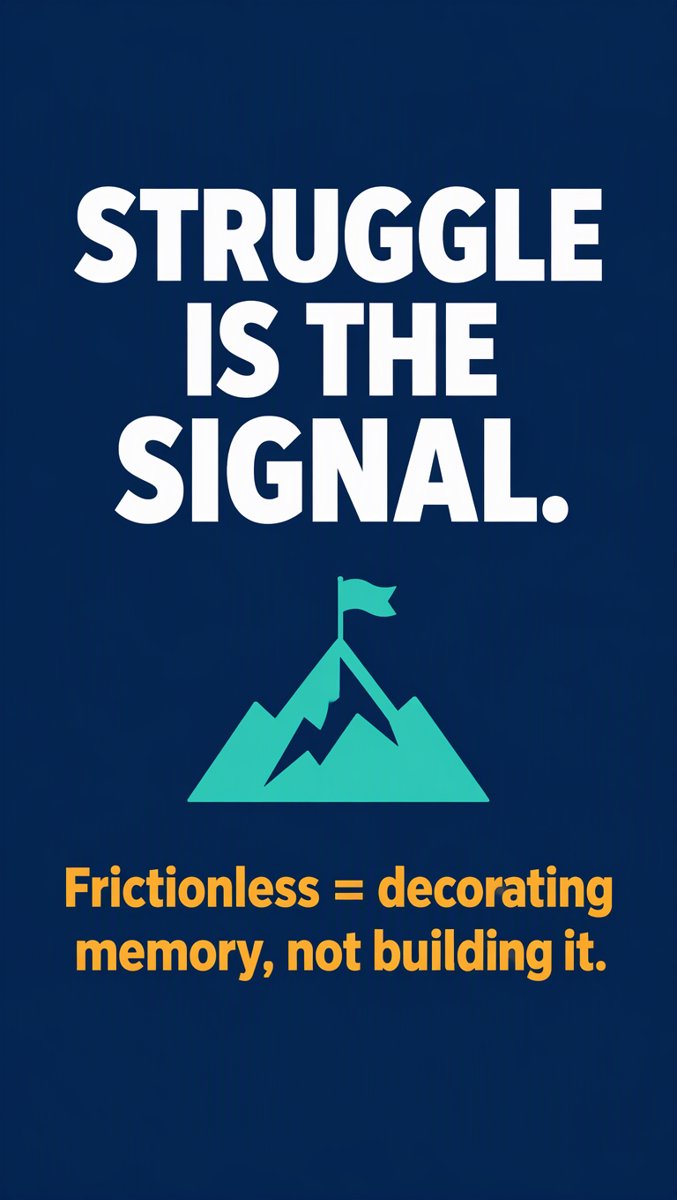
The friction you feel when you force a guess is not a bug in your learning. It is the learning.
Sources
- Slamecka, N. J., & Graf, P. (1978). The Generation Effect: Delineation of a Phenomenon. Journal of Experimental Psychology: Human Learning & Memory, 4(6), 592–604. — https://psycnet.apa.org/record/1980-20399-001
- Kornell, N., Hays, M. J., & Bjork, R. A. (2009). Unsuccessful Retrieval Attempts Enhance Subsequent Learning. Journal of Experimental Psychology: Learning, Memory, and Cognition. — https://pubmed.ncbi.nlm.nih.gov/19586265/
- Richland, L. E., Kornell, N., & Kao, L. S. (2009). The Pretesting Effect: Do Unsuccessful Retrieval Attempts Enhance Learning? — https://learninglab.uchicago.edu/Pre-Testing_files/RichlandKornellKao.pdf
- Psychonomic Society featured content: Test first, learn later: The power of pretesting to enhance learning. — https://featuredcontent.psychonomic.org/test-first-learn-later-the-power-of-pretesting-to-enhance-learning/
🎬 Narration Script (164 words · ~70s)
[Cover] What if reading less helped you remember more? Here's the Generation Effect.
[Slide 1 — a] The Generation Effect is simple: answers you produce stick better than answers you read.
[Slide 1 — b] Slamecka and Graf proved it in 1978: five experiments, generated words won every time.
[Slide 2 — a] Here's the mechanism. First you guess. Your brain searches hard, processing the question deeply.
[Slide 2 — b] A curiosity gap opens. When the answer lands, it drops into a prepared slot.
[Slide 3 — a] Now the strange part. UCLA researchers found even failed guesses supercharge learning.
[Slide 3 — b] Students who were wrong every single time still beat passive readers — across history, statistics, psychology.
[Slide 4 — a] So apply it. Before you read, skim the headings and answer them from your head.
[Slide 4 — b] Cover and predict. Finish each session by rebuilding the key ideas from a blank page.
[Slide 5] Remember: struggle is the signal. If learning feels frictionless, you're decorating memory, not building it.
[CTA] That's the Generation Effect. Try the pre-quiz on your next chapter and feel the difference. Subscribe to Think and Growth — one mental model a day.
📋 Clip Timeline
| # | Image | Motion | Words | Est. sec |
|---|---|---|---|---|
| 1 | cover | none | 12 | 5 |
| 2 | slide-1 | none | 14 | 6 |
| 3 | slide-1 | none | 14 | 6 |
| 4 | slide-2 | none | 14 | 6 |
| 5 | slide-2 | none | 14 | 6 |
| 6 | slide-3 | none | 11 | 5 |
| 7 | slide-3 | none | 15 | 6 |
| 8 | slide-4 | none | 15 | 6 |
| 9 | slide-4 | none | 15 | 6 |
| 10 | slide-5 | none | 15 | 6 |
| 11 | cta | fade_out | 25 | 10 |
Total: 11 clips, ~164 written words, ~68s written → ~72-79s measured (TTS runs 10-20% long). All clips ≤15 words / ≤6s. All motion "none" except CTA fade_out. All subtitle "none".