
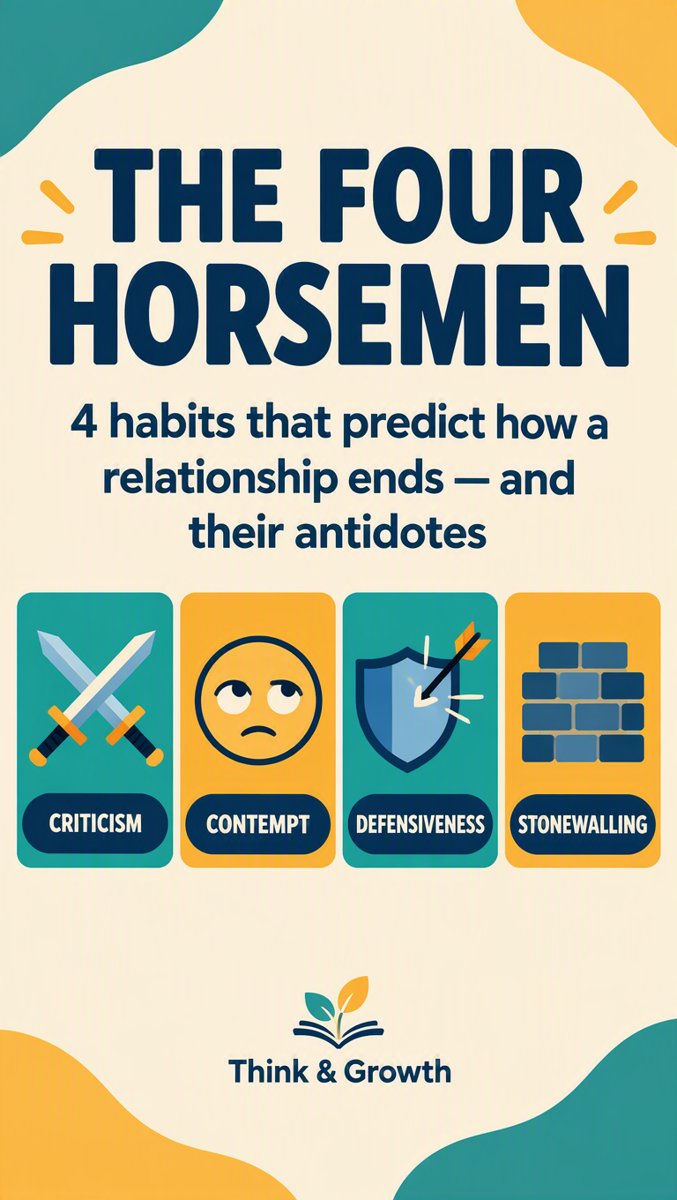
The Four Horsemen: Four Habits That Predict How a Relationship Ends
Think & Growth — Daily Mental Model · Wednesday, September 16, 2026 · Theme: Family — Relationships & Communication
Every couple fights. That's not the problem — Gottman's "Masters" of relationships argue too. The question is how you fight. In the 1970s and 80s, psychologist John Gottman and Robert Levenson began outfitting an apartment lab with cameras and physiological sensors and watching thousands of couples argue for hours. Decades of follow-up later, one finding kept repeating: the way a couple communicates during conflict predicts whether the relationship survives — and four specific patterns show up again and again in the ones that don't. He named them after the Four Horsemen of the Apocalypse: criticism, contempt, defensiveness, and stonewalling.
The Idea: Conflict Isn't Random — It Follows Patterns
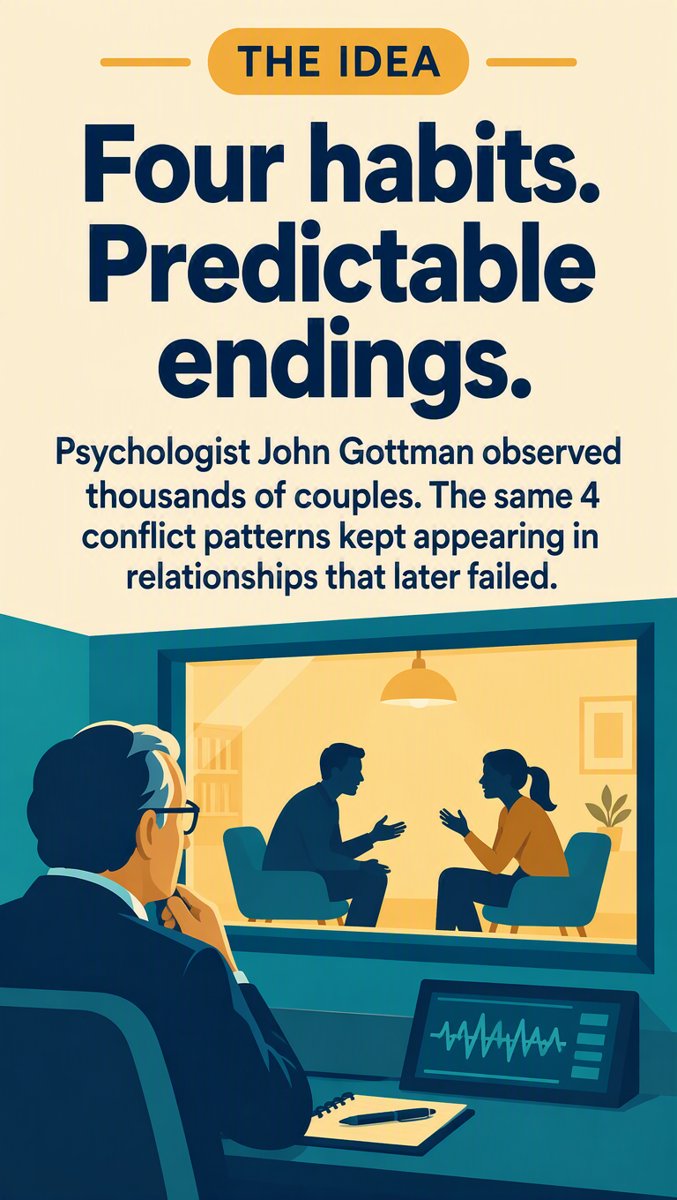
Gottman's insight was to stop asking couples what they fight about and start studying how they fight. Conflict is not a series of random explosions; it's a behavioral system. When he coded the observed interactions moment by moment — words, tone, even micro-expressions — four destructive patterns kept appearing in relationships that later failed. That predictability is bad news and good news at once: bad, because these habits are real and measurable; good, because a pattern you can see is a pattern you can interrupt.
How It Works: The Cascade
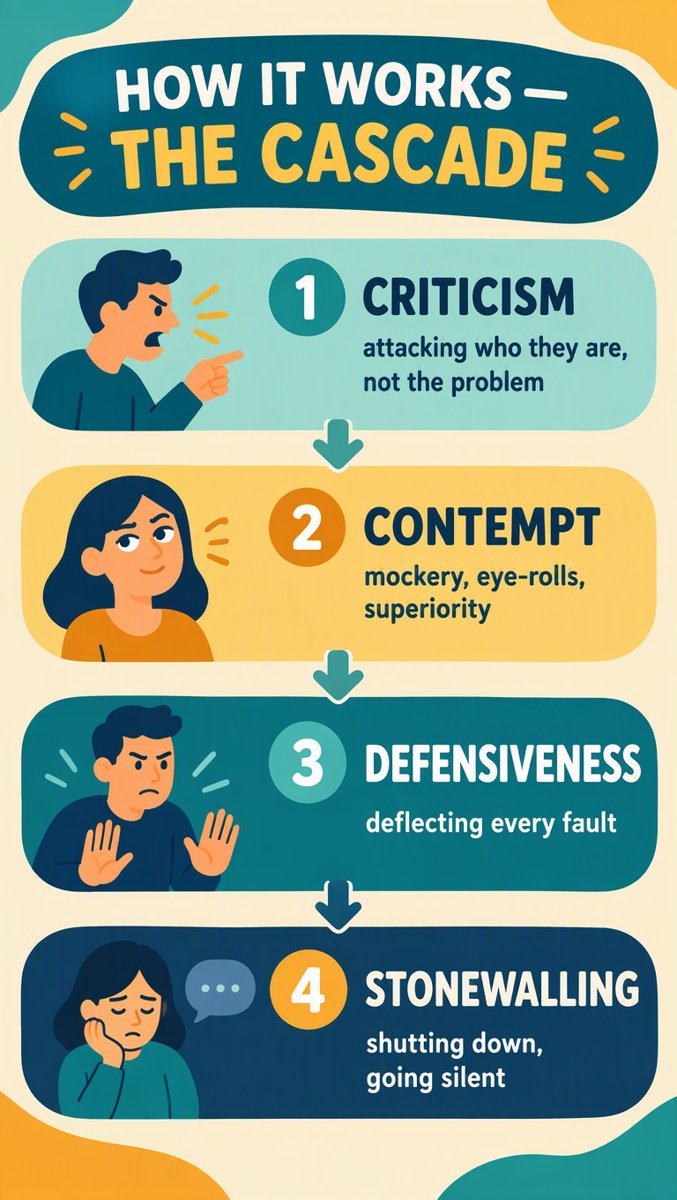
The Horsemen tend to arrive in order, each one lowering the temperature of the relationship further:
- Criticism — attacking your partner's character instead of the problem. "You're so selfish" is a character verdict; "I was scared when you were late and didn't call" is a complaint about a specific moment. The Gottman Institute's guidance is blunt: a complaint addresses an issue, criticism dismantles a person.
- Contempt — mockery, sarcasm, name-calling, eye-rolling, any communication from a position of moral superiority. This is the worst of the four. In Gottman's research, contempt is the single greatest predictor of divorce and must be eliminated. It even correlates with weakened immune function — contemptuous couples report more infectious illness.
- Defensiveness — the reflexive excuse, the innocent-victim posture, the counter-attack ("It's not my fault we're always late; it's your fault"). The Institute calls defensiveness "really a way of blaming your partner." It communicates: your concern doesn't matter.
- Stonewalling — the listener withdraws: tuning out, turning away, acting busy, going silent. Usually a response to feeling physiologically flooded — heart rate spiking, stress hormones surging — at which point rational discussion is literally out of reach.
The Evidence: 93.6% — With an Asterisk Worth Keeping
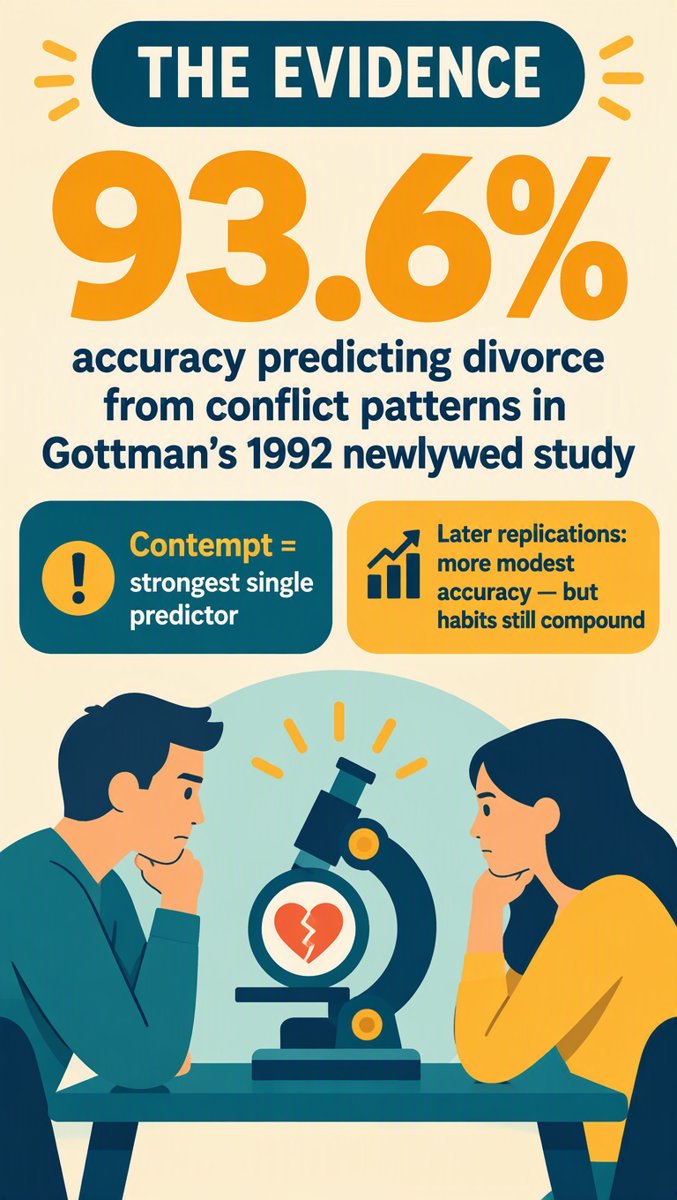
Here's the claim, stated precisely. In the 1992 study by Buehlman, Gottman and Katz, Gottman predicted which newlywed couples would divorce — from observed conflict patterns alone — with 93.6% accuracy. The famous "94%" headline floats around; the Gottman Institute's own research FAQ clarifies what it actually means: a couple is behaving like the couples in the group that divorced in that 1992 study. Across seven divorce-prediction studies, six were genuinely predictive, and independent teams (Conger and Simons at Iowa State among them) replicated parts of the work.
But intellectual honesty matters more than a punchy number. At least one independent generalizability study reported that Gottman's major findings failed to replicate in its sample, and reviews of the Gottman Method's evidence base describe later replications as "more modest and more variable" than the headlines. So treat 93.6% as a striking result from one research program — not a law of physics. The durable lesson doesn't need the big number: habits compound. Small negative interactions, repeated daily, steer a relationship somewhere neither partner chose. Gottman's own data sketch the timeline: the Horsemen predict early divorces (about 5.6 years after the wedding), while emotional withdrawal and anger predict later ones (about 16.2 years).
Spot It Tonight: The Two-Minute Audit
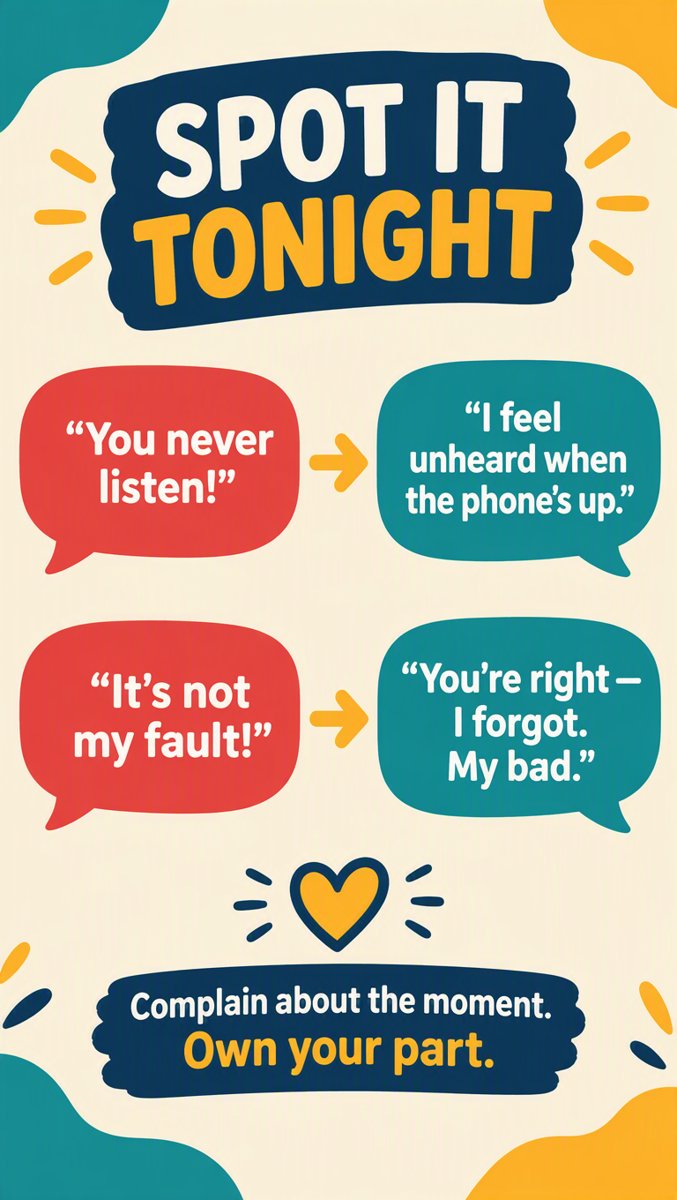
You don't need a lab to run this experiment. Tonight's disagreement is the dataset. Two swaps to watch for:
- "You never listen!" — a criticism (it prosecutes the person). Swap: "I feel unheard when the phone's up." Same issue, but it names a feeling and a moment instead of a character flaw.
- "It's not my fault!" — defensiveness. Swap: "You're right — I forgot. My bad." Ownership is disarmingly cheap.
That's the whole audit: did we attack the problem, or the person? Did we own our part?
The Antidotes
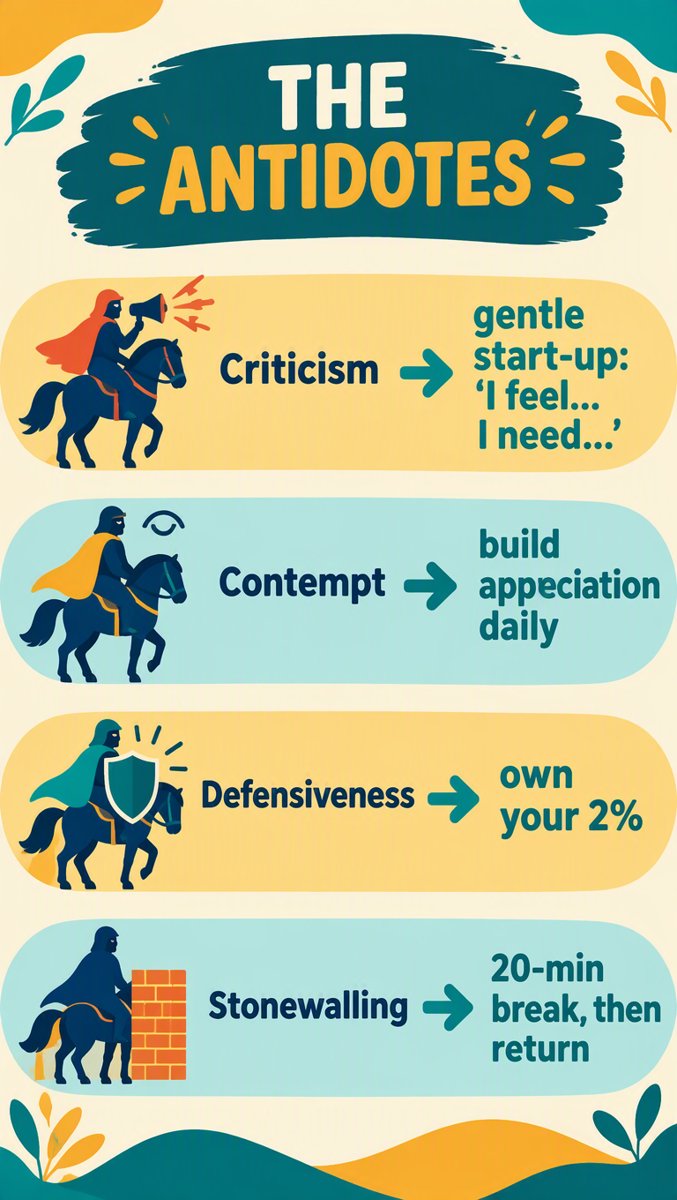
Every horseman has a researched counter-move:
- Criticism → gentle start-up. Complain about the situation, not the person: "I feel X when Y. I need Z."
- Contempt → build a culture of appreciation. Deliberately notice what's going right and say it out loud — daily. Contempt can't survive in a mind rehearsing respect.
- Defensiveness → take responsibility. Find the 2% that's genuinely yours and own it first. It changes the whole conversation.
- Stonewalling → a real break. Say "I'm too flooded to talk well right now — can we take 20 minutes and come back?" Then actually self-soothe (walk, read, breathe) before returning. The Gottman guidance is specific: at least 20 minutes of genuinely distracting, soothing activity.
The Takeaway
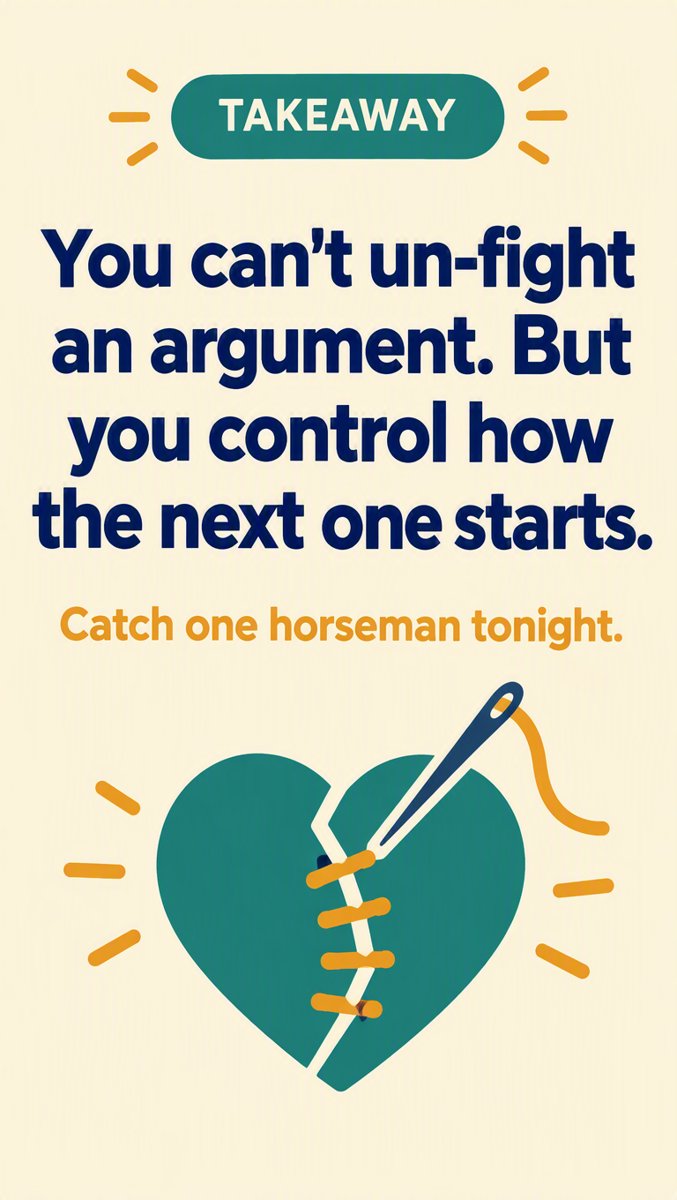
You can't un-fight an argument. But you control how the next one starts. Catch one horseman tonight — just one — and replace it with its antidote. Relationships aren't decided in the dramatic moments; they're decided in the small, repeated ones. That's not just marriage advice. It's compounding, applied to love.
🎬 Narration Script (16 segments · ~196 words · est. ~75-85s)
[Cover] Scientists watched thousands of couples argue. Four habits kept appearing in the ones that broke.
[Slide 1 — The Idea, seg 1] Psychologist John Gottman studied couples for decades. Conflict isn't random — it follows patterns.
[Slide 1 — The Idea, seg 2] Four patterns kept appearing in failing relationships — so he named them the Four Horsemen.
[Slide 2 — The Cascade, seg 1] It starts with criticism: attacking who your partner is, not the actual problem.
[Slide 2 — The Cascade, seg 2] Untreated, it hardens into contempt — mockery, eye-rolls, superiority. The strongest predictor of divorce.
[Slide 2 — The Cascade, seg 3] Then defensiveness — deflecting every fault. Finally stonewalling: shutting down, going silent.
[Slide 3 — Evidence, seg 1] In his 1992 study, Gottman predicted divorce from these patterns with 93.6 percent accuracy.
[Slide 3 — Evidence, seg 2] Later replications found more modest accuracy — but the lesson stands: habits compound daily.
[Slide 4 — Spot It, seg 1] Spot it tonight. "You never listen" attacks the person. Swap in a feeling:
[Slide 4 — Spot It, seg 2] "I feel unheard when the phone's up." Same issue — the problem, not the person.
[Slide 5 — Antidotes, seg 1] Each horseman has an antidote. Criticism? A gentle start-up: "I feel this. I need that."
[Slide 5 — Antidotes, seg 2] Contempt is cured by appreciation — say what's going right, out loud, every day.
[Slide 5 — Antidotes, seg 3] Defensiveness? Own your two percent. Stonewalling? Take a twenty-minute break, then return.
[Slide 6 — Takeaway] You can't un-fight an argument. But you control how the next one starts.
[CTA] If this helped, subscribe — one practical mental model, every day. Think sharper, love better.
Sources
- Gottman Institute — The Four Horsemen: Criticism, Contempt, Defensiveness, and Stonewalling — https://www.gottman.com/blog/the-four-horsemen-recognizing-criticism-contempt-defensiveness-and-stonewalling/
- Gottman Institute — Research FAQ (93.6%, 1992 Buehlman/Gottman/Katz study, replication notes, 5.6/16.2-year timelines) — https://www.gottman.com/about/research/faq/
- TherapyExplained — Gottman Method Research: 40+ Years of Evidence Reviewed — https://www.therapyexplained.com/blog/gottman-method-research
- PMC — Generalizability of Gottman and Colleagues' Affective Process Models — https://pmc.ncbi.nlm.nih.gov/articles/PMC1828692/
- Reallifecounseling — How Dr. Gottman Can Predict Divorce — https://reallifecounseling.us/blog/predict-divorce-gottman