The Energy-Performance Curve: Manage Energy, Not Time — Ride the 90-Minute Wave

Think and Growth — Video: The Energy-Performance Curve
Theme: Health — habits, energy, wellness (Thursday) Model: The Energy-Performance Curve (Ultradian 90-minute waves) Date: 2026-11-19
Full Article (reading / SEO version)
The Energy-Performance Curve: Manage Energy, Not Time
High performers don't outwork everyone. They out-recover.
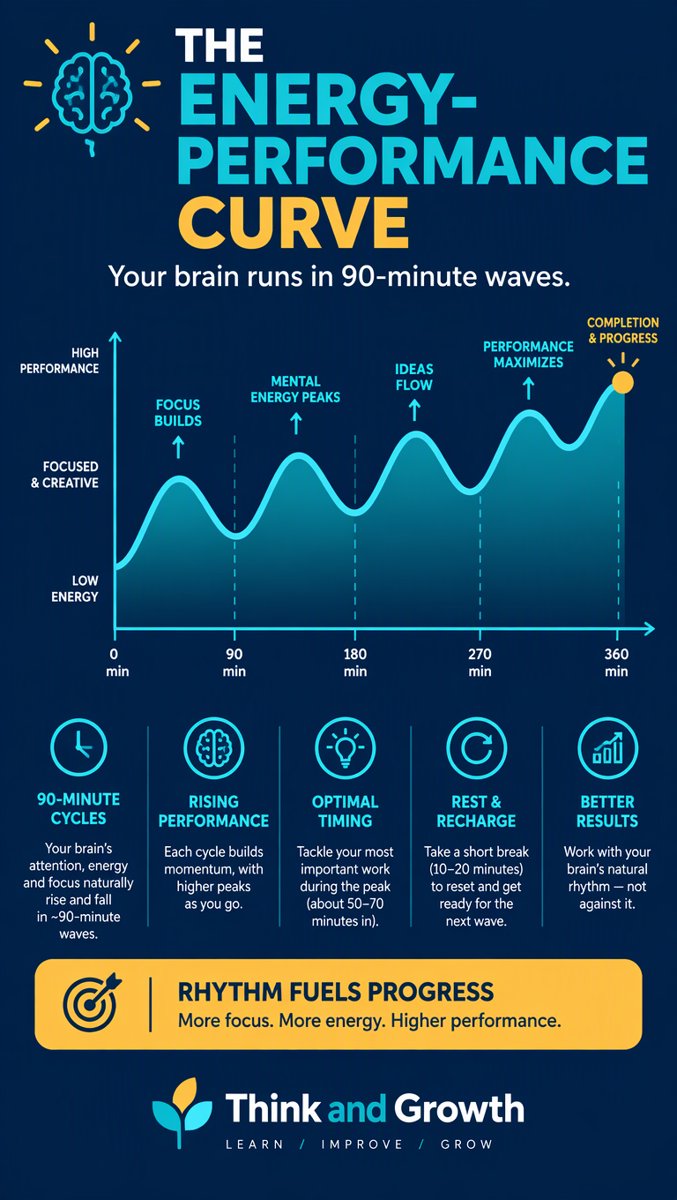
The Energy-Performance Curve is a simple, powerful reframe for your day: your brain and body don't run on a steady line. They run in waves — roughly 90-minute cycles of high alertness followed by a short dip in which energy naturally falls.
This rhythm is called an ultradian rhythm, first mapped by sleep researcher Nathaniel Kleitman in the 1950s as the Basic Rest-Activity Cycle. EEG and performance studies since then keep finding the same pattern: alertness, focus, and cognitive performance rise, peak, and then drop in a wave of roughly 75 to 125 minutes.
Why does this matter for your health and your output? Because the way most of us work — endless back-to-back blocks, grinding through the dip on coffee and willpower — fights that biology. When you push past the recovery trough without resting, you don't get more done. You get sloppier, slower, and more depleted. The research is clear: the distinguishing variable between elite performers and everyone else isn't how hard they train. It's how they alternate intense effort with genuine recovery.
Jim Loehr and Tony Schwartz, founders of The Energy Project, built an entire framework on this observation. They studied world-class athletes and found the best ones trained in cycles of intense exertion followed by deliberate recovery. Their conclusion: we live in a world of relentless pace. Time management is no longer a viable solution — because time is finite, but energy is expandable.
Modern workplace data backs this up. A 2025 study from DeskTime found that top-performing workers averaged about 75 minutes of focused work followed by 33 minutes of rest. That's not laziness. That's alignment with the wave.
How It Works
- Peak phase (75–90 minutes): Alertness is high. Cognitive performance is sharp. This is your deep-work window. Put your hardest thinking here.
- Recovery trough (15–20 minutes): Energy drops. Focus blurs. Your body is asking for a reset. Rest here — walk, hydrate, look outside. Don't scroll, don't answer email, don't "power through."
- Repeat: Each clean cycle returns you to a fresh peak. Two or three clean waves a day outperform eight hours of grinding.
Real-World Proof
- Kleitman's Basic Rest-Activity Cycle (BRAC) — ~90-minute oscillations in arousal during both sleep and waking.
- DeskTime 2025 — top performers averaged ~75 minutes of focus, then ~33 minutes of rest.
- Loehr & Schwartz, The Power of Full Engagement (2003) — athletes win by managing the oscillation between effort and recovery, not by training harder around the clock.
Apply It Today
- Schedule one 90-minute deep-work sprint before 10 a.m., phone face-down, one hard task. Protect the headline.
- Take a real 15-minute recovery after it. Walk, stretch, hydrate, daylight. No feeds, no inbox.
- Time-box your day into waves, not hours. Check the clock at 90 minutes. If the wave has dipped, honor the dip. Energy managed is output multiplied.
Takeaway: Manage energy, not time. Run your day in waves, and both your health and your performance compound.
Narration Script (~190 words total)
Hook (~12w): You don't run out of time. You run out of energy. Here's the wave science that fixes it.
Idea (~30w): This is the energy-performance curve — roughly ninety-minute waves of focus and recovery. Your brain is built to oscillate between peak and trough, every single day. Fight that rhythm, and performance collapses.
Mechanism (~40w): Each cycle works like this: a seventy-five to ninety-minute peak of sharp, deep focus — then a fifteen-to-twenty-minute recovery trough where alertness drops. Push through the trough without resting, and the next peak is weaker, sloppier, and shorter.
Example (~40w): Top-performing workers average about seventy-five minutes of focused work, then thirty-three minutes of genuine rest. The best athletes train the same way: intense effort, then deliberate recovery. Time management can't fix a mismatched rhythm. Energy management can.
Apply (~40w): So, do this today. Schedule one ninety-minute deep-work sprint before ten a.m. — phone away, one hard task. Then take a real fifteen-minute break: walk, stretch, daylight. Repeat the wave, don't grind the trough.
Takeaway + CTA (~25w): Manage energy, not time. Run your day in waves. Follow Think and Growth for the next model — and start your first wave today.
Per-Slide Segment Text
| Slide | Segments |
|---|---|
| Cover | Hook (12w) |
| Slide 1 — The Idea | Idea, split into 2 clips (~15w each) |
| Slide 2 — How It Works | Mechanism, split into 3 clips (~13w each) |
| Slide 3 — Real-World Proof | Example, split into 3 clips (~13w each) |
| Slide 4 — Apply It Today | Apply, split into 3 clips (~13w each) |
| Slide 5 — Takeaway | Takeaway + CTA (~25w) |
| CTA — Peter | Spoken outro, reuse of takeaway/CTA |
by Peter, BDM @ NXagents.net — Think and Growth video series