The Beautiful Mess Effect: Your Vulnerability Looks Braver From the Outside

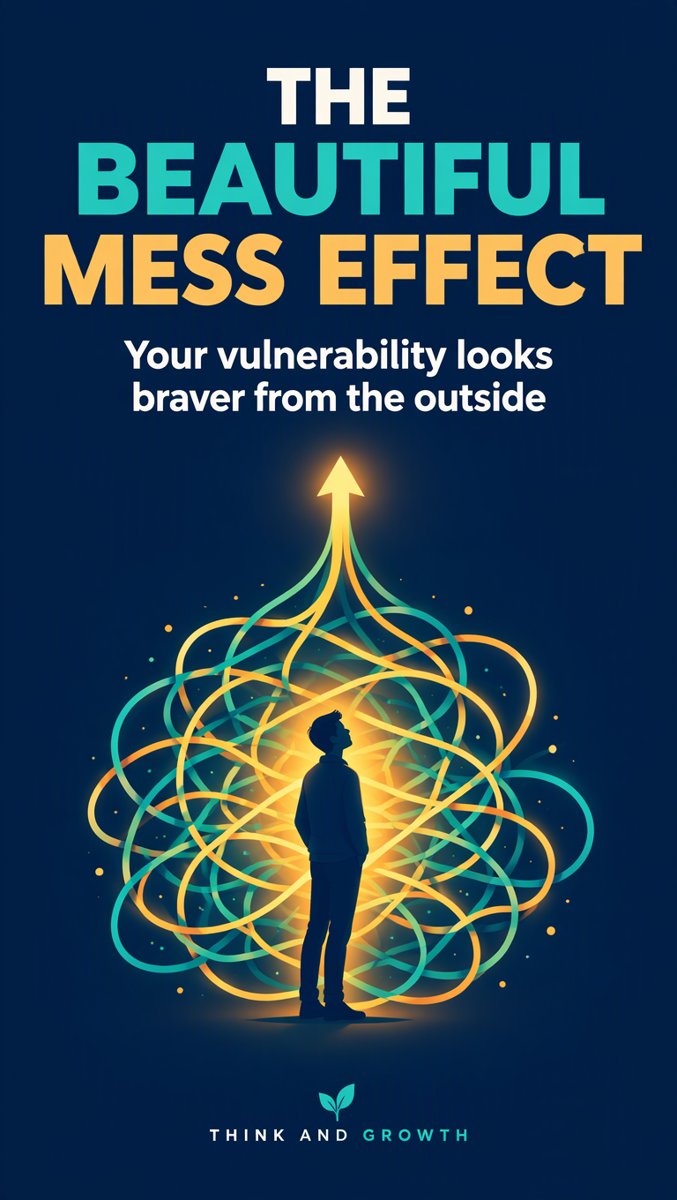
The Beautiful Mess Effect: Your Vulnerability Looks Braver From the Outside
Think and Growth — Episode #36 · Theme: Friendship · November 7, 2026
You think your honesty makes you look weak. Your friends think it makes you brave. That gap — between the verdict you fear and the verdict you'd actually receive — has a name in psychology: the beautiful mess effect.
The Idea: One Act, Two Verdicts
In 2018, psychologists Anna Bruk, Sabine Scholl, and Herbert Bless published a study in the Journal of Personality and Social Psychology that asked a deceptively simple question: how do people evaluate vulnerability — in themselves, and in others?
The answer was strikingly asymmetric. When people imagined showing vulnerability themselves — admitting a mistake, confessing romantic feelings, asking for help in front of others — they tended to rate the act as weakness, as losing face, as exposure. But when they imagined someone else doing the exact same thing, they rated it as courage, as authenticity, even as strength. (Bruk, Scholl & Bless, 2018, JPSP 115(2):192–205)
Same act. Two verdicts. The only variable that changed was whose it was.
How It Works: The Inside View vs. the Outside View
Why does the gap exist? Because you and your observer are watching two different shows.
Inside, you experience the whole mess — the racing heart, the rehearsed sentence that suddenly sounds absurd, the mental catalogue of every way this could go wrong. Your judgment of the moment is saturated with that private chaos.
Outside, none of that is visible. Observers can't see your inner storm; they only see the finished act — a person who chose honesty in a moment where silence was safer. And an act like that reads as brave. You're pricing your fear in a currency nobody else is counting.
This is closely related to what researchers call self–other asymmetries in judgment: we evaluate our own behavior with full access to our doubts, and other people's behavior from the evidence alone. A 2022 follow-up framing found the same pattern with a confession of love — rated more positively when imagined as another person's act than as one's own.
The Evidence in Everyday Moments
The Bruk et al. studies deliberately used ordinary, non-clinical vulnerability: admitting you got something wrong, telling someone how you feel, asking for help. These are the micro-moments friendship is actually built from. Across the scenarios, the pattern held — self-ratings sketched weakness, other-ratings sketched courage. The British Psychological Society's The Psychologist has since covered the effect and the follow-up work it spawned, including 2023 research on secrecy and closeness.
This also lines up with two decades of research by Brené Brown at the University of Houston: her core finding is that "courage is born out of vulnerability, not strength" — and that vulnerability is the birthplace of human connection. Bruk's team supplied the twist Brown's work implied: you are the least reliable judge of how your vulnerability will land.
Why It Matters for Friendship
Friendship deepens through mutual disclosure — each honest exchange lowers the wall a little for both people. But if every person in the friendship overestimates the social cost of going first, everyone stays guarded, and the relationship stalls at the small-talk layer.
The beautiful mess effect says the cost you're calculating is inflated. The bravery you're afraid to show is, statistically, the version of you your friends will admire most.
How to Apply It
1. Name the gap. Before you swallow an honest sentence, remember: the verdict you fear isn't the verdict you'd get. You are judging your mess with insider data your friends will never see.
2. Go first — small. One honest sentence this week. "I've been struggling with this." "I got that wrong." "I actually need help here." Small disclosures are low-risk, and they give the friendship permission to be real.
3. Honor their honesty. When a friend goes first, treat it like the courage it is — because to them it felt exactly as risky as yours does to you. Your response teaches them whether truth is safe with you. That's how a friendship gets deep instead of polite.
The Takeaway
Friendship doesn't deepen in the polished moments. It deepens in the beautiful mess. The mess is the message: what you hide keeps friends out; what you show lets them in.
📺 Narration Script (video version, ~70–80s)
[Cover — Hook] You think your honesty makes you look weak. Your friends think it makes you brave.
[Slide 1 — The Idea] Psychologists call it the beautiful mess effect. In a twenty eighteen study, people judged the same act of vulnerability two opposite ways. Their own: weakness. Someone else's: courage and authenticity.
[Slide 2 — How It Works] Here's why. Inside, you feel the whole mess — the risk, the shaky what-ifs. But observers can't see any of that. They only see the act itself. And the act reads as brave.
[Slide 3 — The Evidence] Researchers tested it with everyday moments — admitting a mistake, confessing feelings, asking for help. Every time, the identical act was judged weaker when it was yours. A twenty twenty-two follow-up found the same with a confession of love.
[Slide 4 — How to Apply It] So use it. One: name the gap — the fear isn't the verdict. Two: go first — one honest sentence with a friend this week. Three: when a friend goes first, honor it. Your response teaches them whether truth is safe with you.
[Slide 5 — Takeaway] Friendship doesn't deepen in the polished moments. It deepens in the beautiful mess.
[CTA Outro] Follow Think and Growth — one mental model a day, every morning.
Sources
- Bruk, A., Scholl, S. G., & Bless, H. (2018). Beautiful Mess Effect: Self–Other Differences in Evaluation of Showing Vulnerability. Journal of Personality and Social Psychology, 115(2), 192–205. — https://www.researchgate.net/publication/326743464_Beautiful_mess_effect_Self-other_differences_in_evaluation_of_showing_vulnerability · https://www.semanticscholar.org/paper/cfbaaa8e5d1d3e4319437eeb2a117d2efafb8784
- The British Psychological Society — The Psychologist, "The beautiful mess effect." — https://www.bps.org.uk/psychologist/beautiful-mess-effect
- Brené Brown, "The Courage to Be Vulnerable," On Being. — https://onbeing.org/programs/brene-brown-the-courage-to-be-vulnerable-jan2015/ · https://fs.blog/great-talks/power-vulnerability-brene-brown/
- Psychology Today, "The Benefits of Letting Yourself Be Vulnerable" (follow-up framing). — https://www.psychologytoday.com/us/blog/social-influence/202110/the-benefits-of-letting-yourself-be-vulnerable