The 69% Rule: Why Most Couple Fights Never Get Solved — And Why That's Normal


The 69% Rule: Why Most Couple Fights Never Get Solved — And Why That's Normal
Every couple has The Fight. You know the one — it has different costumes (the vacation booking, the dishwasher, the in-laws' visit) but the same skeleton. You've had it eleven times. You'll have it again next month. And if you're like most people, you've quietly concluded that this means something is broken.
Here's the finding that should reorganize how you think about family conflict: it doesn't. Relationship researcher John Gottman found that 69% of couple conflicts are "perpetual problems" — and all couples have them. Not the unhappy ones. All of them.
The Number
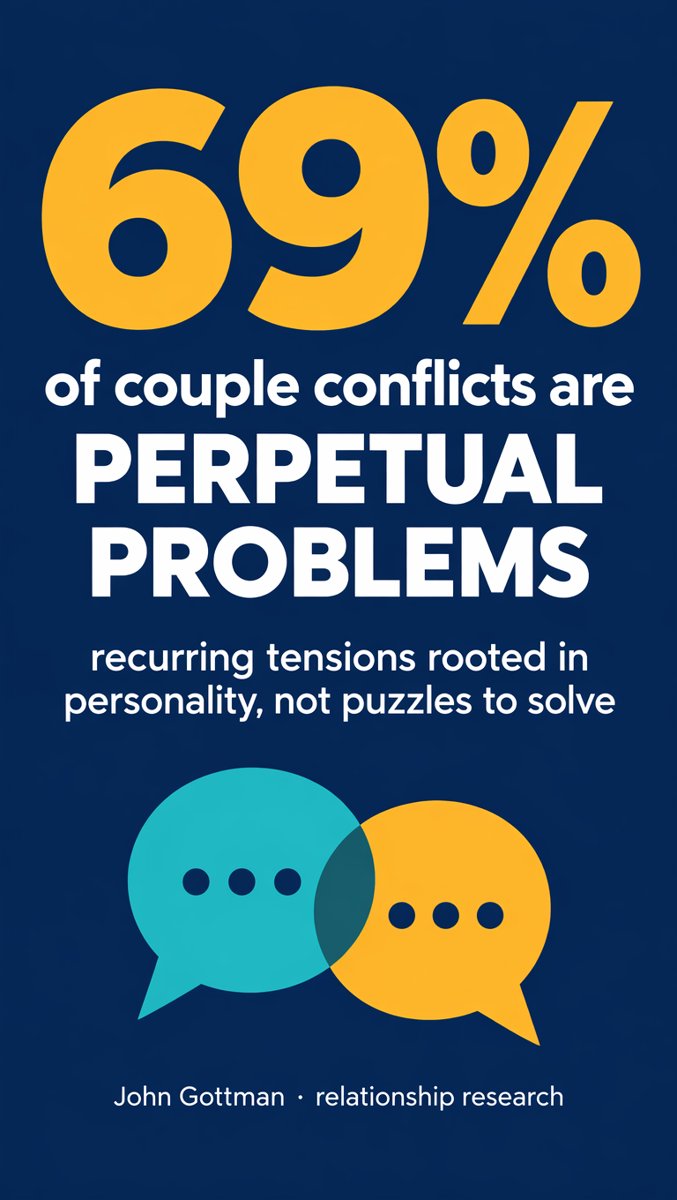
Gottman's decades of longitudinal research — the same body of work that produced the famous Four Horsemen — found that sixty-nine percent of relationship conflict is about perpetual problems: recurring tensions grounded in fundamental differences in personality or lifestyle needs. The Gottman Institute states it plainly: "Sixty-nine percent of relationship conflict is about perpetual problems. All couples have them."
Psychology Today calls this one of the most replicated insights in relationship science. Couples Therapy Inc. corroborates the figure from Gottman's original studies: the friction points over finances, intimacy, family, and lifestyle choices persist across decades.
Read that again: most of your recurring fights are permanent residents, not squatters. The planner married to the spontaneous one does not converge into a middle temperament. The introvert does not become an extrovert because love asked nicely.
Three Buckets, Not Two
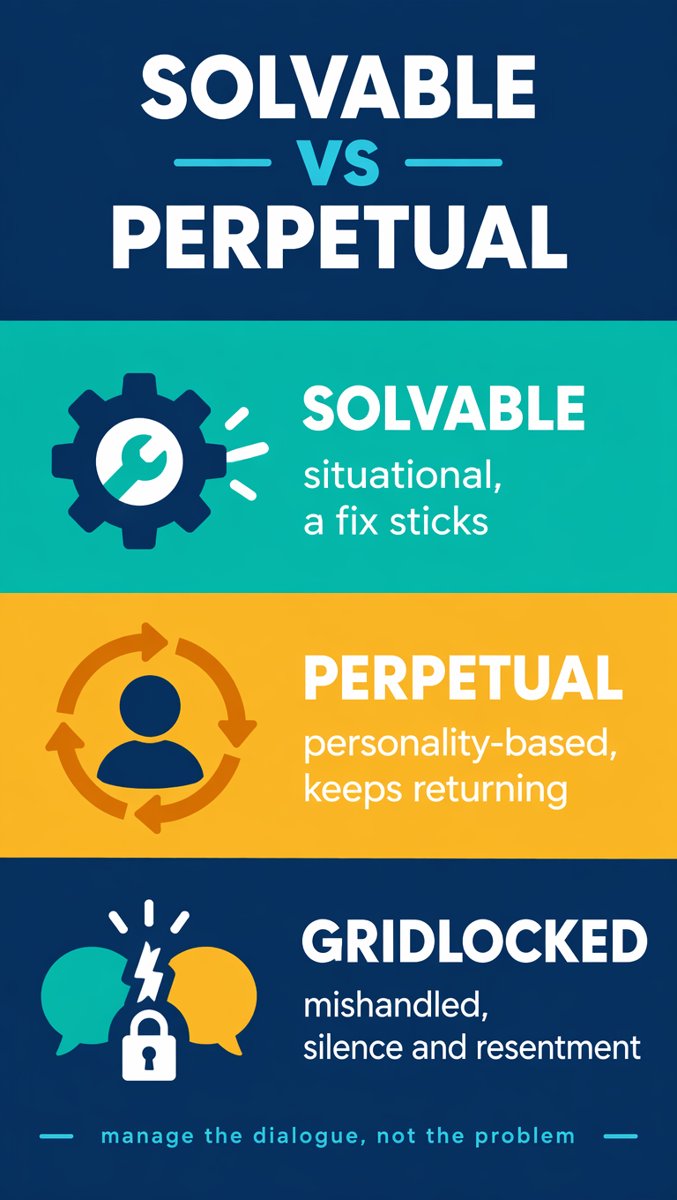
The practical move is diagnosis. Gottman's framework sorts every conflict into three buckets:
- Solvable problems — situational, no deep meaning underneath. A fix exists, and once found, it sticks. Who picks up the kids Thursday can be solved by Thursday.
- Perpetual problems — rooted in personality or lifestyle needs. They return, reliably, forever. The goal is not victory; it's dialogue that stays alive.
- Gridlocked perpetual problems — perpetual problems that got mishandled. They calcify. Conversations feel like spinning wheels. Hidden agendas take over, and eventually emotional disengagement.
Here's the subtlety that makes the model useful rather than fatalistic: the same topic can be solvable for one couple and perpetual for another. Money is a solvable problem for couples who share financial values and a perpetual problem for couples who don't. The topic was never the issue. The meaning underneath it was.
One Fight, Two Endings
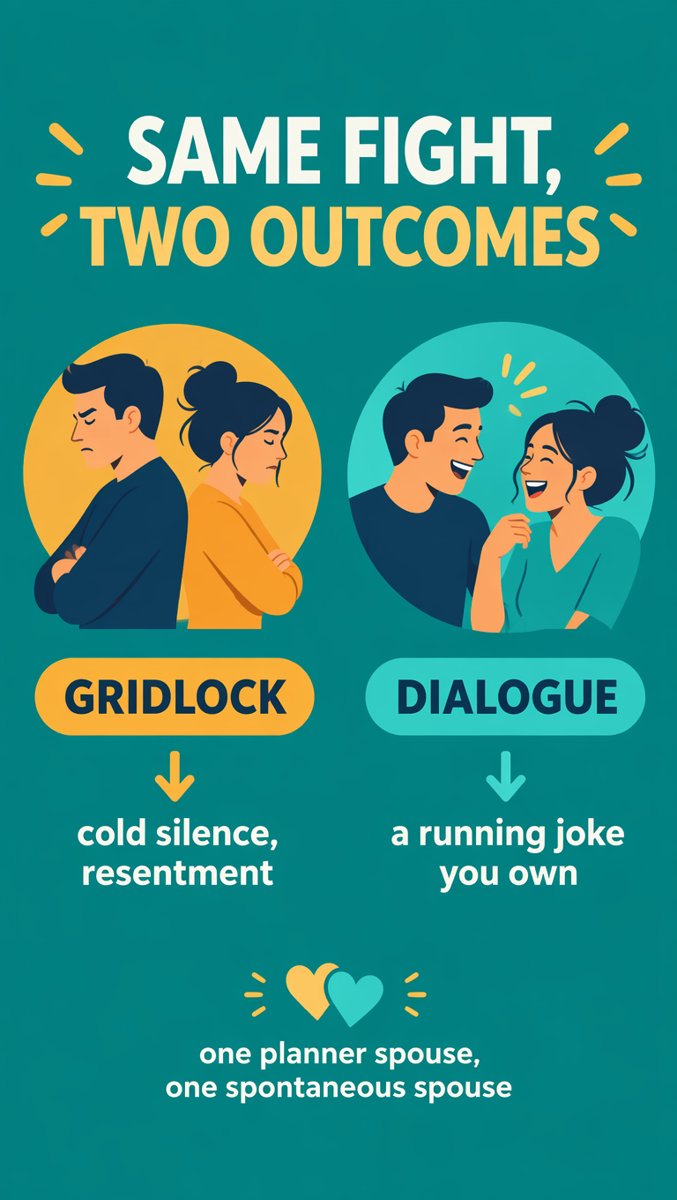
Picture one planner married to one spontaneous free spirit. The trip-planning tension will never disappear — it's personality-level, which means it's permanent.
Now watch the fork in the road. Handled with humor and affection, it becomes a running joke the couple owns — "there goes the spreadsheet gremlin again." Handled with criticism and contempt, it becomes gridlock: cold silences, scorekeeping, the slow drift toward parallel lives under one roof.
Gottman's research is unambiguous about which ending predicts relationship survival. What matters is not whether the perpetual problem exists, but the affect with which it is discussed — dialogue delivered with humor, affection, even amusement. Gridlocked discussions, his work found, almost always involve the Four Horsemen: criticism, contempt, stonewalling, defensiveness.
The Playbook
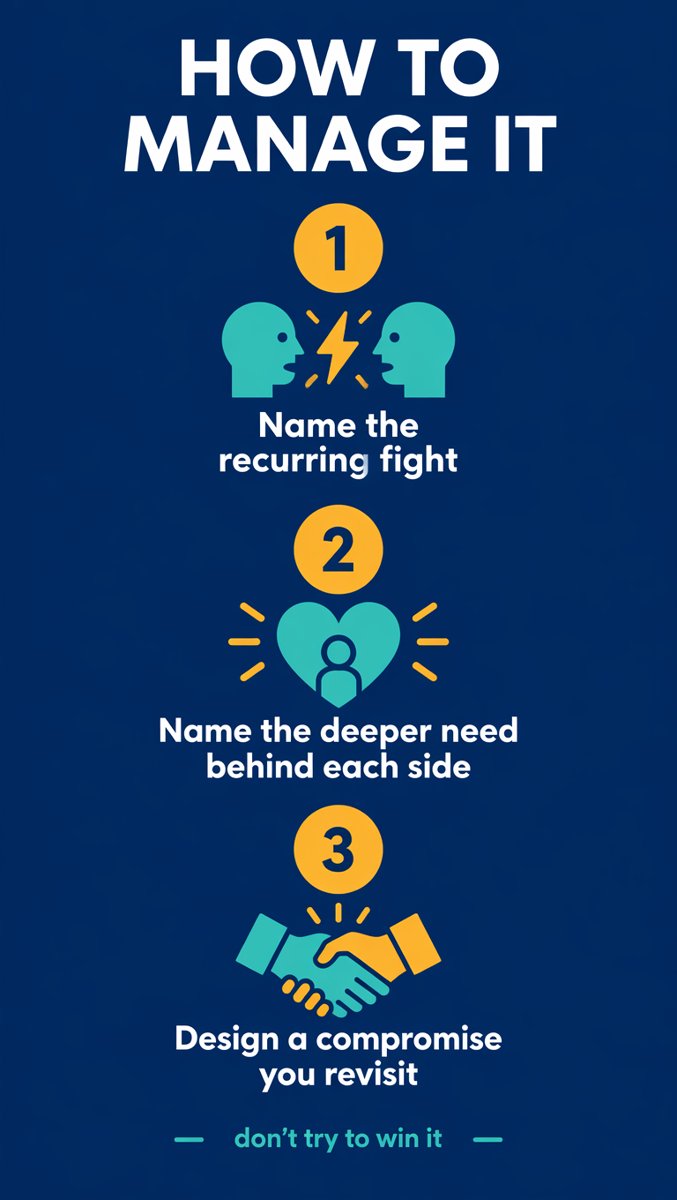
Three steps to manage a perpetual problem instead of fighting it:
- Name the recurring fight for what it is. Literally say it out loud: "This is our perpetual problem, not an emergency." Naming it downgrades the threat level. You're not diagnosing a marriage failure; you're cataloguing a personality difference.
- Name the deeper need behind each side. The planner's need is usually security and predictability; the spontaneous partner's is autonomy and aliveness. The fight about flights is never about flights.
- Design a compromise you both accept — and plan to revisit it. The word is temporariness. A perpetual problem is managed the way a garden is managed: not solved once, but tended repeatedly, with a standing appointment to renegotiate.
The Takeaway
The goal was never to fix each other. Happy couples don't have fewer differences than miserable ones — Gottman's data shows they have roughly the same number of perpetual problems. What they have is a warmer way of carrying them.
So run the diagnosis on your next recurring fight. If it's solvable — solve it and move on. If it's perpetual — stop spending goodwill trying to win it, and start spending warmth managing it.
Stop solving. Start managing.
Sources:
- Managing Conflict: Solvable vs. Perpetual Problems — The Gottman Institute
- Decoding "Perpetual Problems" — Couples Therapy Inc.
- Why 69 Percent of Couples' Conflicts Will Never Go Away — Psychology Today
Narration Script (186 words · ~75s)
[Cover] Every couple fights about the same things. Science says that's not a bug.
[Slide 1 — The Idea] John Gottman found that sixty-nine percent of couple conflicts are what he calls perpetual problems. // They return because they're rooted in personality and lifestyle needs — not because anyone's failing.
[Slide 2 — Mechanism] So sort every fight into one of three buckets. // Solvable problems are situational — find a fix, and it sticks. // Perpetual problems come back forever. If you mishandle them, they gridlock into silence and resentment.
[Slide 3 — Example] Picture one planner married to one spontaneous free spirit. // Their trip-planning tension never disappears — it's personality-level. // Handled with humor, it becomes a running joke. Handled with contempt, it becomes gridlock.
[Slide 4 — Apply] Here's the playbook. First, name the recurring fight for what it is. // Second, name the deeper need behind each side's position. // Third, design a compromise you both accept — and plan to revisit it.
[Slide 5 — Takeaway] The goal was never to fix each other. Happy couples don't have fewer differences. // They manage them with warmth. Stop solving. Start managing.
[CTA] If this reframe helps, share it with someone you love — and subscribe to Think and Growth for one mental model every day.