Stress Mindset: The Belief That Decides Whether Pressure Breaks You — or Builds You

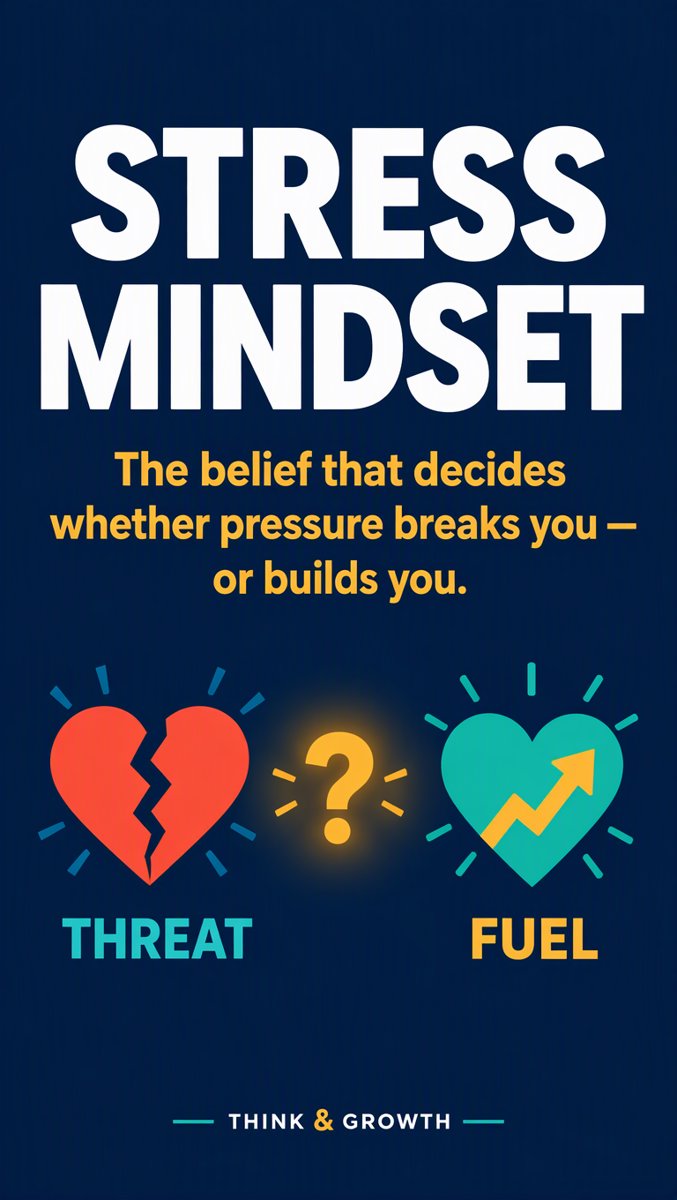
Stress Mindset: The Belief That Decides Whether Pressure Breaks You — or Builds You
Think and Growth — Episode #37 · Friday Theme: Mental Health
Your heart pounds before the big presentation. Your mind races the night before a deadline. Every culture, every doctor, every well-meaning friend has told you the same thing for decades: this is bad for you. Calm down. Don't stress. Stress kills.
Stanford psychologist Alia Crum has spent her career testing that assumption — and the results should change how you handle every pressure-filled week of your life.
Two Mindsets, Two Bodies
Crum's foundational research, published with Peter Salovey and Shawn Achor in the Journal of Personality and Social Psychology in 2013 (PubMed), identified a measurable psychological variable called stress mindset. People fall into two camps:
- Stress-is-debilitating: "Stress is toxic. It harms my health and performance. I must avoid it or manage it."
- Stress-is-enhancing: "Stress is fuel. It sharpens me, focuses me, and helps me grow."
Here's the remarkable part: the two groups experience the same adrenaline, the same pounding heart, the same racing thoughts. What differs is the label the brain attaches to those signals — and the label measurably changes what the body does next.
In Crum's third study, participants with a stress-is-enhancing mindset showed moderate cortisol reactivity under pressure — a healthier, more adaptive hormonal response than either chronic flooding or a flatline. They were also more open to feedback, a core driver of growth (Stanford SPARQ).
The Number That Should Stop You Cold
If mindset only shifted feelings, this would be an interesting footnote. It doesn't. It shows up in death records.
Keller and colleagues, publishing in Health Psychology, surveyed roughly 30,000 American adults with two questions — how much stress did you experience last year, and do you believe stress harms your health — then tracked them for eight years using public death records (full text, PMC).
Among people with high stress who believed stress was damaging their health, the risk of premature death rose by 43% (HR = 1.43, 95% CI [1.20, 1.71]) (APA record).
And the high-stress people who did not believe stress was harming them? They had the lowest death risk of anyone in the study — lower even than the low-stress group.
Read that again. Same world, same deadlines, same pressures. The belief — not the stress — tracked with who lived.
The Mechanism: Your Brain Asks a Question
Why would a belief reach all the way into your blood vessels? Because the stress response is, at its core, energy delivery. Your heart pumps faster. Attention narrows. Glucose mobilizes. Then your brain asks one question: "What does this mean?"
If the answer is threat, blood vessels constrict — the classic panic profile. If the answer is challenge, vessels stay dilated and the extra fuel reaches your brain and muscles. In the Harvard reappraisal experiments cited alongside the Keller study, participants coached to see their arousal as helpful pumped blood more efficiently and kept their vessels significantly more open under social stress.
Mindset, in Crum's phrase, is the instruction manual your brain hands your body. Change the manual, and the same hardware runs a different program. Later work from her lab (Crum et al., 2017) found stress-is-enhancing believers showed sharper anabolic — growth-oriented — hormone responses under both challenge and threat (Stanford Mind & Body Lab).
How to Apply It: The 10-Second Reframe
You don't need a week of training videos — though Crum's UBS intervention showed even that shifts the dial, cutting anxiety symptoms like headaches and insomnia among hundreds of financial employees in the middle of real layoffs. In the moment, her lab's three-step reframe takes about ten seconds:
- Acknowledge it. "I'm stressed." Then connect it to what it means: this pressure exists because something matters to you. Stress is a barometer of caring, not a malfunction.
- Own the energy. The pounding heart isn't failure — it's your body delivering fuel. Say it explicitly: this is fuel, not harm.
- Use it. Spend the arousal on your very next concrete step — the first sentence, the first email, the first rep. Energy with nowhere to go becomes anxiety; energy with a target becomes performance.
The Honest Caveats
This is not a license to ignore chronic, unrelenting overload. The Keller study is observational — it tracks associations, not proof of causation — and a mindset shift does not replace sleep, boundaries, or professional help when you need it. And some stressors genuinely are toxic; the skill is knowing the difference between load you can reframe and load you must remove. Crum's own framing is careful: the goal isn't "stress is always good," it's "stop assuming it's always bad."
The Takeaway
Stress isn't the enemy. The story you tell about it — threat or fuel — decides whether the same pounding heart breaks you down or builds you up. You control the story.
That's the whole model. Ten seconds of reframe, backed by 30,000 lives of data.
Narration Script (video, ~190 words ≈ 76–90s)
[Cover] Your heart pounds. Your focus sharpens. Is that a warning — or fuel?
[Slide 1] Stanford's Alia Crum found two kinds of people: those who believe stress is toxic, and those who believe it's fuel. The belief changes what stress actually does to you.
[Slide 2] Stress releases energy — your heart races, your focus sharpens. Then your brain asks one question: what does this mean? Threat constricts your vessels. Challenge keeps them open — fuel delivered where it's needed.
[Slide 3] This isn't just theory. Researchers tracked nearly thirty thousand adults for eight years. Those who believed stress was harming them had a forty-three percent higher death risk. High-stress people who didn't fear it? The lowest risk of anyone in the study.
[Slide 4] So here's the reframe, in three steps. Acknowledge: "I'm stressed — this matters to me." Own the energy: a pounding heart is fuel, not failure. Then use it: spend that energy on your very next concrete step.
[Slide 5] Stress isn't the enemy. The story you tell about it decides everything.
[CTA] That's today's Think and Growth. If this shifted how you see pressure, follow along — one mental model, every day, in about a minute. See you tomorrow.
Sources
- Crum, A. J., Salovey, P., & Achor, S. (2013). Rethinking stress: The role of mindsets in determining the stress response. Journal of Personality and Social Psychology, 104(4), 716–733. https://pubmed.ncbi.nlm.nih.gov/23437923/
- Keller, A., et al. (2012). Does the perception that stress affects health matter? Health Psychology. https://pmc.ncbi.nlm.nih.gov/articles/PMC3374921/ · https://psycnet.apa.org/record/2011-30116-001
- Stanford SPARQ — To Work Better, Rethink Stress: https://sparq.stanford.edu/solutions/work-better-rethink-stress
- Stanford Mind & Body Lab — Stress: https://mbl.stanford.edu/stress