Stop Letting Everything Affect You by Daniel Chidiac: Honest Review, Rating & Who Should Read It — Verdict 7.5/10

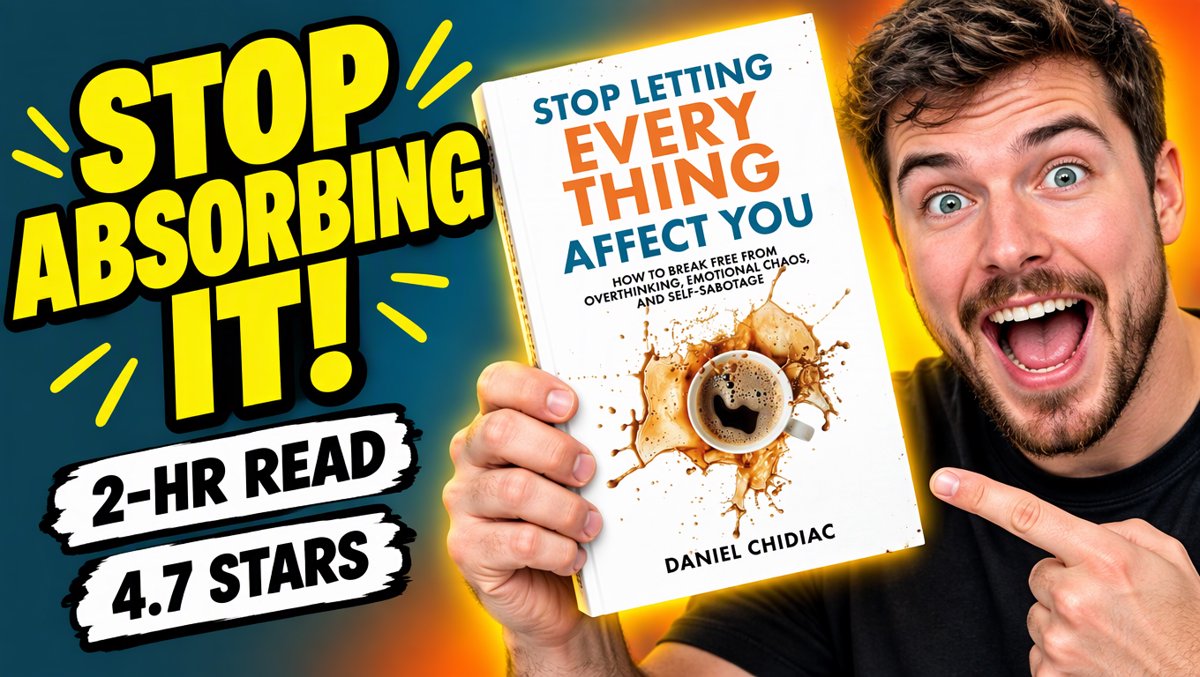
Stop Letting Everything Affect You by Daniel Chidiac: Honest Review, Rating & Who Should Read It — Verdict 7.5/10
Stop Letting Everything Affect You by Daniel Chidiac (2025), Verdict 7.5/10: 4.7 stars from 4,670 Amazon ratings, but only 4.01 from 14,455 Goodreads ratings — the widest gap in modern self-help, and the reason to read this review before you buy. The cover says "STOP LETTING EVERYTHING AFFECT YOU," Chidiac was the #7 Amazon Self-Help bestseller on Nov 26, 2026 and #1 in Self-Esteem and Emotional Self Help, and his pitch — overthinking, emotional chaos, self-sabotage — is exactly what one Amazon buyer (Sep 16, 2026, 62 helpful votes) called "20 sessions of therapy and healing all in one" that she read in two hours and put on her nightstand to reread. And yet Goodreads 1-star reviewers (Apr 7, 2026) call the book "Victim Mentality as a book" that "spends 200 pages explaining how everyone around you is a narcissist" and "is a sales funnel," while a string of readers insist it "reads like it was written by AI" or "the most ChatGPT coded book I've ever read." Both extremes are telling the truth about the same 186 pages. Here's the balance sheet.
The 3-second version
- What it is: A 186-page, 20-chapter emotional-detachment manual for chronic overthinkers, people-pleasers, and anyone who walks away from a small slight carrying it all day.
- Who wrote it: Daniel Chidiac, Melbourne author (b. 1987) of Who Says You Can't? You Do (2012, republished by Penguin Random House) and The Modern Break-Up.
- Why it matters: It's the #7 Amazon Self-Help book right now (Nov 26, 2026) and Bloomberg put it on "The 82 Books That Top Business Leaders Couldn't Put Down" (Nov 2025) — yet it's the same book Goodreads is split on: 35% five stars, 37% four, 20% three, 5% one-or-two.
- The verdict: 7.5/10 — a genuinely useful two-hour reset with real tools, padded by repetition and a late swerve into faith that strict secular readers will trip over.
The book data card
| Field | Detail (checked Nov 26, 2026) |
|---|---|
| Title (full) | Stop Letting Everything Affect You: How to Break Free from Overthinking, Emotional Chaos, and Self-Sabotage |
| Author | Daniel Chidiac (Undercover Publishing House Pty Ltd) |
| First published | July 1, 2025 (Goodreads Kindle); US paperback July 4, 2025 |
| Pages | 186 (Amazon print) / 171 (Kindle) |
| ISBN-13 / ISBN-10 | 978-1764110808 / 1764110803 (paperback); Kindle ASIN B0FGDPP7Q7; hardcover 9781764110853 |
| List price | $22.99 paperback · $9.99 Kindle · $34.99 hardcover · $0.99 audiobook + Audible |
| Amazon | amazon.com/dp/1764110803 — 4.7★ (4,670 ratings) |
| Goodreads | goodreads.com/en/book/show/237833933 — 4.01 (14,455 ratings, 1,449 reviews) |
| Audible | 4.8★ (3,846 ratings) |
| Bestseller ranks | #512 in Books; #1 in Self-Esteem; #1 in Emotional Self Help; #2 in Stress Management |
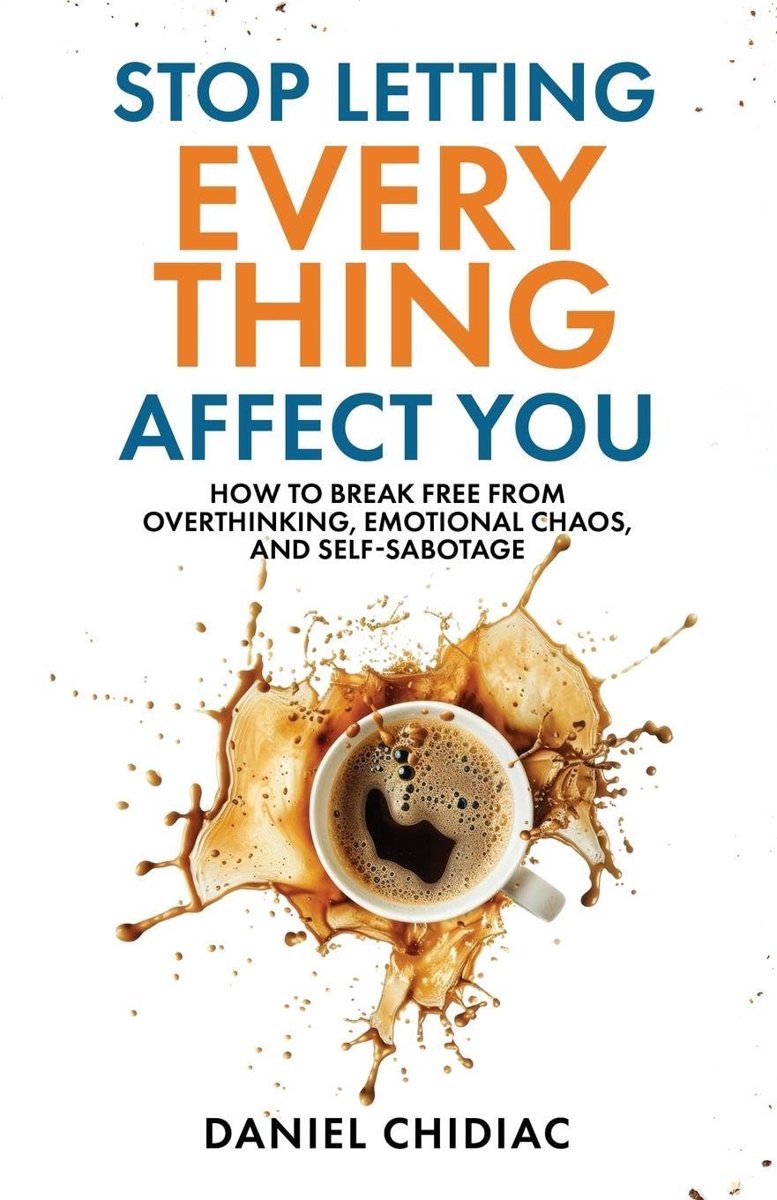
| Cover | Blue/orange block type on white with top-down coffee-splash image; signature stark design |
What does "Stop Letting Everything Affect You" actually teach?
Chidiac's premise is deliberately simple: overthinking is not a character flaw, it is a response pattern, and patterns can be rewritten. "In a world designed to keep you overwhelmed, learning to protect your peace isn't just important—it's essential," he writes — a line he uses as the book's thesis and that reviewers quote more than any other. The book promises eleven outcomes and they are all variations of one move: notice the feeling, name it, and decide how much power it gets over your day.
The structure is an introduction plus 20 numbered chapters (Chapter 1 is "The Root of the Problem: Why You Feel Everything So Deeply"; Chapter 10 covers hidden manipulation in relationships; Chapter 19 is "Finding Light in Life's Journey"; Chapter 20, "Go And Live," closes in three lines — "This is your chapter to write. Go and live... You've got this. Love and Light, Daniel Chidiac"). The 20 chapters are grouped under six parts: Part 1 asks why you let everything affect you, Part 2 argues you're letting life control you, middle parts work through emotional weight and guilt, later parts cover a "witness practice" for standing apart from your own mind, the ego's comfort-zone tricks, and a closing argument about forgiveness being a choice, not a debt. There is no single narrative spine — you can read chapters in any order — which is either the book's best design decision or, as one Goodreads reader put it after finishing, proof that it is "too broad... to truly delve deep into any one subject matter."
The author's story: from 2013 blogger to 2025 bestseller
Daniel Chidiac began writing in 2013, telling audiences on danielchidiac.com that he "wanted to express his deepest thoughts and emotions" and "writing was the only way I could do it." His first title, Who Says You Can't? You Do (2012, republished by Penguin Random House), was about personal responsibility and breaking psychological barriers, and it found him a second act as a coach for media and entertainment professionals — contestants on Dancing with the Stars, DJs, radio hosts, business figures — a BBC Radio London talk-show appearance on relationships and heartbreak in July 2021, and, in 2025, two on-screen episodes of The Real Housewives of Miami as himself. He publishes through Undercover Publishing House Pty Ltd in Australia.
Best books by Daniel Chidiac
| Book | Year | One-line pitch | Link |
|---|---|---|---|
| Stop Letting Everything Affect You | 2025 | Two-hour manual to stop overthinking, people-pleasing and emotional reactivity — his most popular title | Amazon |
| Who Says You Can't? You Do | 2012 (Penguin Random House 2018) | Personal responsibility and the psychology of inner barriers; Goodreads 4.1 from 2,804 ratings | Amazon |
| The Modern Break-Up | 2019 | Relationships, heartbreak and reclaiming yourself after a split (ISBN 9780987166555) | Amazon |
| Awaken Your Mind, Open Your Heart | 2015 | Steps to success, wealth and happiness (ISBN 9781922175649) | Amazon author page |
| Thoughts and Feelings, Vol. 1 | 2023 | Short-form reflections continuing the Who Says line | Amazon author page |
Strengths: where this book genuinely earns its fans
- Shocking relatability. Amazon's review-aspect data says it plainly: Content 390 positive mentions to 4 negative, Relatability 79 to 1, Life-changing 34 to 0, Eye-opening 27 to 0. A reader who bought it for her daughter (Oct 20, 2026) ended up highlighting it for herself: "I originally picked up this book hoping it would be helpful for my daughter, and what I didn't expect was how much I would take away from it myself... I found myself highlighting things, thinking about them later." A Goodreads reader (Feb 17, 2026, 572 reviews) calls it "exactly what I needed to hear... I had so many 'aha' moments... so many passages highlighted." When a book gets that sentence from multiple strangers on two platforms, something real is happening.
- Short enough to actually finish and use. "Customers say... they can read it in just two hours" (Amazon's summary of its own reviews). It is 186 pages in print, under 4 hours as an audiobook, and an Audible listener who heard it on Libby (Aug 15, 2026) found it "a quick non-fiction read... I would listen to again to practice the strategies." The reviewer who read it in two hours said it "felt like 20 sessions of therapy and healing all in one" and "had great strategies to implement when you feel things affecting you bigger than they should." For a genre notorious for 300-page guilt trips, finishing the thing is a feature.
- Concrete tools, not just pep. The guided guilt release method is the book's signature device, quoted back by readers word-for-word: (1) acknowledge the guilt without judgment — "I notice I'm feeling guilty right now"; (2) remind yourself the feeling is temporary; it's your brain adjusting to a new pattern; (3) focus on your breathing until the intensity passes; (4) affirm your right to self-care — "Having boundaries doesn't make me selfish. It makes me balanced and sustainable." Reviewers also keep naming labelling emotions ("I feel rising anger" instead of "I am angry") and Chidiac's "reality preservation protocol" (keep a private journal of actual events when someone keeps rewriting history). These are portable, two-minute practices — the kind you can do in the car after a hard text exchange.
- The compassion-fatigue chapter is genuinely good. A healthcare-adjacent Goodreads reviewer (Aug 15, 2026) singles it out: "a huge contributor to burnout for healthcare professionals... honestly so applicable to anyone dealing with everyday emotional overload," and describes the delivery as "pure, blunt honesty, almost like a wake-up call or reality check... a punch to your gut." Blunt is the right word — this is not a soft book.
- A therapist's endorsement. Kim Tasso, a psychotherapist-columnist, calls it a "great book for psychoeducation — helping people understand support increased self-regulation... used to supplement therapy" and describes it as a "compassionate, accessible and practical guide for anyone struggling with overthinking, rumination, spiralling, emotional overwhelm." When an actual clinician recommends a self-help book as a therapy supplement rather than a replacement, that's a credential the "Pinterest quotes" critics rarely reckon with.
Weaknesses: the criticisms that keep recurring everywhere
- The 20% three-star bloc has a real point. Goodreads readers who cite the book's breadth — a reviewer (Jul 6, 2026) literally asks why the overthinking chapter "moved right past that and never looked back," and says it was "HEAVILY reliant on punchy Pinterest quotes rather than resourceful methods" — are not wrong about the middle. Twenty chapters across guilt, toxic people, ego, forgiveness, manifestation and light means some topics get two pages before the next aphorism arrives. Another reader (Mar 3, 2026) "started off with healthy habits and useful strategies, quickly turned into a repetitive and uninteresting cycle" by the end. If you wanted one deep dive, this is a tasting menu.
- The late religious swerve. This is the single most repeated complaint. Multiple non-religious Amazon and Goodreads reviewers flag that "God has planned everything"-style language appears suddenly, "only once the reader is 75% through," and one Amazon reviewer who rated it 4 stars complained it left her "taken out of my following along of the text" and that the Job story assumed a biblical literacy not all readers have. An atheist-friendlier reader (May 19, 2026) didn't mind it, but the pattern is clear: secular readers hit a wall about 75% through. If you're a committed non-believer, know it's coming; if you are spiritual, this is the moment fans point to.
- The "everyone else is the problem" risk. The sharpest critique (Goodreads, Apr 7, 2026) argues that a book about stopping victimhood "spends 200 pages explaining how everyone around you is a narcissist, a manipulator, or a gaslighter... He rejects victim mentality while handing you a framework that ensures you never have to examine yourself... That is not a framework. That is a sales funnel." The charge is overdrawn — the guilt-release and labelling tools are about your side of the ledger — but the framing of toxic patterns and walking away without regret does tilt long toward other-blame. A reader who lives with depression (Sep 23, 2025) flags the same thing from the other direction: the book "has no room" for people whose low reciprocation comes from illness, or for marriages that can be worth saving, and warns: "read for helpful tips, but also read with caution." Adler and Frankl would indeed ask harder questions about your own interpretation; Chidiac mostly asks you to go quieter and walk away. That is sometimes the right prescription and sometimes an easy out.
- The salt controversy: AI authorship. A distinct strand of Goodreads readers is convinced the book was AI-generated or heavily AI-assisted — "the most ChatGPT coded book I've ever read" (Feb 16, 2026), "1 star for the most obvious chatgpt written book... made it about 5 pages" (Apr 28, 2026), "reads like it was written by AI" (Dec 30, 2025), "much of it was generated or supported by AI/ChatGPT... Proceed with caution" (Mar 3, 2026). One reader ran the quotable passages through a grammar checker, which "flagged" them. No evidence has been published either way — and the reviewer who tried it in an Amazon review admitted honestly: "I cannot tell anymore what is AI slop and what is self-help book norm." Readers should decide for themselves whether the cadence of short-line aphorisms feels human or synthetic; what the allegations do establish is that the book's voice will read as generic to anyone who lives in AI-generated text.
- Short-message paradox. One reader (Nov 21, 2025) reports the book "made my anxiety worse... the general POV is 'we're all inching closer to death day by day... so stop being anxious because it's wasting your quickly diminishing time on earth.'" The "loss before freedom" framing can land as doom pressure on an already-anxious reader. Approach it slowly, with the two-pager at a time.
Reception scoreboard: Amazon says 4.7, Goodreads says 4.01 — both are true
| Source (checked Nov 26, 2026) | Score | What they loved | What they panned |
|---|---|---|---|
| Amazon (4,670 ratings, 82% five-star) | 4.7★ | "20 sessions of therapy in 2 hours"; Relatability 79-to-1; Life-changing 34-to-0 | AI-suspicion; late Christian references (esp. Job story) |
| Goodreads (14,455 ratings, 1,449 reviews) | 4.01 | Science case studies; 4-hour audiobook; guilt-release + labelling tools; compassion-fatigue chapter | Pinterest-quote style; repetition; religious turn at 75%; "AI coded"; others-are-toxic framing |
| Audible (3,846 ratings) | 4.8★ | Author's own Australian-accent narration; "perfect length at just under 4 hrs" | Same voice/style debate; few audio-specific complaints |
| Kim Tasso, therapist columnist (May 13, 2026) | Positive | "Great psychoeducation... supplement therapy"; accessible and practical | — |
| Blinkist | 4.7 (468 ratings) | Chapter-by-chapter summary app endorsement | — |
| Goodreads 1-star crowd | 1.0 | — | "Victim Mentality as a book" (Apr 7, 2026); "copy, paste Pinterest quotes... if you've ever been to therapy or read even one other self help book, this book will be laughable" (Dec 10, 2025) |
The disagreement that matters: the gap between 4.7 and 4.01 is its own data point. Amazon's audience reads it as therapy-adjacent help; Goodreads' audience reads it as genre literature and grades against Atomic Habits, Adler and Frankl. The same patient who feels "called out" by the compassion-fatigue chapter on Monday writes a "ChatGPT coded" drive-by by month's end. Chidiac's book is better than Goodreads' average and slightly worse than Amazon's average — a genuinely good 7.5.
What should you read instead (or next)?
These are the books Amazon itself suggests for people looking at Stop Letting Everything Affect You today, verified against live Amazon listings on Nov 26, 2026:
| Similar book | Why you'd pick it | Verified rating/price |
|---|---|---|
| The Mountain Is You — Brianna Wiest | The direct shelf-mate: self-sabotage, self-mastery, and the same "stop letting your head run your life" promise, with more poetic, more novelistic prose. Chidiac's reader who wants narrative will prefer Wiest's. | Amazon 4.7 (29,646 ratings); paperback $14.39 (was $17.99), Kindle $9.33 |
| Don't Believe Everything You Think — Joseph Nguyen | The Buddhist-psychology answer to the same problem: your thinking is the beginning and end of suffering. More meditative, less relationship-heavy. | Audiobook 4.6 (27,394 ratings); paperback $11.85 |
| The Art of Letting Go — Nick Trenton | The big shelf of the Path to Calm series: overthinking, negative spirals, emotional freedom. Shortest, if you want an even smaller dose. | Audiobook 4.4 (1,782 ratings); paperback $13.68, Kindle $3.99 |
| The Let Them Theory — Mel Robbins | The current #2 Amazon Self-Help book (Nov 26): the let-others-go theory. Chidiac = stop absorbing everything; Robbins = stop controlling everything. | Goodreads 3.98/4.0 (369,463 ratings) |
| The Anxious Generation — Jonathan Haidt | If you want the evidence-heavy pole of this same debate: phone-era childhood rewiring, social-media harms, and where Chidiac's clinical "study references" become a full social-science argument with citations. | Goodreads 4.3 (228,727 ratings) |
This book is for you if...
- You absorb everyone else's energy without filtering. The people-pleaser chapters are bluntly aimed at the reader who "gives everything I have to make others happy, fear confrontation, absorb everyone else's emotions and try to fix them, and let others people's words or actions towards me affect my self worth" — the exact profile of the 62-helpful-vote reviewer. The payoff is permission plus procedure.
- You find most self-help too long and intimidating. Reviewers keep naming the same virtue: Bleona (Aug 11, 2025) calls it "digestible and less intimidating... so I can actually put the strategies to use quickly." If your shelf has three unfinished 300-page self-help books on it, this one you will finish and, per multiple rereaders, reread.
- You want relationship-exit criteria, not just calm-down advice. "Identify toxic patterns in relationships and walk away without regret," "recognize the difference between real guilt and manipulation," the reality-preservation journal, and the chapter on hidden manipulation are concrete decision-rules for breakups, bad bosses and one-way friendships. If your problem is a person, not just your feelings, this half of the book will do the most work.
- You like your motivation blunt. "Almost like a punch to your gut" is the Goodreads line; "I felt callllled out" is another. If gentle affirmation just bounces off you, Chidiac's wake-up-call register may be exactly the tone you need.
- You want to test the water before therapy. The therapist endorsement ("supplement therapy") gives you a responsible on-ramp: read it, use the tools, and if the anxiety persists, you have a clearer vocabulary to bring to a professional.
The fine print: who should skip it
- If you are a seasoned self-help reader who already cites Adler or Frankl. The Goodreads 1-star logic applies: "if you've ever been to therapy or read even one other self help book, this book will be laughable" (Dec 10, 2025). You will find the first half familiar and the middle repetitive; try the companion texts above instead.
- If you are strongly non-religious. The religious turn at roughly 75% will genuinely annoy you; the complaint trail is long and consistent (three independent Goodreads 1-stars flag the same pivot). Read the first three-quarters as a secular book and take only what has currency for you.
- If you're in active crisis. This is a two-hour, friendly-wisdom book, not a crisis manual. If anxiety is costing you sleep most nights, jobs, or relationships, start with a therapist (the Tasso endorsement frames it as a supplement for a reason) and read Chidiac alongside.
- If you dislike quote-book prose. The chapters for several readers topple into "punchy Pinterest quotes rather than resourceful methods." You'll either vibe with the cadence or find it hollow. A librarian's copy via Libby lets you decide for $0.
Verdict: 7.5/10
Broken down — Story/Idea 7.0 (the core move — your response, not the event, is the variable — is correct and well-chosen, but 20 diffuse chapters dilute it); Writing 6.5 (digestible and often quotable, expensive in repetition and undeniably polarized in voice); Payoff 7.5 (the guilt-release four-step, emotion labelling and reality-preservation protocol are unusually portable tools for a 186-page book); Value 7.5 ($22.99 paperback / $9.99 Kindle, two hours, Audible 4.8, free on many library apps — the cost of one coffee-shop drink per chapter).
This book is for you if you are a chronically reactive people-pleaser who needs a short, blunt, usable reset — and you are not expecting a systematic science of emotion. The single best line in it remains the author's own: "In a world designed to keep you overwhelmed, learning to protect your peace isn't just important—it's essential." Read it for that reframe, use the guilt protocol, and leave the last quarter on the shelf if it isn't your faith.
FAQ
Is "Stop Letting Everything Affect You" worth reading? Yes for beginners, maybe for veterans. It is 4.7 stars from 4,670 Amazon ratings and 4.01 from 14,455 Goodreads ratings. Readers who call it "20 sessions of therapy in 2 hours" and those who call it Pinterest-quote filler describe the same pages honestly; the two-hour length and the guilt-release protocol are the strongest concrete reasons to read it.
How long is "Stop Letting Everything Affect You"? 186 pages in paperback, 171 pages on Kindle; the audiobook runs under 4 hours (Audible 4.8 from 3,846 ratings). Most readers report finishing it in a two-hour sitting.
What is "Stop Letting Everything Affect You" about without spoilers? It is a guide to breaking cycles of overthinking, emotional chaos and self-sabotage: why small things ruin your day, how to set boundaries without guilt, how to spot manipulation, and how to practise emotional detachment without going cold. Its signature tool is a four-step "guided guilt release" method.
Who is Daniel Chidiac? An Australian author (born 1987 in Melbourne) known for personal-development books: Who Says You Can't? You Do (2012, Penguin Random House), The Modern Break-Up (2019) and, in 2025, Stop Letting Everything Affect You.
Why do some reviewers say it was written by AI? There is no published confirmation of AI authorship. A strand of Goodreads reviewers says it "reads like it was written by AI" or is "ChatGPT coded" because of its repetitive aphoristic cadence; an Amazon reviewer honestly concedes, "I cannot tell anymore what is AI slop and what is self-help book norm." Read the voice, then decide.
Is "Stop Letting Everything Affect You" a religious book? It is marketed as secular self-help, but a faith turn appears around the 75% mark (references to God and the Job story). Some readers are put off, others don't mind. It is easy to read the first three-quarters as a fully secular book.
What should I read next if I liked it? Read The Mountain Is You by Brianna Wiest for deeper prose, Don't Believe Everything You Think by Joseph Nguyen for a meditation-forward take, or The Anxious Generation by Jonathan Haidt for the evidence-based social-science version.
Research checked Nov 26, 2026. All ratings, prices and ranks are from live Amazon and Goodreads fetches that day. Verdict 7.5/10 is this review's own judgment, weighted against the filed reception data above.