
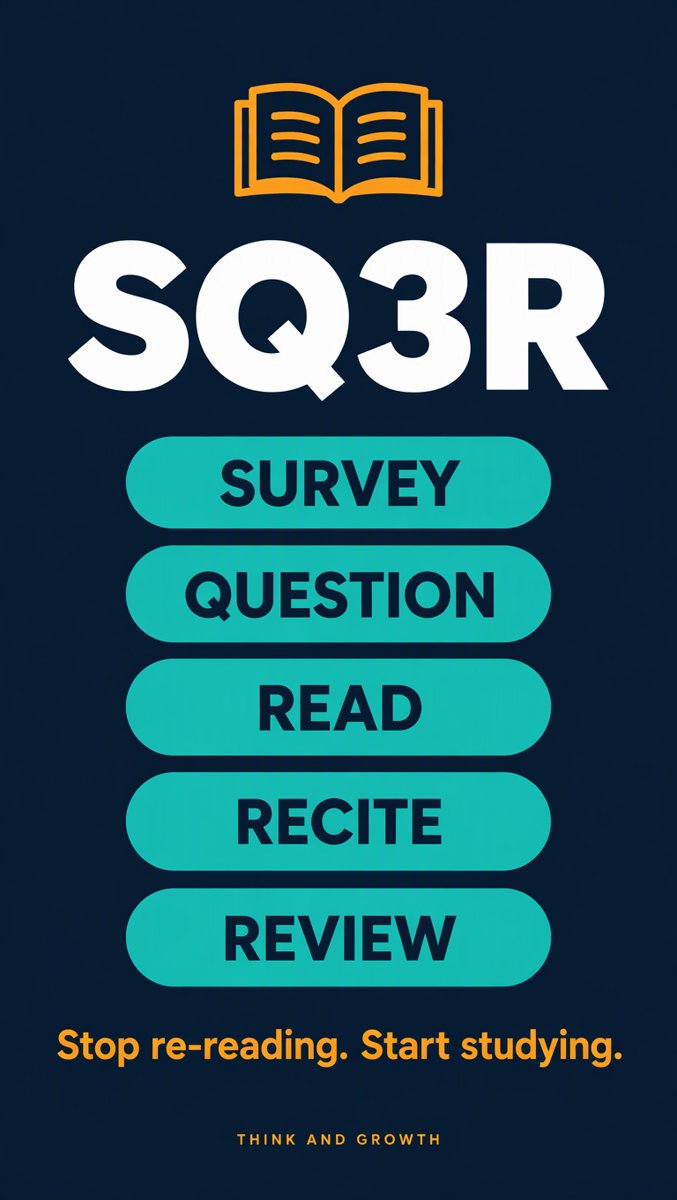
SQ3R: The 80-Year-Old Study System That Beats Re-Reading
Think and Growth — Episode #90 · Theme: School (learning fast, study systems) Daily teaching video — Tuesday, November 10, 2026
You read the chapter. You highlighted everything. Two days later, the page might as well be written in another language. If that sounds familiar, the problem isn't your memory — it's your method. And the fix has been sitting in study-skills handbooks since 1946.
What Is SQ3R?
SQ3R — sometimes written SQRRR — is a reading comprehension method named for its five steps: Survey, Question, Read, Recite, Review. It was introduced by Francis P. Robinson, an American reading specialist who developed the system while working at Ohio State University, in his book Effective Study (Wikipedia dates the book to 1941; the widely-taught 1946 edition cemented it in classrooms — either way, the method is roughly eighty years old and still the backbone of most university study-skills courses).
The core insight is simple: reading a textbook and studying a textbook are not the same activity. SQ3R is "a procedure for reading a textbook chapter so that it is remembered rather than merely finished" (ScholarSail). It transforms passive reading into active learning.
The Five Steps (How It Works)
- Survey. Before you read a word, spend two minutes skimming: chapter title, headings, bold terms, charts, the summary at the end. You're building a mental map of the terrain.
- Question. Turn each heading into a question. "Causes of the War of 1812" becomes "What caused the War of 1812?" Now your brain has a job.
- Read. Read the section to answer your question — not to "cover material." Purpose changes everything; you're hunting, not wandering.
- Recite. Close the book. Say the answer out loud, in your own words. If you can't, you didn't learn it — go back once. This is the retrieval step, and it's where memory is actually forged.
- Review. The next day, take a quick pass over your questions and answers. Spaced re-exposure locks the material in long-term.
Does It Actually Work?
Yes — and the evidence isn't just folklore. A 2024 classroom study published in the Jurnal Ilmu Pendidikan dan Humaniora found "a significant increase in reading comprehension scores among students who were exposed to the SQ3R method" (JIPH). A literature review compiled at Atlantis Press concluded SQ3R was effective across studies at improving elementary students' reading comprehension (Atlantis Press).
And in a 2025 head-to-head, Yuda and Mustadi reported that SQ3R was more effective than Speed Reading at improving both learning motivation and reading comprehension (ResearchGate). Read that again: the slow, deliberate system beat the "fast" one on every measure that matters. Speed feels productive; structure is productive.
How to Apply It Tonight
- Pick one chapter — don't SQ3R your whole syllabus on day one.
- Survey it in two minutes flat: headings, bold terms, summary.
- Write each heading as a question in the margin.
- Read each section to answer its question.
- Recite each answer aloud, book closed, before moving on.
- Review for five minutes tomorrow. That's the whole system.
Total added time: about ten minutes per chapter. Total saved time: every hour you currently waste re-reading highlighted pages that never stuck.
The Takeaway
Don't just read the page. Interrogate it. Eighty years of classrooms agree.
📝 Narration Script (145 written words → ~70s measured)
[Cover] You read the chapter, highlight everything — and remember nothing. The fix is eighty years old.
[Slide 1 — a] It's SQ3R: Survey, Question, Read, Recite, Review — built in 1946 to turn reading into studying.
[Slide 1 — b] Five steps that stop your eyes from drifting and start your brain working.
[Slide 2 — a] Survey first: skim the headings, bold terms, and summary before you read a word.
[Slide 2 — b] Then turn each heading into a question, and read only to answer it.
[Slide 2 — c] Recite with the book closed — say the answer out loud. Review it all again tomorrow.
[Slide 3 — a] Does it work? Classroom studies show significant comprehension gains when students study this way.
[Slide 3 — b] And in a 2025 head-to-head, SQ3R beat speed reading on motivation and memory.
[Slide 4 — a] Tonight: survey one chapter for two minutes, then turn its headings into questions.
[Slide 4 — b] Read to answer them, recite out loud, book closed — and review tomorrow.
[Slide 5] Don't just read the page. Interrogate it.
[CTA] If this made studying click, follow Think and Growth — one practical mental model every single morning. See you tomorrow.
🎬 Clip Timeline (12 clips, subtitle-fit rule)
| # | Image | Motion | Subtitle | Words |
|---|---|---|---|---|
| 1 | cover | none | none | 17 |
| 2 | slide-1 | none | none | 16 |
| 3 | slide-1 | none | none | 14 |
| 4 | slide-2 | none | none | 14 |
| 5 | slide-2 | none | none | 13 |
| 6 | slide-2 | none | none | 16 |
| 7 | slide-3 | none | none | 14 |
| 8 | slide-3 | none | none | 13 |
| 9 | slide-4 | none | none | 14 |
| 10 | slide-4 | none | none | 12 |
| 11 | slide-5 | none | none | 7 |
| 12 | cta | fade_out | none | 19 |
Motion: none on all content clips; fade_out on CTA only. Subtitle: "none" on every clip (infographics carry their own text). 12 ≤ 20 clip cap.
Sources
- Wikipedia — SQ3R: https://en.wikipedia.org/wiki/SQ3R
- ScholarSail — SQ3R Method guide: https://scholarsail.com/guides/sq3r-method
- JIPH (2024) — SQ3R and reading comprehension: https://journals.ristek.or.id/index.php/jiph/article/view/95
- ResearchGate (2025) — SQ3R vs Speed Reading: https://www.researchgate.net/publication/391081950
- Atlantis Press — SQ3R for elementary students: https://www.atlantis-press.com/article/125999897.pdf
💬 Chat with Peter: https://www.nxplace.com/x/think-and-growth?go=chat