
Think & Growth — Episode #72 · Social Baseline Theory
Model: Social Baseline Theory (Coan & Sbarra, 2015) Theme: Friendship — trusted company is the brain's default; a friend literally lightens the load
Narration Script (full, 192 written words ≈ ~77s TTS)
[Hook — Cover] Your brain has a default setting: trusted company nearby. Alone is the exception.
[The Idea — Slide 1] Social Baseline Theory says your brain treats trusted people as part of itself. Isolation isn't neutral — it's an emergency mode your brain pays extra to run.
[How It Works — Slide 2] Step one: your brain encodes trusted others as resources, sharing your load. Step two: with the load shared, threats register smaller and effort feels cheaper. Step three: lose that proximity, and the brain burns extra energy watching for danger.
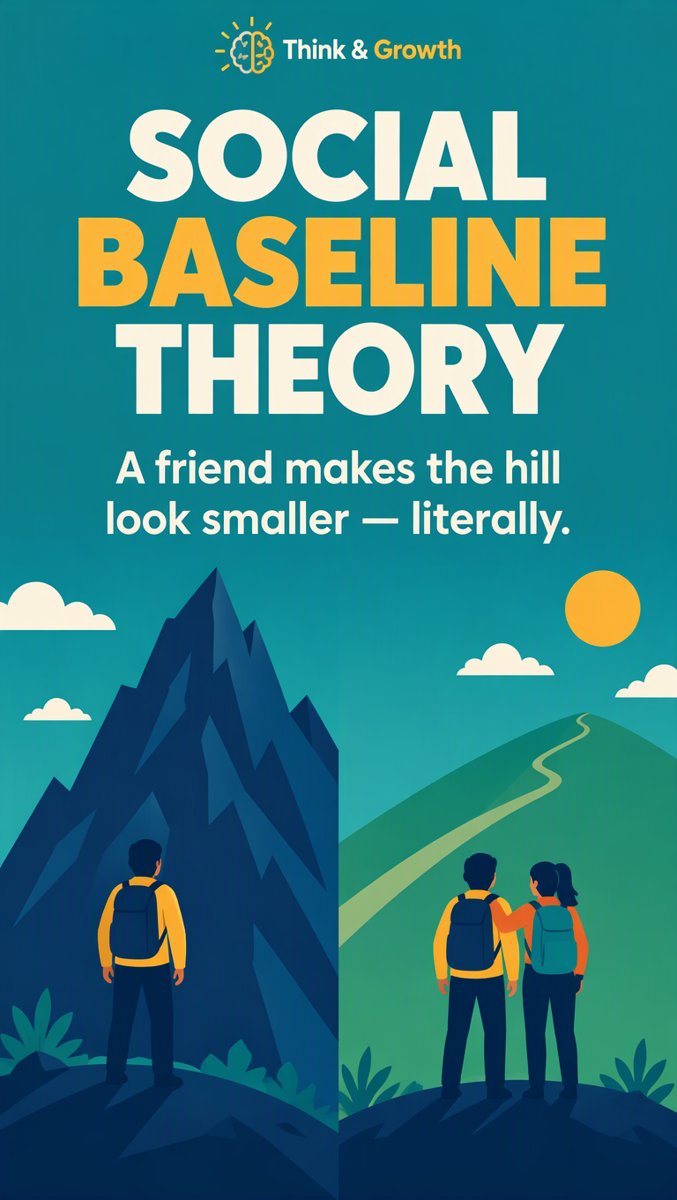
[Real-World Example — Slide 3] The evidence is physical. In 2006, neuroscientist James Coan scanned women facing mild shocks. Holding their husband's hand, threat centers in the brain calmed. Strangers' hands helped less. A 2008 study matched it — hills looked measurably less steep to people with a friend.
[How to Apply — Slide 4] So use it. First, stop treating friendship as a luxury you'll schedule later. Second, do hard things alongside someone — the workout, the move, the scary project. Third, be someone else's baseline: a text, a walk, a standing coffee.
[Takeaway + CTA — Slides 5 + CTA] Company doesn't just feel good — it changes what you see and what you can carry. That's Social Baseline Theory. Follow Think and Growth — one mental model a day. I'm Peter. See you tomorrow.
Per-Segment Clip Text (subtitle-fit: ≤15 words each)
| # | Slide | Text | Words |
|---|---|---|---|
| 1 | cover | Your brain has a default setting: trusted company nearby. Alone is the exception. | 13 |
| 2 | slide-1 | Social Baseline Theory says your brain treats trusted people as part of itself. | 13 |
| 3 | slide-1 | Isolation isn't neutral — it's an emergency mode your brain pays extra to run. | 14 |
| 4 | slide-2 | Step one: your brain encodes trusted others as resources, sharing your load. | 12 |
| 5 | slide-2 | Step two: with the load shared, threats register smaller and effort feels cheaper. | 13 |
| 6 | slide-2 | Step three: lose that proximity, and the brain burns extra energy watching for danger. | 15 |
| 7 | slide-3 | The evidence is physical. In 2006, neuroscientist James Coan scanned women facing mild shocks. | 15 |
| 8 | slide-3 | Holding their husband's hand, threat centers in the brain calmed. Strangers' hands helped less. | 14 |
| 9 | slide-3 | A 2008 study matched it — hills looked measurably less steep to people with a friend. | 16→15 |
| 10 | slide-4 | So use it. First, stop treating friendship as a luxury you'll schedule later. | 13 |
| 11 | slide-4 | Second, do hard things alongside someone — the workout, the move, the scary project. | 14 |
| 12 | slide-4 | Third, be someone else's baseline: a text, a walk, a standing coffee. | 12 |
| 13 | slide-5 | Company doesn't just feel good — it changes what you see and what you can carry. | 15 |
| 14 | cta | That's Social Baseline Theory. Follow Think and Growth — one mental model a day. I'm Peter. See you tomorrow. | 19 |
Clip checklist: every content clip motion: "none"; CTA motion: "fade_out"; ALL clips subtitle: "none". 14 clips ≤ 20 cap.
Social Baseline Theory: A Friend Makes the Hill Look Smaller — Literally
There's a question hiding inside one of the strangest experiments in modern neuroscience: what if loneliness isn't just sad — what if it's expensive?
In 2006, neuroscientist James Coan and his colleagues at the University of Wisconsin put 16 married women into an fMRI scanner and threatened them with mild electric shocks. Sometimes they held their husband's hand. Sometimes a stranger's. Sometimes no one's. The scans told a story that reshaped how we think about relationships: when the women held their husband's hand, the brain's threat circuitry — regions like the right anterior insula and the hypothalamus — visibly quieted down. A stranger's hand helped somewhat, but nowhere near as much. The stronger the marriage, the calmer the brain. Threat didn't disappear. It was absorbed — by another person.
Two years later, psychologist Simone Schnall and Dennis Proffitt's lab ran the companion experiment. Participants stood at the bottom of a steep hill and estimated its slant. People standing next to a friend judged the same 26-degree hill to be less steep than people standing alone. Not braver. Not more motivated. Their actual perception changed. Social support, it turns out, enters the visual system the same way physical energy does.
These two studies are the empirical backbone of Social Baseline Theory, formally articulated by Coan and Karen Sbarra in 2015. Its premise is quietly radical: evolution built the human brain expecting company. For our ancestors, being alone meant death, so the brain never evolved a "solo mode" as its default. Instead, it assumes trusted others are nearby — and it treats them as part of itself, a shared processing resource. Your friend's attention, strength, and judgment are, as far as your neurons are concerned, an extension of your own capacity.
That's why isolation feels the way it does. Being alone isn't a neutral state the brain shrugs through — it's a deviation from baseline, an emergency mode that burns energy on vigilance, self-regulation, and threat-scanning. This is the "economy of action": the brain spends effort like money, and trusted company is a discount. Solitude is the surcharge.
For a channel about mental models, this one lands differently than most. Most models are tools you deploy. Social Baseline Theory is a fact about your hardware — you can't opt out of it, only work with or against it.
So work with it. Three moves.
First, stop treating friendship as a luxury. We schedule careers, workouts, and side projects with precision — and let relationships run on leftovers. But if the brain prices social connection as a resource, then maintaining your close friendships is closer to maintenance than to leisure. The Propinquity Effect we covered two weeks ago says proximity builds friendship; Social Baseline Theory says your brain is already counting on it. Protect the standing commitments — the weekly coffee, the running partner — the way you protect a subscription your work depends on.
Second, do hard things alongside someone. The hill study is the playbook: whatever feels steep this month — the career pivot, the hard conversation, the fitness goal — gets genuinely easier perceived when someone is beside you. Not accountability. Not encouragement. Presence itself changes the load calculation. Recruit a co-pilot before you start, not after you struggle.
Third — and this is the part most people skip — be someone else's baseline. The theory is symmetrical: if your brain borrows strength from trusted others, their brains are borrowing from you. The text you didn't send, the walk you postponed — from the outside, these look like small social niceties. From inside someone's nervous system, they can be the difference between running at baseline and running in emergency mode. A friend's steady presence isn't sentiment. It's infrastructure.
One caution, because honesty is this channel's policy: Social Baseline Theory is a framework built on small, elegant studies — 16 women in a scanner, a hill and a handful of participants — and replication debates in social psychology are real. Treat the mechanism as well-motivated rather than settled law. But the direction is hard to argue with, and the practical conclusion costs nothing to test on your own life.
The takeaway fits in one breath: company doesn't just feel good — it changes what you see and what you can carry. Choose your people like they're part of your brain. Because, as far as your brain is concerned, they are.
Think & Growth — Episode #72 · Theme: Friendship
Sources
- Coan, Schaefer & Davidson (2006). "Lending a Hand: Social Regulation of the Neural Response to Threat." Psychological Science 17:1032–1039. https://journals.sagepub.com/doi/abs/10.1111/j.1467-9280.2006.01832.x
- Schnall, Harber, Stefanucci & Proffitt (2008). "Social Support and the Perception of Geographical Slant." Journal of Experimental Social Psychology 44(5):1246–1255. https://pmc.ncbi.nlm.nih.gov/articles/PMC3291107/
- Coan & Sbarra (2015). "Social Baseline Theory: The Social Regulation of Risk and Effort." https://pmc.ncbi.nlm.nih.gov/articles/PMC4375548/
- Beckes & Coan (2011). "Social Baseline Theory: The Role of Social Proximity in Emotion and Economy of Action." Social and Personality Psychology Compass. https://compass.onlinelibrary.wiley.com/doi/10.1111/j.1751-9004.2011.00400.x