
Think & Growth — Episode #73 · Six Thinking Hats
Model: Six Thinking Hats (Edward de Bono, 1985) Theme: Innovation — the meeting framework that turns argument into parallel thinking
Narration Script (full, 169 written words ≈ ~70s TTS)
[Hook — Cover] Your meetings aren't short on ideas. They're short on order. Meet the Six Thinking Hats.
[The Idea — Slide 1] Edward de Bono created Six Thinking Hats in 1985. The rule is simple: parallel thinking. Everyone wears the same hat at the same time. Nobody defends a fixed position.
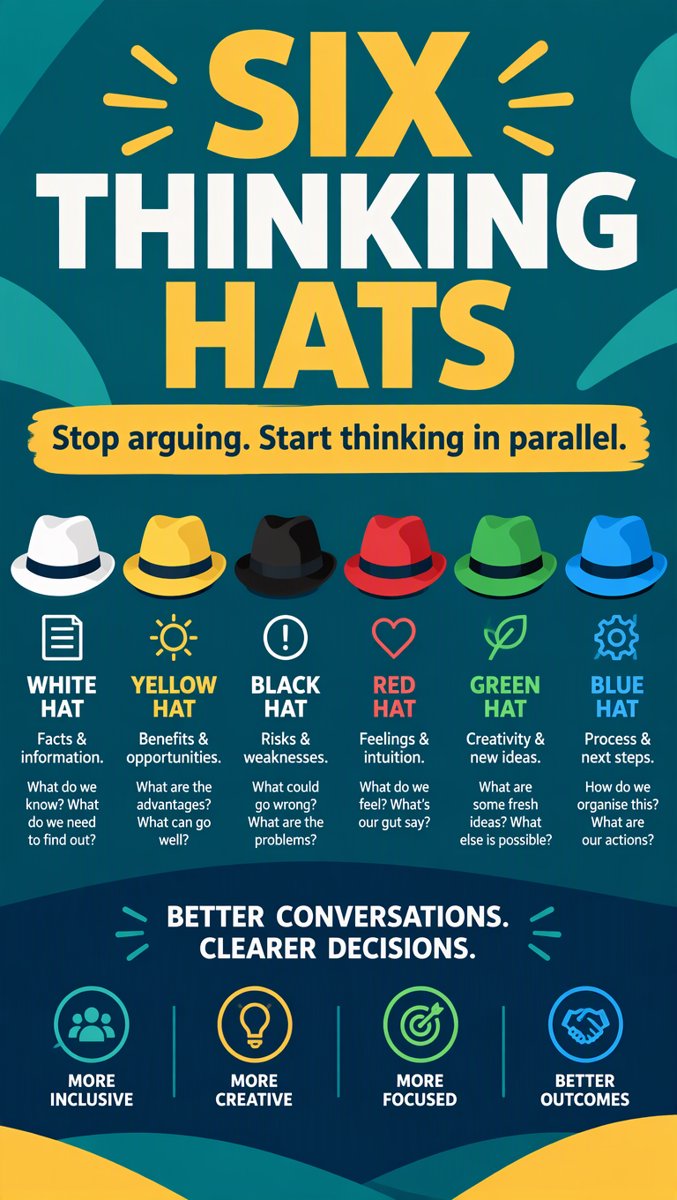
[How It Works — Slide 2] White means facts. Yellow finds benefits. Black hunts risks. Red speaks feelings. Green creates options. Blue is the referee — it sets the sequence and keeps every other hat honest.
[Real-World Example — Slide 3] Does it work? A peer-reviewed study found teams trained in the hats outperformed untrained teams. One corporate client of de Bono's institute even reported forty percent faster development cycles.
[How to Apply — Slide 4] Here's your playbook. First, appoint a Blue Hat chair to set the sequence. Second, run one hat at a time — the whole room together, no exceptions. Third, cover facts, benefits, risks, and ideas before anyone decides anything.
[Takeaway + CTA — Slides 5 + CTA] Stop trying to win the argument. Wear the same hat — then switch. That's Six Thinking Hats. Follow Think and Growth — one mental model a day. I'm Peter. See you tomorrow.
Per-Segment Clip Text (subtitle-fit: ≤15 words each)
| # | Slide | Text | Words |
|---|---|---|---|
| 1 | cover | Your meetings aren't short on ideas. They're short on order. Meet the Six Thinking Hats. | 15 |
| 2 | slide-1 | Edward de Bono created Six Thinking Hats in 1985. The rule is simple: parallel thinking. | 15 |
| 3 | slide-1 | Everyone wears the same hat at the same time. Nobody defends a fixed position. | 14 |
| 4 | slide-2 | White means facts. Yellow finds benefits. Black hunts risks. Red speaks feelings. Green creates options. | 15 |
| 5 | slide-2 | Blue is the referee — it sets the sequence and keeps every other hat honest. | 14 |
| 6 | slide-3 | Does it work? A peer-reviewed study found teams trained in the hats outperformed untrained teams. | 15 |
| 7 | slide-3 | One corporate client of de Bono's institute even reported forty percent faster development cycles. | 14 |
| 8 | slide-4 | Here's your playbook. First, appoint a Blue Hat chair to set the sequence. | 13 |
| 9 | slide-4 | Second, run one hat at a time — the whole room together, no exceptions. | 13 |
| 10 | slide-4 | Third, cover facts, benefits, risks, and ideas before anyone decides anything. | 11 |
| 11 | slide-5 | Stop trying to win the argument. Wear the same hat — then switch. | 12 |
| 12 | cta | That's Six Thinking Hats. Follow Think and Growth — one mental model a day. I'm Peter. See you tomorrow. | 18 |
Clip checklist: every content clip motion: "none"; CTA motion: "fade_out"; ALL clips subtitle: "none". 12 clips ≤ 20 cap. 169 written words ≤ 200 budget.
Six Thinking Hats: Stop Winning Arguments — Start Thinking in Parallel
Picture your last frustrating meeting. One colleague plays the permanent skeptic, shooting down every idea before it lands. Another is the relentless cheerleader who thinks risk-talk is negativity. Someone leads with feelings; someone else refuses to move until every spreadsheet cell is justified. Nobody is wrong, exactly. They're just all thinking in different modes — at the same time — and the conversation turns into a slow-motion collision.
In 1985, the Maltese physician and psychologist Edward de Bono — the same man who coined "lateral thinking" in 1967 — published a deceptively simple fix. He called it Six Thinking Hats, and its engine is a concept he named parallel thinking: instead of people arguing from fixed positions, the entire group points its attention in the same direction at the same time, then deliberately rotates.
The metaphor is the method. Each "hat" is a mode of thinking:
- White Hat — facts and data. What do we know? What don't we know?
- Yellow Hat — benefits and optimism. Why could this work?
- Black Hat — caution and risk. What could go wrong? (De Bono considered it the most valuable — and the most dangerous when overused.)
- Red Hat — feelings and intuition. Gut reactions, stated without justification.
- Green Hat — creativity and alternatives. New ideas, lateral moves, options.
- Blue Hat — process control. The chair of the meeting; it decides which hat comes next and keeps the sequence honest.
The power isn't in the colors — it's in the choreography. When Black Hat thinking happens by everyone, at a scheduled moment, skepticism stops being a personality and becomes a phase. When Green Hat time arrives, even the office cynic is required to generate options. Emotional reactions get a legitimate, time-boxed home in the Red Hat, so they stop leaking into every other part of the discussion. There's no single correct order either — the Blue Hat sets the sequence to fit the problem. A common flow for a decision: Blue → White → Green → Yellow → Black → Red → Blue.
Does any of this actually work, or is it corporate theater? The honest answer: the strongest public evidence is modest but positive. A peer-reviewed field study published via ERIC (EJ1112926) found that professionals trained in the Six Hats technique showed better outcomes on workplace innovation tasks and outperformed counterparts with no training — concluding the method "is learnable and usable in the workplace for better outcomes." On the commercial side, de Bono's own institute markets the method with documented corporate ROI, and one client testimonial on record reports a 40% increase in development-process efficiency after adopting the hats. (Skeptical note, Black Hat style: some famous anecdotes about massive savings at big corporations circulate widely online but couldn't be verified from primary sources — treat those as unconfirmed.)
For your own meetings, the playbook is three moves.
First, appoint a Blue Hat chair. Before any topic opens, someone owns the sequence. "Two minutes of facts. Three minutes of benefits. Three minutes of risks. One round of gut reactions. Then ideas." That 30-second framing does more for meeting quality than most agendas.
Second, one hat at a time — everyone together. The rule that breaks argument culture is totality. If you're in Black Hat phase, even optimists voice risks. If you're in Green, even skeptics must propose. Positions dissolve because the mode belongs to the room, not to a person.
Third, cover the full map before deciding. Facts, benefits, risks, feelings, alternatives — then Blue Hat synthesizes. Most bad decisions aren't made from bad information; they're made from one-sided information, whichever side the loudest voice preferred.
The deeper lesson reaches beyond meetings. De Bono's insight was that Western thinking inherited an argument habit from Socrates, Plato, and Aristotle — 2,400 years of "I'm right, you're wrong." Parallel thinking is the upgrade: attention as a shared spotlight, not a courtroom. The next time a discussion circles the drain, don't ask who's right. Ask which hat the room is wearing — and which one it's missing.
Stop trying to win the argument. Wear the same hat — then switch. That's the whole method.
Think & Growth — Episode #73 · Theme: Innovation
Sources
- Wikipedia — "Six Thinking Hats": https://en.wikipedia.org/wiki/Six_Thinking_Hats
- The Decision Lab — "Six Thinking Hats" reference guide: https://thedecisionlab.com/reference-guide/organizational-behavior/six-thinking-hats
- de Bono Group — official Six Thinking Hats program + ROI testimonials: https://www.debonogroup.com/services/core-programs/six-thinking-hats/
- Peer-reviewed workplace study (ERIC EJ1112926): https://files.eric.ed.gov/fulltext/EJ1112926.pdf
- Six Thinking Hats method & sequence overview: https://criticalthinkingexercisez.com/six-thinking-hats/