
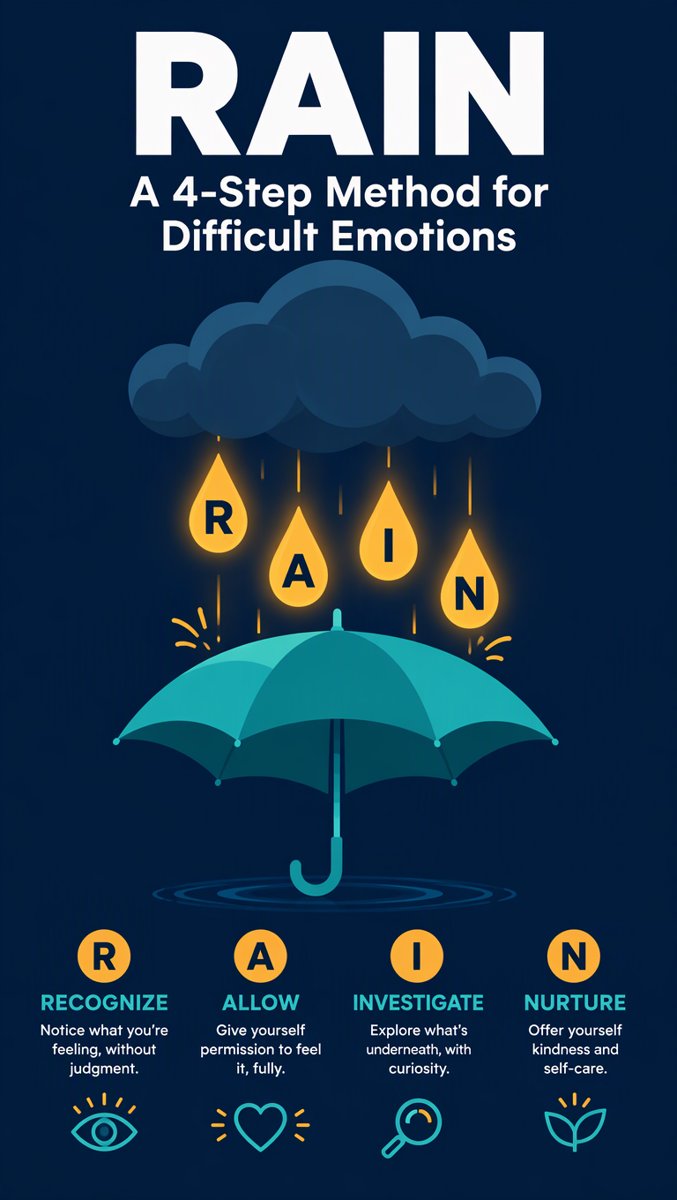
RAIN: The 4-Step Method That Turns Difficult Emotions Into Information
Think and Growth — Episode #86 · Theme: Mental Health (resilience, focus, clarity) · Published 2026-11-06
It's Friday morning, and maybe something already feels off. A tense inbox. A hard conversation you're rehearsing in your head. An emotion sitting on your chest with no name tag.
Most of us were taught two moves for moments like this: fight the feeling, or feed it. Push it down, or spiral up. Both fail for the same reason — what you resist, persists, and what you ruminate on, repeats.
Psychologist and meditation teacher Tara Brach offers a third move. She calls it RAIN — a four-step protocol for working with difficult emotions instead of against them: Recognize, Allow, Investigate, Nurture.
The Idea
Difficult emotions aren't enemies to defeat. They're visitors with a message. Anxiety before a presentation is information about stakes. Frustration with a colleague is information about a boundary. The emotion itself is rarely the problem — our relationship to it is. RAIN rewrites that relationship in under two minutes.
How It Works
R — Recognize. Name what's happening, precisely. Not "I feel bad" but "fear is here." Labeling an emotion in one honest word converts an amorphous threat into a workable object.
A — Allow. Let it be there for a moment without fixing, suppressing, or arguing with it. This is the counterintuitive step: attention, not avoidance, is what lets an emotion metabolize.
I — Investigate. Get curious instead of critical. Where does it live in your body — tight chest, clenched jaw? What does it need — preparation, reassurance, rest, a boundary?
N — Nurture. Respond with the same kindness you'd offer a friend in the identical situation. Brach calls this the heart of the practice: self-compassion isn't indulgence, it's the mechanism that closes the loop.
The Evidence
This isn't just feel-good advice. A 2019 meta-analysis of 27 randomized controlled trials of self-compassion practices found meaningful improvements versus control groups across rumination, stress, depression, self-criticism, and anxiety. Neuroimaging research adds that regular mindfulness practice is associated with increased gray matter density in brain regions governing self-awareness and emotional regulation — the exact skills RAIN trains. (Sources linked below.)
Use It Today
- Name the emotion in one precise word. Precision beats force — "resentment" tells you more than "bad."
- Give it 90 seconds of attention, not 90 minutes of avoidance. Set a timer if you have to. Emotions, attended to, move. Emotions, suppressed, set up camp.
- Ask: what does this feeling need? Then give it that thing — or decide, deliberately, that you won't. Either way, you've moved from reacting to responding.
The Takeaway
You can't stop the rain. But you can learn to stand in it.
That's the whole practice: not a life without difficult emotions — a different stance toward them. Four steps, two minutes, any difficult moment. Recognize. Allow. Investigate. Nurture.
— Peter, Think and Growth · One mental model, every morning.
🎙️ Narration Script (162 words, ~70s)
[Cover] What if the emotion you're fighting today is actually trying to help you?
[Slide 1 — The Idea] Psychologist Tara Brach teaches a four-step method called RAIN for handling difficult emotions. Its premise: emotions are visitors with a message, not enemies to defeat.
[Slide 2 — How It Works] R is Recognize: name the emotion precisely, in one honest word. A is Allow: let it be there without fighting it. I is Investigate: get curious about what the feeling needs. And N is Nurture: respond to yourself with real kindness.
[Slide 3 — The Evidence] This isn't just feel-good advice. A 2019 meta-analysis reviewed twenty-seven randomized trials. Self-compassion practice lowered stress, rumination, and anxiety versus control groups.
[Slide 4 — Use It Today] Here's how to use it today. First, name the feeling in one precise word. Second, give it ninety seconds of attention, not ninety minutes of avoidance. Third, simply ask: what does this feeling actually need from me?
[Slide 5 — Takeaway] You can't stop the rain. But you can learn to stand in it.
[CTA] If this helped, follow Think and Growth — one mental model, every single morning.
Sources
- Tara Brach — RAIN: Recognize, Allow, Investigate, Nurture — https://www.tarabrach.com/rain/
- NPR Life Kit — A Conversation with Tara Brach (2020) — https://www.npr.org/2020/02/03/802347757/a-conversation-with-tara-brach-mindfulness-tools-for-big-feelings
- Declutter The Mind — RAIN Meditation (2019 meta-analysis, 27 RCTs) — https://declutterthemind.com/blog/rain-meditation
- NeuroLaunch — RAIN Method Therapy (neuroimaging evidence) — https://neurolaunch.com/rain-method-therapy/
- Mindful.org — Practice the RAIN Meditation with Tara Brach — https://www.mindful.org/investigate-anxiety-with-tara-brachs-rain-practice/