NSDR: The 10-Minute Rest That Recharges Your Brain — Without Falling Asleep

NSDR: The 10-Minute Rest That Recharges Your Brain — Without Falling Asleep
Think and Growth — Daily Teaching Video · Episode #77 · Theme: Health
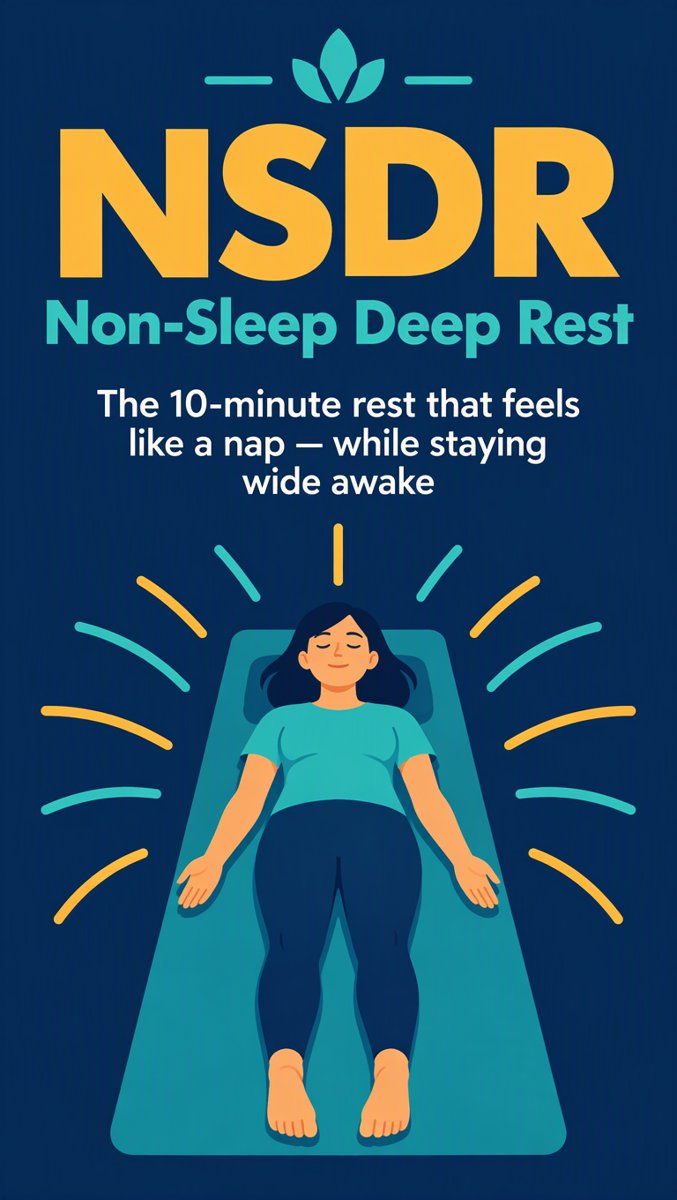
It's two P.M., you're running on fumes, and coffee isn't working. NSDR stands for Non-Sleep Deep Rest — and it's exactly what it sounds like. Your body drops into sleep-level relaxation, while your mind stays quietly awake and aware.
The Idea
NSDR is a term coined by Stanford neuroscientist Andrew Huberman for a family of guided protocols — yoga nidra being the classic example — that take your body into deep, sleep-like relaxation without you actually falling asleep. It is not meditation-with-extra-steps and it is not a nap. It sits deliberately in the gap between the two: body at sleep depth, mind still aware. Think of it as a manual override for the nervous system — a way to bank rest at times of day when sleep isn't an option.
The phrase "I'll sleep when I'm dead" gets the physiology backwards. You don't need to wait for night to recover. Deep rest is a state you can enter on demand — and the research says your brain rewards you for it.
How It Works
The protocol is almost embarrassingly simple:
- Lie down, eyes closed, and follow a guided voice. The guidance does the work — you don't have to concentrate the way seated meditation demands. This is why it works even when your focus is already spent.
- The voice slowly scans your body, toes to head. Slow, systematic attention to each body part downshifts the nervous system out of fight-or-flight and toward the parasympathetic "rest-and-digest" state.
- You hover at the edge of sleep — deeply rested, never fully asleep. Brain imaging shows practitioners sitting in slow, high-amplitude EEG states that resemble the deepest stages of sleep, while remaining consciously aware. That's the whole trick: the restoration of sleep depth without losing the day.
And this isn't just a nice feeling. In a landmark PET-scan study, Kjaer and colleagues (2002, Cognitive Brain Research) injected volunteers with a dopamine-tracing dye and scanned them during yoga nidra. Raclopride binding in the ventral striatum — the brain's reward and motivation hub — dropped by 7.9%, which corresponds to roughly a 65% increase in endogenous dopamine release. Sixty-five percent. Measured in a scanner, not reported on a wellness blog. Dopamine is the chemistry of drive — and NSDR replenishes it while you lie still and do nothing.
The Evidence Base
- Kjaer et al., 2002 — PET imaging during yoga nidra showed a ~65% increase in ventral striatal dopamine release; the first in vivo demonstration of neurotransmitter release tied to a conscious state. (PubMed)
- Moszeik et al., 2022, Current Psychology — an 11-minute daily yoga nidra practice improved stress, sleep quality, well-being and mindfulness — benefits held even with short sessions. (Springer)
- Huberman Lab — Huberman's NSDR hub collects the protocols he recommends: 10–20 minutes, after learning sessions or after poor sleep, to restore focus and offset sleep loss. (hubermanlab.com/nsdr)
The dose-response curve is friendly: you don't need 45 minutes on a yoga retreat. Around 10–20 minutes is the working range Huberman recommends, and Moszeik's trial found meaningful benefits at just 11 minutes a day.
How to Apply It
- Find a guided NSDR audio — 10 to 20 minutes. Free options are everywhere; search "NSDR" or "yoga nidra" on YouTube. Headphones help but aren't required.
- Stack it where you leak energy: after lunch (instead of a third coffee), right after a focused learning or study session (rest consolidates what you just learned), or after a rough night of sleep (it won't replace the night, but it measurably takes the edge off the fog).
- Don't judge the drifting. If you fall asleep, you still rested. The protocol counts either way — this is one of the few health habits with no failure state.
The Takeaway
Sleep is non-negotiable, and NSDR is not a substitute for it. But between "perfect eight hours" and "white-knuckle through the afternoon," there is a third option most people never use. You can't always add more sleep. But you can always add more rest.
Ten minutes, lying down, guided audio. Your dopamine system will do the rest.
🎬 Narration Script (~181 words, ~75s)
[Cover] It's two P.M., you're running on fumes, and coffee isn't working.
[Slide 1] NSDR stands for Non-Sleep Deep Rest — and it's exactly what it sounds like. Your body drops into sleep-level relaxation, while your mind stays quietly awake and aware.
[Slide 2] Here's how it works. Lie down, close your eyes, and follow a guided voice. The voice slowly scans your body, and your nervous system downshifts toward sleep's edge. You hover there — deeply rested, yet never fully asleep. That's the whole trick.
[Slide 3] And this isn't just relaxing. Scientists measured it in a brain scanner. During yoga nidra, dopamine release in the brain's reward center jumped sixty-five percent. That's the chemistry of motivation — restored by lying still and doing nothing.
[Slide 4] Here's how to use it. Find a guided NSDR audio — ten to twenty minutes. Do it after lunch, after a learning session, or after a rough night of sleep.
[Slide 5] You can't always add more sleep. But you can always add more rest.
[CTA] Try one ten-minute session today and notice the difference. Subscribe to Think and Growth — one mental model, every day.
Sources
- Huberman Lab — Non-Sleep Deep Rest: https://www.hubermanlab.com/nsdr
- Kjaer et al. 2002, Cognitive Brain Research — Increased dopamine tone during meditation-induced change of consciousness: https://pubmed.ncbi.nlm.nih.gov/11958969/
- Moszeik et al. 2022, Current Psychology — Effectiveness of a short Yoga Nidra meditation on stress, sleep, and well-being: https://link.springer.com/article/10.1007/s12144-020-01042-2