Lateral Thinking: When You're Stuck, Stop Digging Deeper — Dig Somewhere Else

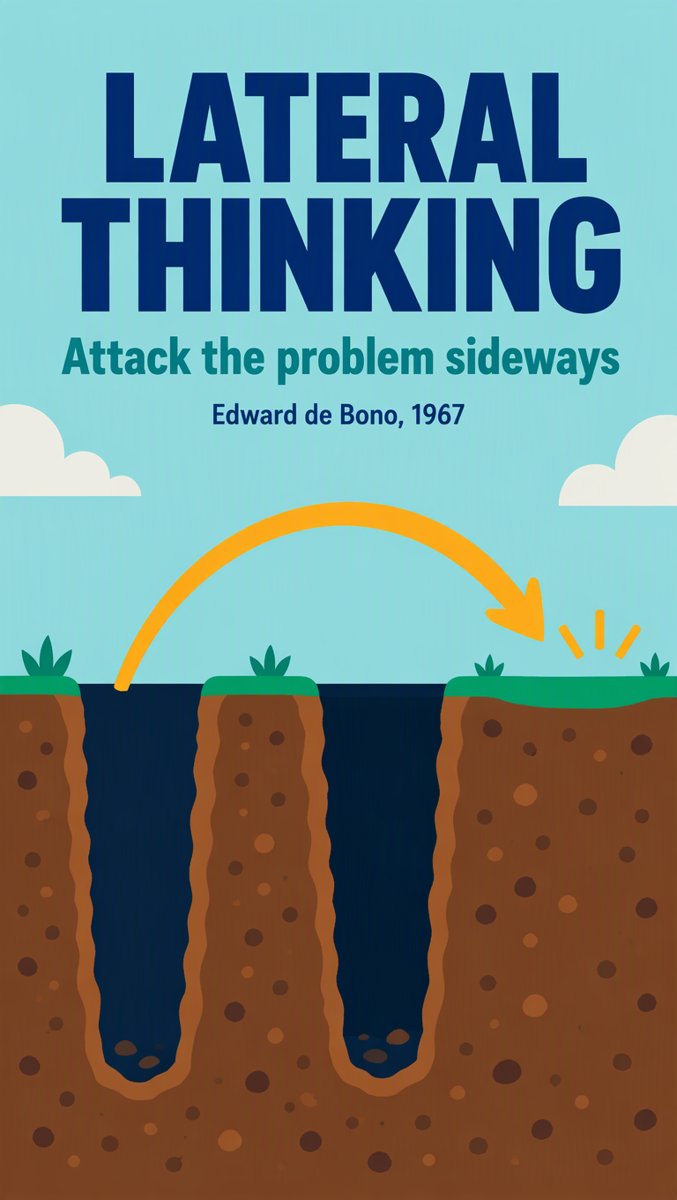
Lateral Thinking: When You're Stuck, Stop Digging Deeper — Dig Somewhere Else
Think and Growth · Daily Mental Model · Sunday, September 27, 2026 · Theme: Innovation
One of the most consequential ideas in environmental regulation started as an absurd sentence: the factory is downstream of itself.
It sounds like nonsense. A factory can't move — it sits where it sits, and the river flows where the river flows. But that deliberate piece of nonsense, proposed by Dr. Edward de Bono, produced a rule that later became law in some countries: a factory's water intake must be located downstream of its own waste pipe. No filters mandated. No inspectors required. The factory drinks its own pollution, so suddenly the cheapest way to make clean products is to make cleaner products. Self-interest did the enforcement.
That is lateral thinking in one story. Not brainstorming fluff, not "think outside the box" as a poster slogan — a repeatable mechanism for producing ideas that logic alone cannot reach.
The Idea
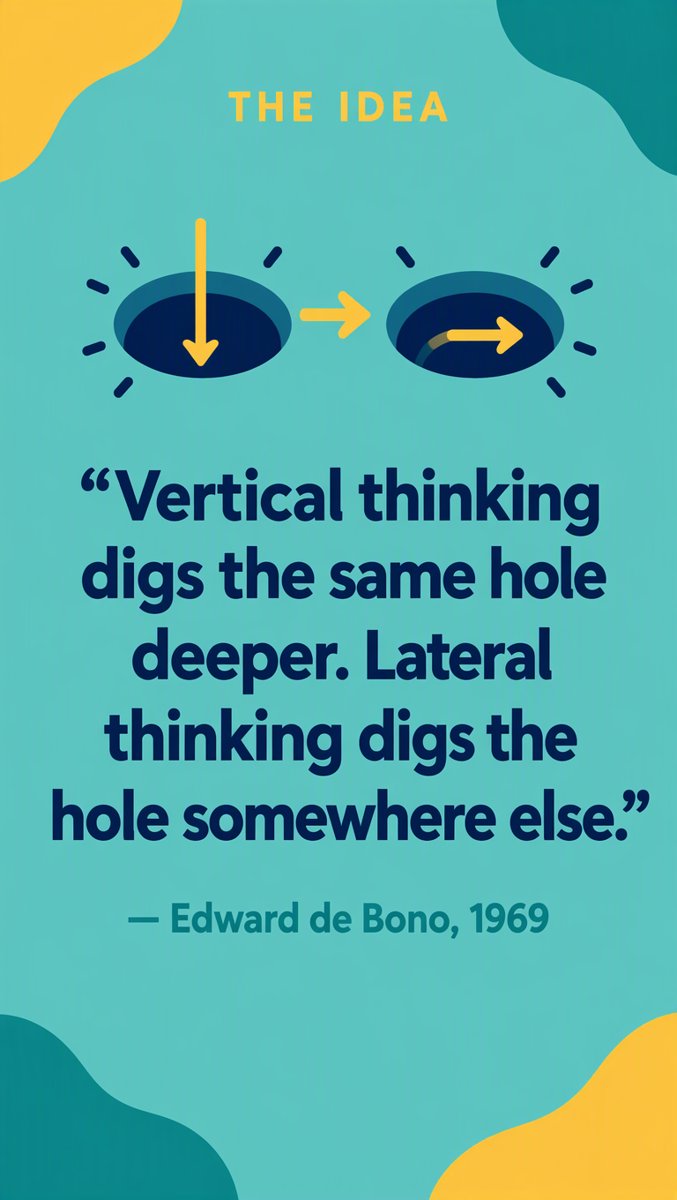
De Bono, a Maltese psychologist and physician, coined the term lateral thinking in 1967. His own contrast, published in The Journal of Creative Behavior in 1969, remains the cleanest definition ever written:
"Vertical thinking is concerned with digging the same hole deeper. Lateral thinking is concerned with digging the hole somewhere else."
Vertical thinking is what schools and spreadsheets reward: take the premises you already have, apply logic, optimize. It is indispensable — and it has a blind spot. If your starting frame is wrong, more rigor just makes you wrong faster and with better formatting. Lateral thinking is the deliberate, systematic process of questioning the frame itself: escaping established patterns of thought to generate ideas that pattern-locked minds literally cannot see.
De Bono's own examples ranged from the Nine Dots Puzzle — the origin of "think outside the box," which is only solvable if your pencil leaves the square — to the sewing machine, which solved tailoring bottlenecks not by hiring more seamstresses (vertical: more of the same) but by automating the stitching itself (lateral: change what's being optimized).
The Mechanism: Provocation
How do you dig a new hole on command? De Bono left us a tool with a strange name: the provocation, marked by the nonsense operator "Po."
A provocation is a statement you know is wrong or impossible — and you say it anyway, on purpose. Not to be edgy, but because the brain, forced to reason from a false premise, cannot use its usual ruts. It has to build new pathways. The technique runs in three moves:
- Write your obvious, best answer — then cross it out. The first answer isn't wrong; it's premature. It's the dominant pattern, and as long as it's on the table, every "new" idea will orbit it.
- Say "Po:" and state the impossible version. "Po: the factory is downstream of itself." "Po: the meeting has no agenda and no chair." "Po: your best customer is also your competitor."
- Withhold judgment and mine the absurdity. Ask: if this were true, what would follow? What principle is hiding inside the nonsense? Extract that principle and build a workable idea on it.
The key discipline is the withholding of judgment. Ordinary brainstorming judges ideas as they arrive, which kills exactly the weird ones that lateral routes run through. A provocation is legally protected nonsense — you're not claiming it's true, you're using it as a stepping stone.
The Real-World Example
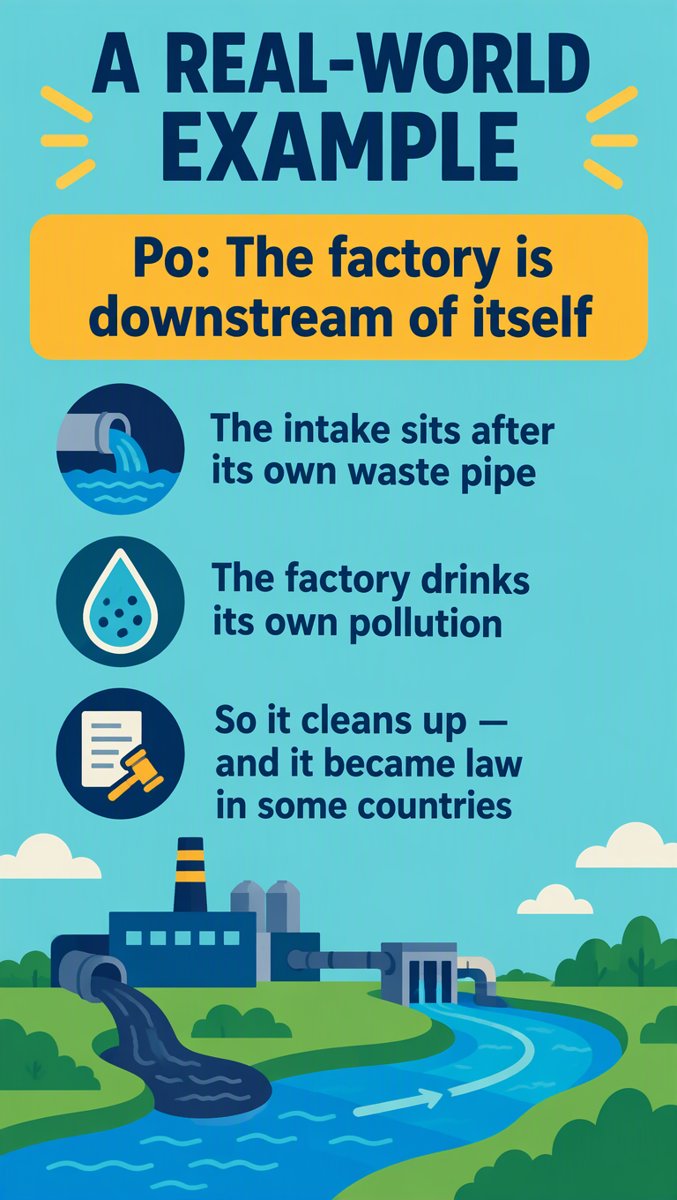
Run the river case through the mechanism. The problem: factories pollute rivers, people downstream suffer. The obvious vertical answers — stricter limits, more inspections, better filters — all dig the same hole: they push against the factory's incentives with external force. So de Bono crossed them out.
Po: the factory is downstream of itself.
Take the nonsense literally and one fact falls out: if the factory's input water comes from after its own output pipe, then every unit of pollution it dumps, it drinks. The external regulator disappears; the feedback loop moves inside the polluter. The principle hidden in the absurdity — make the polluter consume its own pollution — is clean, implementable policy. And it was, eventually, enacted into law in some countries, per Wikipedia's account of de Bono's example.
That's the signature of a genuinely lateral idea: once stated, it looks obvious, and nobody had seen it for decades.
How to Apply It Today

You don't need a workshop or a whiteboard. One stuck problem and ten minutes:
- Pick one problem you've been grinding on. Write your current best answer at the top of a page. Then draw a line through it. It stays visible — you're not discarding it, you're demoting it from "the answer" to "the pattern."
- Write three provocations. Format: "Po: [absurd version of the situation]." Make them genuinely impossible — invert a constraint, delete a sacred resource, merge two things that should never touch. "Po: we fire all our customers." "Po: the product is free but the problem is paid."
- Harvest one principle and build. For each provocation, write: what would this imply, if it were somehow true? Find the one insight with real weight inside the nonsense, then translate it back into a workable move. Ship that move this week.
The Takeaway
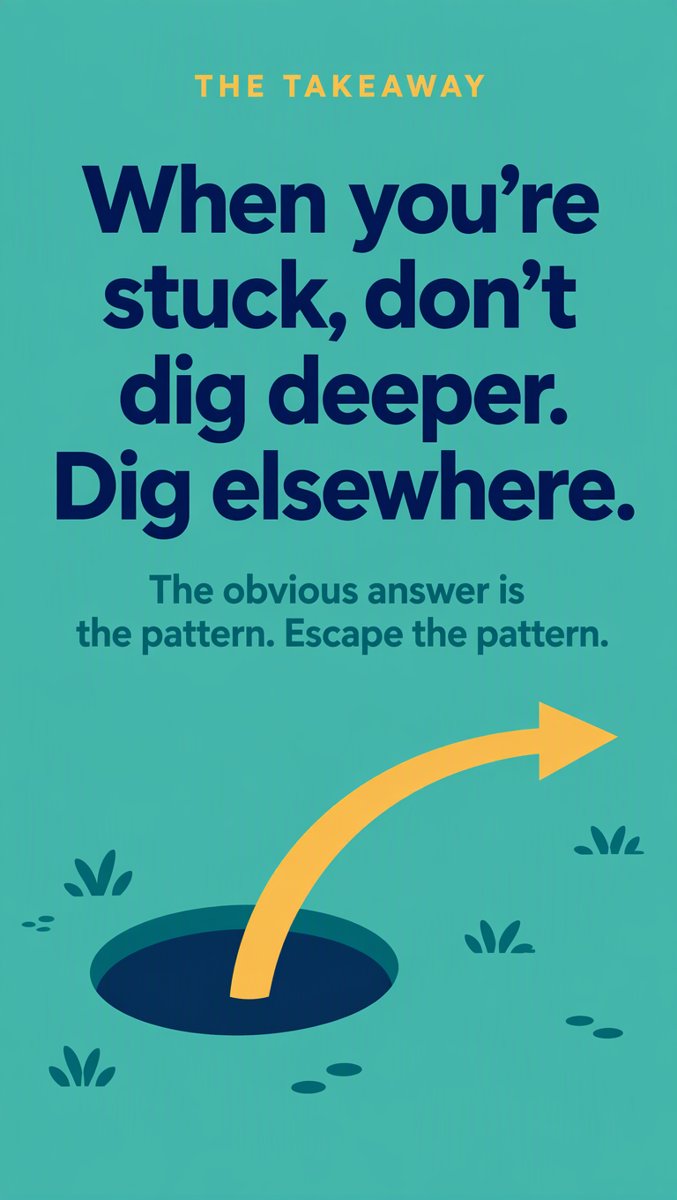
When the same hole stops producing, the instinct is to dig with a bigger shovel — more hours, more analysis, more of the same. De Bono's insight is that effort inside a wrong frame compounds nothing. The hole is the problem.
So when you're stuck this week, don't dig deeper. Dig elsewhere — and watch new ground open up.
Sources: Wikipedia, "Lateral thinking" (en.wikipedia.org/wiki/Lateral_thinking); Edward de Bono, "Information Processing and New Ideas — Lateral and Vertical Thinking," The Journal of Creative Behavior (1969), via ScienceDirect; De Bono Group, "Lateral Thinking" program (debonogroup.com).
📝 Narration Script (TTS, ~186 written words, Puck voice)
[Hook — cover] The smartest fix for pollution didn't come from a filter. It came from an absurd question.
[Idea — slide 1] In 1967, Edward de Bono named a skill most people never train: lateral thinking. His line: vertical thinking digs the same hole deeper. Lateral thinking digs somewhere else.
[Mechanism — slide 2] Here's the mechanism. Write your obvious answer first — then cross it out. Now say Po — de Bono's trigger word — and state the impossible version of the problem. Withhold judgment. Ask what principle hides inside the absurdity — and steal it.
[Example — slide 3] Here's de Bono's classic. A river, a factory, and one absurd question. Po: the factory is downstream of itself — so its intake drinks its own waste. Suddenly cleanup pays. That idea later became law in some countries.
[Apply — slide 4] Try it today. Take one stuck problem and write your best answer. Cross it out. Then write the most absurd fix you can imagine. Ask what principle is inside it — and build your real solution there.
[Takeaway — slide 5] Same hole, no answers? Stop digging deeper. Dig elsewhere — and watch new ground open up.
[CTA] Follow Think and Growth for one mental model every day. Tomorrow's is waiting. Subscribe now.
Per-Segment Map (image ↔ segment)
| # | Image | Segment | Words | Subtitle rule |
|---|---|---|---|---|
| 1 | cover | Hook | 16 | none |
| 2 | slide-1 | Idea a | 13 | none |
| 3 | slide-1 | Idea b | 15 | none |
| 4 | slide-2 | Mechanism a | 13 | none |
| 5 | slide-2 | Mechanism b | 15 | none |
| 6 | slide-2 | Mechanism c | 13 | none |
| 7 | slide-3 | Example a | 13 | none |
| 8 | slide-3 | Example b | 15 | none |
| 9 | slide-3 | Example c | 11 | none |
| 10 | slide-4 | Apply a | 12 | none |
| 11 | slide-4 | Apply b | 12 | none |
| 12 | slide-4 | Apply c | 14 | none |
| 13 | slide-5 | Takeaway | 16 | none |
| 14 | CTA | Subscribe CTA | 16 | none |
All clips motion: "none" except CTA (fade_out). All clips subtitle: "none". 14 clips total (≤20). Music: calm ambient lo-fi @ 0.3, Puck voice, 9:16, narration_flow on.