Inversion: Stop Asking How to Win — Ask How You'd Lose

Inversion: Stop Asking How to Win — Ask How You'd Lose
Sunday Innovation Edition · Think and Growth · October 11, 2026
Everyone plans the victory lap. The pitch deck has the hockey stick. The habit tracker assumes day 30. And most plans die anyway — not because the dream was wrong, but because nobody bothered to ask the most productive question in problem-solving: what would guarantee failure?
That flip has a name: Inversion.
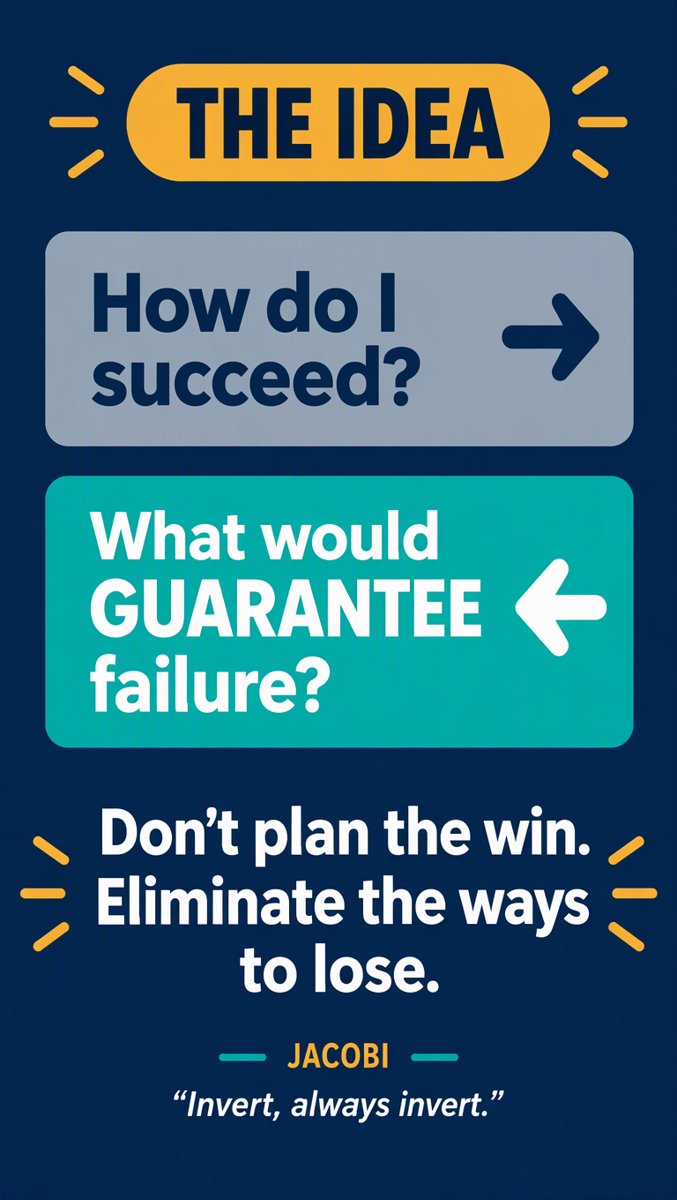
The Idea: Solve It Backwards
The maxim comes from Carl Gustav Jacob Jacobi, one of the great 19th-century mathematicians. His working rule: "man muss immer umkehren" — "Invert, always invert." When a problem looked impossible going forwards, Jacobi would assume the opposite and work toward a contradiction. Many of his hardest results came from attacking the problem from the back end (The Engineering Manager).
A century later, Charlie Munger — Warren Buffett's partner at Berkshire Hathaway — turned Jacobi's maxim into an operating philosophy. Munger's argument is disarmingly simple: much of his long-term advantage came not from being brilliant, but from trying to be consistently not stupid. His favorite version of the idea: "All I want to know is where I'm going to die, so I'll never go there" (ModelThinkers).
That's the whole model. Don't ask how do I succeed? Ask what would guarantee failure? Then don't do that.
Why It Works
Your brain has a spotlight problem. When you plan forwards, you see the sunny path and stay blind to the cliffs. Inversion works because it forces the cliffs into view:
- Negativity is more specific. "What would make this fail?" produces concrete, fixable items. "What would make this work?" produces slogans.
- Avoidance compounds. Dodging one catastrophic mistake is worth more than ten incremental optimizations. Munger's whole career is an argument for avoiding unforced errors.
- It's cheaper. A failure discovered on a whiteboard costs an hour. The same failure discovered in month nine costs the project.
The Proof: Gary Klein's Premortem
The cleanest modern application comes from psychologist Gary Klein: the premortem. Before a project launches, the team gathers and hears one sentence: "It's one year from now. The project has failed. Write the story of why."
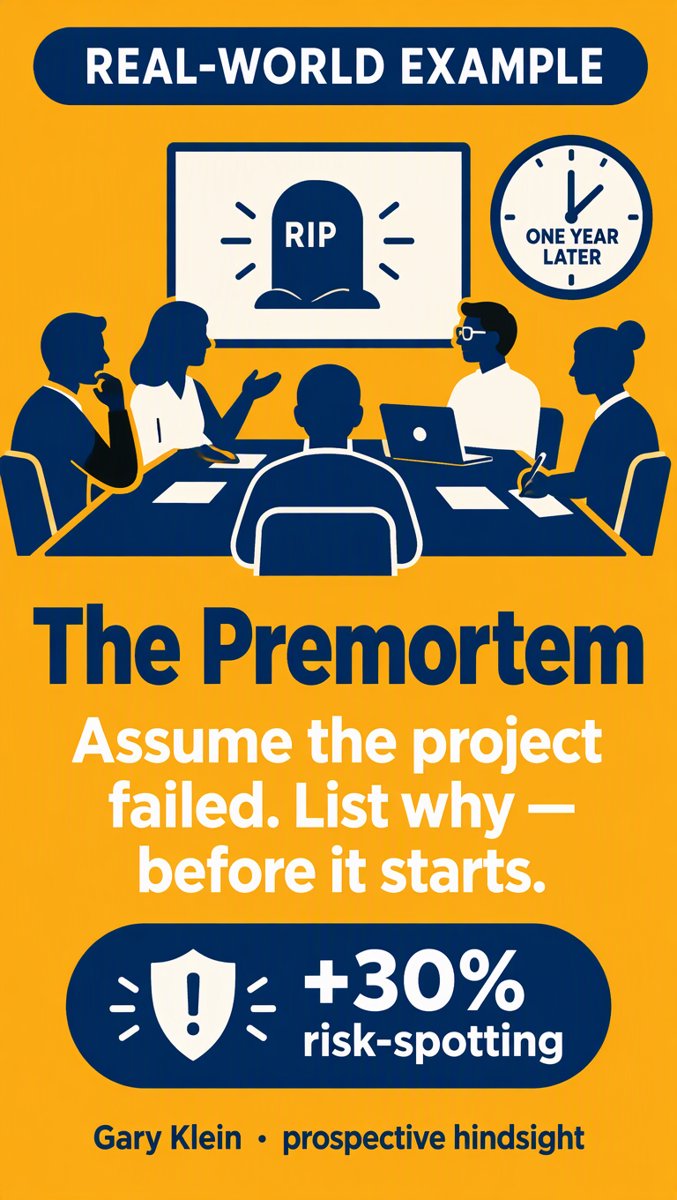
This is prospective hindsight — borrowing the clarity that only exists after a disaster and using it before the disaster. Research by Mitchell, Russo, and Pennington (1989) found that imagining an outcome as already having happened improves people's ability to correctly identify the reasons for it by about 30% (Rock, The Uncertainty Project).
The genius of the framing: in a normal risk review, junior people stay quiet and optimism dominates. In a premortem, "we failed" is the given — so listing reasons becomes permission rather than dissent. Klein published the technique in Harvard Business Review in 2007, and it has since become standard practice in project management, medicine, and startup planning.
How to Apply It This Week
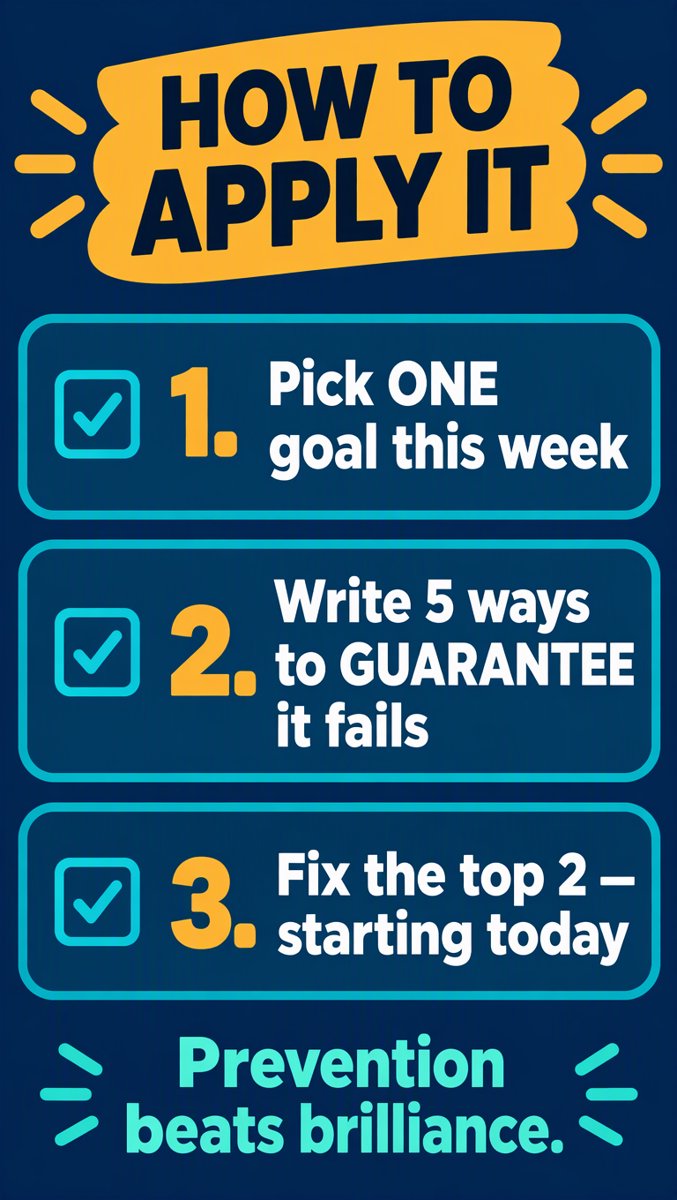
- Pick ONE goal that matters this week — a launch, a difficult conversation, a fitness target.
- Write five ways to guarantee it fails. Be brutally specific: "I never block the calendar," "I ship without feedback," "I skip sleep all week."
- Fix the top two before you take another forward step. Most of the time, the fix is embarrassingly simple — because the risk was obvious once you finally looked at it.
The Takeaway
Innovation isn't only about generating better ideas. Half of it is subtracting the failure modes. Stop asking how to win. Ask how you'd lose — then don't.
🎬 Narration Script (~167 words · ~70s at 2.5 wps)
[Hook] The smartest people don't ask how to win. They ask how to lose.
[Idea] Mathematician Carl Jacobi had a rule: invert, always invert. When a problem looked impossible, he solved it backwards. Charlie Munger's edge wasn't genius — it was avoiding stupidity.
[Mechanism] Here's the move. Take your goal and state it forwards. Then flip it: what would guarantee failure? List every way. Attack the biggest risks first. Preventing disasters beats chasing brilliance.
[Example] Psychologist Gary Klein turned this into the premortem. Before launch, the team hears: the project failed. Write the story of why. This lifts risk-spotting about thirty percent. The failure was imaginary — the fixes are real.
[Apply] Try it today. Pick one goal that matters this week. Write down five ways to guarantee it fails. Be brutally honest. Then fix the top two before you take another step.
[Takeaway] Stop asking how to win. Ask how you'd lose — then don't.
[CTA] That's Inversion — one mental model at a time. Follow Think and Growth for tomorrow's model.
📑 Per-Slide Segment Map
| Slide | Segments (words) | Motion |
|---|---|---|
| Cover | "The smartest people don't ask how to win. They ask how to lose." (14) | none |
| Slide 1 — The Idea | Jacobi rule (10) · solved backwards (10) · Munger edge (11) | none |
| Slide 2 — How It Works | state it forwards (9) · flip it, list every way (10) · prevent disasters (10) | none |
| Slide 3 — Example | premortem intro (8) · the failed-project prompt (12) · +30% stat (14) | none |
| Slide 4 — Apply It | pick one goal (8) · five failure modes (11) · fix the top two (11) | none |
| Slide 5 — Takeaway | closing line (11) | none |
| CTA | channel ask (16) | fade_out |
All 15 clips: subtitle: "none" (cards carry their own text) · every content slide motion: "none" · every segment ≤ 15 words.
Sources
- ModelThinkers — Inversion (Jacobi maxim, Munger): https://modelthinkers.com/mental-model/inversion
- The Engineering Manager — Invert, Always Invert: https://www.theengineeringmanager.com/growth/invert-always-invert/
- The Uncertainty Project — Pre-Mortem (Gary Klein, prospective hindsight): https://www.theuncertaintyproject.org/tools/pre-mortem
- Rock — Pre-Mortem template (Mitchell, Russo & Pennington 1989, ~30%): https://www.rock.so/blog/pre-mortem
- The Geeky Leader — Inversion Thinking (Munger, "consistently not stupid"): https://thegeekyleader.com/2025/03/30/inversion-thinking-the-mental-model-used-by-charlie-munger-and-jeff-bezos/