Interleaved Practice: Your Organized Study Plan Is the Reason You're Forgetting

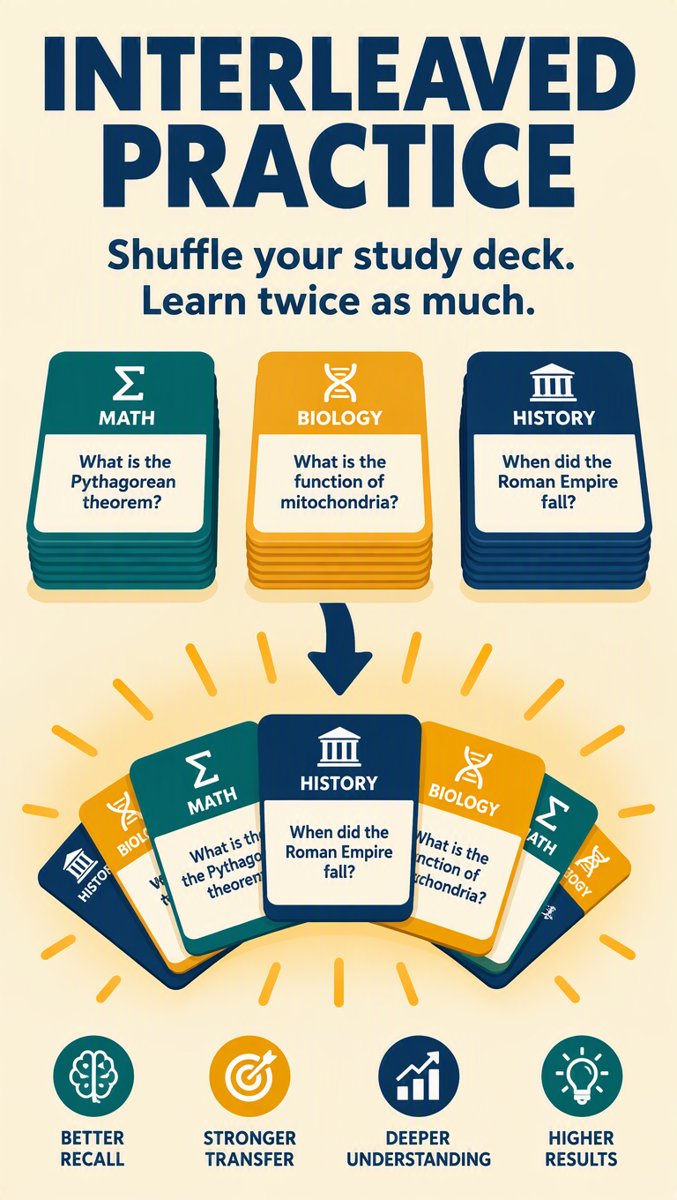
Interleaved Practice: Your Organized Study Plan Is the Reason You're Forgetting
Think & Growth — Daily Teaching Video · Tuesday, September 15, 2026 · School theme
The uncomfortable headline
You did everything right. You picked one topic, made a clean plan, drilled it until it clicked, and moved on to the next. It felt productive. It was organized. And according to one of the most consistently replicated results in learning science, that tidy approach is likely the single biggest reason the material evaporates before the exam.
The fix is called interleaved practice — and it's exactly the opposite of what feels natural: shuffle related problem types together inside a single session instead of drilling one type at a time.
The idea in one sentence
Blocked practice — AAA BBB CCC — groups your problems by type. Interleaved practice — A C B A C B — mixes the same problems, in the same session, for the same total time. Nothing about the content changes. Only the order does.
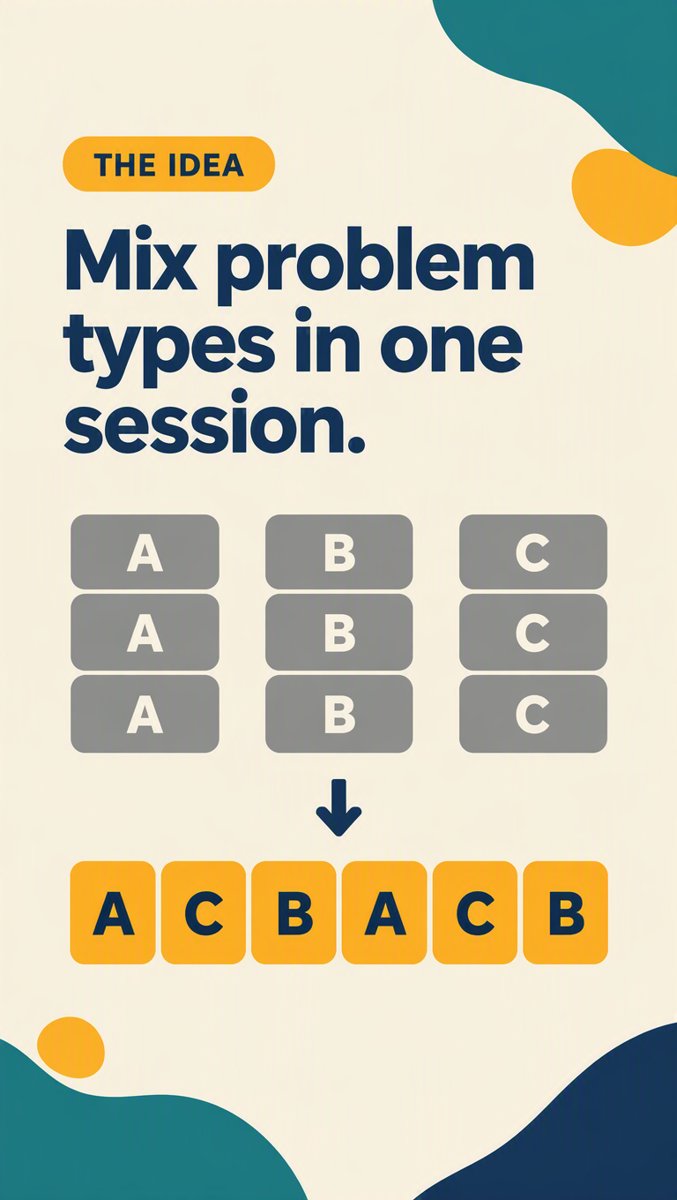
Why would order alone matter this much? Because when problems come pre-sorted, your brain already knows the method before it reads the question. The fifth volume problem in a row requires no thinking about which strategy to use — you loaded that strategy into working memory five problems ago. You're rehearsing execution, not judgment.
Shuffle the deck, and every single problem forces a decision first: what kind of problem is this, and which method does it need? That decision — discrimination between similar categories followed by retrieval of the right procedure — is the actual skill that exams measure. Real tests never announce which chapter a question came from. Blocked practice removes that judgment entirely; interleaving rehearses it every few seconds.
The numbers: same hours, nearly double the score
This isn't a niche laboratory curiosity. The classroom evidence is unusually large and clean.
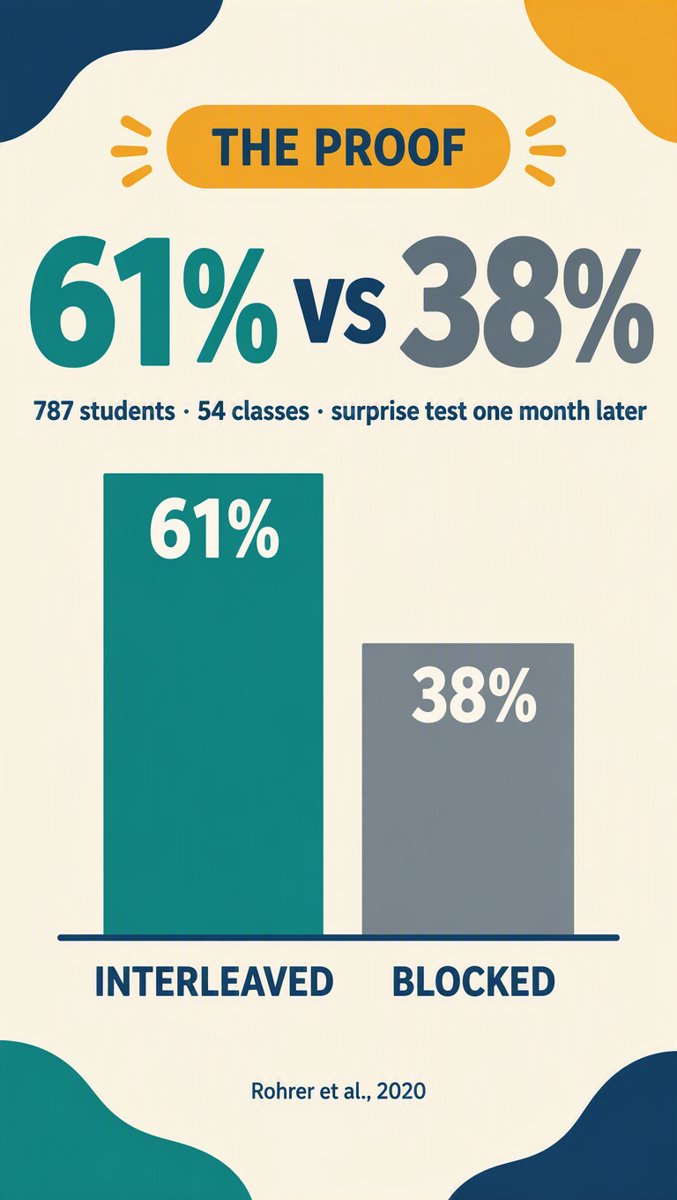
The capstone is a randomized controlled trial by Rohrer, Dedrick, Hartwig, and Cheung published in the Journal of Educational Psychology (2020): 787 students across 54 classes in five schools practiced math problems in interleaved or blocked order for four months. One month after practice ended, without warning, they took a test. The interleaved group scored 61%. The blocked group scored 38%. Same material, same hours — an effect size of d = 0.83, which in education research is enormous.
The pattern doesn't stop there:
- Taylor & Rohrer (2010): fourth graders, test one day later — interleaved 77% vs blocked 38% (d = 1.21).
- Rohrer, Dedrick & Stershic (2015): 126 seventh graders over three months — immediate test 80% vs 64%; then, on a test delayed 30 times longer, the interleaved group slipped only from 80% to 74%, while blocked performance collapsed to 42%.
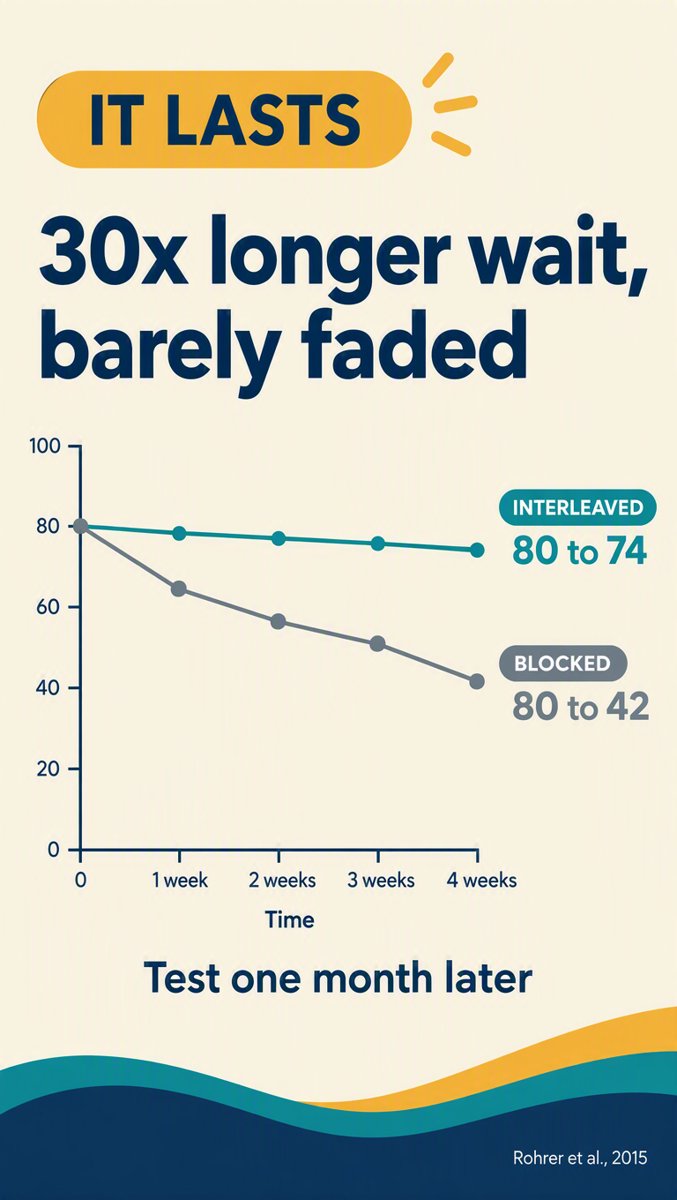
That last number deserves a second look, because it answers the standard objection. Interleaving looks worse during practice — slower, rockier, less confident — so surely it fades faster too? The data says the opposite. Interleaved learning is remarkably resistant to forgetting precisely because the skill it built (choosing the right method) is the skill the delayed test demands. The delayed test didn't get harder; it just stopped pretending.
Zoom out, and a 2019 meta-analysis by Brunmair and Richter (Psychological Bulletin) pooling 59 studies and 238 effect sizes lands on a moderate, reliable overall benefit of g = 0.42 — strongest for confusable visual categories, solid for mathematics.
The catch that keeps the secret safe
If it's this good, why isn't every student doing it? Because of what researchers call the fluency illusion. Blocked practice feels smooth, and smoothness reads as mastery. Interleaved practice feels bumpy, and bumpy reads as failure. Both readings are wrong.
In Kornell and Bjork's 2008 study, participants learned to identify painters' styles from mixed or grouped examples. Interleaving clearly won the test — yet when asked which method worked, 64 of the 72 participants who expressed a preference picked the approach that had actually hurt their scores. Their sense of learning was inversely related to their learning. Your feelings during a study session are not evidence. The surprise test one month later is.
One honest boundary condition: interleaving pays off when the things you mix are similar enough to be confused — math problem types, grammar rules, diagnostic categories. If the topics have nothing in common, there's nothing to discriminate, and mixing just adds switching cost.
How to apply it tonight
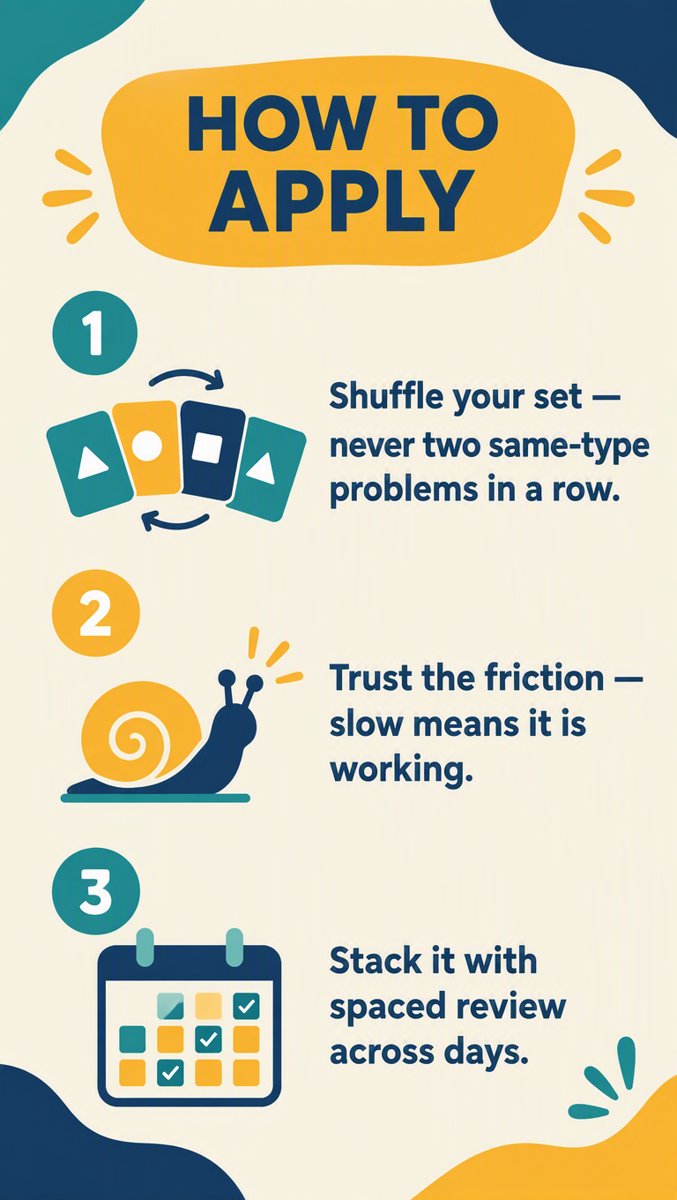
- Shuffle your set. Take the problems you were going to do as AAA BBB CCC and mix them so no two consecutive problems use the same method. Ten minutes of reordering, zero extra hours.
- Trust the friction. It will feel slower and messier than blocking. That discomfort is the mechanism working, not a bug. Slow, error-prone practice that ends in durable skill beats smooth practice that evaporates.
- Stack it with spacing. Interleaving controls the order within a session; spaced repetition controls the timing across sessions. They solve different problems and compound beautifully. Interleave today's session, then revisit it again in a few days.
The takeaway
Smooth practice rehearses what you already know. Bumpy practice builds what you'll actually need. Your organized study plan isn't neutral — it's an active preference for feeling good today over performing well next month.
Shuffle the deck.
Sources
- Rohrer, D., Dedrick, R. F., Hartwig, R., & Cheung, C.-N. (2020). A Randomized Controlled Trial of Interleaved Mathematics Practice. Journal of Educational Psychology, 112(1), 40–52. https://gwern.net/doc/psychology/spaced-repetition/2019-rohrer.pdf
- Rohrer, D., Dedrick, R. F., & Stershic, S. (2015). Interleaved Practice Improves Mathematics Learning. Journal of Educational Psychology, 107(3), 900–908. https://files.eric.ed.gov/fulltext/ED557355.pdf
- Taylor, J. A., & Rohrer, D. (2010). The effects of interleaved practice. Applied Cognitive Psychology, 24, 837–848.
- Brunmair, M., & Richter, T. (2019). Similarity matters: A meta-analysis of interleaved learning and its moderators. Psychological Bulletin, 145(11).
- Kornell, N., & Bjork, R. A. (2008). Learning Concepts and Categories: Is Spacing the "Enemy of Induction"? Psychological Science, 19(6).
- Pan, S. C. (2015). The Interleaving Effect: Mixing It Up Boosts Learning. Scientific American. https://www.scientificamerican.com/article/the-interleaving-effect-mixing-it-up-boosts-learning/
- Rohrer, D., & Taylor, K. (2007). The shuffling of mathematics problems improves learning. Instructional Science, 35, 481–498. https://link.springer.com/article/10.1007/s11251-007-9015-8
Narration Script (video, ~70s, 197 words)
[HOOK — Cover] Your perfectly organized study plan might be the thing holding you back.
[THE IDEA — Slide 1] Interleaved practice means mixing problem types inside one session. Blocked drills AAA, then BBB. Interleaving shuffles them: A, C, B, A. Same problems, same time, different order.
[MECHANISM — Slide 2] Here's why order matters. When problems come pre-sorted, your brain knows the method before reading. You're rehearsing execution, not judgment — not the skill exams actually measure. Shuffle the deck: each problem forces you to name its type first. And naming the right method is the skill exams actually test.
[EVIDENCE — Slide 3] The evidence is huge. In a randomized trial of 787 students across 54 classes, interleaved learners scored 61 percent on a surprise test one month later. Blocked group: 38. Same material, same hours — nearly double the score.
[RETENTION — Slide 4] And it lasts. Stretch the delay thirty times longer: interleaved scores slip just six points, from 80 to 74. Blocked scores collapsed all the way to 42.
[APPLY — Slide 5] Try it tonight. Shuffle your set — never two same-type problems back to back. It feels slower, rockier. Trust the friction: that struggle builds discrimination.
[TAKEAWAY — Slide 6] Smooth practice rehearses what you know. Bumpy practice builds what you'll need.
[CTA] Subscribe to Think and Growth — one mental model, every day.
Per-Slide Segment Text (clip timeline mapping)
| Clip | Card | Segment |
|---|---|---|
| 1 | cover | Your perfectly organized study plan might be the thing holding you back. |
| 2 | slide-1 | Interleaved practice means mixing problem types inside one session. Blocked drills AAA, then BBB. |
| 3 | slide-1 | Interleaving shuffles them: A, C, B, A. Same problems, same time, different order. |
| 4 | slide-2 | Here's why order matters. When problems come pre-sorted, your brain knows the method before reading. |
| 5 | slide-2 | You're rehearsing execution, not judgment — not the skill exams actually measure. |
| 6 | slide-2 | Shuffle the deck: each problem forces you to name its type first. |
| 7 | slide-2 | And naming the right method is the skill exams actually test. |
| 8 | slide-3 | The evidence is huge. In a randomized trial of 787 students across 54 classes, |
| 9 | slide-3 | interleaved learners scored 61 percent on a surprise test one month later. Blocked group: 38. |
| 10 | slide-3 | Same material, same hours — nearly double the score. |
| 11 | slide-4 | And it lasts. Stretch the delay thirty times longer: interleaved scores slip just six points, |
| 12 | slide-4 | from 80 to 74. Blocked scores collapsed all the way to 42. |
| 13 | slide-5 | Try it tonight. Shuffle your set — never two same-type problems back to back. |
| 14 | slide-5 | It feels slower, rockier. Trust the friction: that struggle builds discrimination. |
| 15 | slide-6 | Smooth practice rehearses what you know. Bumpy practice builds what you'll need. |
| 16 | cta | Subscribe to Think and Growth — one mental model, every day. |