Friendship Collection: The Mere Exposure Effect, The Strength of Weak Ties, and Reciprocity

Friendship Collection: The Mere Exposure Effect, The Strength of Weak Ties, and Reciprocity
Think and Growth — Collection #1 · Theme: Friendship
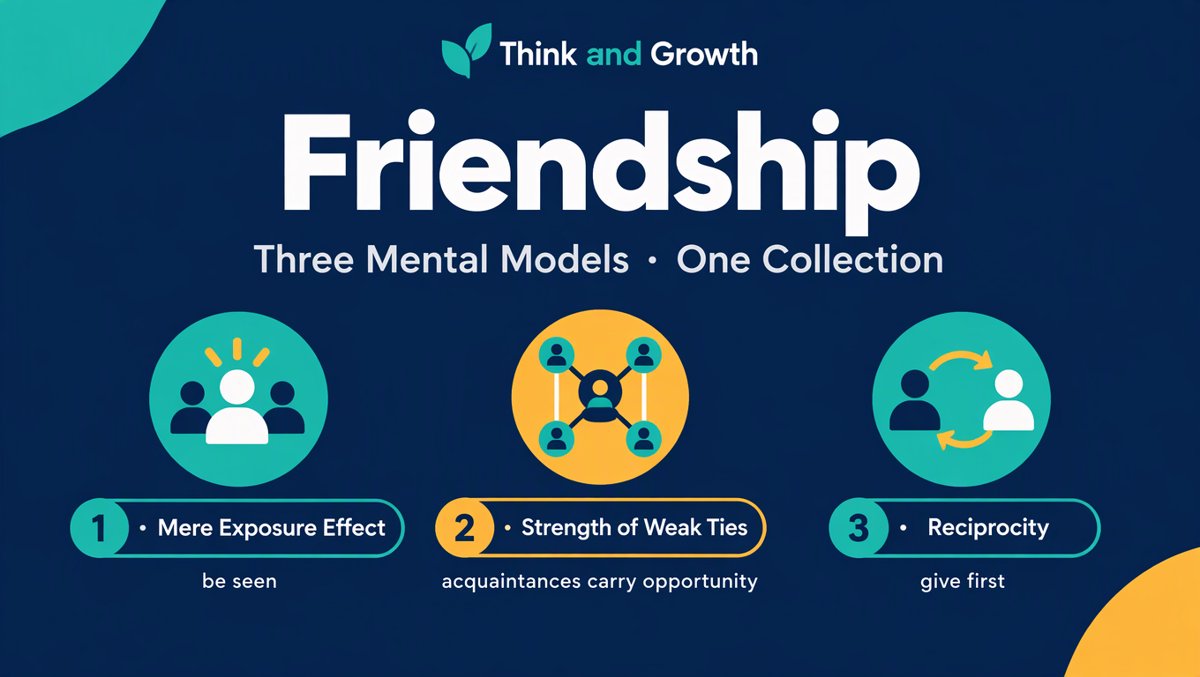
Friendship isn't one skill — it's three. This collection assembles three of our daily teachings into one deep-dive: the Mere Exposure Effect (why simply showing up builds liking), the Strength of Weak Ties (why acquaintances — not best friends — carry your biggest opportunities), and Reciprocity (why giving first, without keeping score, builds the strongest bonds). The models compound: presence gets you seen, weak ties put you in new rooms, and giving first turns both into lasting relationships. Same science as the original verticals — now with room to breathe.
Model 1 — The Mere Exposure Effect: Why We Like What We Already Know
Here's a strange truth from 1968 that still runs your life: you like things simply because you've seen them before. Not because they're better. Not because they earned it. Because they're familiar.
That's the Mere Exposure Effect, and psychologist Robert Zajonc proved it in the most stubborn way possible — by showing people nonsense words, Chinese characters, faces, and tone sequences, over and over, with zero rewards attached. The more times people saw a stimulus, the more they reported liking it. No persuasion. No interaction. Just seeing.
Why familiarity feels like goodness. The mechanism is almost embarrassingly simple. Your brain processes familiar things more easily — what psychologists call fluency. And your brain makes a quiet mistake: it feels that ease and interprets it as a property of the thing itself. This is easy to think about, therefore it must be good. One more practical detail: the first few exposures do the heaviest lifting. After that, returns diminish fast. You don't need fifty touchpoints — you need the first handful, repeated.
The proof that works on people. This isn't just about logos and jingles. In a classic 1992 classroom study (Moreland & Beach), women attended a university class zero, five, ten, or fifteen times — sitting there, saying nothing. When students rated them afterward, the more often a woman had simply shown up, the more attractive she was rated. No conversations. No jokes. Presence alone moved the needle.
How to use it this week:
- Pick two or three recurring rooms — the same gym hour, the same community chat, the same coffee shop, the same weekly call.
- Show up consistently instead of impressively. One brilliant appearance loses to ten ordinary ones.
- Keep it simple and consistent — the same face, the same intro, the same lane. Consistency is what the fluency machine reads.
Watch-out: Exposure is a lever, not a virtue. Repetition also makes falsehoods feel true — that's the illusion of truth at work, the same fluency machinery misfiring. So curate what you repeat: feed yourself good inputs, good rooms, good people.
Model 2 — The Strength of Weak Ties: Your Next Big Break Won't Come From Your Best Friend
In 1973, Stanford sociologist Mark Granovetter published one of the most-cited papers in the history of sociology. Its conclusion was so counterintuitive it still surprises people fifty years later: your acquaintances — not your close friends — are your single best source of new jobs, ideas, and opportunities. He called it The Strength of Weak Ties, and it flips our instincts about networking completely upside down.
Why it works. Think about how information actually flows. Your close friends share your world. You go to the same places, read the same news, hear about the same openings. That information is redundant — valuable for support, but not for novelty. Your acquaintances live somewhere else entirely. They work in different industries, live in different neighborhoods, run in different circles. When they hear about an opening, it's news to you. Every casual connection is a bridge into a network you can't see from where you stand. Novel information — the kind that changes careers — travels along those bridges.
The proof. Granovetter didn't just theorize. He surveyed 282 men in a Boston-area town about how they had found their jobs. The results were stunning: of those who found work through personal contacts, 84% got the job through someone they saw rarely or occasionally — a former colleague, an old college acquaintance, a guy they played squash with twice a year. Not their best friend. Not their spouse's network. The people on the fringes. The pattern has held up in the modern era too — studies of professional networks keep finding that job-changers land new roles through 2nd-degree connections far more often than through their tight inner circle.
How to use it:
- Reconnect with one dormant tie each week. Pick someone you haven't spoken to in a year. Send two lines: genuine interest in them, a quick update from you. No ask attached.
- Stay visible in adjacent circles. Comment on an acquaintance's work. Show up at the cross-industry event. Weak ties decay silently — visibility is maintenance.
- Give before you need. Forward the opportunity you can't use to someone who can.
Watch-out: Weak ties work because they're real relationships maintained at low intensity — one genuine five-minute check-in beats fifty mass connection requests.
The takeaway: Invest five minutes in an acquaintance — that's where the future hides.
Model 3 — Reciprocity: The Science of Winning Friends by Giving First
We all want to be liked. But most of us approach this backward — we wait for others to make the first move. What if the secret to winning friends wasn't about being charming, funny, or impressive — but simply about giving first?
Reciprocity is one of Robert Cialdini's universal principles of persuasion. The rule is simple: people feel obligated to return what they receive. If someone invites you to their party, you feel compelled to invite them to yours. If a colleague does you a favor, you owe them one. It's not transactional math — it's a deeply wired human instinct, found in every human culture ever studied.
The mint experiment. The most famous demonstration comes from a series of restaurant studies documented by Cialdini. Waiters gave diners a single mint with the check — tips increased by 3%. When they doubled the gift to two mints, tips quadrupled to 14%. But when the waiter gave one mint, started to walk away, paused, turned back and said — "For you nice people, here's an extra mint" — tips went through the roof. A 23% increase. Same two mints. Same cost. The difference? Personalization. The gift felt unexpected, thoughtful, and directed specifically at them.
The three-step mechanism:
- Step 1: Initiate. You give first. This breaks the standoff. Most relationships stall because both sides wait for the other to signal interest.
- Step 2: Personalize. Generic doesn't trigger the instinct. Mass emails and obligatory holiday cards register as noise. What triggers reciprocity is the unexpected and personalized.
- Step 3: Receive — multiplied. The return almost always exceeds the investment. The waiter spent two cents on mints and earned dollars in tips.
How to apply it today:
- Be the first to reach out. Text a friend you haven't spoken to in a while — just "thought of you today." That's a reciprocity deposit.
- Remember the small things. Birthdays. Coffee orders. Names of their kids. Following up says: I pay attention to you. That triggers the 23% effect, not the 3% one.
- Give freely — never keep score. The moment reciprocity becomes transactional math, it stops working. People can smell obligation.
The Takeaway
Three models, one playbook: show up until familiarity works for you, branch out until weak ties start routing opportunity your way, and give first until the returns compound into real friendship. Nobody remembers who sent the first text. They remember who was always there. Be that person.
— Peter, Think & Growth
Source verticals: The Mere Exposure Effect · The Strength of Weak Ties · Reciprocity