
First Principles Thinking: The Question That Rebuilt a $600 Battery
Think & Growth · Sunday Innovation Series · September 13, 2026
Here's a hard truth about how most of us think: we rarely think at all. We recall. We pattern-match against what everyone around us is doing, and we call that reasoning. Psychologists call it reasoning by analogy, and it's the default operating system of every industry, every meeting, every career.
It's also exactly why genuinely new things almost never come from incumbents.
This Sunday, the mental model is First Principles Thinking — the innovation engine behind some of the most aggressive cost breakthroughs of the last two decades, and a tool you can run on a single sticky note.
The Idea: Reason Up From What's True
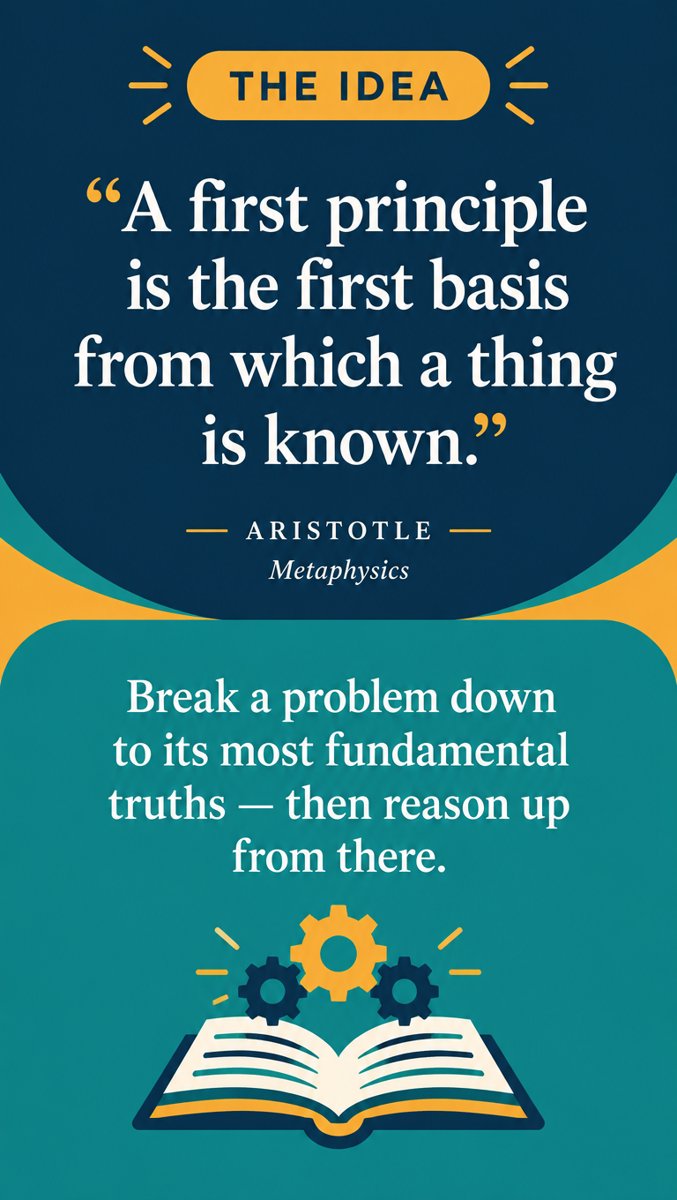
The idea is old enough to predate the printing press. Aristotle, in his Metaphysics, defined a first principle as "the first basis from which a thing is known" — the irreducible truth underneath a system (Wikipedia: First principle).
First principles thinking means you refuse to reason from convention. You break a problem down to its most fundamental truths — physics, raw materials, basic math — and then you rebuild the solution upward from those atoms (Ciris: First Principles Thinking).
The difference between the two modes is stark:
- Reasoning by analogy: "Batteries are expensive because battery packs have always cost around $600 per kilowatt-hour."
- First principles: "What are batteries made of, and what do those materials cost on the open market?"
One copies the past. The other interrogates it.
How It Works: Three Steps
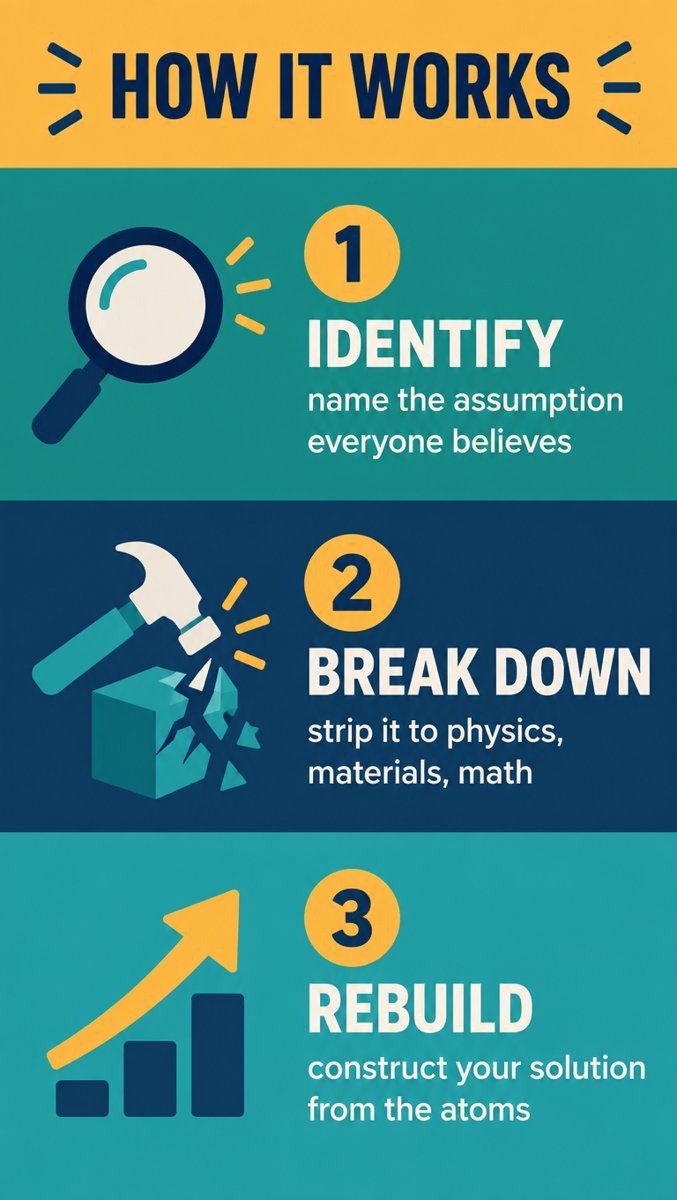
The mechanism fits on an index card:
- Identify the assumption. Write down the belief everyone in your field treats as a law of nature.
- Break it down. Strip the problem to fundamentals: physical laws, material costs, unit economics.
- Rebuild from zero. Construct a new solution from those atoms — deliberately ignoring how it's "supposed" to be done.
Step 1 is where most people fail, by the way. Not because they can't break things down — because they can't see the assumption in the first place. It doesn't look like an assumption. It looks like the weather.
The Proof: The $600 Battery
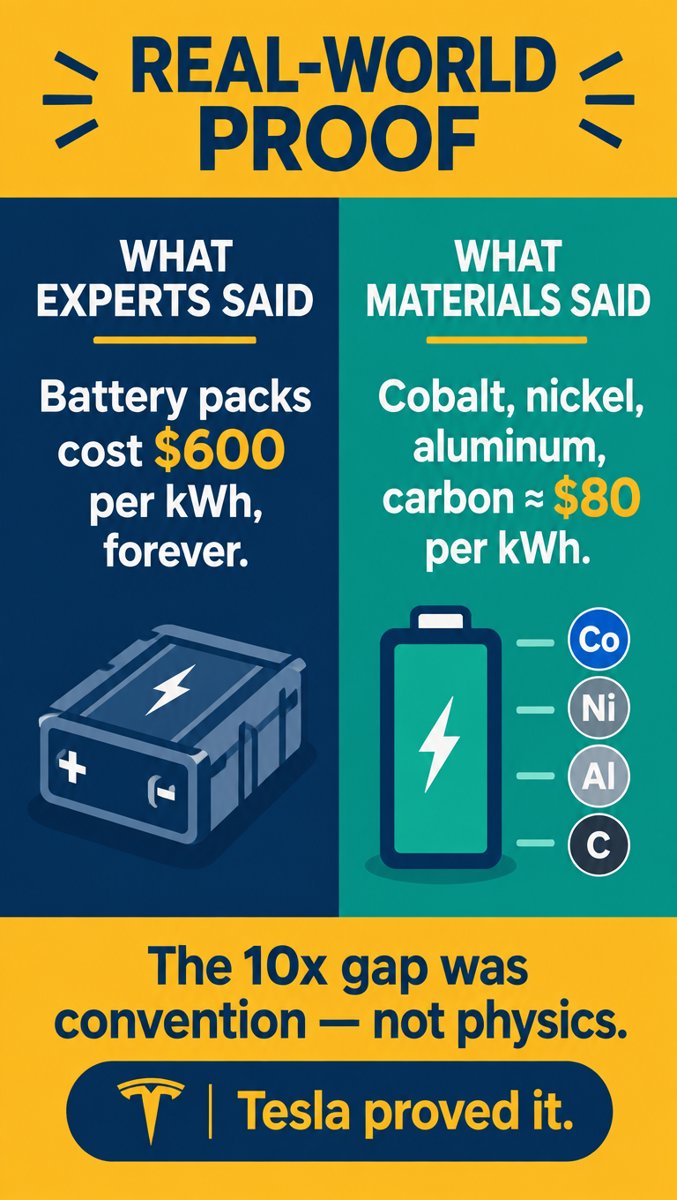
In a 2012 interview, Elon Musk walked through the case that made this model famous. The experts' consensus: rechargeable battery packs historically cost $600 per kilowatt-hour, and they weren't going to get much better (Startup Archive).
Musk did the exercise. He broke the battery into its constituent materials — cobalt, nickel, aluminum, carbon, polymer separators, a sealed steel can — and priced each on the London Metal Exchange. The raw material value came out to roughly $80 per kilowatt-hour.
Read that gap again: $600 of convention, ~$80 of physics. Everything in between was assumption — inherited manufacturing choices, accepted supplier margins, historical inertia dressed up as inevitability. That gap is where Tesla's entire cost roadmap came from, and battery prices did go on to fall by more than 80% in the following decade.
SpaceX ran the same playbook on rockets. The industry treated rockets as single-use — build one, fly it, let it burn up over the ocean. Musk's analogy cut through: that's like throwing away a 747 after every flight; air travel priced that way would make a one-way Boston-to-Shanghai ticket cost around $500,000 (Harvard Business School RCTOM: SpaceX, A First Principles Company). Nothing in physics said a rocket couldn't land back. Falcon 9 landings followed, and launch costs fell by roughly an order of magnitude.
How to Apply It This Week
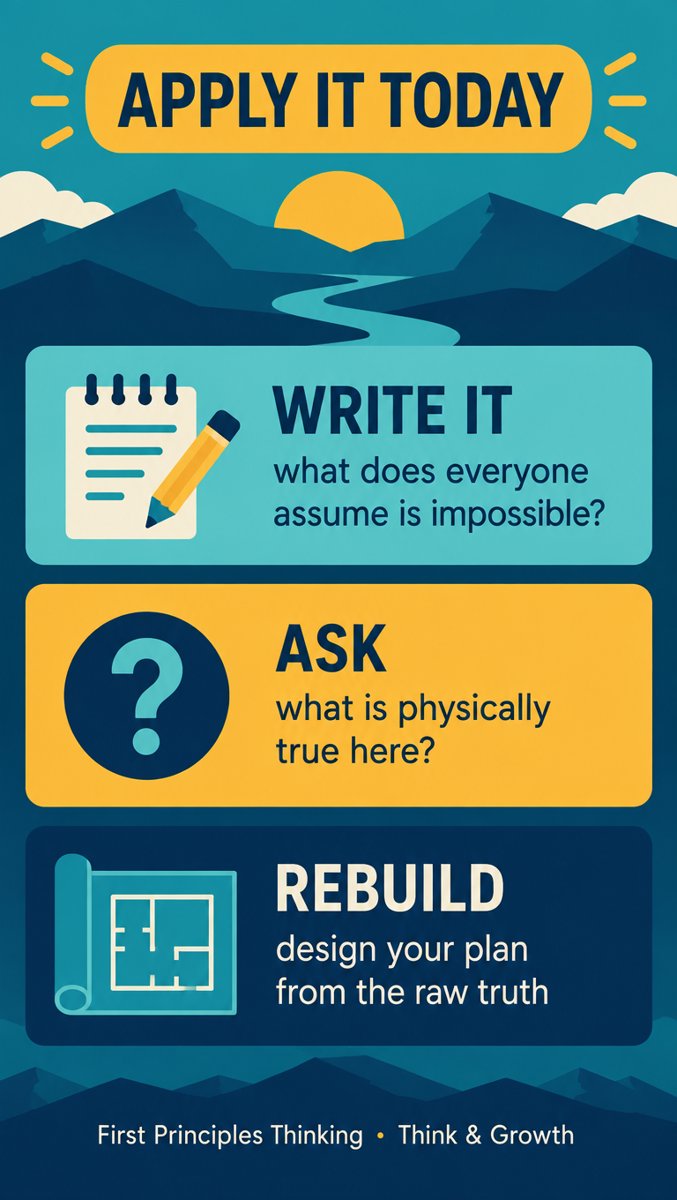
You don't need a battery factory to run this model. You need a pen:
- Write down one belief your industry calls impossible or permanent. "Clients won't pay for that." "That's always been the margin." "Nobody would switch."
- Ask what is physically, mathematically true underneath it. What are the actual unit costs? What does the customer actually do, minute by minute? Where is the real constraint — and where is it just habit?
- Rebuild one plan from the raw truth. Not the whole company. One pricing model, one process, one offer. Design it as if the convention never existed.
That's it. The model is simple; the discipline is not. The hard part is that every assumption on your list will feel obvious. "It's just how things work." That feeling is the tell.
The Takeaway

Analogies copy the past. First principles create the future.
Innovation isn't reserved for geniuses with rocket factories. It's available to anyone willing to ask one uncomfortable question: is that actually true?
Narration Script (~155 words, ~70s)
[Cover] The world's biggest battery breakthrough started with one uncomfortable question: is that actually true?
[Slide 1a] Aristotle called it the first basis from which a thing is known.
[Slide 1b] First principles thinking breaks a problem down to fundamental truths — then reasons up from there.
[Slide 2a] Step one: identify the assumption everyone treats as fact.
[Slide 2b] Step two: break it down to physics, materials, and math.
[Slide 2c] Step three: rebuild your solution from those atoms, ignoring convention.
[Slide 3a] In 2012, experts insisted battery packs cost six hundred dollars per kilowatt-hour, and always would.
[Slide 3b] Musk priced the raw materials instead: about eighty dollars. That gap was convention, not physics.
[Slide 4a] This week, write down one belief your field calls impossible.
[Slide 4b] Ask what is physically true. Then rebuild your plan from the raw truth.
[Slide 5] Analogies copy the past. First principles create the future.
[CTA] If this sharpened your thinking, subscribe to Think and Growth. One mental model, every single day. See you tomorrow.
Sources
- First principle — Wikipedia — Aristotle, Metaphysics 1013a: "the first basis from which a thing is known"
- Elon Musk explains first principles thinking — Startup Archive — the $600/kWh breakdown and 80%+ battery price decline
- SpaceX: A First Principles Company — Harvard Business School RCTOM — the 747 analogy and ~10x launch cost reduction