
Elaborative Interrogation: The Question That Doubles What You Remember
Think and Growth — Tuesday, October 20, 2026 · Theme: School (learning fast, study systems)
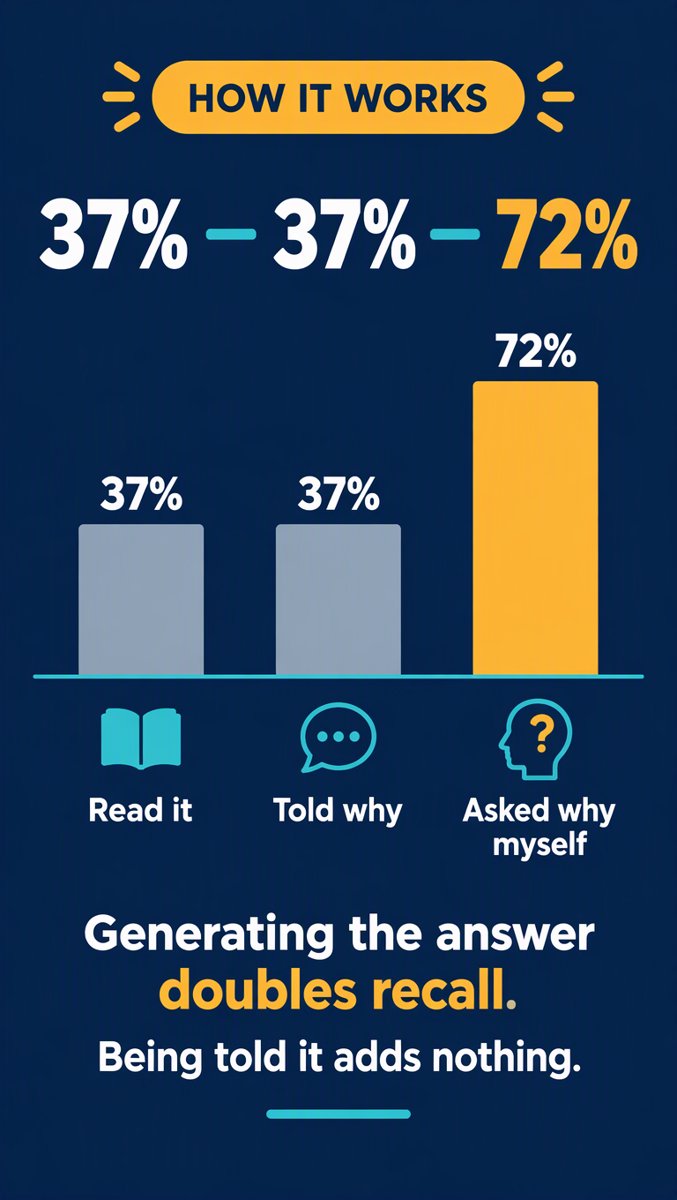
Here's an uncomfortable experiment result for anyone with a beautiful highlighter collection: students who were handed a perfect explanation remembered just as little as students who never got one at all. Both scored around 37 percent. The only group that scored high — 72 percent — was the group forced to generate the explanation themselves.
That's the entire case for elaborative interrogation, one of the highest-rated study techniques in the most famous review of learning strategies ever conducted. And it takes exactly one question: "Why is this true?"
What it is
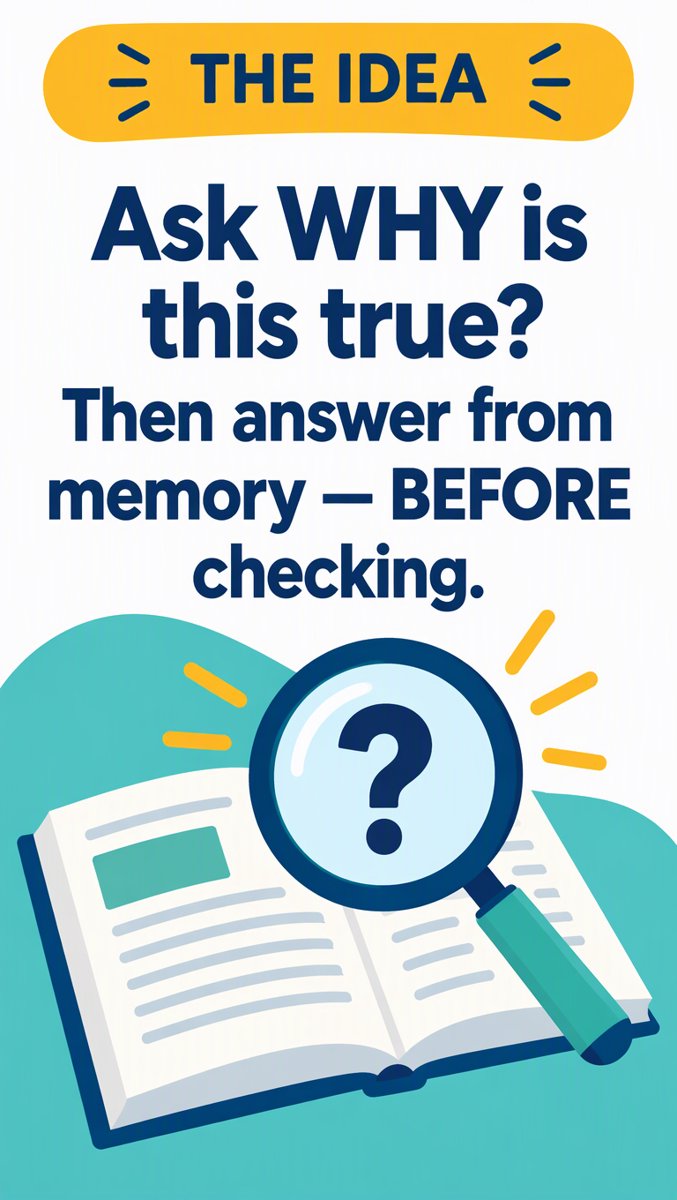
Elaborative interrogation is a study strategy where, for every key fact you encounter, you ask yourself why that fact is true — and then answer from memory before checking the source. Not "what does this say?" but "why would this be true of X and not of Y?"
The classic contrast:
- Memorizing: "Animals in cold climates have smaller ears." Read it, repeat it.
- Elaborative interrogation: "Why would cold-climate animals have smaller ears?" Because ears shed heat through their surface — smaller ears mean less heat lost. Desert animals want the opposite, so bigger ears help them dump heat.
The second version takes maybe ten extra seconds. But it produces a reason, and reasons are what memory is actually built to store. Cognitive psychologists say you're activating a schema — hooking the new fact onto knowledge you already own. Connected facts are easier to find later. Disconnected facts are the ones that evaporate overnight.
The evidence: telling isn't teaching yourself
The founding experiments come from Michael Pressley and colleagues in 1987. Undergraduates read sentences like "The hungry man got into the car." One group just read. A second group was given the explanation ("...to go to the restaurant"). A third group was prompted: why did that particular man do that? — and had to produce the answer.
On the final test — "who got into the car?" — the results, as summarized in Dunlosky's review:
| Condition | Final-test accuracy (approx.) |
|---|---|
| Read the sentence | 37% |
| Given the explanation | 37% |
| Asked why, answered it themselves | 72% |
Look hard at that middle row. Being handed a good explanation did nothing. The benefit came entirely from producing the explanation — the same generation effect that powers active recall.
And it's not a lab curiosity. In a 2010 study by Smith, Holliday, and Austin, real undergraduates in an introductory biology course read a textbook passage on human digestion. Half saw 21 "Why is this true?" prompts woven through the text — roughly one every 150 words. The prompted group scored 76% versus 69% on 105 true/false questions afterward, even after controlling for prior knowledge and verbal ability. Total cost: about four extra minutes (32 vs 28).
In 2013, John Dunlosky's team reviewed ten popular study strategies in Psychological Science in the Public Interest. Highlighting and rereading — the two most common techniques students report using — scored low utility. Elaborative interrogation earned moderate utility, among the best ratings given, praised for working across subjects, ages (upper elementary through university), and requiring almost no training or extra time.
The difference between a weak answer and a strong one
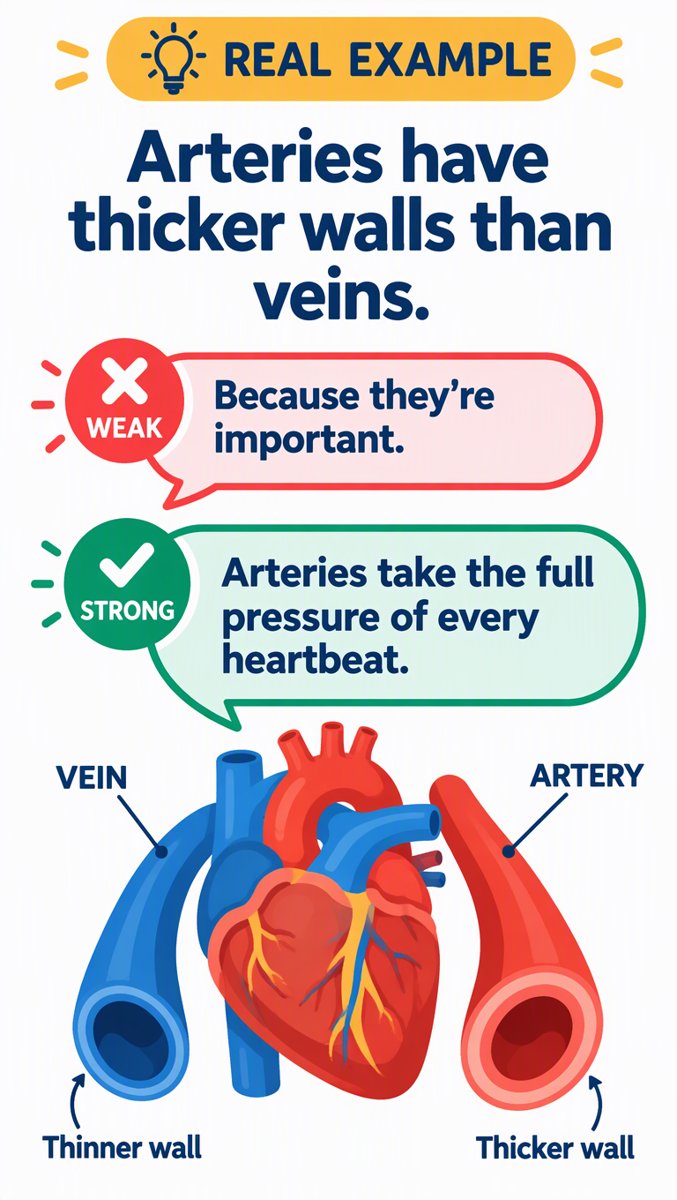
Take the fact from the slide: arteries have thicker, more muscular walls than veins.
- Weak answer: "Because they're important." (Adds nothing. You'll forget it.)
- Strong answer: "Because arteries receive blood at full heartbeat pressure straight from the heart — they need strength and elasticity to handle it."
The strong answer names a mechanism. Vague answers feel like studying but retrieve like nothing. When your why-answer is specific — when it names a pressure, a cause, a difference — you've built a link you can actually pull on in the exam.
How to apply it (a 25-minute routine)
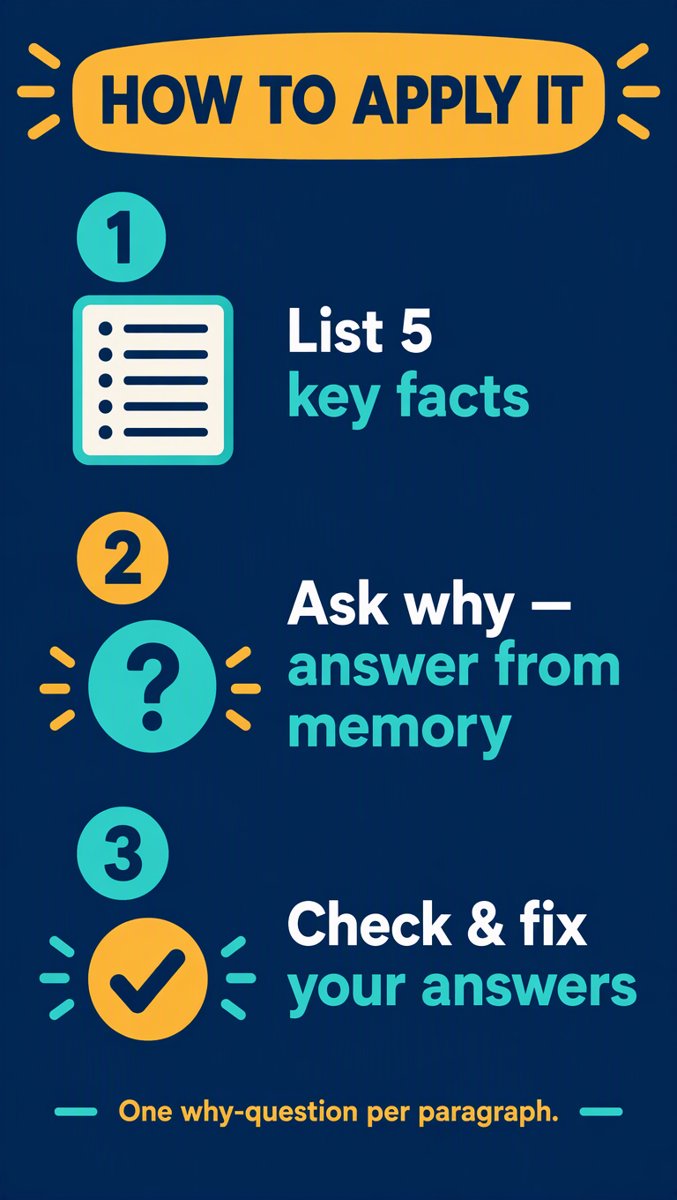
- Read one section. One or two pages, or one lecture topic.
- List 5–8 key facts as short statements: "Arteries have thicker walls than veins."
- Ask why — and answer from memory. One or two sentences per fact, before looking anything up. Stuck? Write your best guess and mark it with a question mark.
- Check and correct. Compare against the textbook. Fix wrong answers in a different color — a confident wrong explanation can stick, and that hurts more than not answering.
- Make why-cards. Turn your best questions into flashcards and answer them cold tomorrow — now you're combining elaboration with retrieval practice, and the two compound.
Two evidence-backed dial settings: keep the questions dense (roughly one per paragraph — benefits shrink or vanish at one per chapter), and only elaborate on material where you have some background. Research by Woloshyn, Pressley, and Schneider found the benefit was about twice as large in a familiar domain (24% vs 12% gains). No hooks, no benefit — read the basics first.
The takeaway
Highlighting copies information. Asking why connects it. The ten seconds you spend generating an answer — even a slightly wrong one that you then fix — is worth more than the tenth time you re-read the page.
Your notes can stay perfect. Just make sure your brain has to earn them.
🎬 Narration script (video version, ~178 words ≈ 71s at TTS pacing)
[Hook] Your notes are perfect. So why can't you remember any of it tomorrow?
[The Idea] The fix is a question. For every key fact, ask: why is this true? Then answer from memory — before you check the book. Rebuild it. Don't re-read it.
[Mechanism — Pressley 1987] In one classic experiment, students read sentences like: the hungry man got into the car. Readers scored thirty-seven percent. Students handed the explanation? Also thirty-seven. Only the ones who asked why themselves — and answered — hit seventy-two percent.
[Example] Take this fact: arteries have thicker walls than veins. Weak answer: "because they're important." Strong answer: arteries take the full pressure of every heartbeat. That detail sticks.
[Apply] Here's the routine. List five key facts from a section. Short statements. Ask why — and answer from memory. Then check the book and fix your mistakes. Aim for one why-question per paragraph. That's the dose.
[Takeaway] Highlighting copies. Asking why connects. One question turns notes into knowledge.
[CTA] If this made you think, follow Think and Growth — one mental model every morning, until sharper thinking is automatic.
📋 Per-segment ↔ clip mapping
| # | Slide | Segment | Words |
|---|---|---|---|
| 1 | cover | Hook | 14 |
| 2 | slide-1 | Idea seg 1 | 15 |
| 3 | slide-1 | Idea seg 2 | 14 |
| 4 | slide-2 | Mechanism seg 1 | 15 |
| 5 | slide-2 | Mechanism seg 2 | 13 |
| 6 | slide-2 | Mechanism seg 3 | 13 |
| 7 | slide-3 | Example seg 1 | 16 |
| 8 | slide-3 | Example seg 2 | 12 |
| 9 | slide-4 | Apply seg 1 | 11 |
| 10 | slide-4 | Apply seg 2 | 15 |
| 11 | slide-4 | Apply seg 3 | 10 |
| 12 | slide-5 | Takeaway | 14 |
| 13 | cta (fade_out) | CTA | 21 |
All clips: motion: "none" (content) / fade_out (CTA only) · all subtitle: "none" · all segments ≤ 16 words.
Sources
- Active Recalling — Elaborative Interrogation: Study by Asking Why (Pressley et al. 1987 37/37/72; Smith et al. 2010 76% vs 69%; Woloshyn et al. 1992; Dunlosky et al. 2013 moderate utility): https://activerecalling.com/blog/elaborative-interrogation-technique
- The Learning Scientists — Learn How to Study Using... Elaboration (Sumeracki & Weinstein): https://www.learningscientists.org/blog/2016/7/7-1
- Wikipedia — Elaborative interrogation: https://en.wikipedia.org/wiki/Elaborative_interrogation
- LEAI — confirms Dunlosky 2013 review in Psychological Science in the Public Interest: https://leai.app/blog/elaborative-interrogation-why-questions-boost-learning
- LITFL — confirms 'moderate utility' rating: https://litfl.com/elaboration-and-elaborative-interrogation/