

Deliberate Practice: 10,000 Hours Is the Wrong Lesson
Think and Growth — Daily Teaching Video · Theme: School (learning fast, study systems)
The Hook
You've heard the rule. Put in 10,000 hours at anything and you'll be world-class. It's one of the most quoted ideas of the last two decades — and according to the researcher whose work started it all, it's a misquote.
In the early 1990s, psychologist K. Anders Ericsson studied violinists at the Music Academy of West Berlin. By age 18, the elite players — the ones rated most likely to become soloists — had accumulated roughly 7,410 hours of practice (Tradicted summary of Ericsson, Krampe & Tesch-Römer 1993). Malcolm Gladwell later rounded the idea up into a tidy, sellable "10,000-hour rule." Ericsson himself objected: the hours were never the point. What separated the best from the merely good wasn't how long they practiced. It was how.
The Idea: Structure Beats Volume
That how has a name: deliberate practice. It's practice designed — not just performed. In Ericsson's framework, most people engage in "naive practice": playing the songs they already know, typing the emails they already type, running the pace they already run. It feels productive, and it plateaus almost immediately, because it never touches the parts of the skill that are actually weak.
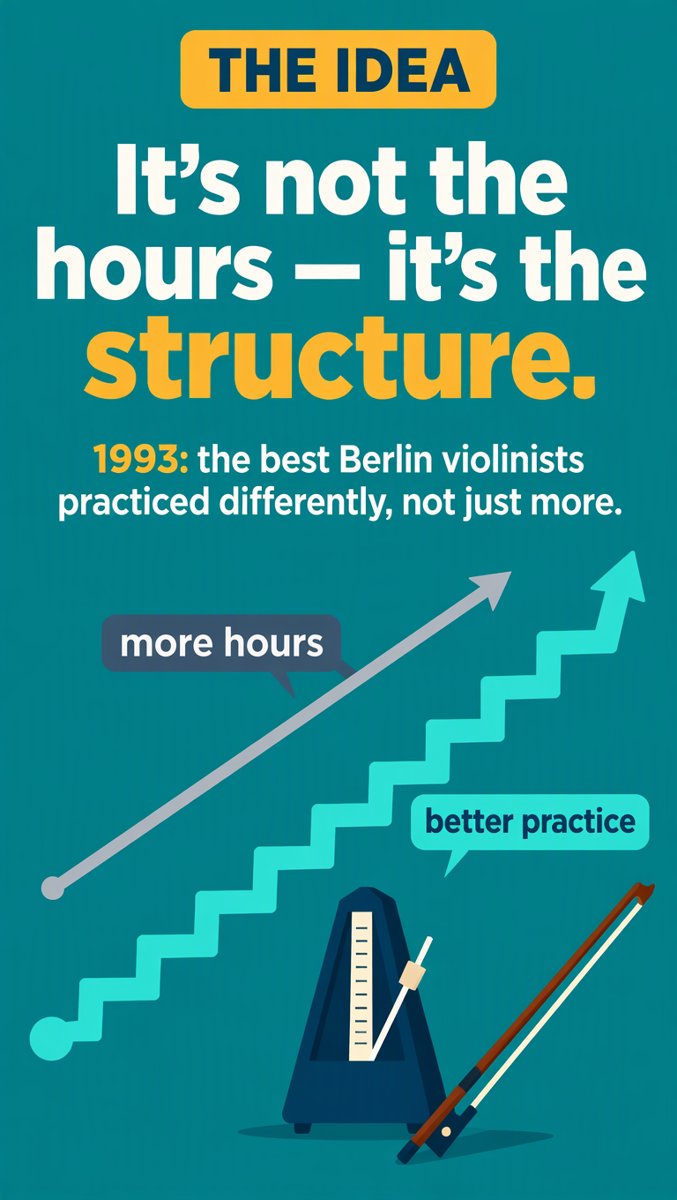
Deliberate practice is the opposite. It's uncomfortable by design, because it targets the gap between what you can do and what you can't — yet.
How It Works: The Four Components
Ericsson's research, popularized in his book Peak, keeps the definition tight. Deliberate practice has four essential components (Antoine Buteau, "Lessons from Dr. Anders Ericsson"):
- A specific goal. Not "get better at guitar" — "nail the transition between measures 8 and 12 at 90 BPM." Vague goals produce vague improvement.
- Intense focus. Full attention, no autopilot. This is why deliberate practice is tiring in a way that casual practice isn't — and why sessions are short.
- Immediate, informative feedback. You need to know right away whether the attempt worked — from a coach, a recording, a metric. Practice without feedback is just repetition.
- Working at the edge of your comfort zone. The attempt lives just beyond current ability. That's where the brain is forced to adapt — and where most people quietly refuse to go.
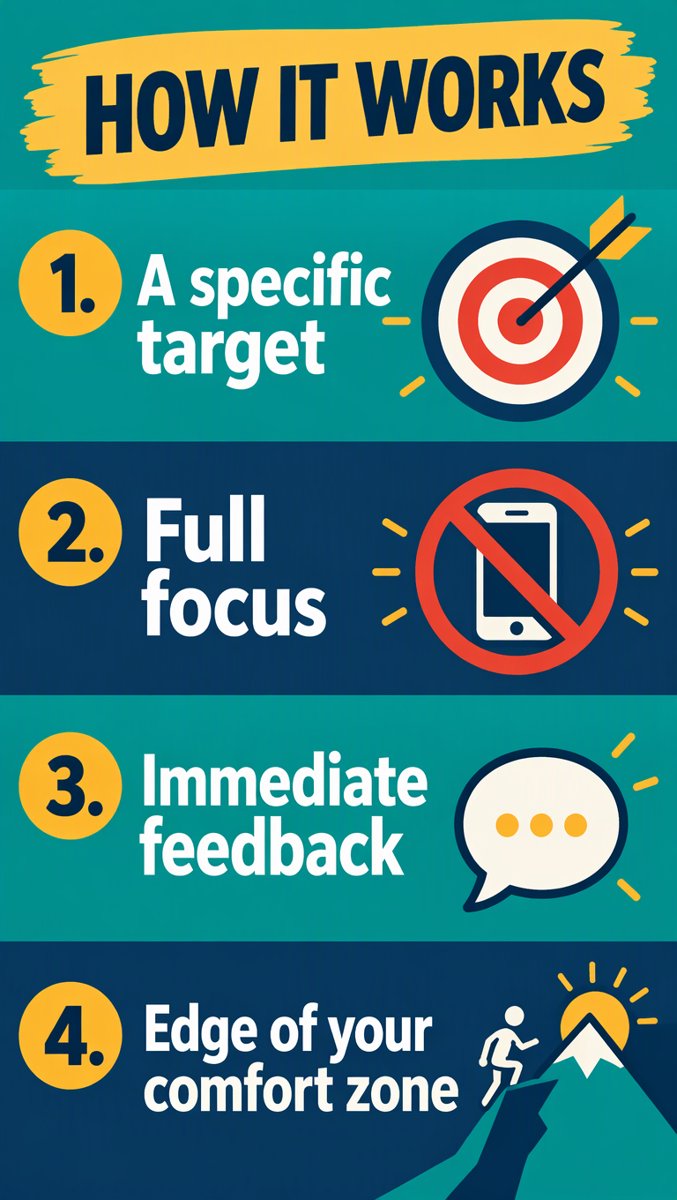
Drop any one component and you're back to naive practice — motion, not progress.
The Evidence: SF and the 82 Digits
The most striking demonstration came from Ericsson's earlier memory research. Chase and Ericsson trained a college student referred to as "SF" — a young man with entirely normal memory who, like almost everyone, could hold about seven random digits in mind. The researchers didn't ask him to "try harder." They trained him in structured sessions, at the edge of his limit, with immediate feedback on every attempt, building strategy on top of strategy (Cognitive Science, Yoon et al. 2018).
The result: across roughly 264 hours of training, SF's digit span went from 7 to 82. Same brain. Not a gifted memorist. The difference was entirely in the structure of the practice — a finding that has been replicated and discussed across the expertise literature since (Memory & Cognition).

This is the lesson the 10,000-hour headline buried: SF didn't out-work the average person by 10x in raw hours. He practiced in a way that forced adaptation, and the adaptation compounded.
How to Apply It Today
You don't need 10,000 hours or a Berlin conservatory. You need one honest loop, run deliberately:
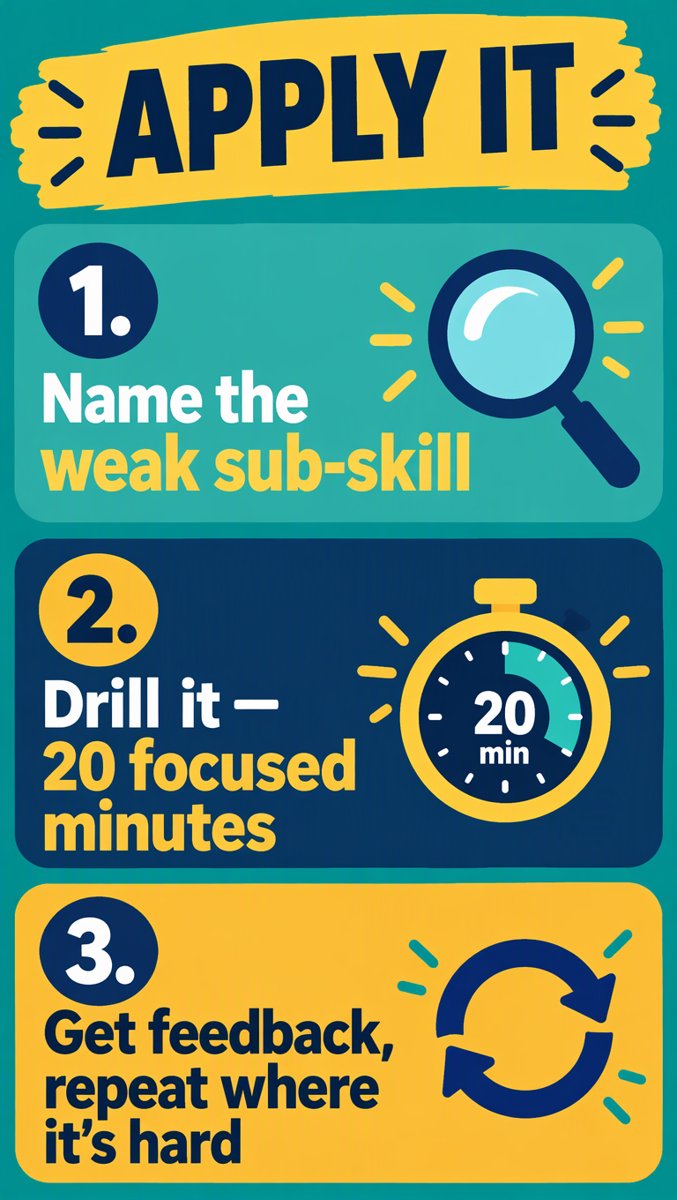
- Name the weak sub-skill. Pick one thing you're learning right now and get brutally specific about where it breaks. Not "get better at public speaking" — "stop filling every pause with 'um.'" Naming the weakness is half the work, because naive practice always avoids it.
- Drill it — 20 focused minutes. One sub-skill, one session, zero distractions, difficulty set just past comfortable. Twenty minutes at the edge beats two hours on autopilot — that intensity is exactly why elite performers don't do this all day.
- Get feedback, then repeat where it's hard. Record it, measure it, or ask someone who'll tell you the truth. Then go straight back to the uncomfortable part — not the part you're already good at.
Loop this daily and you get the quiet superpower: your practice compounds while everyone around you is just repeating.
The Takeaway
Hours build habits. Deliberate practice builds skill. The elite violinists hadn't just practiced more — they'd practiced differently, and SF's 82 digits prove the ceiling is set by structure, not talent (what Ericsson actually found).
So the question for today isn't "how many hours have I put in?" It's "was any of that practice deliberate?"
Practice where it's hard.
📽️ Narration Script (142 words · ~70 seconds)
Ten thousand hours made you a promise. Ericsson's own research says you misheard it.
In 1993, Ericsson studied violinists at the Berlin music academy. The best hadn't just practiced more hours. They practiced differently — structured, specific, focused.
Deliberate practice has four parts. A specific target. Full focus. Immediate feedback. And the fourth: you work at the edge of your comfort zone, where growth lives.
One student, SF, had a normal memory. He could hold seven digits. After structured training at his limit, he recalled eighty-two. Same brain. Better structure.
Here's your move. Name one weak sub-skill in something you're learning right now. Drill it for twenty focused minutes. Get feedback. Repeat where it feels hard.
Hours build habits. Deliberate practice builds skill. Practice where it's hard.
That's today's mental model. Follow Think and Growth — one practical idea, every single morning.
Sources
- Deliberate Practice: Why 7,410 Hours Separate Elite Performers from Amateurs — Tradicted — Ericsson, Krampe & Tesch-Römer (1993), Psychological Review; Berlin violinist study details
- Lessons from Dr. Anders Ericsson — Antoine Buteau — the four essential components of deliberate practice
- Effects of 30 Years of Disuse on Exceptional Memory Performance — Cognitive Science (Wiley) — SF: digit span 7 → 82 over 264h of training
- Deliberate Practice: What Ericsson Actually Found (and Why Gladwell Got It Wrong) — alfred_ — the misquote backstory
Episode #41 · Think and Growth — one practical mental model, every morning. New video daily, 7 days a week.