
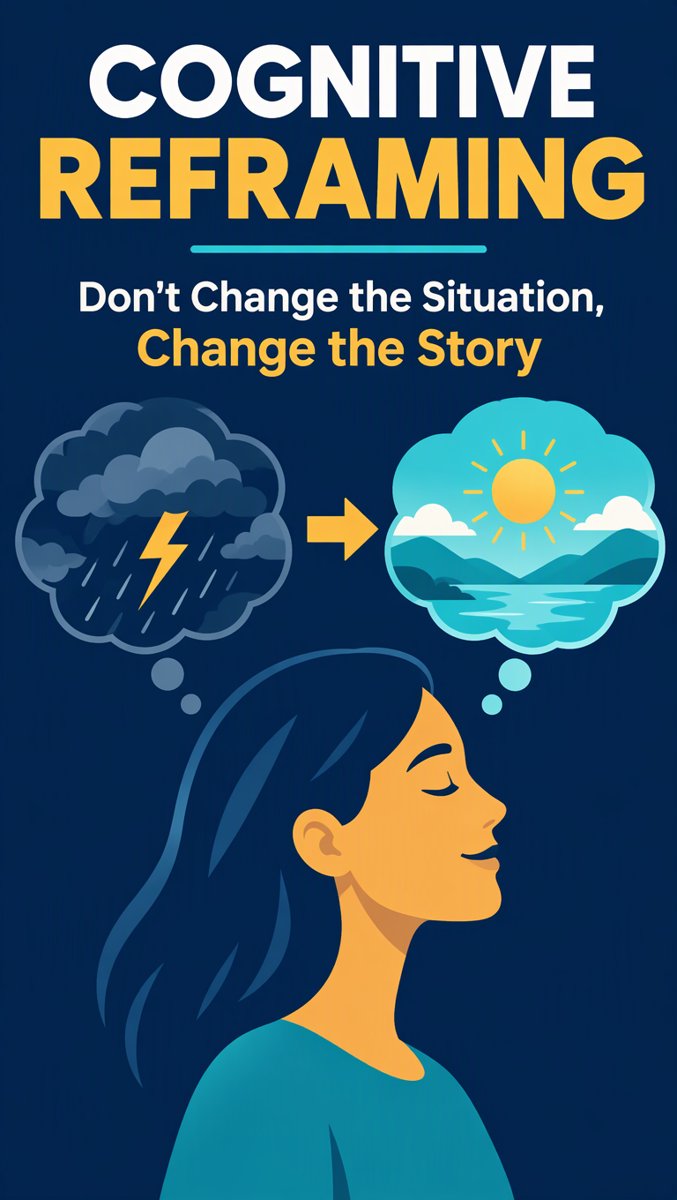
Cognitive Reframing: Don't Change the Situation — Change the Story
Think and Growth — Friday, Mental Health theme · 2026-11-20 · By Peter, BDM @ NXagents.net
The event didn't ruin your day. Your story about it did.
The model
Cognitive reframing (also called cognitive reappraisal) is swapping an automatic, distressing thought for a truer one. Albert Ellis proved the mechanism in 1957 with his ABC model: Activating event, Belief about it, Consequence (the feeling). The event never causes the feeling — your belief does. Aaron Beck built Cognitive Therapy on the same insight in the 1960s.
James Gross's emotion-regulation science adds the timing rule: strategies that act early — reappraising the interpretation before the emotion fully forms — outperform strategies that act late, like suppressing the feeling after it's already burning. Reappraisal reduces negative emotion without the physiological cost suppression carries. In short: change the frame early, and the feeling never takes over.
How it works
- Catch it. Name the trigger and name the thought before it hijacks you.
- Check it. What is the evidence? Would a scientist convict on this proof?
- Change it. Accurate, not fake-positive. "Prepared for most" beats "doomed."
The aim is accuracy, not cheerfulness. "I'll fail this presentation" never becomes "I'll definitely succeed" — it becomes "this is harder than I'd like, and I can prepare."
The real-world example
Before a big pitch, the automatic thought fires: "Everyone will judge me if I mess up." That thought creates the anxiety, not the pitch. The reframed version: "I'm prepared for most questions — and if one stumps me, I'll take a note and follow up." Same room, same audience, completely different physiology. Accurate beats terrified, every single time.
In my world: one lost deal does not make a failed career. It is one data point. Your win rate over the last twenty deals is the story — and that's usually a much kinder one.
How to apply it
Do this in sixty seconds, today, the next time a thought hooks you:
- Name the trigger.
- Write the automatic thought down, word for word.
- Argue with it like a scientist — evidence for, evidence against.
- Write the truer thought. Say it out loud. That is your new default.
The takeaway
A thought is just a draft. You are the editor. Edit accordingly.
Narration script (video — ~198 words, ~74s)
Clip 1 (cover): "The event didn't ruin your day. Your story about it did. Here's the fix." Clip 2 (slide 1): "This is cognitive reframing: swapping an automatic thought for a truer one." Clip 3 (slide 1): "Albert Ellis proved it: the event never causes the feeling. Your belief does." Clip 4 (slide 2): "Step one, catch it. Name the trigger, name the thought before it hijacks you." Clip 5 (slide 2): "Step two, check it. What is the evidence? A scientist would demand more proof." Clip 6 (slide 2): "Step three, change it. Accurate, not fake-positive. Prepared beats doomed." Clip 7 (slide 3): "Real example. Before the pitch you think: 'Everyone will judge me if I mess up.'" Clip 8 (slide 3): "Reframed: 'I'm prepared for most questions. If I miss one, I'll follow up.'" Clip 9 (slide 3): "Accurate beats terrified. Every single time." Clip 10 (slide 4): "Apply it today. One, name the trigger. Two, write the thought down." Clip 11 (slide 4): "Three, argue with it like a scientist: evidence for, evidence against." Clip 12 (slide 4): "Four, write the truer thought, say it out loud. That's your new default." Clip 13 (slide 5): "Takeaway: a thought is just a draft. You are the editor. Edit accordingly." Clip 14 (slide 5): "Train this daily and clarity compounds. Think sharper. Decide faster. Grow daily." Clip 15 (CTA): "I'm Peter. Follow Think and Growth for one mental model every single day." Clip 16 (CTA): "Reframing starts with one honest sentence. Your move. See you tomorrow."
Sources
- https://pubmed.ncbi.nlm.nih.gov/12212647/
- http://www.johnnietfeld.com/uploads/2/2/6/0/22606800/gross_2015.pdf
- https://www.simplypsychology.org/cognitive-therapy.html
- https://sdlab.fas.harvard.edu/cognitive-reappraisal/positive-reframing-and-examining-evidence
- https://therapygroupdc.com/therapist-dc-blog/how-to-use-cognitive-reframing-for-anxiety-and-stress/