Chunking: Your Brain Can't Hold Ten Digits — But It Can Hold a Phone Number

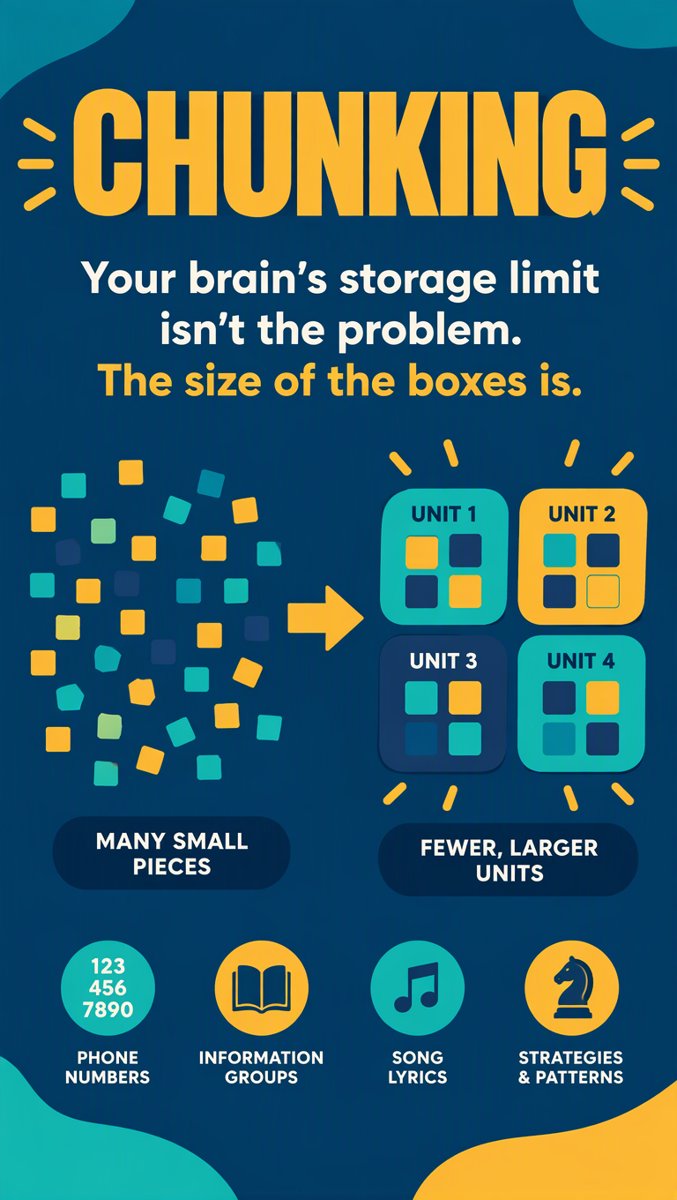
Think & Growth — Episode #75 · Chunking
Model: Chunking (George A. Miller, 1956; Nelson Cowan, 2001) Theme: School — why your brain can't hold ten digits, but can hold a phone number
Narration Script (full, 158 written words ≈ ~75s TTS)
[Hook — Cover] Here's why a ten-digit number feels impossible — and a ten-digit phone number doesn't.
[The Idea — Slide 1] Working memory holds just four to seven chunks at once — that's the famous Miller limit. But the unit isn't a digit or a letter. It's a chunk: a meaningful group.
[How It Works — Slide 2] Say you're studying. Don't memorize twenty scattered facts. Group them under three or four labels. Each label carries its whole group into memory at once.
[Real-World Example — Slide 3] Chess masters reconstruct a real game board after five seconds of viewing. Shuffle the same pieces randomly — and the masters collapse to beginner level.
[How to Apply — Slide 4] This week: break any overwhelming list into three or four named groups. Anchor each group to something you already know.
[Takeaway + CTA — Slides 5 + CTA] Stop trying to store more items. Start storing bigger chunks. That's chunking. Follow Think and Growth — one mental model a day. I'm Peter. See you tomorrow.
Per-Segment Clip Text (subtitle-fit: ≤15 words each)
| # | Slide | Text | Words |
|---|---|---|---|
| 1 | cover | Here's why a ten-digit number feels impossible — and a ten-digit phone number doesn't. | 14 |
| 2 | slide-1 | Working memory holds just four to seven chunks at once — that's the famous Miller limit. | 15 |
| 3 | slide-1 | But the unit isn't a digit or a letter. It's a chunk: a meaningful group. | 15 |
| 4 | slide-2 | Say you're studying. Don't memorize twenty scattered facts. Group them under three or four labels. | 15 |
| 5 | slide-2 | Each label carries its whole group into memory at once. | 10 |
| 6 | slide-3 | Chess masters reconstruct a real game board after five seconds of viewing. | 11 |
| 7 | slide-3 | Shuffle the same pieces randomly — and the masters collapse to beginner level. | 12 |
| 8 | slide-4 | This week: break any overwhelming list into three or four named groups. | 11 |
| 9 | slide-4 | Anchor each group to something you already know. | 8 |
| 10 | slide-5 | Stop trying to store more items. Start storing bigger chunks. | 10 |
| 11 | cta | That's chunking. Follow Think and Growth — one mental model a day. I'm Peter. See you tomorrow. | 16 |
Clip checklist: every content clip motion: "none"; CTA motion: "fade_out"; ALL clips subtitle: "none". 11 clips ≤ 20 cap. 158 written words ≤ 200 budget.
Chunking: Your Brain Can't Hold Ten Digits — But It Can Hold a Phone Number
Try a quick experiment. Read this string once, then look away and recall it: 8451976302. Most people fail. Now try the same ten digits with three small marks added: 845-197-6302. Suddenly it's easy. Nothing about your memory changed. Nothing about the information changed. Only the packaging did — and that packaging has a name: chunking.
The integer that haunted a psychologist
In 1956, Harvard cognitive psychologist George A. Miller published one of the most cited papers in the history of psychology. He opened it with a confession: "My problem is that I have been persecuted by an integer." That integer was seven. Across study after study, people could hold about seven items — plus or minus two — in immediate memory before accuracy collapsed. Seven random digits. Seven letters. Seven simple tones. The number showed up everywhere, and Miller published his findings in Psychological Review (read the original paper).
The genius of the paper isn't the number. It's the reframe. Those seven "items" aren't fixed units like digits or letters — they're chunks, and a chunk is whatever your mind has learned to treat as one thing. FBI is three letters to a child and one meaningful unit to you. 8451976302 is ten items; 845-197-6302 is three. Same information. A third of the slots.
And the limit is even tighter than Miller thought. In 2001, Nelson Cowan re-examined decades of evidence in Behavioral and Brain Sciences and concluded the true focus of attention holds closer to four chunks (NIH summary). Four. That's the real shelf space you're working with.
The chess masters who proved the point
Here's where it gets interesting. If capacity is ~4-7 chunks, how does anyone get genuinely good at anything complex? In 1973, William Chase and Herbert Simon ran the decisive experiment, published in Cognitive Psychology (overview). They flashed a chess position for about five seconds, then asked players to reconstruct it from memory. Grandmasters and masters rebuilt the board nearly perfectly. Novices managed a handful of pieces.
Then the twist: they shuffled the same pieces into positions that could never occur in a real game. The masters' advantage vanished — they dropped to near-novice recall. Their memory wasn't superhuman. They had simply spent years building a vast library of game-shaped chunks, each one grouping several pieces into a single meaningful pattern. Real board = a few dozen big chunks. Random board = dozens of loose pieces. Skill, in other words, is stored packaging.
The honest caveats
This channel doesn't sell shortcuts, so here are the limits. One: chunks are skill-specific. The chess master's pattern library doesn't transfer to chemistry or contract law — you have to build your own. Two: there's no way around the reps. Chase and Simon's estimate of master-level play implied tens of thousands of stored patterns, accumulated over years of deliberate practice. Chunking doesn't replace effort; it redirects it. Three: chunking improves storage, not automatically understanding. Pair it with retrieval practice — we covered that in Desirable Difficulties and Active Recall — so what you've packed actually comes back out under pressure.
Your playbook, in three moves
First, group before you memorize. Facing twenty scattered facts? Never learn them as twenty. Sort them into three or four natural categories first — by cause, by era, by function. The grouping itself is already studying.
Second, name each group in one word. A label is what turns a pile into a chunk. "The three causes of the war" is one item your brain can carry; eleven unconnected bullet points are eleven items it will drop. If you can't name the group in a word or two, the grouping isn't real yet.
Third, anchor groups to what you already know. Attach each new chunk to an existing one — a familiar example, a personal story, a number you already own. Cowan's four-slot shelf means every new chunk should arrive with a place to sit. New knowledge that lands on old knowledge stays. New knowledge that lands on nothing falls off.
The deeper lesson: your working memory was never going to grow. Stop trying to store more items. Start storing bigger chunks.
Don't just study harder. Package smarter — group it, name it, anchor it.
Think & Growth — Episode #75 · Theme: School
Sources
- Miller, G. A. (1956). "The Magical Number Seven, Plus or Minus Two: Some Limits on Our Capacity for Processing Information." Psychological Review, 63(2), 81–97 — https://labs.la.utexas.edu/gilden/files/2016/04/MagicNumberSeven-Miller1956.pdf
- Chase, W. G., & Simon, H. A. (1973). "Perception in Chess." Cognitive Psychology, 4(1), 55–81 — https://notes.andymatuschak.org/Chase_and_Simon_-_Perception_in_chess
- Cowan, N. (2001). "The magical number 4 in short-term memory: A reconsideration of mental storage capacity." Behavioral and Brain Sciences, 24(1), 87–114 — https://pubmed.ncbi.nlm.nih.gov/11515286