

Box Thinking: Think Inside the Box — and Win
Think and Growth · Sunday — Innovation · 2026-11-15 · By Peter, Business Development Manager, NXagents.net
Everyone says innovation means "thinking outside the box." Box Thinking says the opposite: the breakthrough comes from thinking harder inside the box. When you strip away the romance, the teams and founders who create the most are not the ones with total freedom. They are the ones who name their constraints — budget, time, format, materials — and then mine them like an asset.
This episode explains Box Thinking: where it comes from, why it works, the real-world proof behind it, and the three moves you can run on your very next stuck problem.
The Idea: Constraints Are the Fuel, Not the Enemy
Box Thinking rests on a simple inversion. The familiar move — add resources, remove limits, open the possibilities — feels creative. It usually isn't. Unlimited choice produces more of the same, because every brain reaches for its first, easiest answer. Put a wall in place, and that easy answer can no longer be used. The brain has to search further, reach deeper into its associative networks, and return with something nobody expected.
Two bodies of work define the method:
- Jacob Goldenberg and Roni Horowitz, Inside the Box (Systematic Inventive Thinking / SIT). Their research found that successful products share recurring internal patterns — a kind of DNA. Creativity, in their framing, is not inventing from a blank page; it is spotting the pattern and re-applying it to a new situation. Their canonical example: Transition (photochromic) sunglasses, where one attribute — darkness — rises and falls together with another — external light. One move, two attributes changed.
- Mike Thompson, When the Box Is the Limit. A decade of innovation consulting distilled into a suite of techniques for "using natural or self-imposed constraints to the benefit of creativity and innovation." Exactly the muscle Box Thinking trains.

The core principle, in one line: creativity is not the absence of constraint. It is the exploitation of it.
How It Works: The Three-Step Search
Box Thinking is a procedure, not a mood. Run it in this order:
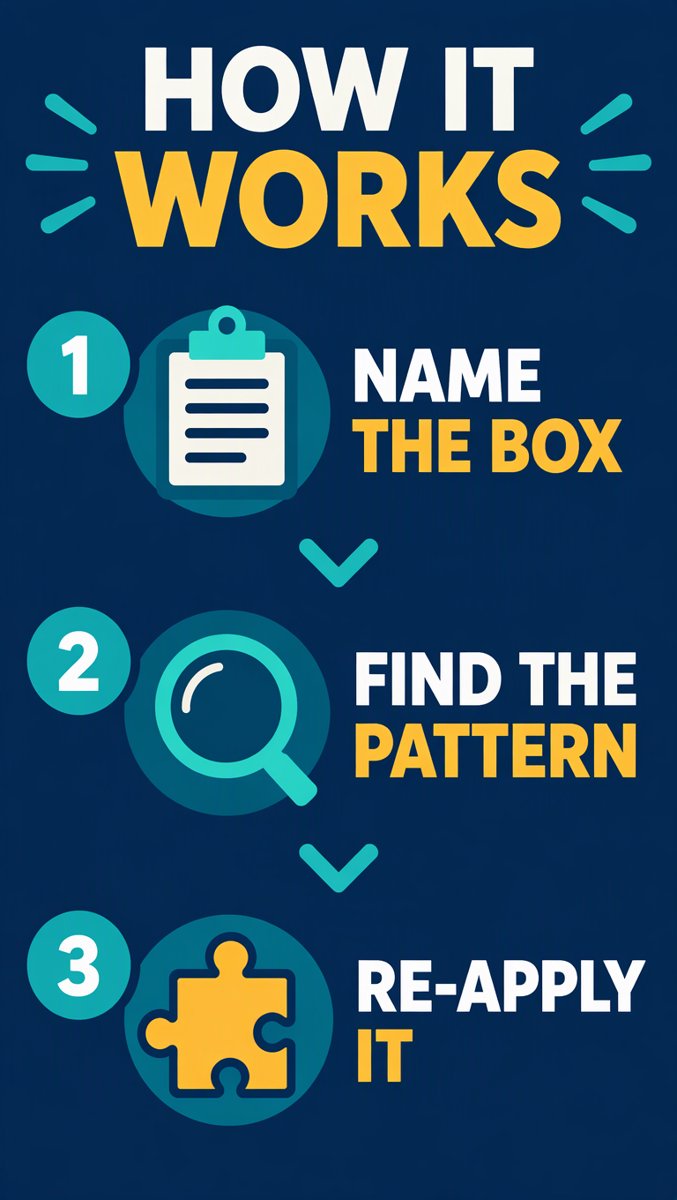
Step 1 — Name the box. Write down the hard constraints before you touch the problem: the deadline, the budget ceiling, the character limit, the material you can't use, the format you can't change. Most teams skip this and argue about the problem in the abstract. The constraints are the problem's shape — refuse to name them and you will never see the solution's shape either.
Step 2 — Find the pattern. Ask: who else has solved something inside limits like these? Patterns travel. A business that automated one recurring task has a pattern for your onboarding flow. A drugstore shelf layout has a pattern for your landing page. Goldenberg and Horowitz's whole method is built on the fact that these patterns repeat across industries and get reused constantly.
Step 3 — Re-apply the pattern. Transplant the pattern onto your problem, unchanged where possible. If it doesn't fit perfectly, that's the signal — the mismatch is exactly where the invention lives. You are not borrowing to be derivative; you are borrowing to be fast, and the adaptation is where your originality enters.
Real-World Proof: The Limits Created the Invention
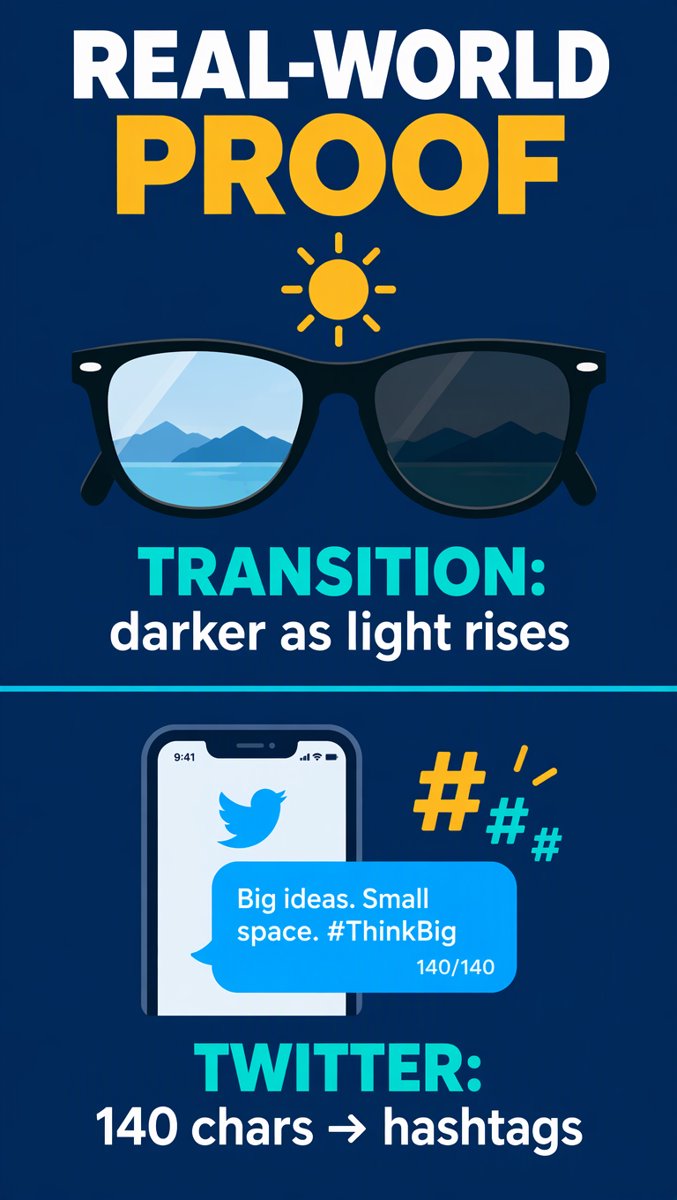
Transition sunglasses. The SIT method's textbook case. The product doesn't redesign the lens from scratch; it applies a single pattern — one attribute changes with another — so the glasses darken as the light outside brightens. The breakthrough is a reused structure, not a lightning strike.
Twitter's 140 characters. The most famous accidental Box Thinking demo in business history. A brutal product constraint forced users to invent the entire grammar of social media inside it: hashtags to group topics, @mentions to address people, retweets to forward content, abbreviations and link-shorteners to fit more signal into less space. Nobody designed those. They were found by searching inside the box.
The research backs the pattern. A review of the creativity-and-constraints literature states it plainly: "Increasing constraints — and thereby decreasing choice and limiting options — actually promotes creativity." And in Johnathan Cromwell's 2024 typology of creative problem solving, "extreme levels of constraint can push people to use different types of creative problem solving" — the constraint level changes the kind of creativity you get; it doesn't erase it. Even Pablo Picasso's line of breakthroughs, in Patricia Stokes's research, followed periods of self-imposed restriction on palette, subject, and technique — the limits forced him past his own established style.
How to Apply It This Week
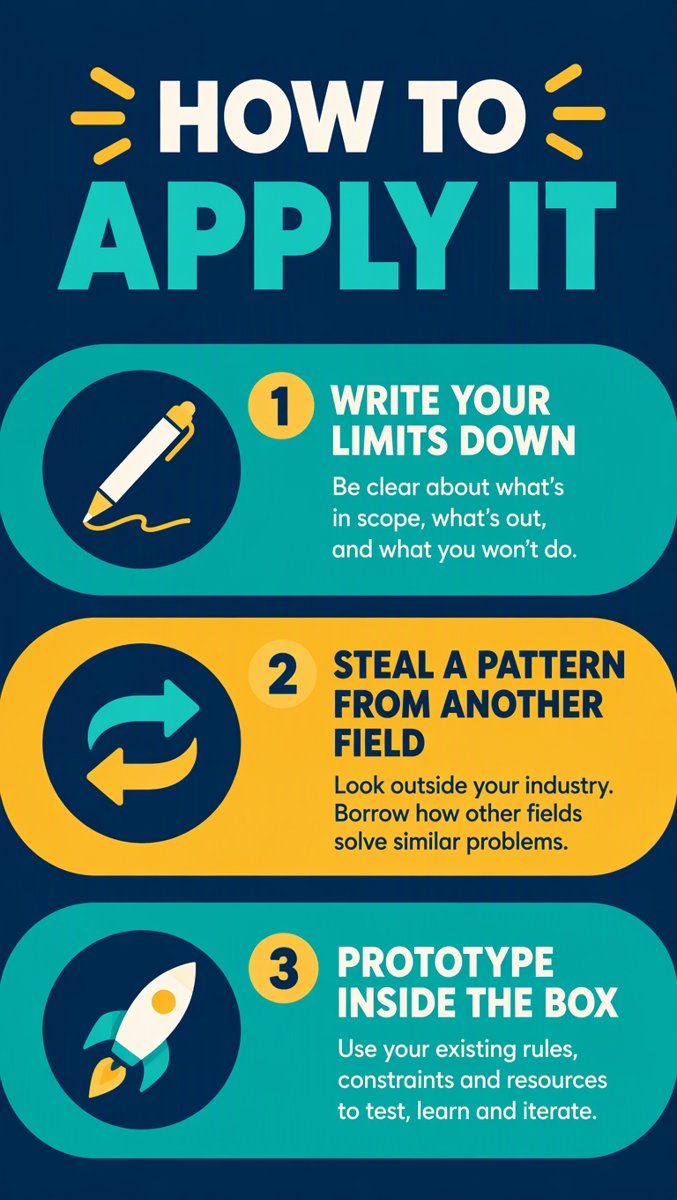
1. Write your limits down. Take the problem you keep circling. List three constraints on one sheet of paper: money, time, format. Get specific — "$4,000 and ten days," not "not much budget." The sharper the box, the sharper the thinking.
2. Steal a pattern from another field. Ask who outside your industry faced the same limit. A restaurant with a two-hour table turnover solved a scheduling pattern your startup can use. A pilot's pre-flight checklist solved a reliability pattern your process needs. Patterns are industry-blind; copying them is how fast learners actually innovate.
3. Prototype inside the box. Build the smallest version that respects every constraint on your list. Do not spend your first week redesigning the box — arguing for a bigger budget, a later deadline, a wider format. Spend it generating five answers inside the box you have. Four will be mediocre. The fifth will be the one you couldn't have found with the limits removed.
The Takeaway

You don't need a bigger box. You need a sharper search inside it.
The people who look like visionaries are usually just people who got ruthless about searching the space they already had. Box Thinking turns every stuck project from "we need more" into "we need to look harder" — and looking harder, as the evidence shows, is where the breakthroughs actually live.
— Peter, BDM @ NXagents.net
Sources:
- Inside the Box (Systematic Inventive Thinking / SIT) — https://insidetheboxinnovation.com/
- SIT case-study summary: Transition sunglasses pattern — https://www.sitsite.com/inside-the-box-a-proven-method-of-creativity-for-breakthrough-results/
- Mike Thompson, When the Box Is the Limit — https://www.whentheboxisthelimit.com/thebook
- "Creativity from constraints: Theory and applications to education" (ScienceDirect) — https://www.sciencedirect.com/science/article/abs/pii/S1871187122001870
- Cromwell, J. R. (2024), constraint typology (SAGE) — https://journals.sagepub.com/doi/10.1177/20413866231202031
- Stokes's Picasso research summary — https://verybigbrain.com/psychology-thinking/the-counterintuitive-reason-why-constraints-make-you-more-creative/
Narration Script (video — ~136 words, ~55-60s)
- Cover (hook, 11w): "Stop trying to think outside the box. Think harder inside it."
- The Idea (22w): "Box Thinking says constraints are the fuel of creativity, not the enemy. Tight limits kill lazy answers and force deeper search."
- How It Works (30w): "Name the box. Find the pattern. Re-apply it. First list your hard limits. Then find what already works inside similar ones. Finally, transplant that pattern onto your problem."
- Real-World Example (25w): "Transition sunglasses darken as light rises, one pattern that moves an attribute. Twitter's 140 characters forced hashtags, retweets, at-mentions. The limits created them."
- How to Apply It (23w): "Write your constraints down. Steal a pattern from another field. Prototype inside the box. Never spend energy redesigning the box first."
- Takeaway (14w): "You don't need a bigger box. You need a sharper search inside it."
- CTA (11w): "Follow Think and Growth for one mental model every single day."
Per-Slide Segments (subtitle-fit: ≤15 words / ≤6s each)
| Clip | Image | tts_text |
|---|---|---|
| 1 | cover | Stop trying to think outside the box. Think harder inside it. |
| 2 | slide-1 | Box Thinking says constraints are the fuel of creativity, not the enemy. |
| 3 | slide-1 | Tight limits kill lazy answers and force deeper search. |
| 4 | slide-2 | Name the box. Find the pattern. Re-apply it. |
| 5 | slide-2 | First list your hard limits. Then find what already works inside similar ones. |
| 6 | slide-2 | Finally, transplant that pattern onto your problem. |
| 7 | slide-3 | Transition sunglasses darken as light rises, one pattern that moves an attribute. |
| 8 | slide-3 | Twitter's 140 characters forced hashtags, retweets, at-mentions. The limits created them. |
| 9 | slide-4 | Write your constraints down. Steal a pattern from another field. |
| 10 | slide-4 | Prototype inside the box. Never spend energy redesigning the box first. |
| 11 | slide-5 | You don't need a bigger box. You need a sharper search inside it. |
| 12 | cta | Follow Think and Growth for one mental model every single day. |