
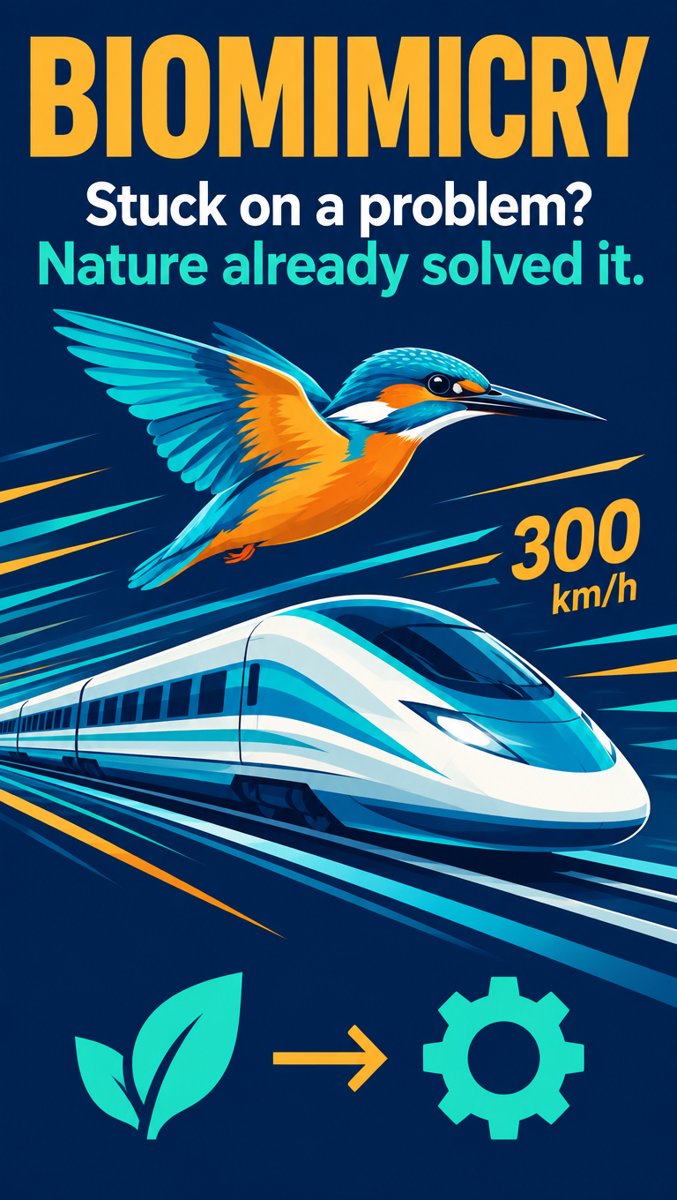
Biomimicry: The Answer to Your Hardest Problem Might Have Wings
Think and Growth — Sunday, October 18, 2026 · Theme: Innovation
Japan's fastest train had a noise problem. Every time the Shinkansen 500 series shot out of a tunnel at 300 kilometers per hour, the air it compressed exploded outward as a thunderclap — a "tunnel boom" loud enough to rattle windows hundreds of meters away. Regulations capped the speed. Conventional engineering kept hitting the same wall.
The man who finally cracked it wasn't just an engineer. Eiji Nakatsu was a birdwatcher. And he asked a question that separates ordinary problem-solvers from breakthrough thinkers: has nature already solved this?
That question has a name: Biomimicry.
The Idea
Biomimicry is the practice of solving human design problems by studying and emulating designs that nature has already perfected. The term was popularized by biologist Janine Benyus in her 1997 book Biomimicry: Innovation Inspired by Nature, and her framing is disarmingly simple: nature is model, measure, and mentor. She calls it 3.8 billion years of free research and development — every organism alive today is the winner of an unbroken chain of design iterations that never stopped running.
The core principle: before you invent from scratch, ask "How would nature solve this?" Then study the organism that solved it, extract the underlying principle — not the surface appearance — and translate that principle into your context.
How It Works
Three steps, and none of them require a laboratory.
- Define your problem plainly. "My train is too loud in tunnels." "My package won't stay closed." A precise, simple problem statement is what makes nature searchable.
- Ask which organism already solved it. Diving birds face exactly the same physics as tunnel-exiting trains: a low-friction medium (air) slamming into a high-friction one (water or pressurized tunnel air) with the least splash possible.
- Extract the principle, translate the design. What matters isn't copying the bird — it's understanding why its shape works, then rebuilding your own system around that principle.
The Proof: The Kingfisher Bullet Train
Nakatsu's team studied the kingfisher, a bird that dives from air into water to catch fish while producing barely a ripple. The geometry that minimized the pressure wave in their tests kept coming back the same shape: the kingfisher's long, tapered beak.
They rebuilt the train's nose around it. The redesigned 500 Series Shinkansen eliminated the tunnel boom, cut electricity consumption by roughly 15% thanks to reduced drag, and ran about 10% faster — all by borrowing the face of a bird. (Biomimicry NZ, Japan Apparently)
The pattern shows up everywhere once you look:
- Velcro came from burdock burrs clinging to a dog's fur — Swiss engineer George de Mestral examined the hooks under a microscope in 1941 and patented hook-and-loop fasteners.
- Gecko-style grips come from the microscopic foot hairs that let lizards climb glass.
- Benyus's own examples: solar cells modeled on leaves, self-cleaning surfaces modeled on lotus leaves — designs that run on sunlight, recycle everything, and fit form precisely to function (The Biomimicry Institute).
How to Apply It This Week
Take the problem that's been stuck on your whiteboard and run it through the biomimicry lens:
- Write it as one sentence. Vague problems can't be looked up in nature's catalog; precise ones can.
- Find nature's version. Which living system faced the same constraint — distribution, cooling, adhesion, coordination under uncertainty — and thrived anyway?
- Steal the principle, not the appearance. A kingfisher's colors are irrelevant; its beak geometry changed a national rail system.
You don't need to be an engineer to use this. Negotiators study how wolf packs settle disputes without fatal fights. Product designers study how termite mounds self-regulate temperature. The catalog is free, and it has been running for 3.8 billion years.
The Takeaway
Before you invent from scratch, remember: your problem may already have a billion-year-old answer — and it might have wings.
Watch today's full teaching video above, then go find nature's version of your stuck problem.
*Sources: The Biomimicry Institute — Janine Benyus · Biomimicry NZ — The Shinkansen and the Kingfisher ·

· Japan Apparently — Shinkansen kingfisher nose*
🎬 Narration Script (12 segments, 173 written words ≈ 70-80s measured)
| # | Slide | Segment |
|---|---|---|
| 1 | Cover | Japan's fastest train had a noise problem. The fix came from a bird. |
| 2 | Idea | Biomimicry means solving human problems by copying designs nature already perfected. |
| 3 | Idea | Biologist Janine Benyus calls it three point eight billion years of free research. |
| 4 | Mechanism | Step one: define your problem simply. Step two: ask which organism already solved it. |
| 5 | Mechanism | Step three: study the biology, extract the principle, then translate it into your design. |
| 6 | Example | Engineer Eiji Nakatsu faced a real problem. His bullet train boomed like thunder in tunnels. |
| 7 | Example | A birdwatcher, he modeled the nose on the kingfisher's beak. The boom vanished. |
| 8 | Example | The train used fifteen percent less electricity and traveled ten percent faster. |
| 9 | Apply | Try it this week. Write your problem as one sentence. Ask how nature solved it. |
| 10 | Apply | Velcro came from burrs on a dog. Gecko grips came from lizard feet. |
| 11 | Takeaway | Before you invent from scratch, remember: your problem may already have a billion-year-old answer. |
| 12 | CTA | If this reframe helps, share it with a friend who's stuck on a hard problem. Follow Think and Growth for one mental model every day. |
Clip rules applied: every clip motion: "none" (CTA fade_out), every clip subtitle: "none" (infographic cards carry their own text), every segment ≤ 15 words.