Attention Restoration Theory: Your Focus Isn't Broken — It's Out of Battery

Attention Restoration Theory: Your Focus Isn't Broken — It's Out of Battery
Think & Growth · Friday, October 9, 2026 · Theme: Mental Health — focus, clarity, resilience
There's a moment every afternoon — usually around 2:30 — when your brain simply stops cooperating. You reread the same email three times. You open a tab, forget why, close it. You tell yourself you need more discipline.
You don't. You need a different theory of how focus works.
Psychologists Rachel and Stephen Kaplan proposed one in the 1980s at the University of Michigan. It's called Attention Restoration Theory, and it starts with a claim that sounds small but changes everything: directed attention is a finite resource.
The Idea: Focus Is a Battery
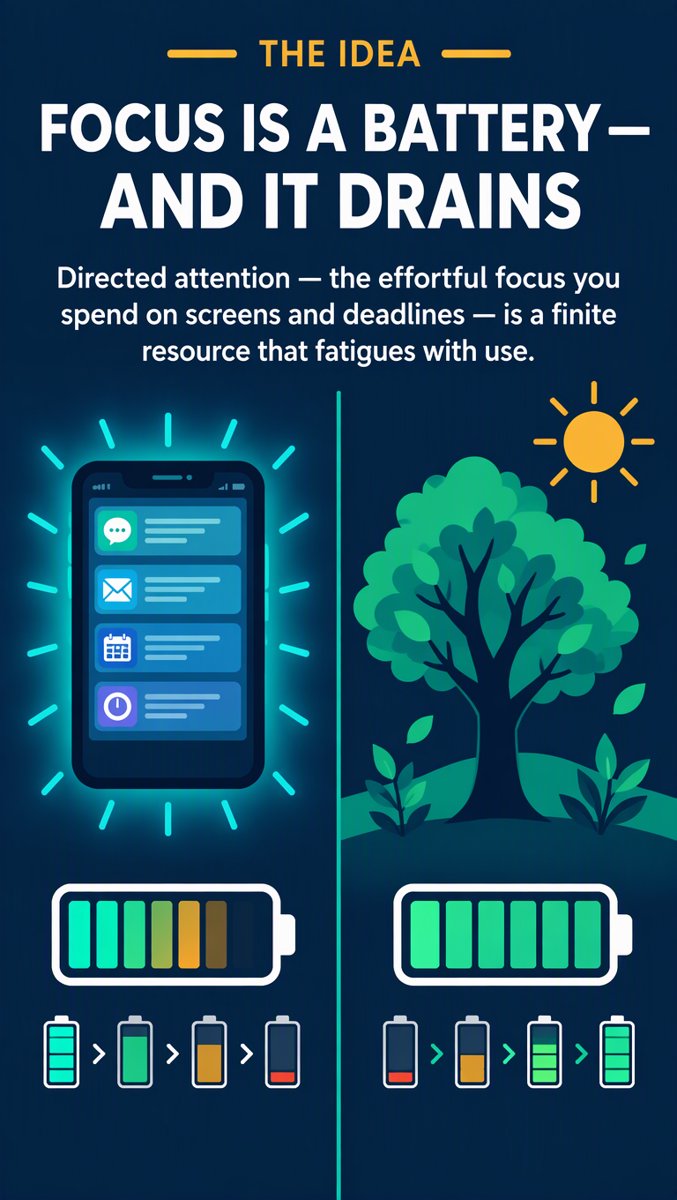
Directed attention is the effortful kind — the focus you deliberately point at a spreadsheet, a Zoom call, a difficult conversation. The Kaplans' insight was that this system fatigues with use, exactly like a muscle. Every tab you open, every notification you triage, every decision you make draws down the same battery.
Most of us respond to a drained battery the way you'd respond to a drained phone: press harder. Grind through. Drink another coffee. But caffeine doesn't recharge the battery — it just masks the low-battery warning. The Kaplans argued that what the system actually needs is idling time, and that certain environments put the mind into exactly that state.
How It Works: Soft Fascination
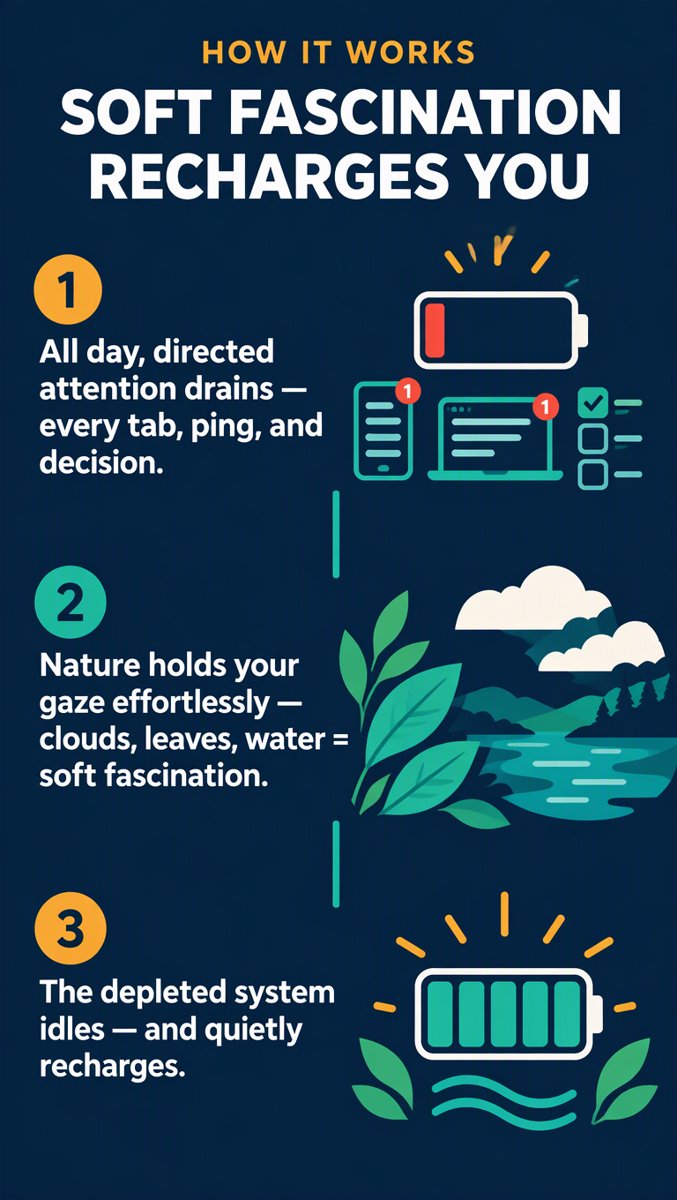
The mechanism is something the Kaplans called soft fascination: stimuli that hold your attention effortlessly. Clouds drifting. Leaves moving in wind. Water. They're interesting enough to occupy your mind — so work worries stop looping — but not demanding enough to draw on the depleted directed-attention system. Your focus gets to sit in park, literally.
Natural environments are unusually rich in soft fascination, which is why the theory centers on them. Cities, by contrast, are full of hard fascination — traffic, signage, crowds — that requires you to actively filter. That filtering is directed attention. Walking downtown doesn't recharge you; it bills you.
The Proof: 20% and 20 Minutes
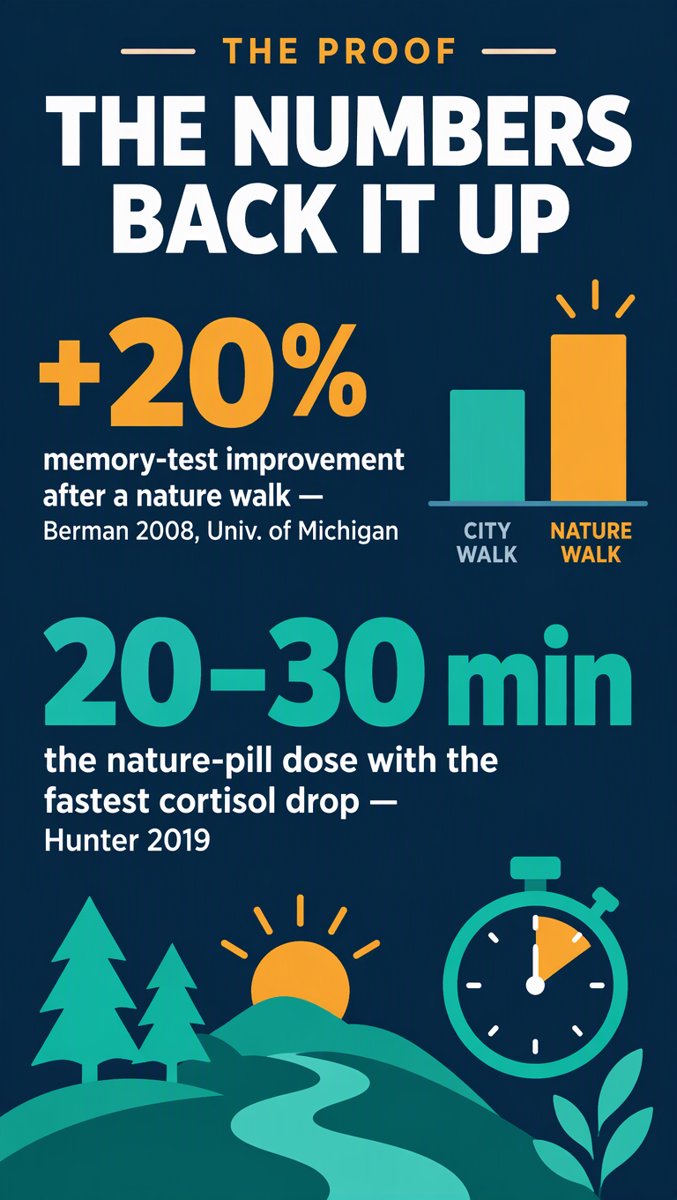
This isn't vibes. In a widely cited 2008 study in Psychological Science, Marc Berman, John Jonides, and Stephen Kaplan sent University of Michigan students on a walk — one route through the Ann Arbor arboretum, one through downtown. Back at the lab, the nature walkers improved their performance on a demanding memory test by about 20 percent. The city walkers? No improvement at all. The only variable was the scenery. Even looking at pictures of nature produced measurable gains, which tells you the restoration happens in attention, not in the exercise.
And the dose is known, too. A 2019 study led by MaryCarol Hunter at the University of Michigan — published in Frontiers in Psychology — had people take "nature pills" in urban green spaces and measured their cortisol, the primary stress hormone. The most efficient relief came from 20 to 30 minutes of sitting or walking in nature: cortisol dropped at roughly 21.3% per hour beyond its natural daily decline, with the best return in that 20–30 minute window. After that, benefits keep accruing, just at a slower rate.
Sources: Berman, Jonides & Kaplan 2008 (PubMed) · Hunter et al. 2019 (Frontiers in Psychology) · NYT on Berman's Nature and the Mind
How to Apply It
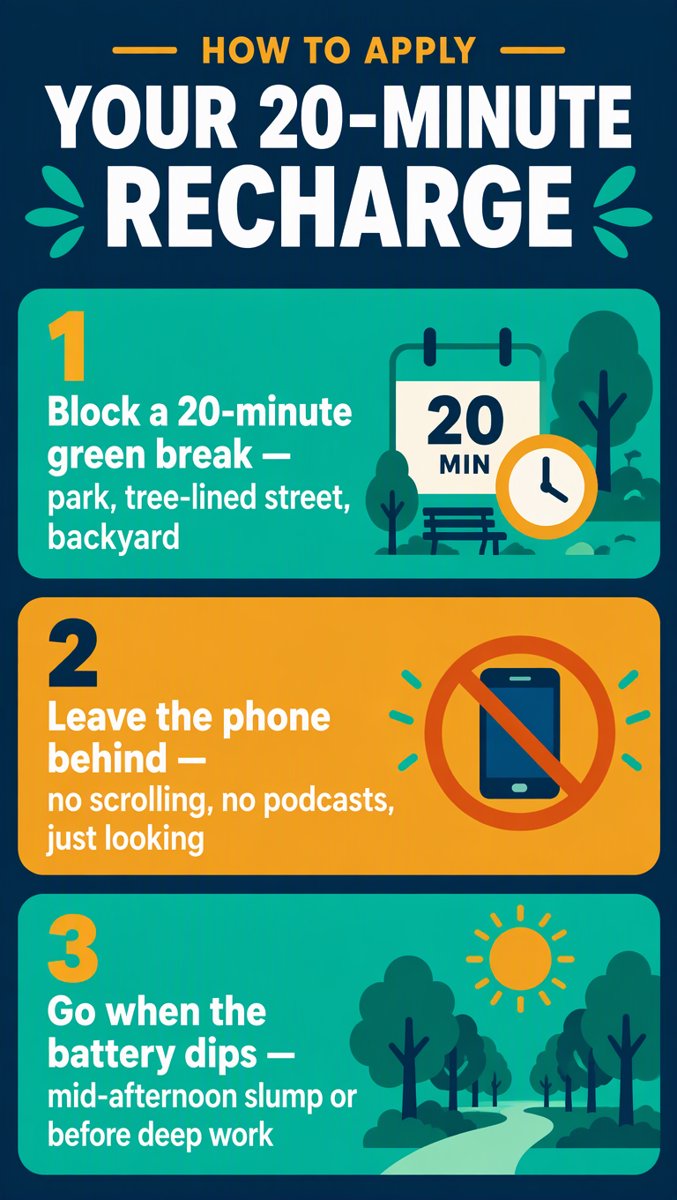
- Block a 20-minute green break. A park, a tree-lined street, a backyard. Twenty minutes is the researched dose — treat it like a meeting with your own prefrontal cortex, because that's what it is.
- Leave the phone behind. Scrolling is directed attention. If you swap soft fascination for your feed, you've changed the battery for another drain cable.
- Go when the battery dips. The afternoon slump, or right before deep work. Restoration is scheduled maintenance, not a vacation reward.
The Takeaway
We treat focus like a character trait. It's a resource. And for thirty years, the research has said the same thing: you don't refill this one by pushing harder at your desk.
Focus isn't trained by grinding harder. It's restored by stepping outside.
Twenty minutes. No phone. Let the leaves do the work.
🎬 Narration Script (for the video)
Hook / Cover (13w) Your focus isn't failing. It's just out of battery. Here's the fix.
The Idea (slide-1, 2 segments) Psychologists Rachel and Stephen Kaplan call it directed attention. It's the effortful focus behind every screen, meeting, and decision — and it fatigues.
How It Works (slide-2, 2 segments) Their fix is soft fascination: clouds, leaves, water hold your gaze effortlessly. Your depleted attention system finally idles — and quietly recharges.
The Proof (slide-3, 3 segments) University of Michigan students walked through an arboretum or downtown Ann Arbor. The nature walkers scored twenty percent higher on a memory test. City walkers? Zero. And twenty to thirty minutes outside is the dose with the fastest cortisol drop.
Apply (slide-4, 2 segments) Block a twenty-minute green break. Park, tree-lined street, backyard — anywhere with leaves. Leave the phone behind, and go when your battery dips — the afternoon slump.
Takeaway (slide-5) Focus isn't trained by grinding harder. It's restored by stepping outside.
CTA (Peter outro) If this reframe helped, share it with someone who's been white-knuckling their focus. Follow Think and Growth for one mental model a day.
(Total: 161 written words ≈ 65–75 seconds measured TTS)