Aristotle's Three Friendships: Not All Friends Keep You for the Same Reason

Aristotle's Three Friendships: Not All Friends Keep You for the Same Reason
Think and Growth — Episode #40 · Theme: Friendship (connection, loyalty) · 2026-11-21 · By Peter, Business Development Manager at NXagents.net
Utility friends are a tool. Pleasure friends are a season. Virtue friends are a foundation. Build the foundation.
The Idea
In Nicomachean Ethics, Book VIII, Aristotle asks a deceptively simple question: why do you value your friend? His answer sorts every friendship into one of three kinds — and once you see the sort, you can't unsee it.
Every friendship is held together by one of three things: usefulness, pleasure, or character. Each one is real. Each one has its place. But they are not the same — and they don't last for the same reasons.
This is not a hierarchy of good and bad friends. It's a diagnostic. When a friendship ends, the question that matters is never "What went wrong?" It's "What was actually holding us together?"

How It Works
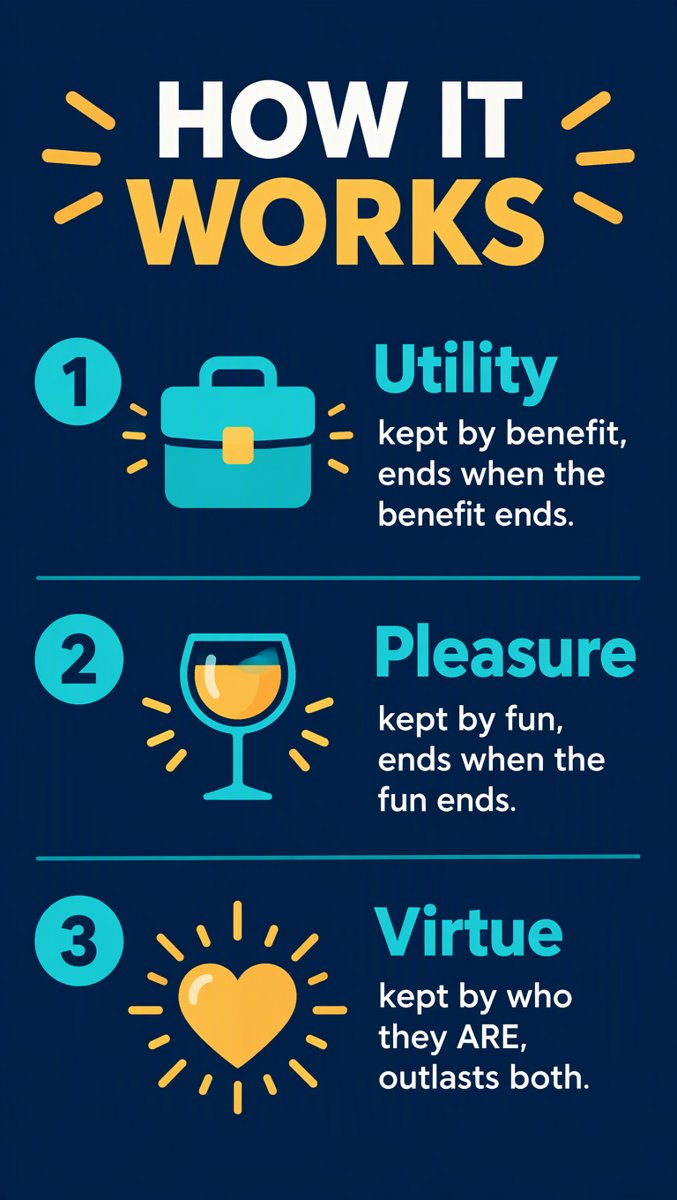
1. Friendship of utility — kept by benefit. You value this friend for what they provide: the introduction, the referral, the covering shift, the discount, the door they can open. Aristotle is blunt about it: in such a friendship, we love the friend "not as being the person loved, but as useful." That's not a criticism — it's a description. Utility friendships are perfectly healthy as long as both people know what they are. They end when the benefit ends, and that's not a betrayal. That's their nature.
2. Friendship of pleasure — kept by fun. You value this friend for the enjoyment you share: the training crew, the pub circle, the group chat that never sleeps. Philosophy Break notes that this kind of friendship genuinely enriches life — but it's tied to a shared activity and a shared mood. As one modern gloss on Aristotle puts it, "what provides pleasure for me now may not later." When interests shift or the season of life changes, the pleasure friendship dissolves — nobody did anything wrong. The fun simply moved on.
3. Friendship of virtue — kept by who they ARE. The third kind is the one Aristotle calls complete: you value the friend for their character — honesty, courage, judgment, loyalty. In this friendship there is mutual, recognized goodwill: each person wishes well to the other for the other's own sake, not for advantage, not for fun. This is the rare kind. Philosophy Break calls it the type that "contributes most to the good life" — and warns it is difficult to cultivate, and you may achieve it only a few times in a lifetime. That's exactly why it's worth building on purpose.
Real-World Example
Think about three real relationships — you've lived all three.
First, the useful contact: the former colleague who always knew someone, who opened the door to the client or the landlord or the fix. For two years they were gold. Then you changed industries, and the calls tapered off. Nobody fought. Nobody failed anyone. The utility simply completed its job.
Second, the fun crew: the gym team, the intramural squad, the holiday circle where every weekend was easy laughter. Then life reorganized — a move, a baby, a new job — and the circle quietly dissolved. The pleasure didn't sour. It just ran its course, the way summer does.
Third, the virtue friend: the one who told you the truth about the bad deal when it cost them your approval. The one who showed up during the ugly year when there was nothing fun to share and nothing useful to extract. You didn't choose them for a benefit. You trust them because of who they are — and that's why, years later, they're still standing next to you.
The diagnostic question is simple: for each friendship in your life, ask — if the benefit disappeared and the fun stopped, would anything be left? If the answer is yes, you've found your foundation.

How to Apply It
Three moves, one week, no spreadsheets required.
1. Audit your three circles. List your closest ten relationships and label each one: utility, pleasure, or virtue. You don't have to act on the list — just look at it. Most people discover their circle is heavy on the first two and thin on the third. That imbalance is the whole lesson.
2. Show up when there's nothing in it for you. Virtue friendship is built in the moments utility and pleasure can't explain: the hard phone call returned, the congratulatory text with no angle, the presence during a bad week instead of just good ones. Every such act is a small deposit of goodwill "for their own sake" — and goodwill compounds.
3. Stop grieving utility friendships when they lapse. When a useful relationship quietly ends, don't rewrite it as a betrayal. It didn't break — it completed. Honor it for what it was, keep the door open, and put your emotional energy where it belongs: the foundation.

The Takeaway
Utility friends are a tool. Pleasure friends are a season. Virtue friends are a foundation. Tools wear out, seasons pass — and foundations are what everything else stands on. Build the foundation.

Sources
- Research synthesis (Perplexity Sonar, 2026-11-21): Aristotle distinguishes friendship of utility, pleasure, and virtue in the Nicomachean Ethics; mutual recognized goodwill; virtue friendship "for their own sake."
- Stanford Encyclopedia of Philosophy — "Friendship" entry (three kinds from Nicomachean Ethics, Book VIII): https://plato.stanford.edu/entries/friendship/
- Philosophy Break — "Aristotle On the 3 Types of Friendship": https://philosophybreak.com/articles/aristotle-on-the-3-types-of-friendship-and-how-they-enrich-life/
- Jared Henderson — "Three Forms of Friendship | Nicomachean Ethics, Book VIII": https://jaredhenderson.substack.com/p/three-forms-of-friendship-nicomachean
- The Epoch Times — "Aristotle's 3 Types of Friendship": https://www.theepochtimes.com/bright/aristotles-3-types-of-friendship-5743858
- TheCollector — "Aristotle's 3 Types of Friendship": https://www.thecollector.com/aristotle-friendship-types/
- YouTube: Stoicism Legion, "3 Types of Friendships According to Aristotle" — https://www.youtube.com/watch?v=kJ587c36144; PhilosophyToons, "Aristotle on Friendship: The Nicomachean Ethics" — https://www.youtube.com/watch?v=bsq-uLoAYWM
Narration Script (video — ~195 words, Charon voice)
HOOK (cover): Not all friends keep you for the same reason. Aristotle sorted every friendship into exactly three kinds. Know which kind you're in.
IDEA (slide-1, 2 clips): Every friendship is held together by one of three things. Usefulness. Pleasure. Character. Each is real. Each has a place. But they are not the same, and they don't last for the same reasons.
MECHANISM (slide-2, 3 clips): One — utility. You're kept by benefit. It ends when the benefit ends, and that's not betrayal. That's its nature. Two — pleasure. You're kept by fun. When interests shift, the bond dissolves. Three — virtue. You're kept by who they ARE. It outlasts both.
EXAMPLE (slide-3, 3 clips): The useful contact. The fun crew. The friend who tells you the truth at cost. Ask of every friendship: if the benefit disappeared and the fun stopped, would anything be left? If yes — that's your foundation.
APPLY (slide-4, 3 clips): Audit your three circles this week. Show up when there's nothing in it for you. And stop grieving utility friends when they lapse. It didn't break. It completed.
TAKEAWAY (slide-5): Utility friends are a tool. Pleasure friends are a season. Virtue friends are a foundation. Build the foundation.
CTA (cta card): I'm Peter. This is Think and Growth — one mental model, every day, built to compound. If this one landed, subscribe and share it with the friend who tells you the truth. See you tomorrow.
Per-slide segment text (submitted as per-clip tts_text)
- cover ×1 — "Not all friends keep you for the same reason. Aristotle sorted every friendship into exactly three kinds. Know which kind you're in."
- slide-1 ×2 — "Every friendship is held together by one of three things. Usefulness. Pleasure. Character." / "Each is real. Each has a place. But they are not the same, and they don't last for the same reasons."
- slide-2 ×3 — "One. Utility. You're kept by benefit. It ends when the benefit ends, and that's not betrayal." / "That's its nature. Two. Pleasure. You're kept by fun. When interests shift, the bond dissolves." / "Three. Virtue. You're kept by who they ARE. It outlasts both."
- slide-3 ×3 — "The useful contact. The fun crew. The friend who tells you the truth at cost." / "Ask of every friendship: if the benefit disappeared and the fun stopped, would anything be left?" / "If yes, that's your foundation."
- slide-4 ×3 — "Audit your three circles this week." / "Show up when there's nothing in it for you." / "And stop grieving utility friends when they lapse. It didn't break. It completed."
- slide-5 ×1 — "Utility friends are a tool. Pleasure friends are a season. Virtue friends are a foundation. Build the foundation."
- cta ×1 — "I'm Peter. This is Think and Growth. One mental model, every day, built to compound. If this one landed, subscribe and share it with the friend who tells you the truth. See you tomorrow."