
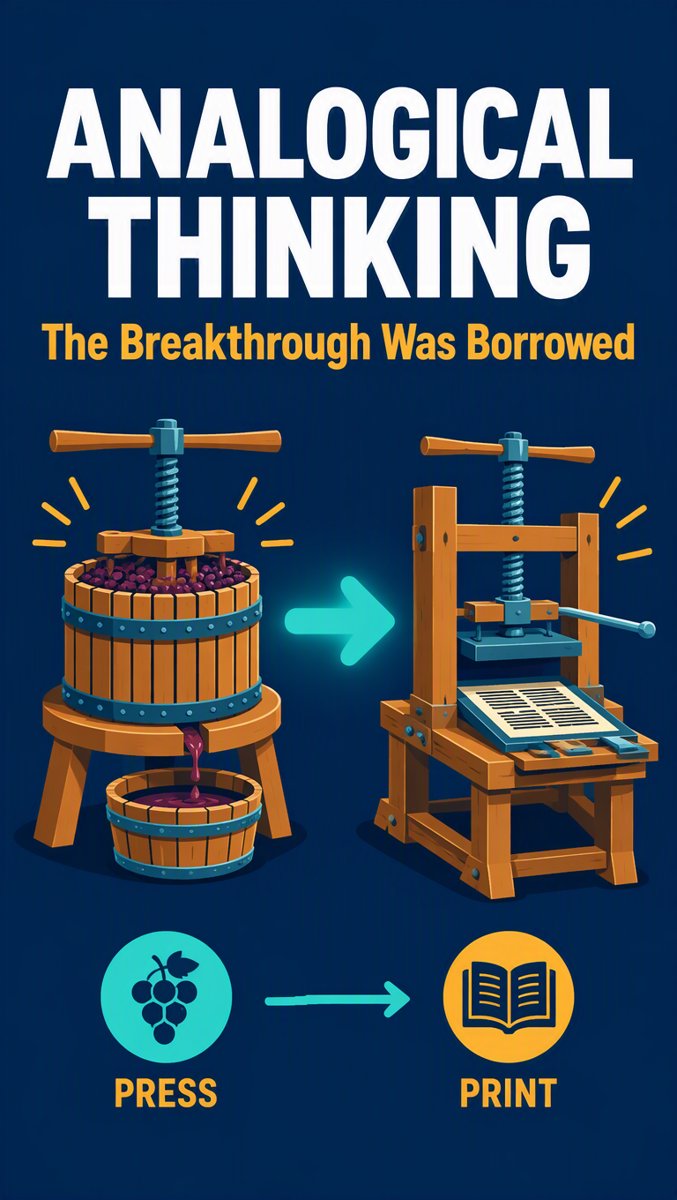
Analogical Thinking: The Printing Press Was Assembled, Not Invented
Think and Growth — Sunday Innovation Edition · September 20, 2026 · Mental Model #61
Ask most people how breakthroughs happen and they picture a lightning bolt: genius alone in a room, inventing something from nothing. History says otherwise. The most consequential invention of the last millennium — the printing press — wasn't conjured from zero. It was assembled, by mapping a solution from one domain onto a problem in another. That move has a name: analogical thinking.
The Idea
Analogical thinking is the practice of taking a solution structure that already works in one field and mapping it onto a problem in a completely different field. You are not inventing a new mechanism — you are transferring a relationship that has already been proven elsewhere.
Cognitive scientist Dedre Gentner formalized this in her structure-mapping theory (Cognitive Science, 1983 — one of the most-cited papers in the field, with nearly 10,000 citations). Her core finding: powerful analogies carry relations, not surface features. "The atom is like the solar system" works because both have a dense center with orbiting bodies — not because atoms are yellow. The transferable part is the structure.
How It Works
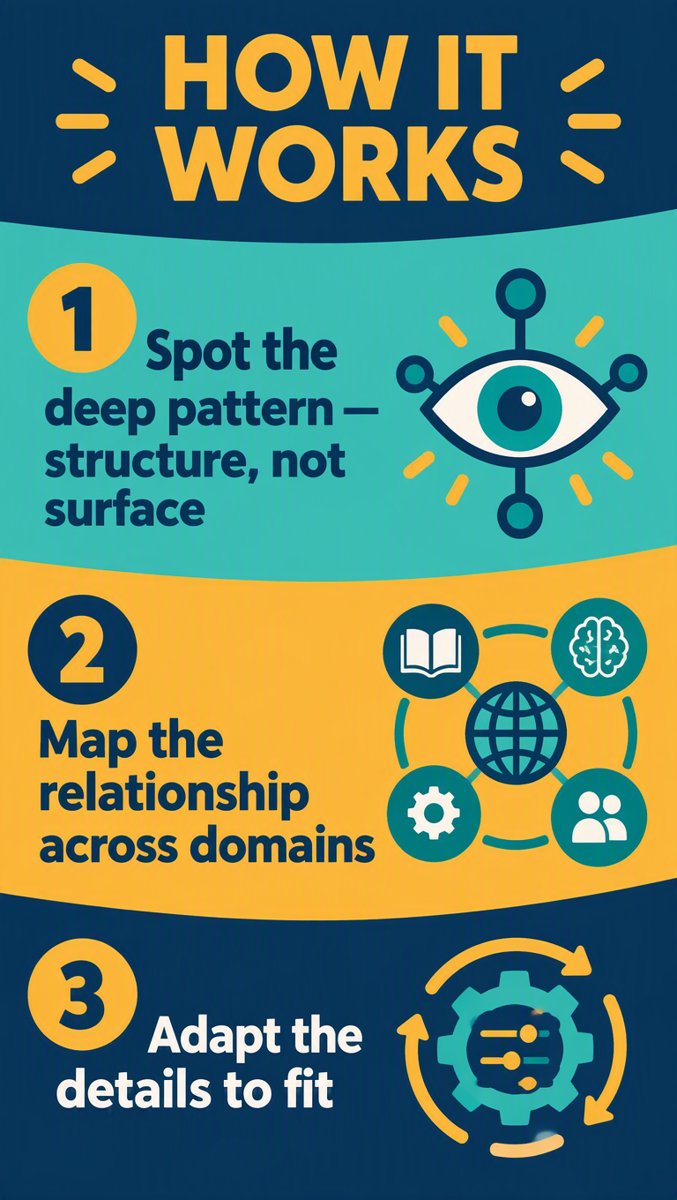
The mechanism runs in three steps:
- Spot the deep pattern. Strip your problem down to its structural skeleton — what forces are at play, what needs distributing, what needs controlling. Ignore what it looks like.
- Map the relationship. Ask: where else in the world does this exact relationship already exist? That domain is your source. Copy its logic, not its appearance.
- Adapt the details. Fit the borrowed structure to the new domain's materials, constraints, and scale. The adaptation is where your craft lives.
The Classic Move: Gutenberg's Wine Press
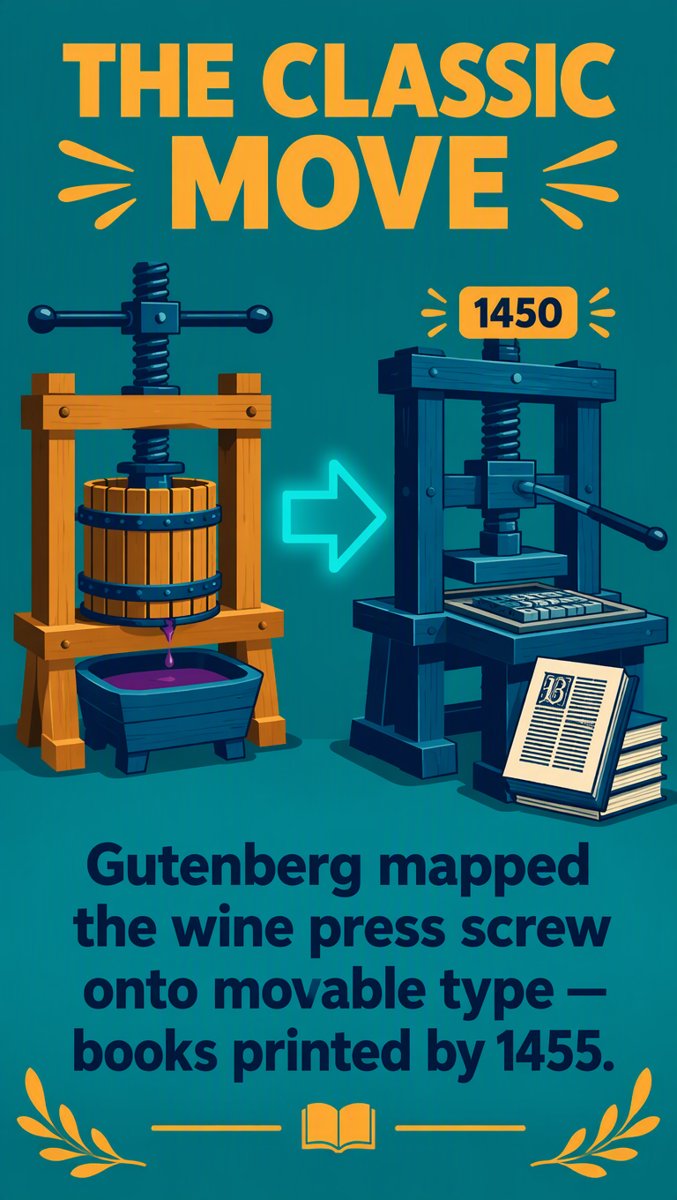
Around 1450, Johannes Gutenberg faced a problem that had defeated everyone before him: how do you press type onto paper with perfectly even, repeatable force? The answer was already sitting in every vineyard in the Rhine Valley. Screw-type presses were, as Wikipedia's history of the printing press notes, "often used by farmers for pressing grapes to make wine and olives to make oil." Historians at History.com agree that "most historians believe Gutenberg's adaptation... employed a screw-type wine press to squeeze down evenly on the inked metal type."
He mapped the wine press's relationship — a screw converting rotation into evenly distributed pressure — onto a new target: movable metal type. By 1455 the press was running in Mainz, producing the first major book printed with movable type in Europe (Britannica). Two old tools. One new machine. An information revolution.
The Pattern Repeats: The Wright Brothers' Bicycle
The same move flew — literally — 450 years later. Orville and Wilbur Wright ran a bicycle shop, and when they turned to flight they carried their bicycle thinking with them. The Smithsonian's Air and Space Museum documents that they "drew on these bicycle concepts when designing their airplane: control, the need for strong but lightweight structures." Most rivals believed a flying machine should be inherently stable, like a ship. The Wrights — as the U.S. National Park Service recounts — "wanted control to depend on the pilot, like a bicycle." An unstable vehicle mastered by a skilled rider. That analogy became the breakthrough: wing-warping for control, bicycle chains and sprockets driving the propellers.
How to Apply It This Week
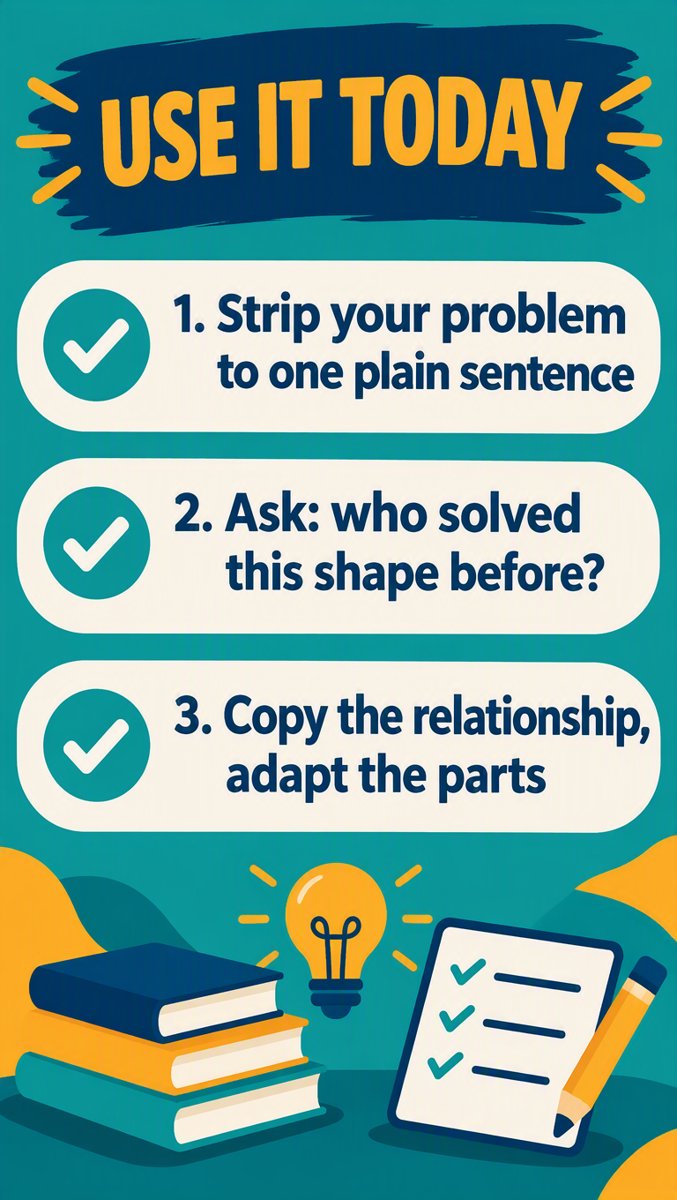
- Strip your problem to one plain sentence. "I need even pressure on an uneven surface." "I need control of an unstable system." If you can't state it plainly, you can't map it.
- Ask who solved this shape of problem before. Not your industry. Anywhere: nature, sports, kitchens, logistics, biology. The further the source domain, the more novel the transfer.
- Copy the relationship, adapt the parts. Write down the source's causal chain, then translate each link into your domain's materials. What survives the translation is your innovation.
One caution — the same tool, used lazily, backfires. Bill Gates warned recently that "analogies to the effects of past innovations are misleading" when judging genuinely novel technologies. Analogies are maps, not proof. Map the structure; then still test the territory.
The Takeaway

Innovation rarely starts from zero. It starts with a good map. Gutenberg didn't invent pressure, screws, ink, or type — he mapped a vineyard mechanism onto a writer's problem. Your next breakthrough is probably already working somewhere else in the world. Go find the map.
🎬 Watch: ~70-second teaching video
The full deck above plays as a narrated vertical video on the Think and Growth channel — one mental model, taught in under 90 seconds.
Narration Script (as recorded)
[Hook] The printing press wasn't invented. It was assembled — from a wine press. [Idea] This is analogical thinking: take a solution that already works in one field — and map it onto a problem in a completely different field. [Mechanism] Here's the mechanism. Step one: spot the deep pattern, the structure — not the surface. Gentner calls it structure-mapping: copy relationships, not appearances. [Example] Around fourteen-fifty, Gutenberg watched a wine press squeeze grapes with even force — then mapped that same screw mechanism onto movable type. By fourteen fifty-five, books flowed. [Apply] Use it today. Strip your problem down to one plain sentence. Ask who has solved this shape of problem before — then copy the relationship, adapt the parts. [Takeaway] Remember: innovation rarely starts from zero. It starts with a good map. [CTA] If this sharpened your thinking, subscribe to Think and Growth. One mental model a day — sharper decisions, faster growth. I'll see you tomorrow.
Sources
- Wikipedia — Printing press: screw presses "often used by farmers for pressing grapes to make wine and olives to make oil"; Gutenberg's adaptation. https://en.wikipedia.org/wiki/Printing_press
- History.com — 7 Ways the Printing Press Changed the World: "most historians believe Gutenberg's adaptation... employed a screw-type wine press to squeeze down evenly on the inked metal type" (Aug 28, 2019). https://www.history.com/articles/printing-press-renaissance
- Britannica — Johannes Gutenberg: first known mechanized printing press in Europe; used 1455. https://www.britannica.com/biography/Johannes-Gutenberg
- Gentner, D. (1983) — Structure-Mapping: A Theoretical Framework for Analogy, Cognitive Science (~9,981 citations). https://www.sciencedirect.com/science/article/pii/S0364021383800093 · Theory overview: https://en.wikipedia.org/wiki/Structure-mapping_theory
- Smithsonian National Air and Space Museum — Wheeling and Flying: Wright brothers "drew on these bicycle concepts when designing their airplane: control, the need for strong but lightweight structures" (May 19, 2017). https://airandspace.si.edu/stories/editorial/wheeling-and-flying
- U.S. National Park Service — Road to First Flight: "they wanted control to depend on the pilot, like a bicycle" (Aug 15, 2017). https://www.nps.gov/articles/roadtofirstflight.htm