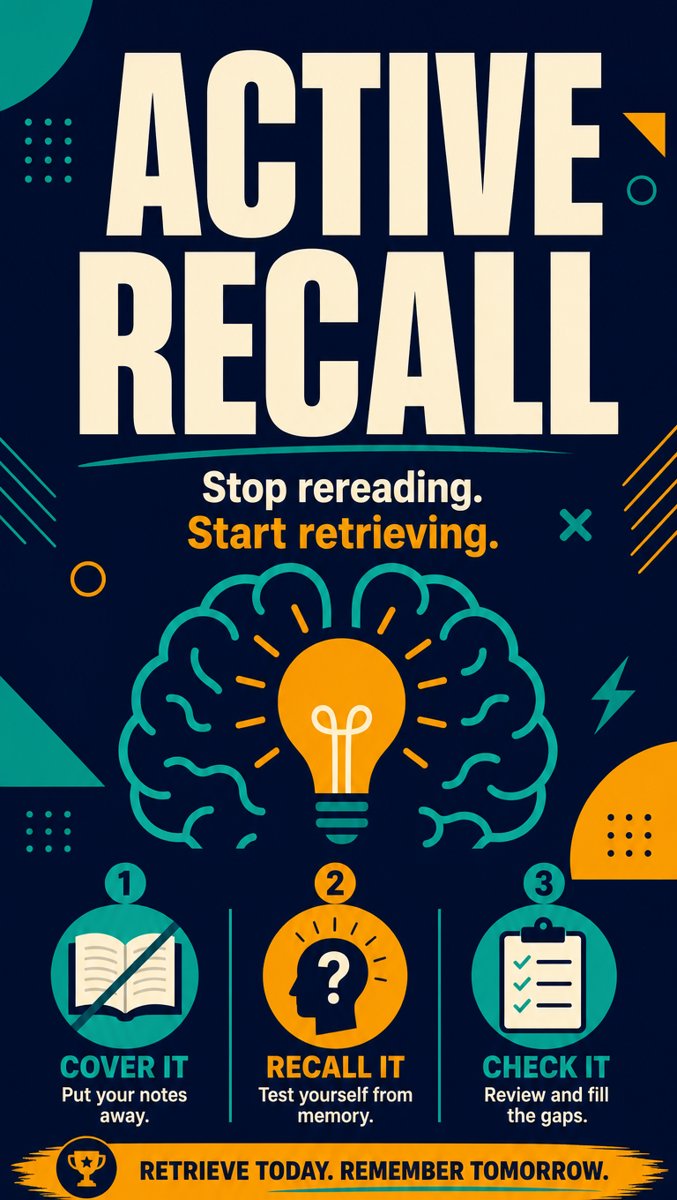
Active Recall: The Study Method That Beat Rereading 61% to 40%
Think & Growth · Tuesday, September 8, 2026 · Theme: School — learning fast, study systems
Here's an uncomfortable truth for anyone who's ever highlighted a textbook: the study strategy that feels the most productive — rereading, highlighting, reviewing your notes until the pages glow — is one of the weakest things you can do for your memory. And the strategy that feels the hardest — closing the book and forcing yourself to remember — is, by a wide margin, the strongest.
That strategy has a name: active recall, which researchers call retrieval practice. It's the act of pulling information out of your head instead of pushing it back in. And it isn't a study hack from a productivity influencer — it's one of the most replicated findings in cognitive psychology.
The Idea: Memory Is a Muscle, and Retrieval Is the Rep
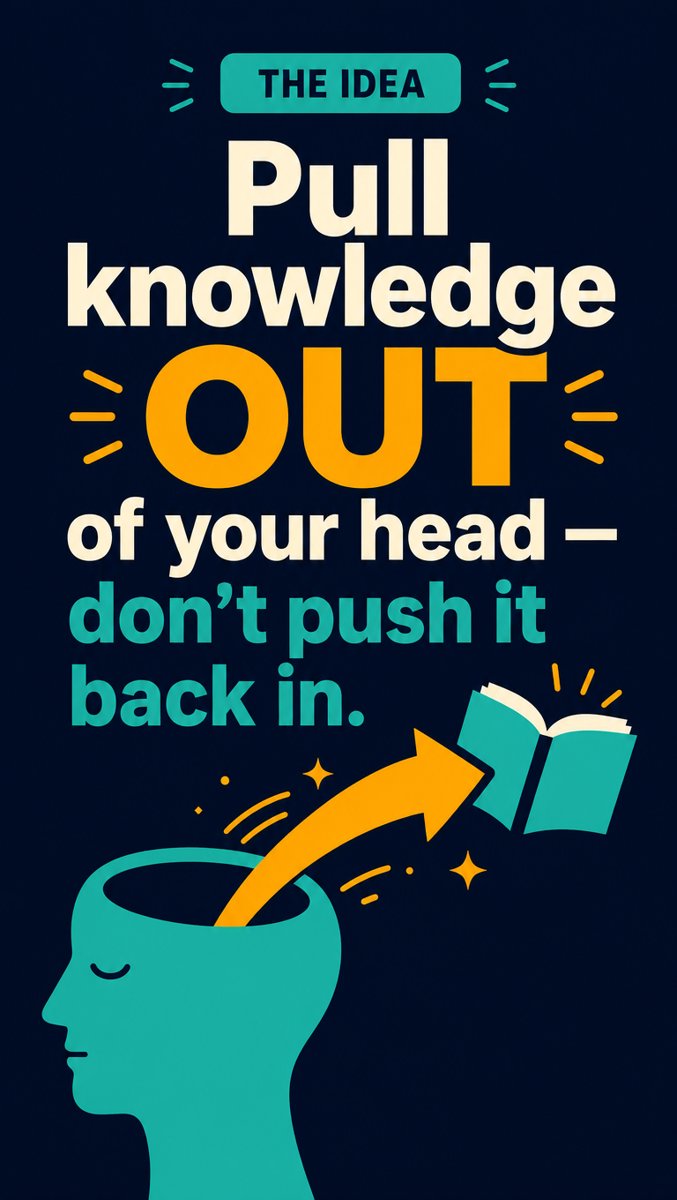
When you reread a page, your brain does something sneaky: it recognizes the material. Recognition feels like knowing. "Yes, I've seen this. I understand this." But recognition is cheap — you'd get the same warm glow from reading someone else's notes.
Retrieval is different. When you close the book and try to explain the topic from memory, you force your brain to reconstruct the knowledge from scratch. Every time you successfully pull a memory out, the pathway to that memory gets physically stronger and easier to find next time. Psychologists call this the testing effect, and the effort itself is what researchers call "desirable difficulty" — the struggle is not a side effect of learning. The struggle is the learning.
The Proof: 61% vs. 40% — and a Famous Study That Got Flipped
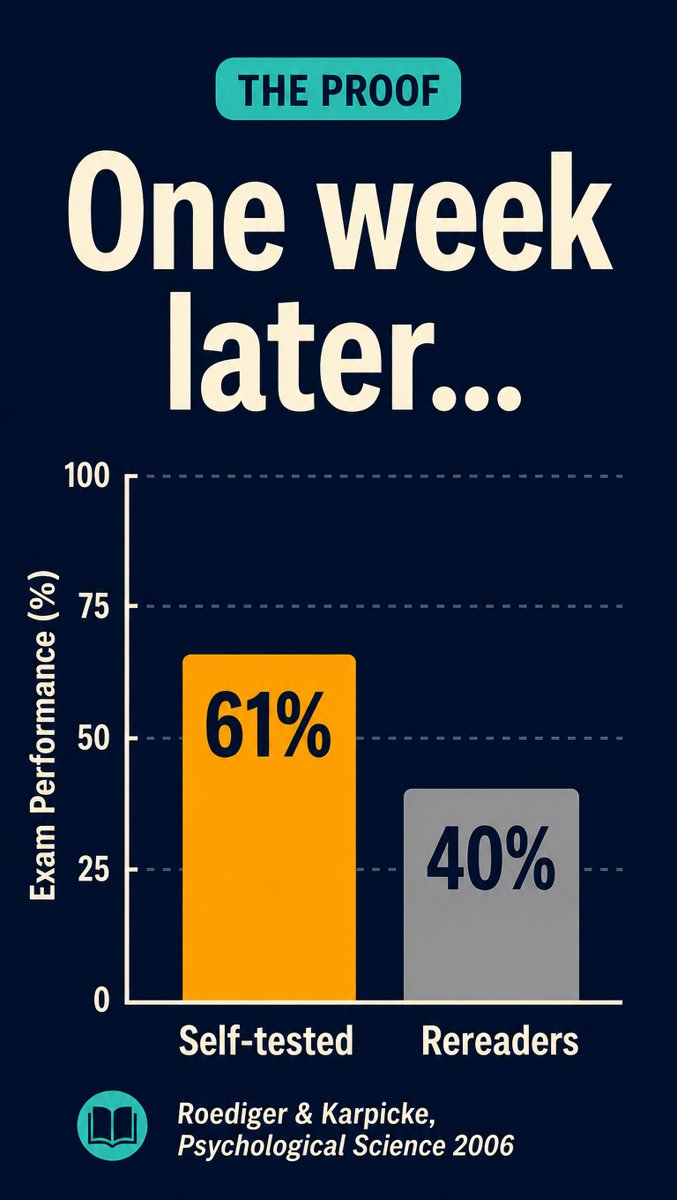
The landmark study came from Henry Roediger and Jeffrey Karpicke at Washington University in St. Louis, published in Psychological Science in 2006. Students studied a prose passage in one of two ways: some reread it repeatedly, while others studied it once and then spent the remaining time testing themselves — writing down everything they could remember.
On a final test taken five minutes later, the rereaders actually looked better. Confidence high, scores high. But on a test taken one week later, the result flipped hard: the self-testing group recalled roughly 61% of the idea units versus about 40% for the group that just restudied. A 21-point victory for retrieval — and note when it happened: at the one-week mark, which is the only mark that matters for exams, presentations, and everything else in real life. (Roediger & Karpicke, 2006)
Still think fancy study strategies beat plain self-quizzing? Karpicke and Blunt tested exactly that in Science in 2011: retrieval practice produced more learning than concept mapping — the elaborate diagramming technique beloved by students and educators alike. Students' predictions about what would work were inverted compared to what actually worked. (Karpicke & Blunt, 2011, Science)
And in the largest review of its kind, Dunlosky and colleagues evaluated 10 popular learning techniques and awarded "high utility" ratings to exactly two: practice testing and distributed practice. Highlighting, rereading, and summarizing all scored low. (Dunlosky et al., 2013)
How to Use It: The Blank-Page Protocol
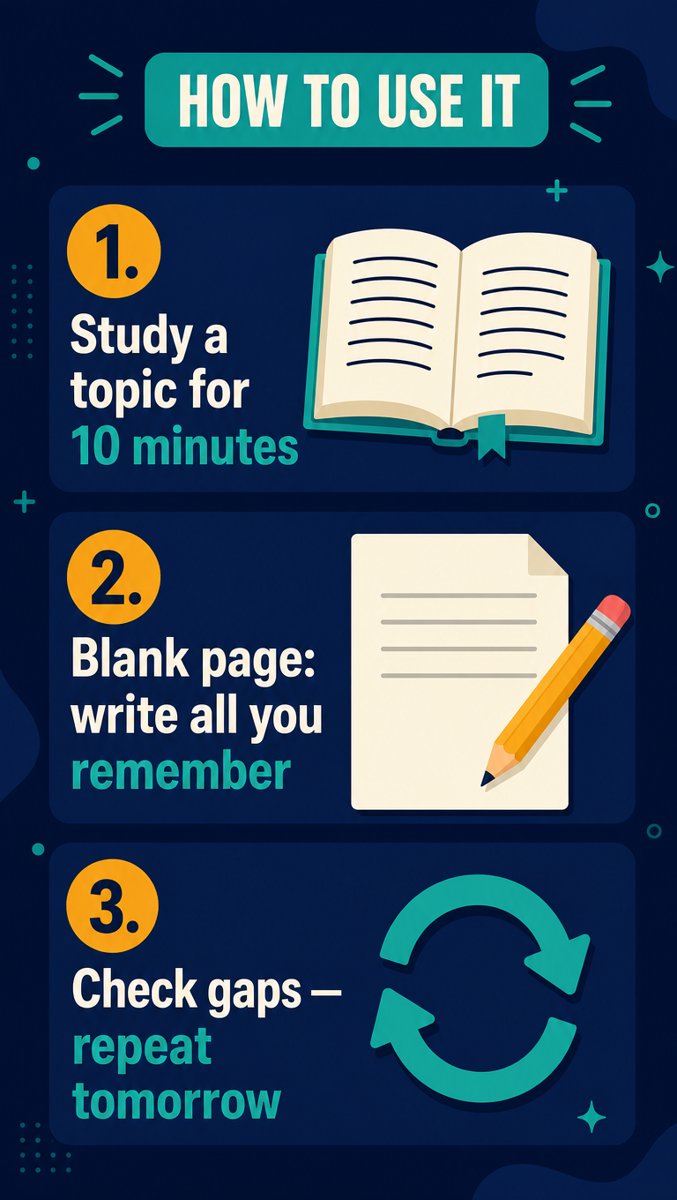
You can run active recall tonight, with zero prep:
- Study a topic for ~10 minutes — read, watch, listen, whatever got you here.
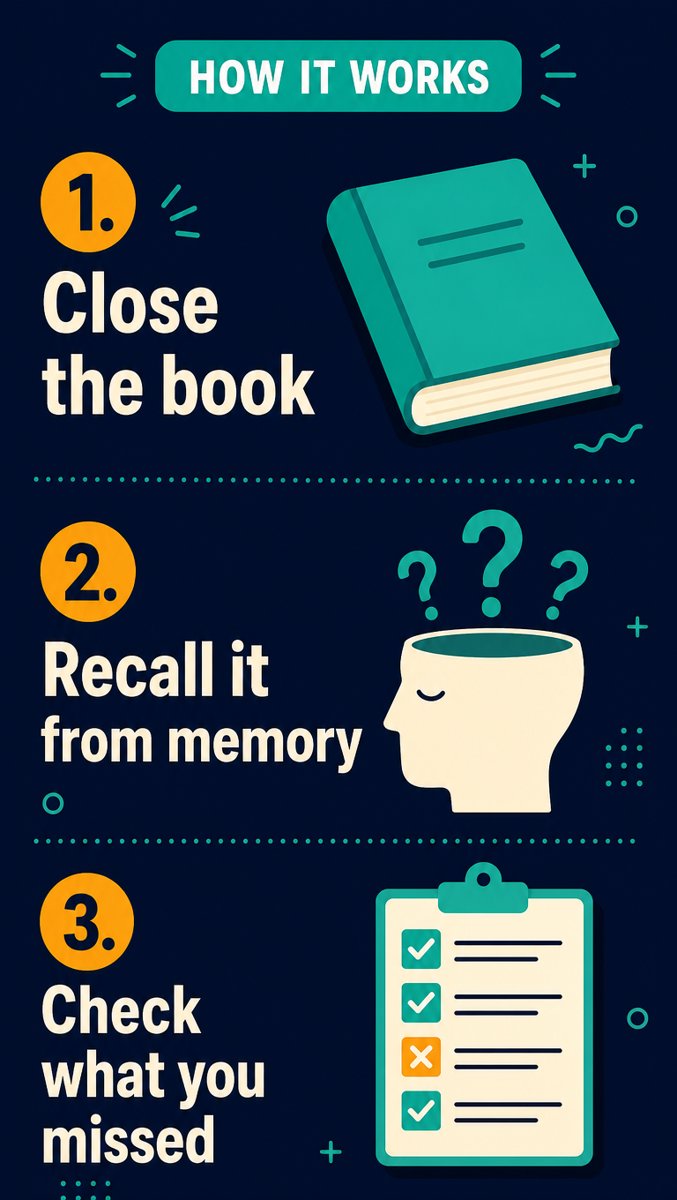
- Close everything. Blank page. Write down everything you remember — definitions, arguments, numbers, connections. Free recall, no peeking.
- Open the source and check. The gaps you find aren't failures — they're your personalized study list. Patch them, then repeat the recall tomorrow.
That last step is the multiplier: repeating retrieval at intervals is spaced repetition — which we covered in this space on August 18 — and it's the other high-utility technique from the Dunlosky review. Active recall plus spacing is the complete system. The two techniques that beat all ten rivals are two halves of the same loop.
One warning: active recall feels bad at first. You'll blank on things you "just read." That discomfort is the signal that it's working — you're at the edge of your memory, which is exactly where growth happens. If studying feels smooth and effortless, you're probably decorating, not learning.
The Takeaway
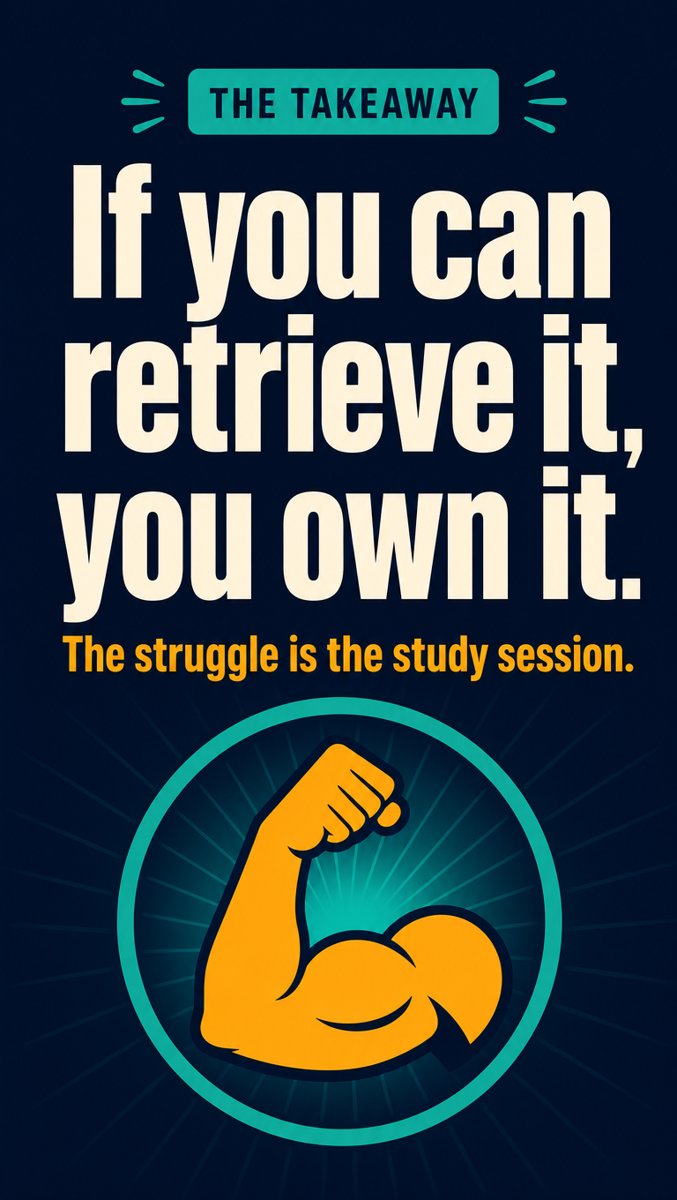
If you can retrieve it, you own it. Stop measuring study sessions in hours of input and start measuring them in successful retrievals. Ten minutes of honest blank-page recall beats an hour of highlighting — and the data has said so for two decades.
Sources
- Roediger, H. L., & Karpicke, J. D. (2006). Test-Enhanced Learning: Taking Memory Tests Improves Long-Term Retention. Psychological Science, 17(3), 249–255. https://journals.sagepub.com/doi/10.1111/j.1467-9280.2006.01693.x
- Karpicke, J. D., & Blunt, J. R. (2011). Retrieval Practice Produces More Learning than Elaborative Studying with Concept Mapping. Science, 331(6018), 772–775. https://www.science.org/doi/abs/10.1126/science.1199327
- Dunlosky, J., et al. (2013). Improving Students' Learning With Effective Learning Techniques. Psychological Science in the Public Interest, 14(1), 4–58. https://journals.sagepub.com/doi/10.1177/1529100612453266
🎬 Narration Script (video version, 168 written words, ~70s)
[Cover] Rereading your notes feels productive. Psychologists say it's mostly wasted effort.
[Slide 1 — The Idea] Active recall means pulling knowledge out of your head, instead of pushing it back in. / Every time you force a memory out, that memory gets easier to find again.
[Slide 2 — How It Works] Here's the method. Close the book. Try to explain the topic from memory alone. / Retrieval is the workout. Checking the page afterward shows you exactly where the gaps are.
[Slide 3 — The Proof] In a classic study, students reread a passage, or tested themselves on it instead. / Five minutes in, the rereaders looked better. One week later, everything flipped. / Self-tested students recalled about sixty-one percent versus forty. Testing won by twenty-one points.
[Slide 4 — How to Apply] Try this tonight. Study a topic for ten minutes, then close every book and screen. / Write down everything you remember, check what you missed, and repeat the same recall tomorrow.
[Slide 5 — Takeaway] Remember: if you can retrieve it, you own it. The struggle is the study session.
[CTA — Peter] Follow Think and Growth for one mental model daily. Subscribe — see you tomorrow.
📺 CTA Outro Card