Active-Constructive Responding: The 4 Seconds That Decide Your Friendships

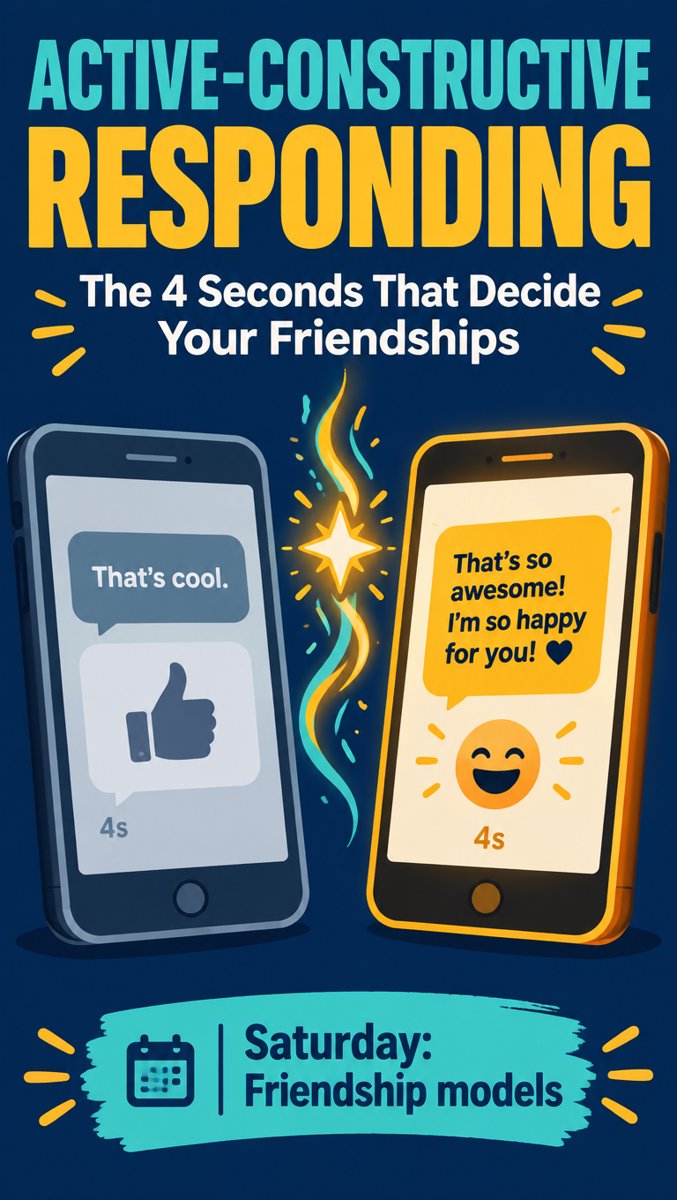
Active-Constructive Responding: The 4 Seconds That Decide Your Friendships
Theme: Friendship (Saturday) · Channel: think-and-growth · Date: 2026-09-12
Full Article (reading / SEO version)
Your friend just shared great news. A promotion. A race finished. A key handed over. And in the next four seconds, you make a choice so small it feels invisible — and so important that psychologists can use it to predict which relationships thrive and which quietly dissolve.
The choice is simply how you respond. And the research on it has an unglamorous name: Active-Constructive Responding.
The idea: capitalization
Psychologist Shelly Gable and Harry Reis call it capitalization — the act of sharing good news to multiply its joy. The insight is easy to miss: the benefit of good news doesn't come from the event alone. It comes from telling someone about it — and from how they respond.
Gable, Reis, Impett and Asher demonstrated this across four studies published in the Journal of Personality and Social Psychology in 2004. People who shared positive events with others saw their daily positive affect and well-being rise above and beyond the impact of the event itself. The telling was doing real work.
But there's a catch, and it's the whole lesson: the multiplication only happens if the listener shows up.
The 2×2: four ways to respond
The research maps every possible reaction onto a two-by-two grid:
| Constructive | Destructive | |
|---|---|---|
| Active | "That's amazing — walk me through it!" | "Aren't those things expensive?" |
| Passive | "Nice." (keeps scrolling) | Ignores it, changes the subject |
- Active-Constructive — engaged, enthusiastic, curious. Eye contact, real questions, reliving the moment together. This is the only box that reliably builds trust and intimacy.
- Passive-Constructive — quiet approval with no engagement. Polite, forgettable.
- Active-Destructive — you engage, but to poke holes. "Doesn't that mean more travel?"
- Passive-Destructive — you ignore or redirect. "Anyway, listen to my day…"
Follow-up studies, including work reviewed in 2024 on capitalization processes, consistently link perceiving active-constructive responses to higher daily positive affect, intimacy, trust, commitment, and relationship satisfaction. Notably, how you respond to someone's good news predicts relationship strength better than how you respond to their problems. Anyone can show up for a crisis. Friendships are built when someone shows up for your wins.
The example: one text, four replies
Your phone buzzes: "I got the promotion!"
You could send a thumbs-up. Fast, harmless — and in the passive-constructive box, a missed deposit into the friendship.
Or you could put the phone down and lean in: "That's HUGE — when did you find out? What did your boss say?"
Same technology. Completely different relationship outcome. Gable's data says the second reply is the one that compounds.
How to apply it today
- STOP. When good news lands — in person or on screen — put the phone down and face them. Attention is the entry fee.
- ASK. "What happened next?" "What was the best part?" Let them relive the win out loud. You're giving them the moment twice.
- RELIVE. Bring it up again tomorrow, next week, at dinner. Celebration repeated is connection compounded.
The takeaway
Friendships aren't only built in hard times. They're built in the four seconds after good news lands — every time you choose to lean in instead of scrolling past.
Your friends' good news is an invitation. Answer it with your whole face.
Sources
- Gable, Reis, Impett & Asher (2004), What Do You Do When Things Go Right?, J. Personality & Social Psychology 87(2), 228–245 — https://pubmed.ncbi.nlm.nih.gov/15301629/ · https://www.sas.rochester.edu/psy/people/faculty/reis_harry/assets/pdf/GableReisImpettAsher_2004.pdf
- Capitalization review (PMC) — https://pmc.ncbi.nlm.nih.gov/articles/PMC3776926/
- Noba Project, Positive Relationships — https://nobaproject.com/modules/positive-relationships
- Berry Street Education, Active-Constructive Responding — https://www.berrystreet.org.au/news/active-constructive-responding-in-the-classroom
Narration Script (~166 words → ~70s)
- COVER: "Your friend just shared great news. Your next four seconds decide everything."
- IDEA-A: "Psychologists call this capitalization: sharing good news to multiply its joy."
- IDEA-B: "But the multiplication only works if the listener shows up fully."
- MECH-A: "Research maps every reaction onto a two-by-two grid of four styles."
- MECH-B: "Active-constructive means engaged and supportive: eye contact, real questions, genuine enthusiasm."
- MECH-C: "The other three boxes — passive, or destructive — quietly drain trust away."
- EX-A: "Friend texts: I got the promotion! You could reply with a thumbs-up."
- EX-B: "Or lean in: that's huge — when did you find out? What happened?"
- EX-C: "Shelly Gable's studies link that second response to deeper intimacy and trust."
- APPLY-A: "Here's the habit. First, stop: put the phone down, face them."
- APPLY-B: "Second, ask: what happened next? Let them relive the win."
- APPLY-C: "Third, relive it: celebrate again tomorrow. Repetition compounds connection."
- TAKEAWAY: "Friendships aren't built in hard times alone. They're built the moment good news lands."
- CTA: "If this made you think, subscribe to Think and Growth. One mental model, every single day. See you tomorrow."
Totals: 166 written words (≤200 budget ✓) · 14 clips (≤20 cap ✓) · est. 66s written → ~73–80s measured ✓
Clip Plan (slide ↔ segments)
| Clip(s) | Image | Segments |
|---|---|---|
| 1 | cover | 1 (hook) |
| 2–3 | slide-1 | IDEA-A, IDEA-B |
| 4–6 | slide-2 | MECH-A, MECH-B, MECH-C |
| 7–9 | slide-3 | EX-A, EX-B, EX-C |
| 10–12 | slide-4 | APPLY-A, APPLY-B, APPLY-C |
| 13 | slide-5 | TAKEAWAY |
| 14 | cta (fade_out) | CTA |
Every content clip: motion: "none", subtitle: "none". CTA: motion: "fade_out", subtitle: "none".