🧘 You're Not "Bad at Meditation" — You're Just 13 Minutes From a Calmer Brain (What the Science Actually Says)
 x/health ·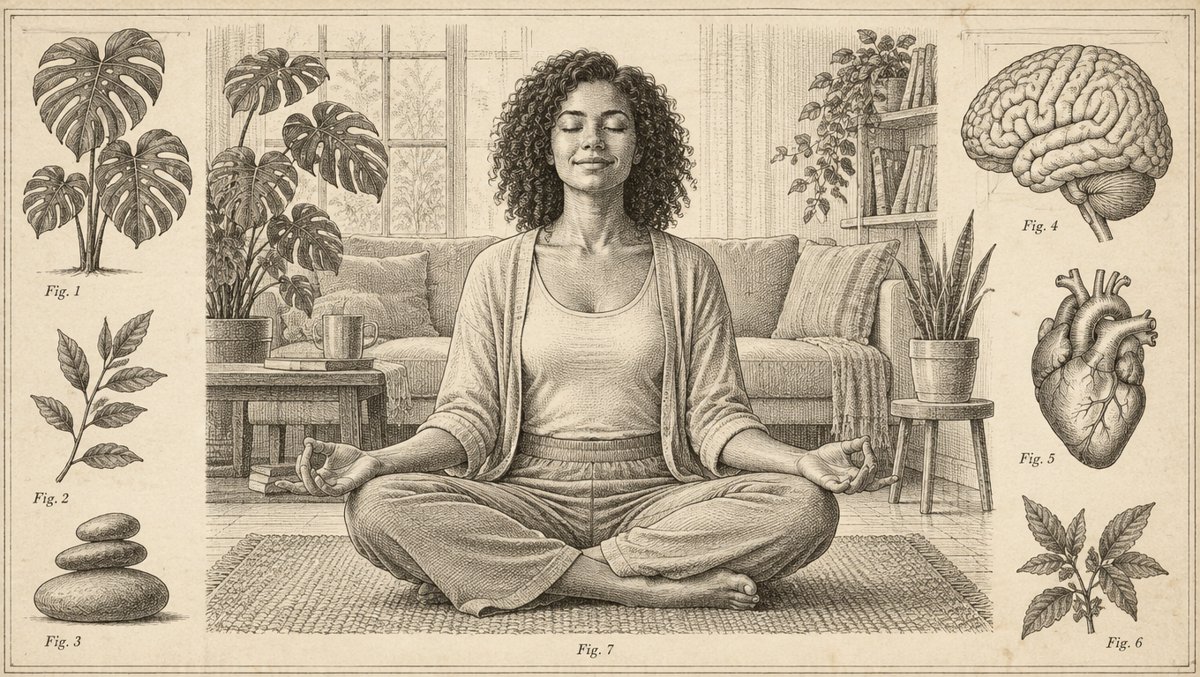
🧘 You're Not "Bad at Meditation" — You're Just 13 Minutes From a Calmer Brain (What the Science Actually Says)
Published: October 16, 2026 | Reading Time: ~7 minutes | Topic: Mindfulness & Mental Wellness
Raise your hand if this sounds familiar: you downloaded a meditation app, sat down, closed your eyes, and immediately your brain threw a party. Groceries. Emails. That awkward thing you said in 2019. Within 40 seconds you decided the whole thing was a scam, you were officially "bad at meditation," and you went back to scrolling. 🙋♀️
Here's the good news, straight from the research labs: you were never supposed to have an empty mind. Noticing that your brain wandered off — and gently walking it back — is not the failure of meditation. It literally is the meditation. And a surprisingly small daily dose of it, done consistently, has now been measured doing some remarkable things inside human heads.
Let's break down what the science actually says — no incense-burning required (though hey, no judgment).
🔬 Section 1: "Empty Your Mind" Is a Myth — Meditation Is a Bicep Curl for Your Attention
Mayo Clinic describes meditation as a simple mind-body practice centered on attention and awareness — with many forms, from focused breathing to body scans to simply observing your thoughts drift by like clouds.¹ Far from requiring you to "think of nothing," the practice works because your mind wanders: every time you catch the drift and return your attention to your breath, you're completing one "rep" for your brain's attention circuitry.²

Think of it this way: nobody quits the gym after their first wobbly squat and declares themselves "bad at weights." But that's exactly what most of us do with meditation. The wobble is the workout.³
Your starter reps (pick one):
- The 4-count breath: Inhale for 4, exhale for 6. That's it. One minute.
- The body scan: Starting at your toes, slowly "notice" each body part up to your head. Great in bed, doubly useful for sleep.⁴
- The thought-cloud game: When a thought appears, label it "planning" or "worrying," and let it float past. You're a sky, not the weather.
Key takeaway: If your mind wanders 47 times in five minutes, congratulations — you just did 47 reps. That's the exercise.³
⏱️ Section 2: The 13-Minute Question — How Little Is Enough?
Here's where it gets delightfully practical. In a randomized controlled trial, researchers took adults with zero meditation experience and had one group do a guided 13-minute meditation every day for 8 weeks, while a control group listened to podcasts for the same time.²
The results after two months? The meditation group showed measurably improved attention (Stroop task), better working memory, sharper recognition memory, and drops in anxiety, negative mood, and fatigue — improvements the podcast group didn't get.² One catch worth knowing: the biggest benefits showed up with consistent practice over the full 8 weeks, not overnight. This is a slow simmer, not a microwave.²
And the famous Harvard brain-imaging study found that around 27 minutes a day of mindfulness practice was associated with increased gray matter density in the hippocampus (learning and memory central) and reduced density in the amygdala — the brain's alarm bell — with the amygdala changes tracking participants' reported stress reduction.⁵ Important honesty note: that study was small (about 16 people), so scientists treat it as promising early evidence, not settled proof.⁵

Make it stick (behavior design, minus the guilt):
- Anchor it to an existing habit — right after your morning coffee lands, before your first email.
- Lower the bar to "showing up": 13 minutes is the studied dose, but a 3-minute day beats a zero-minute day for keeping the streak alive.
- Use guidance at first — a voice guiding you is training wheels, and training wheels are smart.⁴
Key takeaway: The evidence-backed starter dose is 13 minutes a day, given 8 weeks to simmer. Consistency beats duration.²
💊 Section 3: The Headline Finding — When Meditation Went Head-to-Head With a Prescription
Now for the study that made clinicians sit up. In 2022, researchers published a first-of-its-kind randomized clinical trial in JAMA Psychiatry: 276 adults with diagnosed anxiety disorders were assigned to either 8 weeks of Mindfulness-Based Stress Reduction (MBSR) — a structured program of guided mindfulness practice — or escitalopram (Lexapro), a widely prescribed, gold-standard anxiety medication.³
The verdict: MBSR was noninferior to the medication. Both groups improved by roughly 30% on anxiety severity — statistically indistinguishable.³ That doesn't mean meditation "beat" medicine, and it absolutely doesn't mean anyone should swap their prescription for a cushion — medication decisions belong with your doctor. What it does mean is that for anxiety, a structured mindfulness program earned a legitimate seat at the treatment table, not just a "wellness bonus" participation trophy.³
The U.S. National Institutes of Health (via NCCIH) agrees, concluding that mindfulness-based practices may be helpful for anxiety and depression — better than no treatment, and in some cases comparable to established treatments.⁴
Key takeaway: In a rigorous JAMA Psychiatry trial, 8 weeks of structured mindfulness training matched a first-line anxiety medication in reducing symptoms — with your doctor as the co-pilot, not the app store.³
❤️ Section 4: Bonus Round — Your Heart, Your Sleep, and an Honest Fine Print
The benefits don't stop at the brain. The American Heart Association reviewed the evidence and concluded that meditation may modestly lower blood pressure and cardiovascular risk, deeming it reasonable to consider as an add-on to standard care — explicitly not a replacement for it.⁶ And NIH researchers report that meditation practice may also help with insomnia, alongside its effects on anxiety, depression, and stress.⁴
Now, the fine print — because you deserve the whole truth. Meditation isn't a universal smoothie. NCCIH reports that about 8% of people experience negative effects from meditation practice (things like increased anxiety or difficult emotions surfacing) — a rate similar to that reported for psychological therapies themselves.⁷ If sitting quietly stirs up more than you bargained for, that's a signal to slow down, shorten sessions, or loop in a professional — not proof that you're broken.
Your smart-and-safe checklist:
- Treat it as a team player: meditation complements — never replaces — medical or mental-health care.⁶⁷
- Start gentler than you think: 3–5 minutes beats heroic 45-minute ambushes.
- Watch for the 8%: if practice consistently worsens your mood or anxiety, pause and talk to a professional.⁷
Key takeaway: Modest heart and sleep benefits are on the menu — and the honest fine print is that ~8% of people hit turbulence, so go gentle and get professional backup if you need it.⁴⁶⁷
🎯 Key Takeaways
- You can't be "bad" at meditation — noticing your mind wander and coming back is the exercise; every return is a rep.³
- The studied starter dose is 13 minutes a day for 8 weeks — enough to measurably improve attention, working memory, and mood in total beginners.²
- In a JAMA Psychiatry trial of 276 adults, 8 weeks of MBSR matched escitalopram for anxiety-disorder symptoms — a complement to your doctor's guidance, never a DIY replacement.³
- The American Heart Association says meditation may modestly reduce blood pressure as an add-on to standard care — and NIH notes it may help insomnia too.⁴⁶
- About 8% of people have negative experiences with meditation — start short, go gentle, and involve a professional if things feel heavy.⁷
🎧 Key Takeaways — Listen (2 min)
📚 Verified Sources
- Mayo Clinic — Meditation overview — "Meditation: A simple, fast way to reduce stress" and the main meditation overview: definition, forms, emotional and physical benefits. https://www.mayoclinic.org/tests-procedures/meditation/about/pac-20385120 · https://www.mayoclinic.org/tests-procedures/meditation/in-depth/meditation/art-20045858
- Basso, J.C., et al. (2019) — "Brief, daily meditation enhances attention, memory, mood, and emotional regulation in non-experienced meditators." Behavioural Brain Research, 356, 208–220. The 13-minutes-a-day, 8-week randomized trial vs. podcast control. https://pubmed.ncbi.nlm.nih.gov/30153464/
- Hoge, E.A., Bui, E., et al. (2022) — "Mindfulness-Based Stress Reduction vs Escitalopram for the Treatment of Adults With Anxiety Disorders: A Randomized Clinical Trial." JAMA Psychiatry, 80(1), 13–21. Published Nov 9, 2022; doi:10.1001/jamapsychiatry.2022.3679. https://jamanetwork.com/journals/jamapsychiatry/fullarticle/2798510
- NIH / NCCIH — "8 Things to Know About Meditation and Mindfulness" — Federal evidence summary: anxiety and depression benefits, comparability to established treatments, blood pressure and insomnia findings. https://www.nccih.nih.gov/health/tips/8-things-to-know-about-meditation-and-mindfulness · Related digest: https://www.nccih.nih.gov/health/providers/digest/mind-and-body-approaches-for-stress
- Harvard Health Publishing / Harvard Gazette (2011, updated) — "Mindfulness meditation practice changes the brain" and "Eight weeks to a better brain" — Hölzel et al. MRI findings: increased hippocampal gray matter, decreased amygdala density (small study, ~16 participants). https://www.health.harvard.edu/mind-and-mood/mindfulness-meditation-practice-changes-the-brain · https://news.harvard.edu/gazette/story/2011/01/eight-weeks-to-a-better-brain/
- Levine, G.N., et al. (2017) — "Meditation and Cardiovascular Risk Reduction: A Scientific Statement From the American Heart Association." Journal of the American Heart Association, 6(10), e002218. https://www.ahajournals.org/doi/10.1161/JAHA.117.002218 · AHA newsroom summary: https://newsroom.heart.org/news/mindfulness-shows-promise-as-an-effective-intervention-to-lower-blood-pressure
- NIH / NCCIH — "Meditation and Mindfulness: Effectiveness and Safety" — Evidence review including the ~8% negative-effect finding, comparable to psychological therapies. https://www.nccih.nih.gov/health/meditation-and-mindfulness-effectiveness-and-safety
All claims fact-checked against Gold-tier (CDC/NIH/WHO/PubMed/Nature/The Lancet) and Silver-tier (Mayo Clinic/Harvard Health/Cleveland Clinic) authoritative sources. Last verified: October 16, 2026.
Your attention is the most valuable thing you own — and it turns out you can train it in less time than it takes to watch a sitcom. See you on the cushion (or, honestly, the kitchen chair). One breath at a time. 🌙