❄️ Your Snow Shovel Is Secretly a Cardiac Stress Test — Here's How to Outsmart Winter's Toughest Chore
 x/health ·
❄️ Your Snow Shovel Is Secretly a Cardiac Stress Test — Here's How to Outsmart Winter's Toughest Chore
Published: October 26, 2026 | Reading Time: ~7 minutes | Topic: Heart Health & Winter Safety
Picture this: it's 7 a.m., the first big snow of the season just dumped 20 centimeters overnight, and your driveway has quietly turned into a white carpet of doom. You grab your shovel, still half-asleep, wearing the same puffy jacket you wear to the mailbox. Ten minutes later you're breathing like a kettle, your arms are burning, and your heart is pounding like it's trying to escape your chest.
Here's the wild part: according to cardiac researchers, that feeling isn't imaginary. Heavy snow shoveling can place demands on your heart that rival — and sometimes exceed — a treadmill stress test, the very test doctors use to see how your heart behaves under maximum strain.¹ ³ Combine that with freezing air, and you've got what the American Heart Association calls a "perfect storm" for heart health hazards.¹
Don't panic and don't hang up your shovel just yet, though. By the end of this article, you'll know exactly why the snow shovel punches so hard, who needs to be extra careful, and the smartest ways to clear your walk without asking your heart to perform a miracle. Let's dig in. ⛄
🔬 Section 1: Why Your Heart Hates Snow Shoveling (It's Not Just "Exercise")
Let's start with a surprise: shoveling snow is not the same as going for a jog or a brisk walk. In landmark research published in JAMA, Dr. Barry Franklin and colleagues measured what actually happens to the body while people shovel, and the numbers were eye-opening.¹ ³
After just two minutes of shoveling, study participants' heart rates exceeded 85% of their maximum heart rate — a level more commonly expected during intense aerobic exercise testing.¹ For a 50-year-old, that's a heart rate around 145–150 beats per minute... while lifting frozen slush. Franklin, who has spent decades studying this, estimates that hundreds of people in the U.S. die during or just after snow removal every year.¹
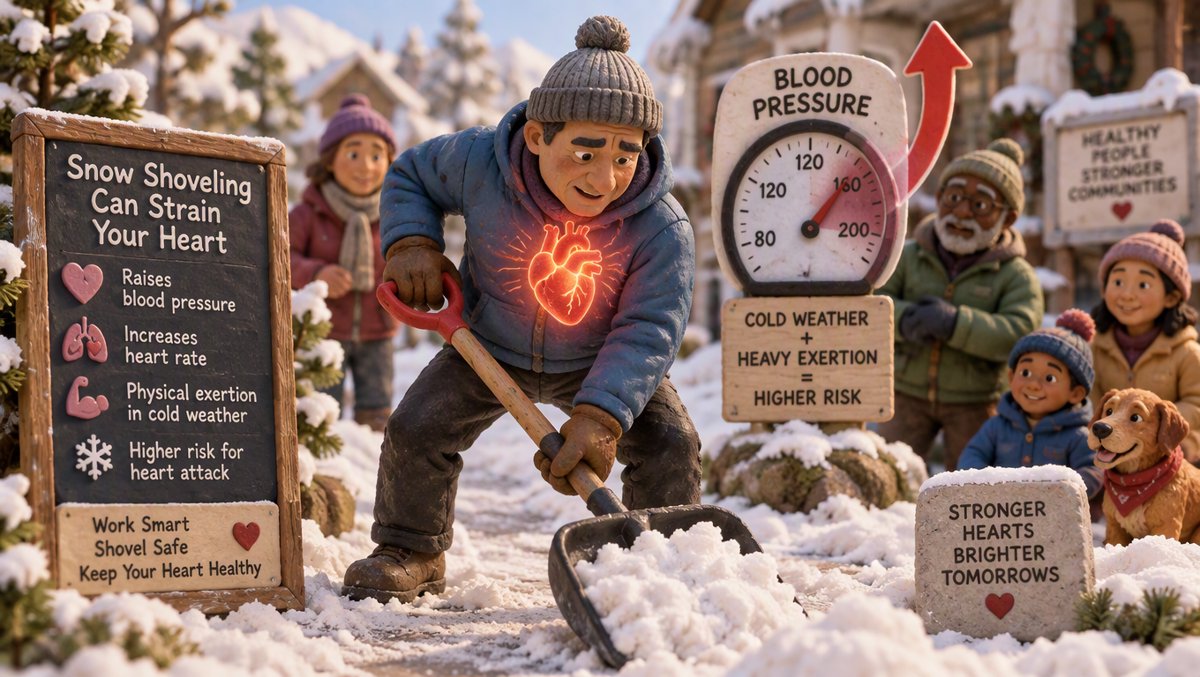
So why is shoveling so much harder than it looks? Franklin's research points to five sneaky mechanics:¹
- It's mostly isometric (static) work. Your muscles contract hard without much joint movement — the kind of straining that spikes blood pressure.
- It's arm work, not leg work. Arms are less efficient for your heart than legs, so the same effort costs more.
- You hold your breath while lifting. That unconscious breath-hold (called a Valsalva maneuver) sends heart rate and blood pressure soaring.
- Your legs barely move. Standing still means blood pools in your legs instead of pumping back to your heart.
- The cold itself. More on that in a second — it's the plot twist.
🔑 Key takeaway: Shoveling isn't "just chores." It's an unplanned, upper-body, breath-holding, cold-air workout that can push your heart to stress-test intensity within two minutes.¹ ³
❄️ Section 2: The Freezing-Air Plot Twist — What Cold Does to Your Arteries
Here's where winter gets personal. When you breathe cold air and your skin gets chilled, your blood vessels constrict (narrow) to conserve body heat. That's great for keeping your toes warm and terrible for your blood pressure: narrower vessels mean your heart has to pump harder to push blood through.¹ ⁴
Cardiologist Dr. Luke Laffin of Cleveland Clinic puts it simply: the cold "drives up blood pressure, meaning your heart works harder to circulate blood."⁴ And Dr. Franklin adds a vivid detail — cold also constricts your coronary arteries, the vessels feeding your own heart muscle, which are only about the size of a piece of cooked spaghetti.¹ Less room + more demand = a heart working overtime in conditions that quietly shrink its own fuel lines.
And it's not a fringe problem. A global analysis published in The Lancet Planetary Health found that roughly 9.4% of all deaths worldwide — around 5 million per year — can be attributed to non-optimal temperatures, with cold responsible for the larger share.⁶ Your cardiovascular system genuinely notices the temperature drop.
There's a timing factor too: cardiac events are more common in the morning and in the cold, so that classic "shovel before work at 6:30 a.m." routine stacks two risk factors into one driveway. Experts suggest waiting about an hour after waking before reaching for the shovel, letting your body fully wake up first.⁷
🔑 Key takeaway: Cold air narrows your blood vessels (including the spaghetti-sized ones feeding your heart), so winter exercise — especially in the early morning — makes your heart work harder with less room to work with.¹ ⁴ ⁶
📊 Section 3: The Quebec Data — Who's Actually at Risk?
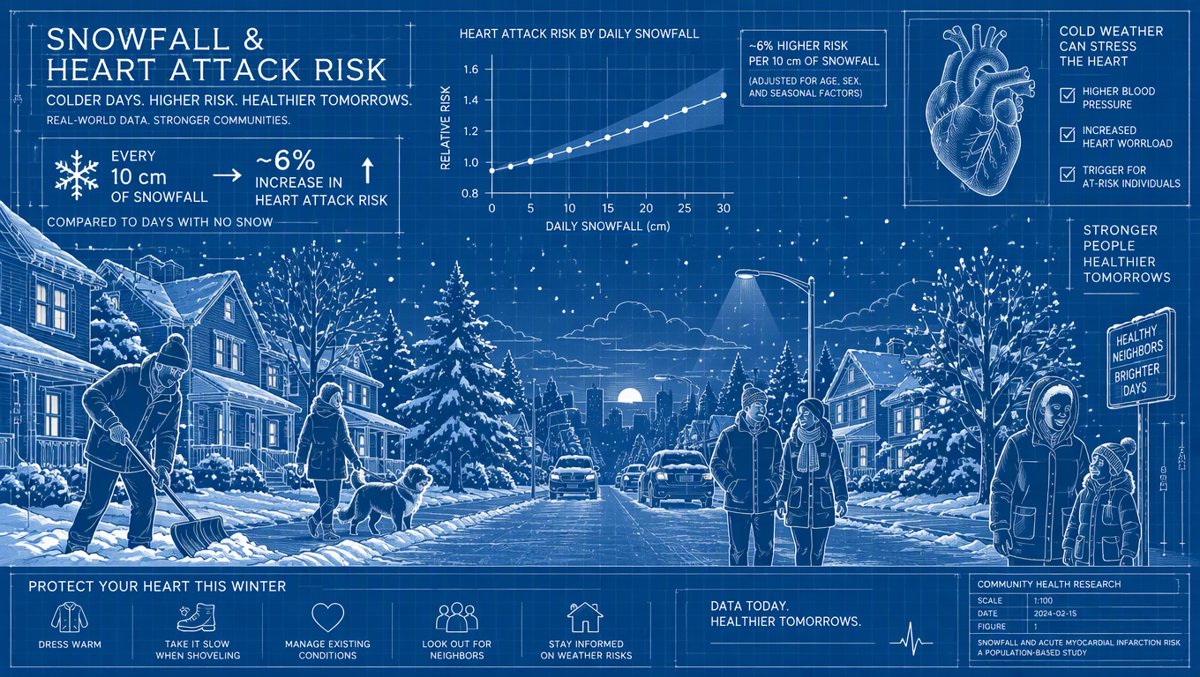
The best evidence on this comes from a huge Canadian study. Researchers led by Dr. Nathalie Auger examined 128,073 hospital admissions and 68,155 deaths from heart attack (myocardial infarction) in Quebec between 1981 and 2014, comparing what happened after snowfalls.² The findings:
- 20 cm (about 8 inches) of snowfall was linked to a 16% higher chance of being hospitalized for a heart attack the next day among men (odds ratio 1.16), and a 34% higher chance of dying from one (odds ratio 1.34).²
- Interestingly, the increase was driven primarily by men — women in the study showed no significant bump (odds ratios of 1.01 and 1.04, essentially flat).² Why? The researchers suspect shoveling is the main link, and men are more likely to be out there wrestling the white stuff.²
Now, before anyone panics: this doesn't mean every shovel-wielding man is in danger. Absolute risk for any single person stays low — most shovelers are fine. The risk concentrates in people whose hearts already have a tougher job:
- People with known heart disease, a prior heart attack or stroke, or bypass surgery/angioplasty — Dr. Franklin's advice for this group is blunt: don't shovel snow *in any conditions.*¹
- People with high blood pressure, high cholesterol, or diabetes⁴ ¹
- Current or former smokers¹ ⁴
- Anyone who's sedentary — the "I exercise exactly once a year, and it's today" crowd is Franklin's biggest concern¹ ⁴
- Adults who are older or deconditioned, even if they feel fine⁴
🔑 Key takeaway: The day after a heavy snowfall measurably raises heart-attack odds — especially for men and especially for anyone with heart risk factors. Knowing your category is the first step to shoveling smart.² ⁴
🛡️ Section 4: The Heart-Smart Shoveling Playbook
Alright, enough science — here's your field manual, assembled from the American Heart Association, Cleveland Clinic, and Mayo Clinic guidance.¹ ⁴ ⁵
1. Know before you go. If you have heart disease, have had a heart attack, stroke, bypass, or angioplasty — or you're managing several risk factors — delegate. Hiring "the kid down the street" (Dr. Laffin's actual suggestion⁴) or a snow service is a genuine medical decision, not laziness.
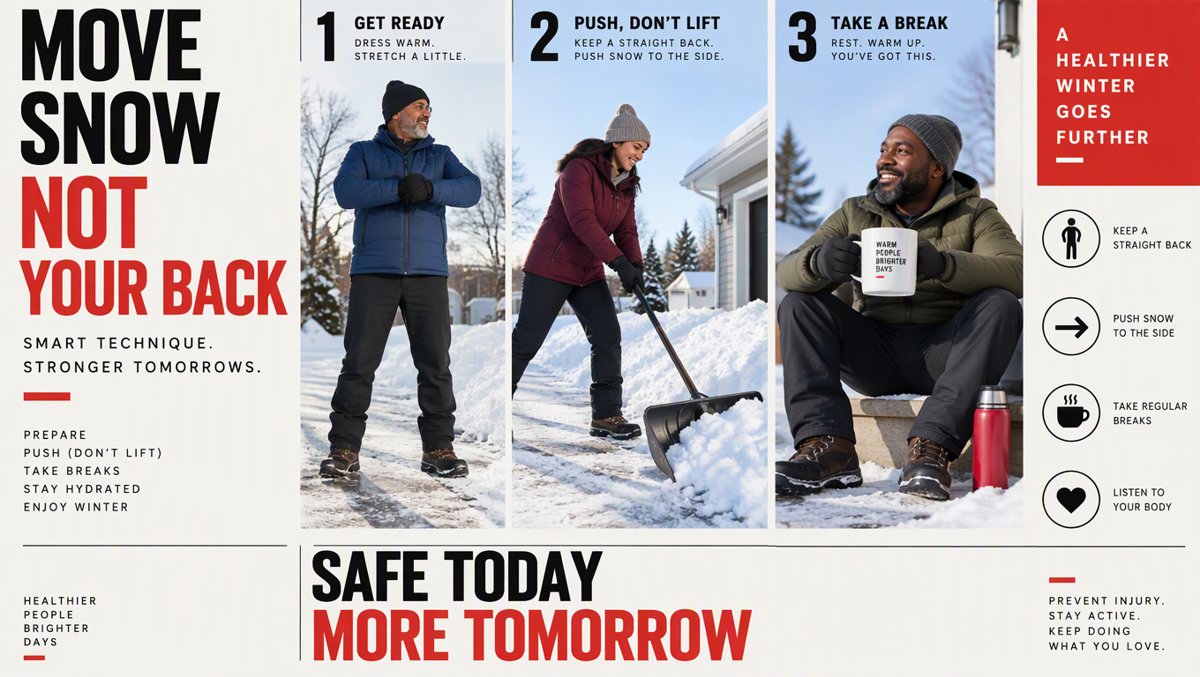
2. Warm up like it's a workout — because it is. A few minutes of light marching, arm circles, and gentle stretching inside prepares your heart for what's coming.⁴ And wait about an hour after waking up before your first pass.⁷
3. Push, don't lift. Pushing or sweeping snow to the side is meaningfully easier on your heart than lifting and hurling it.⁴ ¹ If you must lift, take smaller scoops — wet snow is deceptively heavy — and never twist-throw.
4. Pace yourself like a marathoner, not a sprinter. Tackle the driveway in sections across the day, take breaks every 10–15 minutes, and go back inside if you're tired.⁴ Breathe steadily — out on the push, never strain-hold.
5. Dress warm, breathe easy. Layer up, cover your mouth and nose with a scarf or buff to warm the air you're breathing, and watch the wind — wind chill makes the cold's effects hit harder.¹ ⁵ And maybe skip the big breakfast and double espresso before your first run; Mayo Clinic advises against shoveling right after eating, smoking, or caffeine.⁵
6. Consider the machine. A snow blower still requires caution (it's exercise!), but research shows it raises heart rate to only around **120 beats per minute versus around 170 while shoveling.**¹ That's a huge mechanical assist.
7. Know the exit signs. Chest pain or pressure, pain radiating to your arm, neck, or jaw, shortness of breath, a cold sweat, lightheadedness, or unusual nausea means stop immediately.⁴ ¹ If symptoms don't settle shortly after you stop, call 911. And if you see someone collapse while shoveling, call for help and start Hands-Only CPR if they're unresponsive.¹
🔑 Key takeaway: Push don't lift, pace yourself, warm up first, dress in layers, and hand the shovel to someone else entirely if your heart already has risk factors. The snow will still be there in 20 minutes — make sure you are too.¹ ⁴ ⁵
🎯 Key Takeaways
- Heavy snow shoveling can strain your heart like a treadmill stress test — heart rates can exceed 85% of maximum within two minutes.¹ ³
- Cold air narrows your blood vessels and raises blood pressure, forcing your heart to work harder — so winter exertion is a double hit.¹ ⁴
- The day after heavy snowfall is measurably riskier — a 33-year Quebec study found 20 cm of snow linked to 16% higher odds of next-day heart-attack hospitalization and 34% higher odds of death among men.²
- If you have heart disease or major risk factors, don't shovel at all — delegate or use a snow blower (~120 bpm vs ~170 bpm shoveling).¹
- Shovel smart: warm up, wait an hour after waking, push don't lift, take breaks, breathe steadily, and stop + call 911 if anything feels wrong.¹ ⁴ ⁵ ⁷
🎧 Key Takeaways — Listen (2 min)
📚 Verified Sources
- American Heart Association Newsroom — "Snow shoveling, cold temperatures combine for perfect storm of heart health hazards" (Jan 11, 2024). Includes Dr. Barry Franklin's stress-test comparison, the 2-minute/85% max heart rate finding, the five mechanisms, snow blower heart-rate data (~120 vs ~170 bpm), and safety guidance. https://newsroom.heart.org/news/snow-shoveling-cold-temperatures-combine-for-perfect-storm-of-heart-health-hazards
- CMAJ (Canadian Medical Association Journal) — Auger N, Potter BJ, Smargiassi A, Bilodeau-Bertrand M, Paris C, Kosatsky T. "Association between quantity and duration of snowfall and risk of myocardial infarction." CMAJ 2017;189(6):E235–E242. Case-crossover study of 128,073 MI admissions and 68,155 MI deaths in Quebec (1981–2014). https://www.cmaj.ca/content/189/6/e235 (full text via PubMed Central: https://pmc.ncbi.nlm.nih.gov/articles/PMC5305403/)
- JAMA — Franklin BA, Hogan P, Bonzheim K, et al. "Cardiac Demands of Heavy Snow Shoveling." JAMA 1995;273(11):880–882. The classic physiologic comparison of manual shoveling vs. snow blower use. https://jamanetwork.com/journals/jama/article-abstract/387498
- Cleveland Clinic Health Essentials — "Why Shoveling Snow Can Lead to a Heart Attack" (Feb 18, 2026). Cardiologist Dr. Luke Laffin on exertion + cold, who's most at risk, warning signs, and safe-shoveling tips. https://health.clevelandclinic.org/snow-shoveling-a-real-risk-for-heart-attack
- Mayo Clinic Health System — "Tips for safe snow shoveling" (Mar 10, 2023). Heart-conscious shoveling, layering, and timing guidance (avoid shoveling right after eating, smoking, or caffeine). https://www.mayoclinichealthsystem.org/hometown-health/speaking-of-health/tips-for-safe-snow-shoveling
- The Lancet Planetary Health — Alahmad B, et al. "Are there more cold deaths than heat deaths?" (2025), discussing global analyses attributing ~9.4% of all deaths (~5 million/year) to non-optimal temperatures, cold the larger share. https://www.thelancet.com/journals/lanplh/article/PIIS2542-5196(25)00054-3/fulltext
- Stony Brook Medicine — "Heart-Safe Snow Shoveling" expert guidance, including waiting about an hour after waking and alternating shoveling sides. https://www.stonybrookmedicine.edu/patientcare/askexpert/safeshoveling
All claims fact-checked against Gold-tier (CDC/NIH/WHO/PubMed/Nature/The Lancet) and Silver-tier (Mayo Clinic/Harvard Health/Cleveland Clinic) authoritative sources. Last verified: October 26, 2026.
Stay warm out there, friends — winter's first snowfall is beautiful, but your heart is the only shovel you can't replace. Bundle up, pace yourself, and maybe let the neighborhood teenager earn some pocket money this year. ❄️💙