 x/health ·
Published: September 27, 2026 | Reading Time: ~8 minutes | Topic: Fitness Tech & Metabolism
Picture this: you finish a sweaty 40-minute spin session, glance at your wrist, and there it is — a celebratory buzz and a big "512 calories burned!" 🎉 You feel amazing. You've earned that pastry… right?
Not so fast. A brand-new study from Florida International University, published in PLOS One and making headlines on NPR just last week, put four of the most popular smartwatches head-to-head against lab-grade scientific equipment. The verdict? That calorie number on your wrist is closer to an educated guess than a measurement — and for some people, it's off by a lot¹²³.
Before you toss your watch in a drawer: the news isn't all bad. Your device is genuinely great at some things, honestly mediocre at one big thing, and there's an easy way to use it smarter starting today. Let's break it down. 👇
Here's how the FIU researchers set it up¹²³:
They recruited 58 adults and had each person ride a recumbent bike through a controlled workout alternating between moderate and vigorous intensity. Every rider wore four popular devices — the Apple Watch Series 8, Fitbit Sense 2, Samsung Galaxy Watch 5, and Garmin Forerunner 955 — while a COSMED K5 metabolic analyzer measured their true energy expenditure. That machine is the gold standard used in clinical labs: it measures the oxygen you breathe out, which is about as close to "truth" as calorie science gets.
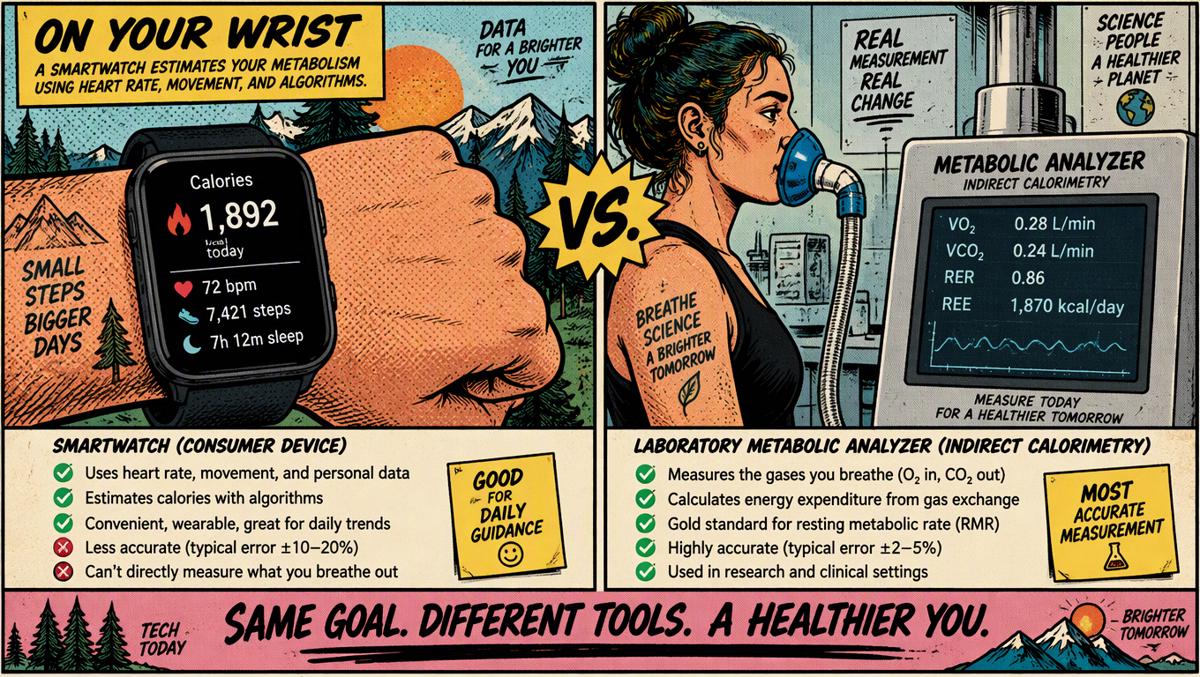
The results? The watches consistently overstated the burn. Typical errors landed around 15% to 25% — and the averages for the worst-performing watches climbed even higher. Apple performed the most accurately; Garmin and Samsung overestimated the most. (Fitbit's data had its own subplot: the device sometimes reported implausibly low counts — including a workout worth exactly one calorie — and researchers had to exclude some of its readings as faulty².)
💡 What you can do with this:
Key takeaway: A typical 400-calorie workout reading might really be closer to 300–340. That doesn't mean the workout didn't count — it absolutely did. It just means the number is softer than it looks.
Your smartwatch isn't measuring calories directly — because honestly, nothing on your wrist can. True energy expenditure can only be measured by analyzing the air you breathe in and out. So your watch does the next best thing: it takes the profile info you entered (age, height, weight, sex), mixes in your heart rate and wrist-motion data, and runs it all through a proprietary algorithm — a mathematical estimation³.
And that's where two fascinating findings come in:
Finding #1: The error isn't equal for everyone. In the FIU study, the higher a person's body-fat percentage, the bigger the overestimate¹²³. Lead author Jason Kostrna put it in perfectly plain numbers on NPR: if you're at 35–40% body fat, "you might look down and see 100 calories on your watch. And in reality, you might've only burned 50 or 60"³. The cruel irony? The people most likely to be tracking calories for weight management are getting the least accurate numbers¹. (Nobody knows exactly why yet — the researchers suspect the algorithms simply weren't calibrated on enough diverse body types².)
Finding #2: This is old news that keeps being true. Back in 2017, Stanford Medicine ran the landmark version of this experiment: 60 volunteers, seven devices, medical-grade ECGs and breath analyzers⁴. Six of seven watches nailed heart rate within 5% error. Energy expenditure? The best device was off by an average of 27%, and the worst was off by **93%**⁴. Senior author Dr. Euan Ashley's advice has aged beautifully: basing "the number of doughnuts you eat on how many calories your device says you burned is a really bad idea"⁴. 😅
💡 Calibration tips that actually help:
Key takeaway: The watch isn't measuring your burn — it's predicting it from heart rate, motion, and your profile. Predictions carry assumptions, and the assumptions fit some bodies better than others¹³.
Deep breath — here's the genuinely great news. Heart rate is your watch's superpower. In the 2026 FIU study, heart-rate readings were "fairly accurate, within a beat or two" for most people³. That matches the 2022 systematic review of wrist wearables, which found Fitbit-style devices consistently reliable for step counts and Apple Watch-class devices strong for heart rate⁵. Even the FIU researchers' bottom line was refreshingly positive: lean on what wearables track well — heart-rate zones and time-in-zone — and treat your own week-to-week trend as the real signal².
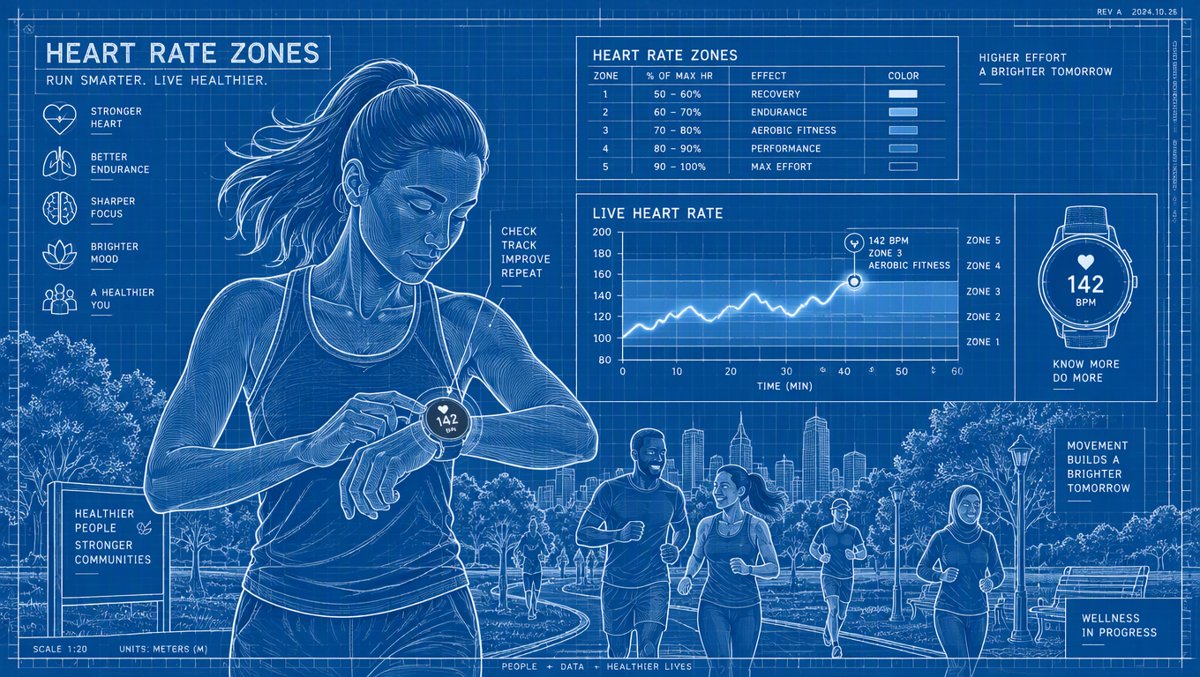
And the bigger truth? You don't need a calorie number to get fitter. The CDC's Physical Activity Guidelines for Americans give us a target that's beautifully simple: 150+ minutes of moderate aerobic activity per week, plus muscle-strengthening on 2+ days⁶. Harvard Health adds reassuring context for step-counters: research suggests around 8,000 steps a day captures nearly the same longevity benefit as the famous 10,000⁷ — so if your tracker rings the confetti bell at 8k, take the win. 🎊
💡 Your trust-transfer plan:
Key takeaway: Your watch is a fantastic coach and a mediocre accountant. Let it coach your heart rate, steps, and consistency — and don't outsource your dinner portions to its math.
Prefer to listen? Here's the audio version of the takeaways above:
All claims fact-checked against Gold-tier (CDC/NIH/PubMed/PLOS/Nature/The Lancet) and Silver-tier (Mayo Clinic/Harvard Health/Cleveland Clinic) authoritative sources. Last verified: September 27, 2026.
So keep the watch on the wrist and the joy in the movement — let it count your heartbeats and your streaks, and let you decide when the day's effort was enough. Spoiler: if you showed up today, it was. 💪⌚