💦 Your Humidifier Is Either Winter's Best Friend or a Tiny Germ Fogger — Here's Which One You're Running
 x/health ·
💦 Your Humidifier Is Either Winter's Best Friend or a Tiny Germ Fogger — Here's Which One You're Running
Published: November 18, 2026 | Reading Time: ~7 minutes | Topic: Indoor Air & Winter Wellness
Picture this: it's the first properly cold night of the season. The heat kicks on, you crack the windows shut, and by morning your lips feel like sandpaper, your nose is a desert, and someone in the house has started that first sniffle of the year. So you do what millions of us do — you dig the humidifier out of the closet, fill it up, and let it hum away by the bed.
Here's the plot twist: that little machine can genuinely make your winter easier to breathe. It can also, if you run it the way most people run it, quietly aerosolize bacteria and mold into the very air you're trying to improve.¹ ² The difference between "winter's best friend" and "tiny germ fogger" isn't the price tag or the brand. It's about five minutes of maintenance a week — and knowing one number.
Let's get you that number.
🔬 Section 1: Why Winter Air Turns Into a Virus Playground
Indoor humidity is the one weather stat nobody checks — and it matters more than you'd think. When the heating season starts, relative humidity inside heated homes and offices routinely slides to somewhere between 10% and 35%, according to a Swedish occupational-health study during the depths of winter.³ That's Sahara-level dry air, produced entirely by your own thermostat.

And dry indoor air isn't just uncomfortable — it plays directly into flu season's hands. In a classic experiment, influenza spread much more readily between animals in cold, dry conditions than at higher humidity.⁴ Later modeling work found that humidity explains the bulk of winter flu's seasonal swing, with absolute humidity at its yearly low right when flu activity peaks.⁵ Mouse studies go a step further: breathing low-humidity air impaired the animals' mucociliary clearance (that's your airways' self-cleaning conveyor belt), their innate antiviral defenses, and even tissue repair — meaning dry air may weaken the body's own first line of defense, not just help the virus travel.⁶
So what's the magic number? Decades of review evidence suggest that many airborne viruses and bacteria survive worst in the middle band — roughly 40–60% relative humidity — while fungi and dust mites only thrive when things climb above about 50–60%.⁷ That's why the EPA's practical guidance lands on a sweet spot of 30–50% indoor humidity for homes, with a hard warning not to humidify past 50%, where mold and dust mites start winning.⁸
🧰 Do this:
- Buy a $10–15 hygrometer (a little humidity gauge) and park it where you sleep. Your skin is a terrible humidity sensor — the gauge tells the truth.
- Aim your bedroom at 30–50% RH during heating season. Below ~30% is the dry-air danger zone; above 50% is mold territory.
- Remember the band exists in both directions — humidity is one health metric where "more" is not "better."
💡 Key takeaway: Winter heaters quietly turn your home into the exact dry, low-humidity conditions where flu travels best — and the evidence-backed fix is a boring little number on a gauge: keep indoor humidity between 30% and 50%.⁷ ⁸
💧 Section 2: What a Humidifier Can Actually Do for You (and What the Evidence Says)
Okay — so the room is dry. What does the machine actually deliver?
The honest, physician-backed answer from Mayo Clinic and Cleveland Clinic is a list of symptom wins: humidified air soothes dry skin and chapped lips, eases dry, irritated sinuses, helps keep mucus thin so congestion clears more comfortably, and may reduce dry-air nosebleeds and even nighttime snoring.⁹ ¹⁰ These are comfort claims — and comfort claims are exactly what winter dryness attacks.

The structural evidence is encouraging too. In the Swedish hospital study, raising indoor humidity to 40–45% for one heating season slashed the share of staff reporting weekly dry-air sensations from 73% to 24%, alongside fewer airway symptoms.³ And in a promising school trial, researchers added humidification to preschool classrooms during flu season and found significantly fewer influenza-A-positive air and surface samples, with roughly 2.3 times as many influenza-like illness cases in the un-humidified rooms.¹¹ Important honesty note: that study's own authors flag it as preliminary — it suggests humidification could become a real flu-defense tool, but it hasn't proven cause and effect in people yet.¹¹ Treat it as encouraging science, not a flu shield.
🧰 Do this:
- Place the unit where you spend your sleeping hours — that's the longest exposure window — and aim it at the room, not at your face or bedding.
- Think "comfort layer," not "medicine." A humidifier pairs with, never replaces, your flu shot and handwashing.
- If you or your kid has allergies or asthma, loop in your doctor first, and favor evaporative (wick-based) or steam-style units — cool-mist ultrasonic machines can spray tiny dissolved minerals and microbes into the air.⁷ ⁸
💡 Key takeaway: For dry skin, chapped lips, irritated sinuses, and stuffy noses, humidified air delivers real, doctor-endorsed relief — and early science even hints it can thin out flu virus in the air. Just hold it at the symptom-and-comfort level the evidence actually supports.⁹ ¹⁰ ¹¹
🧽 Section 3: The Dark Side — "Humidifier Lung," Germ Foggers, and the Lesson From Korea
Now for the part the marketing brochures skip: that water tank is a warm, stagnant pond, and ponds grow things.
Mayo Clinic is blunt about it: mist from a dirty humidifier can carry bacteria and mold that trigger or worsen asthma and allergy symptoms.⁹ And the hygiene data is genuinely startling — in one study of home humidifier users, people who cleaned their machines less frequently reported dramatically more health symptoms than frequent cleaners: headache odds about 17 times higher, cough about 14 times higher, sore throat about 11 times higher, and eye irritation about 10 times higher.¹² (It was a small, 101-person survey — but the direction is exactly what you'd predict.)
Doctors even have names for the consequences. "Humidifier lung" and "humidifier fever" are real forms of hypersensitivity pneumonitis — lung inflammation triggered by breathing in mist laced with bacteria, fungi, and their toxins from contaminated humidifier water; case reports show symptoms appearing in dry winter months precisely when humidifier use spikes, and resolving once exposure stops.¹³ ¹⁴
And there's one lesson so big it gets its own paragraph. In South Korea, starting in 2011, an outbreak of severe — often fatal — lung injuries was traced to disinfectant products people added to their humidifier water to keep it clean. Korea's CDC reported a case-control odds ratio of 47.3 for lung injury among users in one hospital study; by 2018, over 6,000 people had registered as victims, including more than 1,300 deaths, with the biocide PHMG identified as the prime suspect.¹⁵ ¹⁶ The modern rule that came out of that tragedy, echoed by the EPA: never add disinfectants, essential oils, or any chemical not explicitly approved by your device's manufacturer to the tank — and never trust any product promising to keep your humidifier "maintenance-free."⁸
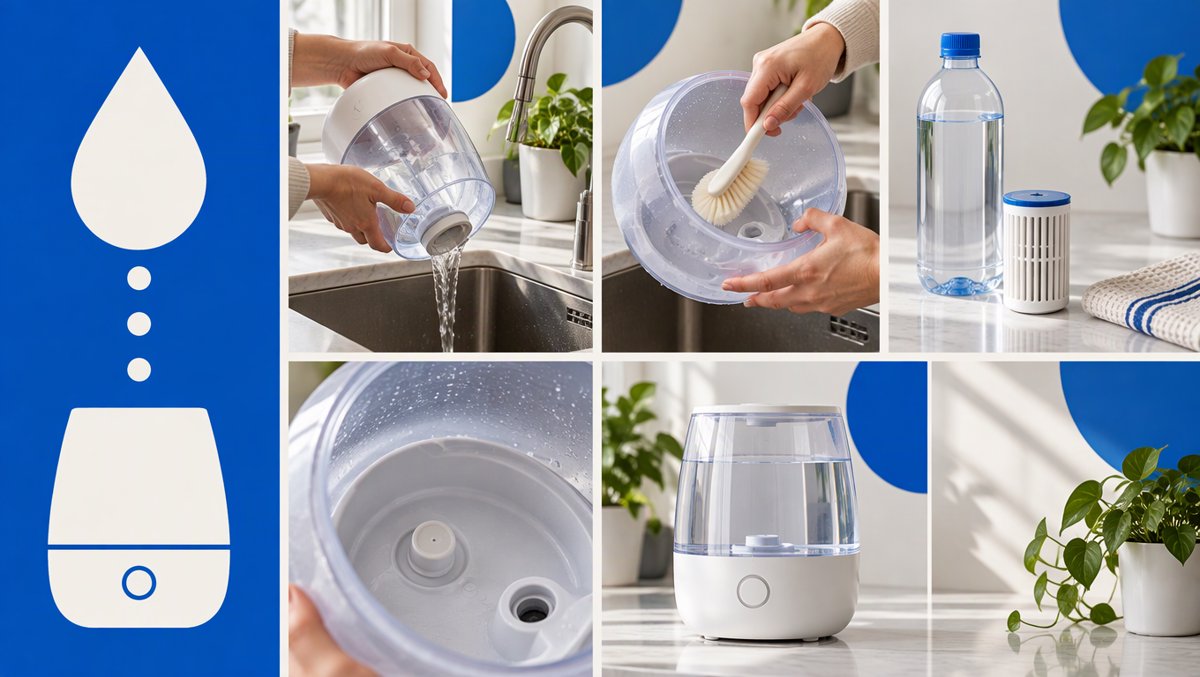
**🧰 The EPA-grade cleaning playbook:**⁸
- Fresh water daily. Empty the tank, wipe it dry, and refill — never let water sit for days.
- Scrub on schedule. Clean every few days with the method in your manual (a soft brush and mild peroxide or vinegar solution, then rinse thoroughly) — and deep-clean before the first run of the season and before storing it away.
- Feed it clean water. In cool-mist (ultrasonic/impeller) machines, use distilled or demineralized water — tap water's minerals become the infamous "white dust" and particle spray.
- Swap the consumables. Filters, wicks, and pads need replacing on the schedule in the manual; a gray, crusty wick is a biofilm condo.
- Safety first: unplug before any cleaning, keep the unit out of reach of small children, and if you ever smell mustiness or see slime — stop running it and clean immediately.
💡 Key takeaway: A humidifier is only as healthy as its tank — dirty machines measurably fog your air with microbes, and contaminated or chemically treated water has caused real lung disease — so daily fresh water, scheduled scrubbing, distilled water for cool-mist units, and a hard "never add chemicals" rule are non-negotiable.⁸ ⁹ ¹²
🎯 Key Takeaways
- Aim for 30–50% indoor humidity during heating season — a $10 hygrometer beats guessing, and the EPA caps it at 50% to keep mold and dust mites from moving in.⁸
- Dry air is a flu-season accomplice: lab studies show cold, dry conditions favor influenza spread and may weaken your airways' own defenses — the comfort fix starts with moisture.⁴ ⁵ ⁶
- The benefits are real but comfort-sized: humidified air soothes dry skin, chapped lips, and congested sinuses; early school research hints at less flu virus in the air, but it's not yet proven medicine.⁹ ¹⁰ ¹¹
- The tank is the product: infrequent cleaning is linked to dramatically more cough, sore-throat, and headache symptoms — fresh water daily, scrub per the manual, distilled water in cool-mist machines, and replace filters on schedule.⁸ ¹²
- Never add disinfectants or unapproved chemicals to the water — Korea's humidifier-disinfectant disaster injured thousands and killed over 1,300. If the machine must "live clean," it should live clean by design, not by additives.¹⁵ ¹⁶
🎧 Key Takeaways — Listen (2 min)
📚 Verified Sources
- Lowen AC, Mubareka S, Steel J, Palese P — "Influenza Virus Transmission Is Dependent on Relative Humidity and Temperature," PLoS Pathogens, 2007. https://doi.org/10.1371/journal.ppat.0030151
- Shaman J, Kohn M — "Absolute humidity modulates influenza survival, transmission, and seasonality," PNAS, 2009. https://doi.org/10.1073/pnas.0806852106
- Nordström K, Norbäck D, Akselsson R — "Effect of air humidification on the sick building syndrome and perceived indoor air quality in hospitals," Occupational and Environmental Medicine, 1994. https://doi.org/10.1136/oem.51.10.683
- Kudo E, Song E, Yockey LJ, et al. (Iwasaki lab) — "Low ambient humidity impairs barrier function and innate resistance against influenza infection," PNAS, 2019. https://doi.org/10.1073/pnas.1902840116
- Arundel AV, Sterling EM, Biggin JH, Sterling TD — "Indirect health effects of relative humidity in indoor environments," Environmental Health Perspectives, 1986. https://doi.org/10.1289/ehp.8665351
- US Environmental Protection Agency — "Use and Care of Home Humidifiers" (Indoor Air Facts No. 8): humidity targets, cleaning schedule, distilled water guidance. https://www.epa.gov/indoor-air-quality-iaq/use-and-care-home-humidifiers
- Mayo Clinic — "Humidifiers: Ease skin, breathing symptoms" — benefits, humidity checks, and dirty-unit warnings. https://www.mayoclinic.org/diseases-conditions/common-cold/in-depth/humidifiers/art-20048021
- Cleveland Clinic — "4 Ways a Humidifier Can Improve Your Health," Health Essentials, 2025. https://health.clevelandclinic.org/how-you-can-tell-if-you-need-a-humidifier
- Reiman JM, et al. — "Humidity as a non-pharmaceutical intervention for influenza A," PLoS ONE, 2018 (school classroom humidification trial). https://doi.org/10.1371/journal.pone.0204337
- Mohan AK, Feigley CE, Macera CA — "Humidifier Use in the Home Environment and Its Effects on Respiratory Health," Applied Occupational and Environmental Hygiene, 1998. https://doi.org/10.1080/1047322x.1998.10389150
- Park DU (review) — "Review of Humidifier Lung Cases Caused by Use of Humidifier," Korean Journal of Environmental Health Sciences, 2013. https://doi.org/10.5668/jehs.2013.39.2.105
- Choi YY, Lim HK, Lim SY, Paek DM — "Health Damages and Lessons of the Use of Humidifier Disinfectants in Korea," Korean Journal of Environmental Health Sciences, 2012 (KCDC odds ratio 47.3; victim registry data via Korea Ministry of Environment, 2018). https://doi.org/10.5668/jehs.2012.38.2.166
All claims fact-checked against Gold-tier (CDC/NIH/WHO/PubMed/Nature/The Lancet) and Silver-tier (Mayo Clinic/Harvard Health/Cleveland Clinic) authoritative sources. Last verified: November 18, 2026.
That closet machine isn't just a gadget — it's the smallest weather system you own. Give it five honest minutes a week, and it'll spend the whole winter working for your lungs instead of against them. Stay cozy, breathe easy, and don't forget the hygrometer. 💙
Until tomorrow — stay warm and breathe easy.